- Season
- Available year-round, with peak cultural prominence in autumn and winter.
- Price
- Medium
Calories and nutrition per 100 g
- 114 kcal
- 23.3 g protein
- 2.3 g fat
- 0 g carbs
Skinless Turkey Breast
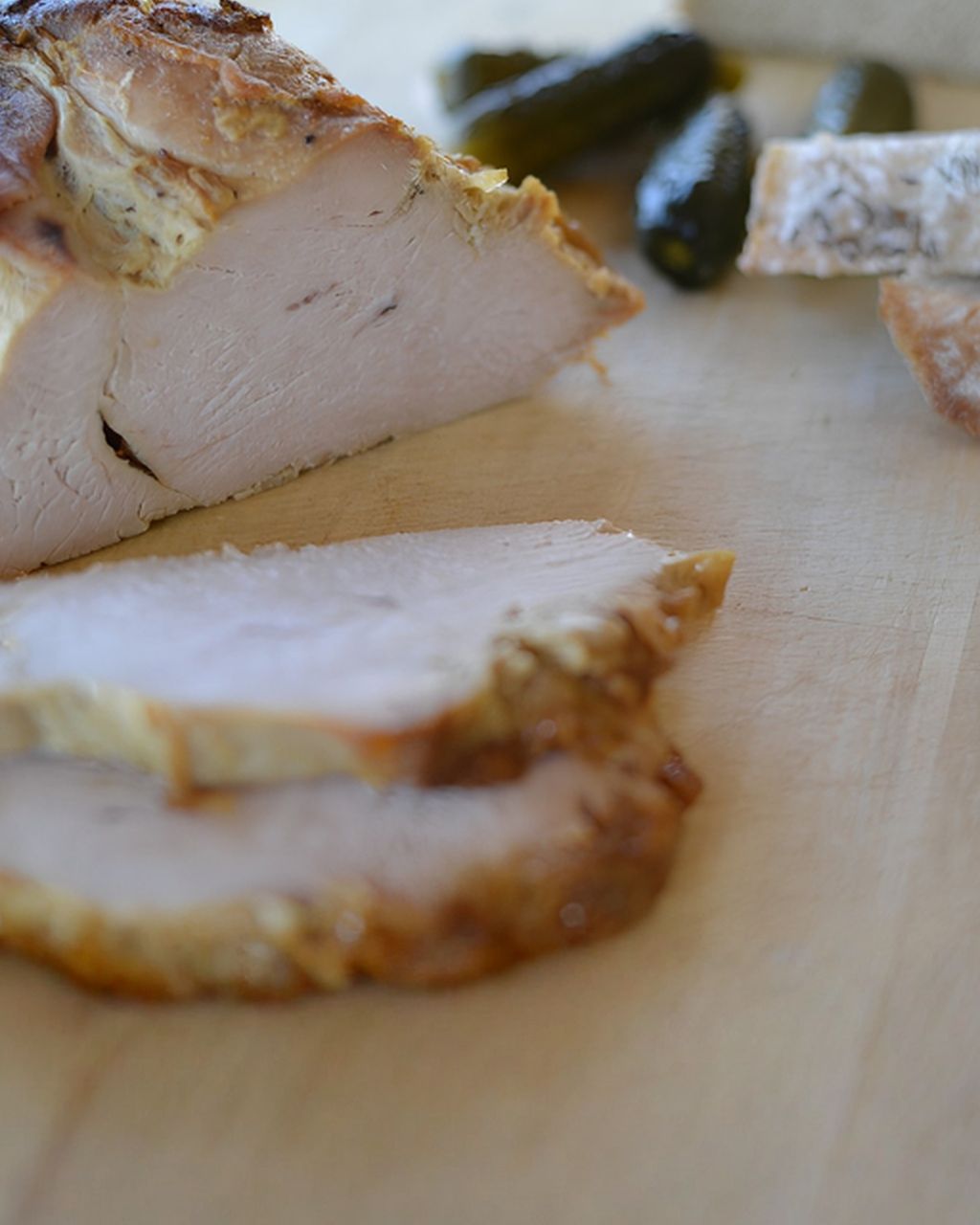
Skinless turkey breast is the boneless or bone-in pectoral muscle of the domesticated turkey, removed of its skin to emphasize leanness and a neutral, adaptable flavor. It is valued both as a fresh roasting joint and as a foundational protein for slicing, curing, and gentle cookery.
Not recommended beyond brief handling during preparation.
Store tightly wrapped at 0–4 °C on the lowest shelf and use by the use-by date on the pack. Loose or butcher-cut breast should be used within 1–2 days.
Freeze well-wrapped for up to 6 months to preserve texture and flavor.
Choose breasts that are plump, evenly shaped, and pale pink without grayness. The surface should appear slightly moist but never sticky, and the aroma should be neutral and faintly sweet. Bone-in breasts retain moisture more readily, while boneless cuts offer ease and uniformity.
Skinless chicken breast, though slightly less mineral and subtly sweeter.
Pork loin, which mimics the leanness but lacks poultry aroma.
Brining for several hours in a lightly salted solution is strongly advised to counteract the cut’s natural leanness. Gentle roasting, poaching, or sous vide cooking preserves moisture, while aggressive high heat should be reserved for thin escalopes.
Bones and trimmings yield a light, gelatin-poor stock ideal for clear soups and sauces, while cooked leftovers slice cleanly for salads and cold preparations.
Roughly what one measure weighs, scooped the way you normally would in the kitchen.
Skinless turkey breast is the boneless or bone-in pectoral muscle of the domesticated turkey, removed of its skin to emphasize leanness and a neutral, adaptable flavor. It is valued both as a fresh roasting joint and as a foundational protein for slicing, curing, and gentle cookery.
The flavor unfolds with a restrained attack, faintly sweet and milky, followed by a mid-palate of delicate poultry savor and mineral clarity. The finish is clean and drying, with little residual fat, making it an ideal canvas for brines, aromatics, and sauces rather than a source of intrinsic richness.
Seasonal baking plans, tested recipes and kitchen tricks that save you time. Unsubscribe in one click.
3 min read
The character of skinless turkey breast is inseparable from breed and rearing. Broad Breasted White: dominates industrial production, yielding large, pale breasts with minimal intramuscular fat and a very mild flavor, best enhanced through brining and seasoning. Broad Breasted Bronze: a similarly heavy, fast-growing commercial type whose breast meat is much like the White's; it has become less common mainly because its dark pinfeathers mark the skin. Heritage breeds: such as Bourbon Red or Narragansett produce smaller breasts shaped by active foraging; their meat carries a firmer texture, pronounced mineral notes, and a savory finish reminiscent of game birds. Terroir asserts itself subtly: pasture-raised birds from grassy landscapes develop clearer herbal undertones, while grain-heavy diets emphasize sweetness. Harvest methods favor rapid chilling to preserve protein integrity, as slow cooling can accentuate dryness in this lean cut.
The turkey’s story begins in Ancient Mesoamerica, where Indigenous peoples domesticated Meleagris gallopavo over two millennia ago, valuing it for meat, feathers, and ritual significance. In the Old World, no true turkey existed in antiquity; Greek and Roman writers instead praised peafowl and guinea fowl, birds later displaced by the turkey’s superior yield. During the early modern period, after Spanish ships brought turkeys to Europe in the early 16th century, they traveled rapidly along Spanish and English trade routes, becoming a novelty in European courts before filtering into rural husbandry. By the Modern era, selective breeding in the 20th century exaggerated the breast muscle, aligning the bird with industrial efficiency and dietary ideals of leanness. The skinless breast, in particular, reflects contemporary nutritional priorities rather than historical preference for fattier cuts.
Skinless turkey breast is composed predominantly of fast-twitch muscle fibers with low myoglobin, explaining its pale color and mild flavor. The scarcity of intramuscular fat limits lubrication during cooking, making water retention and protein denaturation critical variables. Brining increases ionic strength, allowing muscle proteins to bind more water, while low-temperature cooking minimizes moisture loss. Skinless turkey breast is a source of selenium and of B vitamins, notably niacin and vitamin B6.
Ethical concerns center on intensive breeding for oversized breasts, which can compromise animal welfare. Sourcing from farms that prioritize slower-growing breeds, outdoor access, and humane slaughter practices supports better texture, flavor, and ethical integrity. In the EU, the regulated poultry labels 'free range', 'traditional free range' and 'free range – total freedom', and the EU organic leaf, guarantee outdoor access and, in the higher tiers, slower-growing breeds; standards beyond these vary by producer.