Stainless Steel Flower Nail No. 7 (for Piping Roses)
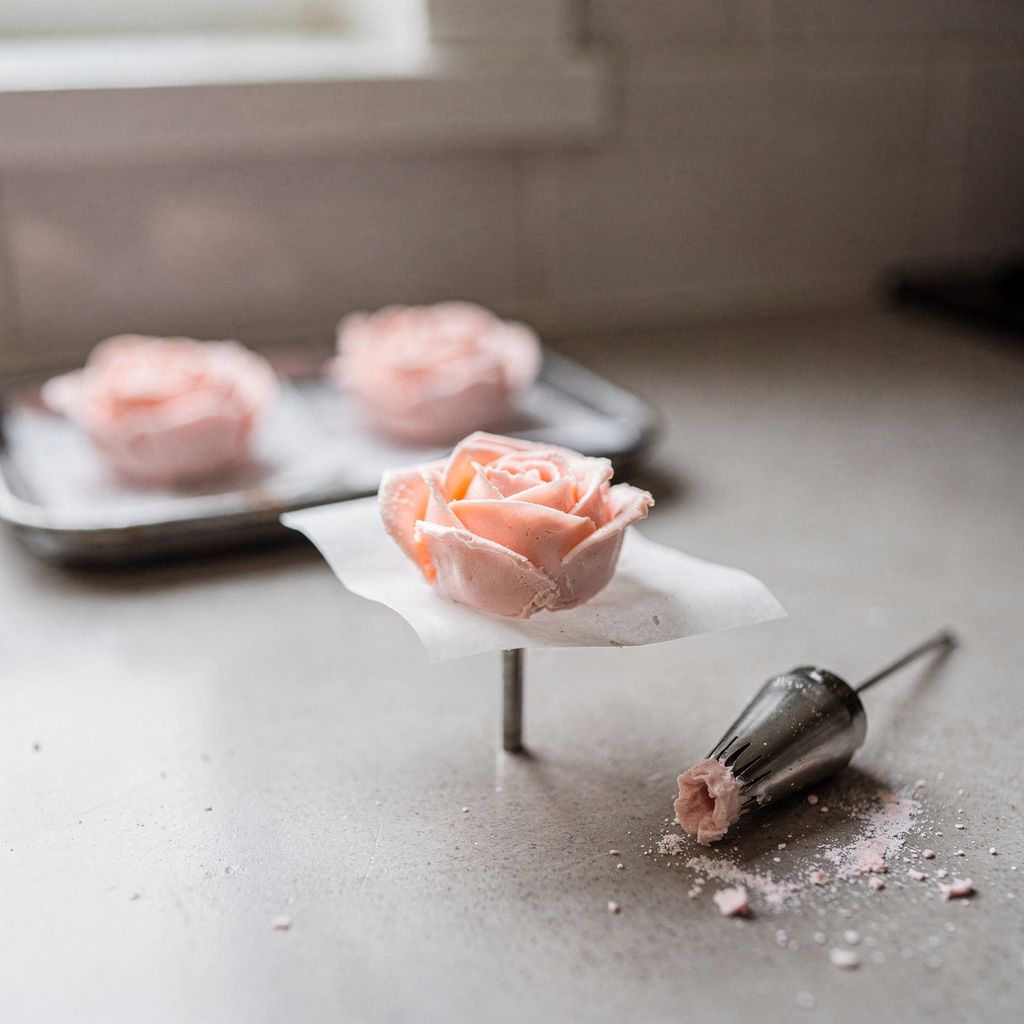
Buttercream Roses on a Flower Nail: Step-by-Step Piping Guide
Updated Oct 8, 2026
You pipe buttercream roses on a flower nail using stiff buttercream and a flat petal tip (Petal 104 or 123): stand a cone on the nail, wrap it with a centre petal, then add rows of 3, 5 and 7 petals while turning the nail smoothly as you go. Freeze the finished rose for 15–20 minutes, then move it, once firm, onto a cake or cupcake. It's all about the rhythm of your two hands, not talent — three or four duds and you've got it.
For a buttercream rose you need five things: a flower nail, a flat petal tip, a piping bag, squares of parchment paper, and stiff buttercream.
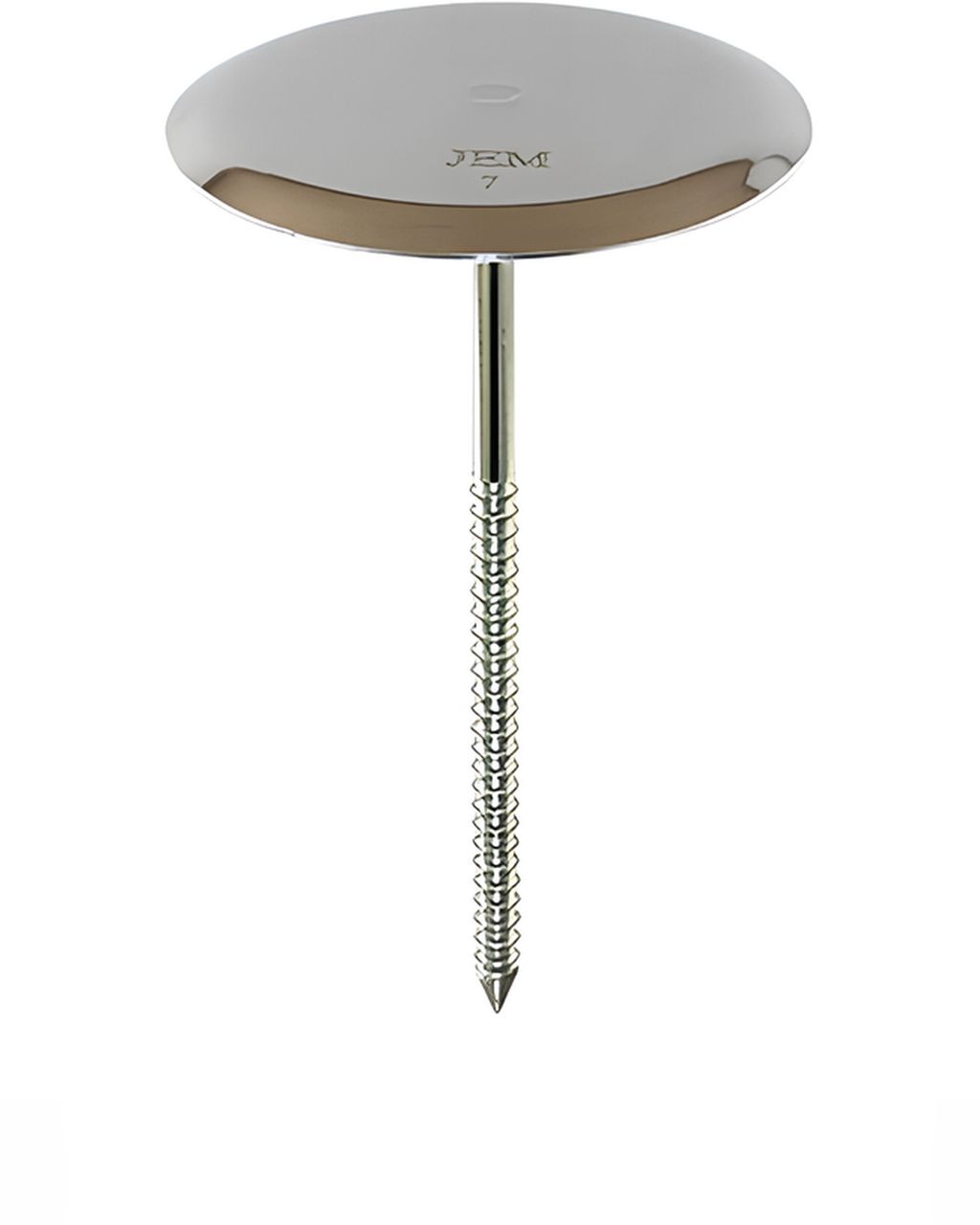
Flower nail – a small metal disc on a stem that you turn between your fingers. It lets you pipe the whole rose in one spot without moving the bag hand. The JEM stainless steel flower nail No. 7 has a disc that's just the right size for a cupcake-sized rose.
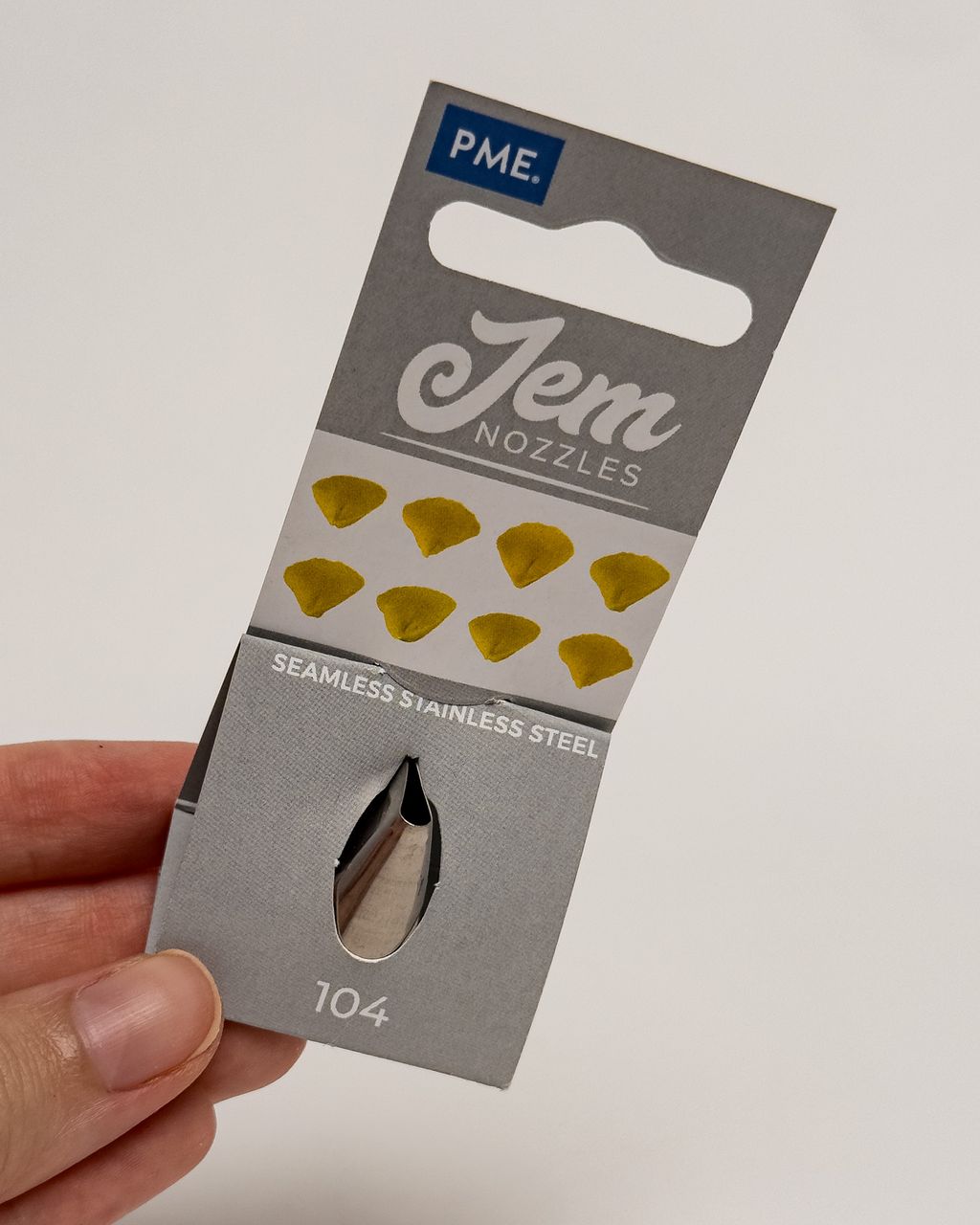
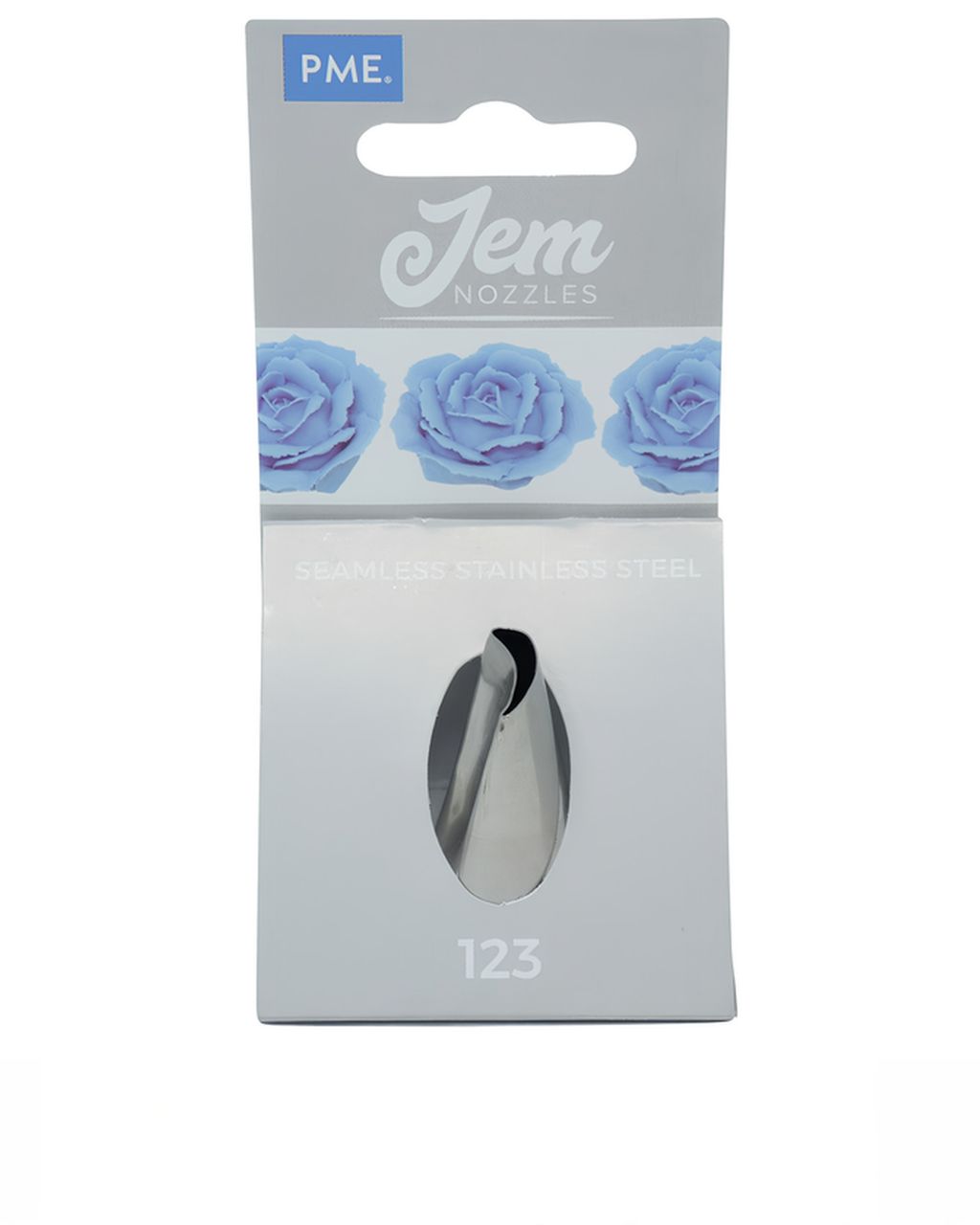
Petal tip – a narrow, curved slot that's wider at one end and narrower at the other. That asymmetry is exactly what shapes a petal that's sturdy at the base and paper-thin at the edge, just like a real one. For roses, reach for the JEM Petal 104 or the larger Petal 123.
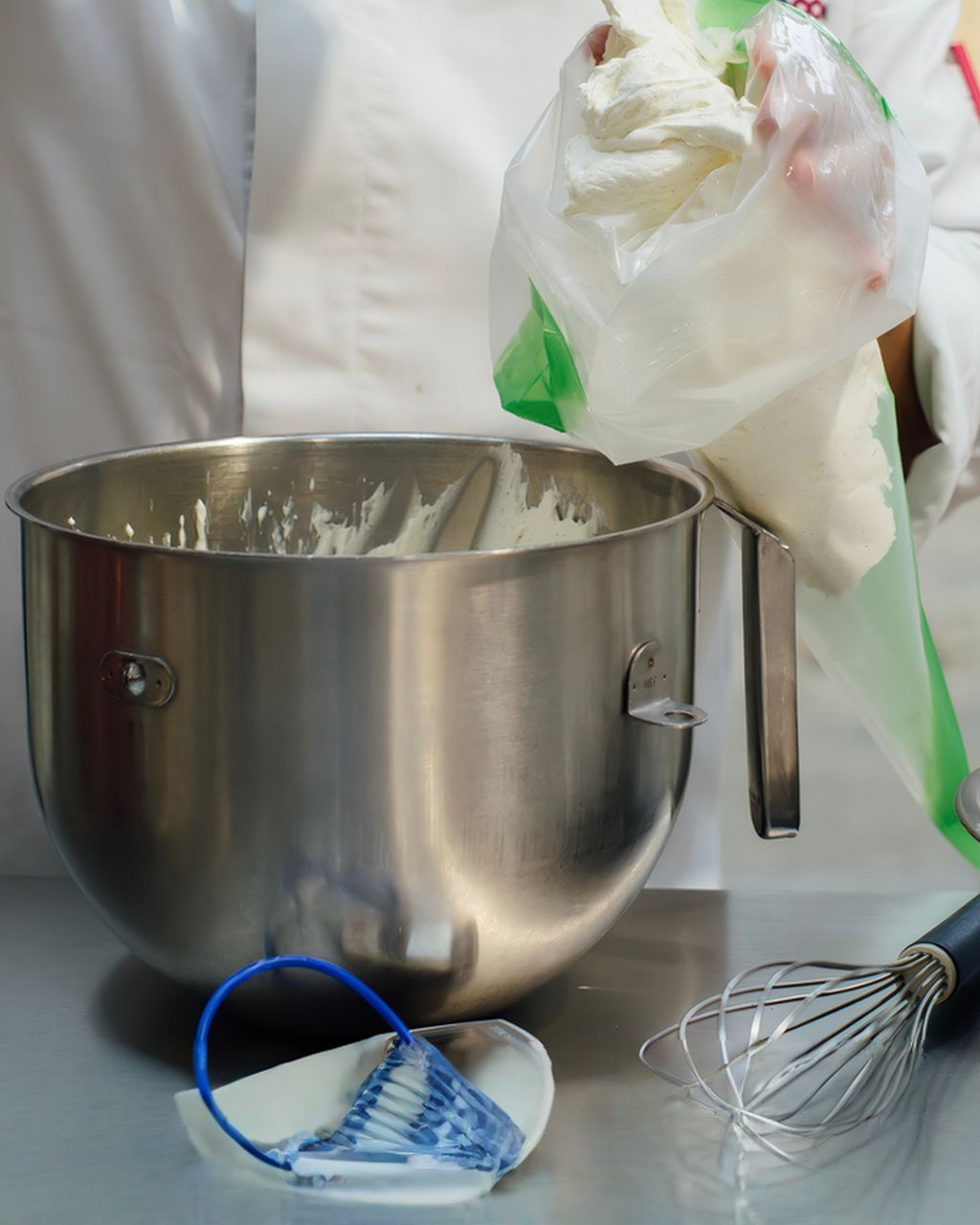
Piping bag – a disposable one 30–46 cm (12–18 in) long is plenty. You'll find tips, bags and couplers together in our piping bags and tips category; our guide on piping bags explains how to pick the right size.
Parchment paper squares roughly 5 × 5 cm/2 × 2 in (closer to 7 × 7 cm/3 × 3 in for tip 123). These let you lift the rose off the nail and freeze it on a tray or board that fits in your freezer.
Stiff buttercream – which kind and why, see below.
Nice to have, but not essential: a coupler, which lets you switch tips without emptying the bag, and a second bag fitted with a round tip for the cone. You can just as easily pipe the cone from a snipped-off bag, though.
Tip 104 makes a smaller rose, suited to cupcakes or a wreath around a cake; tip 123 has a longer slot and makes a bigger rose that can stand out on its own on a cake.
Just starting out? Go with 104. The smaller petal is easier to control, uses less buttercream, and doesn't demand as much hand strength.
Want a few big show-stopper roses on a cake? Go with 123. Expect to squeeze harder, and know that every wobble shows up more on bigger petals.
Want tiny buds between the roses? Smaller tips 102 or 103 are made for that (we don't stock those), or just use tip 104 with only two rows of petals.
In fairness, there are also Russian piping tips, which push out an entire flower in one squeeze straight onto a cupcake. They're fast, and a beginner can get good results right away, but the outcome looks more like a stylised flower than a true rose, and it tends to blur together if the buttercream is on the softer side. If you want something that actually looks like a rose, a flat tip and a flower nail are the way to go. If you'd rather skip the nail altogether, you can pipe a buttercream rosette on a cupcake using a star tip instead — a different technique with a simpler result.
For roses you need stiff buttercream — the kind where a spoon stuck into it stands upright on its own, and a piped petal doesn't droop even at the edge.
Classic American buttercream with powdered sugar is the most reliable: it holds crisp edges and firms up quickly in the freezer. If it's too soft, beat in powdered sugar a spoonful at a time; if petals are tearing, add a splash of milk.
Swiss meringue buttercream is lighter and less sweet, but it softens quickly in warm hands. It can be done — just pop the bag back in the fridge for 10 minutes more often.
Whipped cream, or cream cheese/mascarpone-based frostings aren't stiff enough for roses on a nail — the petals just collapse. Save those for filling and crumb-coating instead.
Colour with gel colours, not liquid ones: liquid colouring thins the buttercream and softens the petals' crisp edges. For why buttercream sometimes goes soft or greasy, see our article on how to whip buttercream, and for more on getting frosting to hold its shape generally, see what buttercream keeps its shape on cupcakes.
One tip that will save your whole afternoon: split the buttercream between two bags and alternate between them. While you work with one, the other chills in the fridge — warmth from your palm is the biggest enemy of crisp petals.
Hold the bag at roughly a 45° angle to the nail's disc, with the wider end of the tip pointing down (towards the buttercream or the base) and the narrower end up, slot held upright along the cone. The buttercream will then rest against the cone from the wider side, and the thin edge of the petal will lift freely, just like on a real rose.
Turn the nail, keep the bag almost still. Right-handers hold the nail between the thumb and index finger of the left hand and turn it counter-clockwise; left-handers do the reverse.
Three motions at once: pressure on the bag, moving the tip up and down (the petal's little arc), and turning the nail. It feels slow at first, but after a few roses it blends into one fluid motion.
Keep the pressure even. Ease off the pressure at the end of each petal before pulling the tip away — otherwise the petal will tear or leave a little tail.
A buttercream rose comes together in six steps: paper on the nail, cone, bud, then a row of 3 petals, a row of 5, and a row of 7.
Attach the paper. Pipe a dot of buttercream onto the nail's disc and press a parchment square onto it.
Pipe the cone. Using a round tip or a snipped bag, pipe a cone in the centre about 1.5 times the length of the tip's slot — around 2 cm/0.8 in for tip 104. The cone is the rose's skeleton: too short and wide, and the rose will come out flat.
The bud. Hold the wider end of the tip level with the middle of the cone's height, tilt the narrow end up and slightly inward. Squeeze, turn the nail once all the way around, and let the petal fold over the top of the cone to close it. This forms the closed bud.
First row: 3 petals. Each petal covers about a third of the circumference. Start at the base of the bud, sweep the tip up in an arc just above its top and back down while turning the nail. Start the next petal halfway along the previous one so they overlap.
Second row: 5 petals. Start a touch lower, make the petals a bit wider, and angle the tip's narrow end slightly outward. This is where the rose starts to open up.
Third row: 7 petals. Start even lower and angle out even further, almost horizontal. The edges can be slightly ruffled — a small flick of the wrist gives you a natural wavy edge.
Then lift the paper and rose off the nail together (slide scissors under the paper, or lift it by the corner with your fingers), set it on a tray, and freeze for 15–20 minutes until firm. Stick a fresh paper square onto the nail and start again.
Move buttercream roses while frozen: peel off the paper, set the rose onto a fresh dot of buttercream on the cake, and press lightly. It will soften and settle into place within a few minutes.
On a cupcake, one large rose from tip 123 is enough, or a smaller one from tip 104 surrounded by tiny buds. These work beautifully on chocolate cupcakes with caramel buttercream, for instance.
On a cake, arrange roses in odd-numbered clusters (3, 5, 7), bigger ones toward the centre, smaller ones at the edges. Fill gaps with buds or green leaves.
A whole bouquet of cupcakes – for how to arrange them so the roses flow together, see cupcake bouquet.
Don't move the roses while they're still soft: a soft petal will dent under your fingers and there's no fixing it afterward. No freezer handy? The fridge works too — just allow 45–60 minutes.
A buttercream rose that hasn't come out right almost always has one of five problems: frayed petals, collapsing petals, a cabbage-like rose, a hole in the centre, or smudged edges. All of them are easy fixes right at the counter.
Petal edges are frayed or tearing → the buttercream is too stiff or dry. Beat in a splash of milk. If it only tears occasionally, there's an air bubble trapped between the tip and the buttercream — pipe a bit out to clear it.
Petals collapse and blur together → the buttercream is too warm or soft. Chill the bag in the fridge for 10 minutes, or beat in a spoonful of powdered sugar.
The rose looks like a cabbage → the petals are angled too far up and the tip's narrow end is pointing inward. In the second and third rows, angle it outward and start the petals lower.
There's a hole in the centre → the bud is too weak or the cone too short. Pipe the cone taller and make sure the bud genuinely closes over the top of it.
The petals look smudged with no crisp edge → the tip's slot is turned flat against the cone, smearing the buttercream against it. Turn it so it sits upright along the cone, wider end down, narrower end up, and hold the bag at a 45° angle.
Feel free to scoop your first three or four roses straight back into the bowl of buttercream. It's practice material, not waste.
You can vary the basic buttercream rose three ways: two-tone petals, a fully bloomed rose, and small buds.
Two-tone petals – pipe a stripe of a deeper colour down one side of the bag, then fill the rest with pale buttercream. Position the darker stripe at the narrow end of the tip and every petal will come out with a coloured edge. The filling method is explained in two-tone buttercream.
Fully bloomed rose – add a fourth row of 7–9 petals piped almost horizontally. This works well on large cakes with tip 123.
Buds – just the cone, the bud, and a first row of 3 petals. Perfect for filling gaps between the larger roses.
Incidentally, that same tip 104 can also pipe ruffles – if you enjoy working with a flat slot, follow up with our ruffle cake article.
Yes, but it's trickier: swap the nail for a skewer or a fork with a jar lid stuck on top, which you turn between your fingers just like a nail. You can also pipe petals without turning anything at all — just move your whole hand around the bud instead — though the petals will come out less even. The easiest no-nail alternative is a spiral rosette piped straight onto a cupcake with a star tip.
Buttercream roses will keep in a sealed container in the freezer for up to 3 months, though it's best to use them within a month. Freeze them loose on a tray first, then transfer to a container once firm so they don't get crushed. Place them on the cake straight from frozen — they'll thaw in place within a few minutes.
Yes, left-handers simply mirror the technique: hold the bag in your left hand and turn the nail clockwise with your right hand. The 45° angle and keeping the wider end of the tip pointing down stay exactly the same.
One recipe worth heating the oven for, one tip, and one deal from the shop. Nothing else.