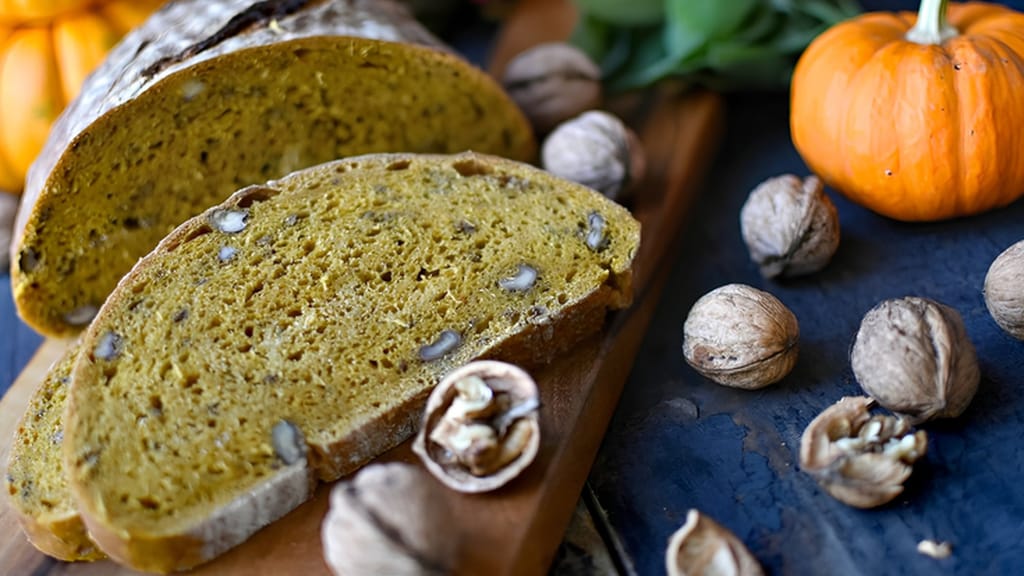
Autumn pumpkin sourdough bread with walnuts and sage
Sourdough Starter: How to Make It, Feed It and Tell When It's Ready
Updated Oct 17, 2026
A sourdough starter is just flour and water in which wild yeast and lactic acid bacteria settle in. You can get one going in 5–14 days, then keep it alive by feeding it fresh flour and water in equal amounts. It's ready when it reliably doubles in volume within 6–8 hours of feeding. Below you'll find a first-week schedule for both rye and wheat starters, feeding ratios, why you shouldn't trust the float test, and how to revive a dried starter or one forgotten in the fridge.
A sourdough starter (also called a sourdough culture or levain) is a living culture of flour and water that leavens bread in place of commercial yeast. It contains wild yeast, which produces carbon dioxide and makes the dough rise, and lactic acid bacteria, which give the bread its tangy flavour and aroma.
You don't need anything else – the flour itself brings the yeast and bacteria. No store-bought yeast, no yogurt, no grapes. All you need is time, a steady temperature and regular feeding.
What you'll need:
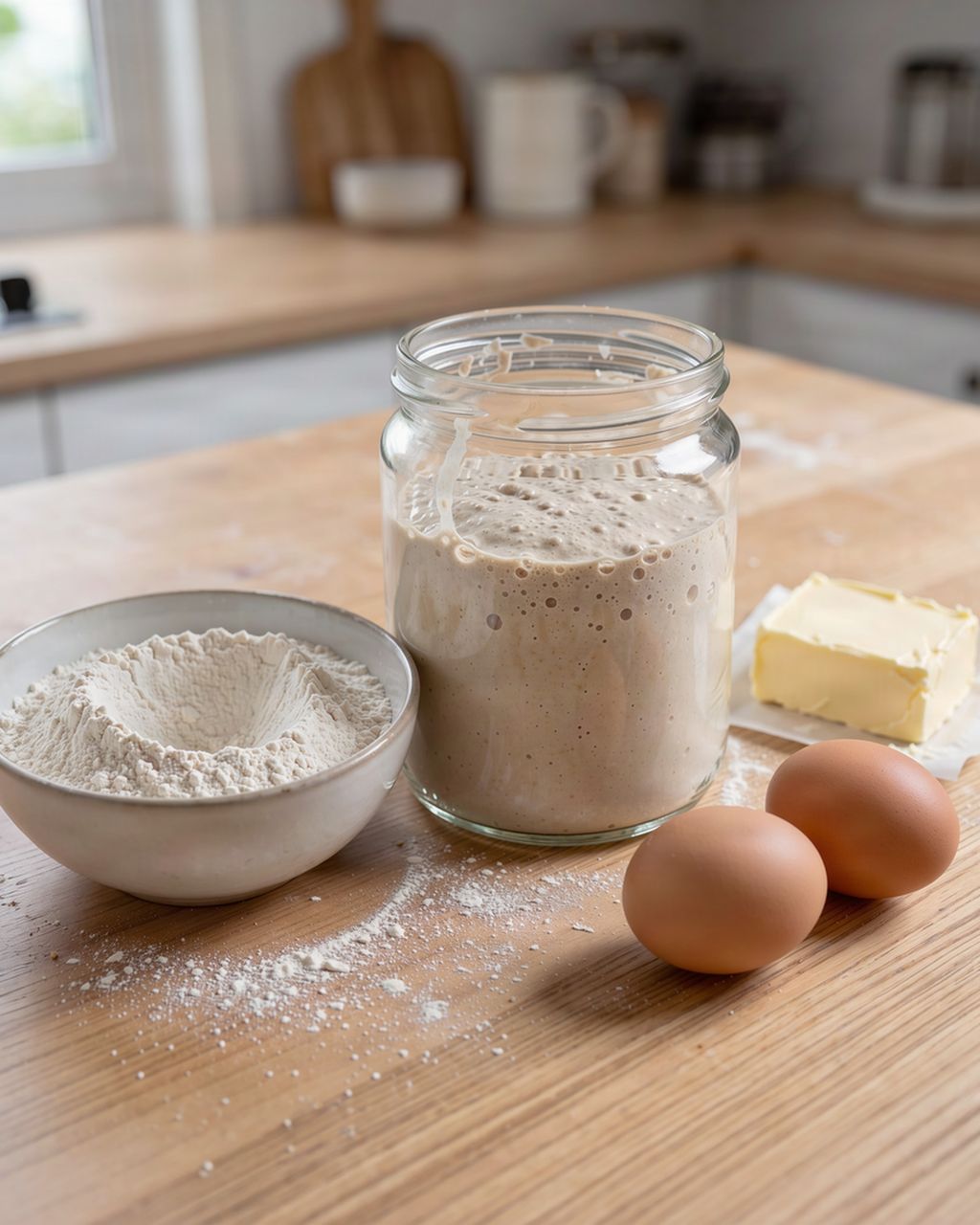
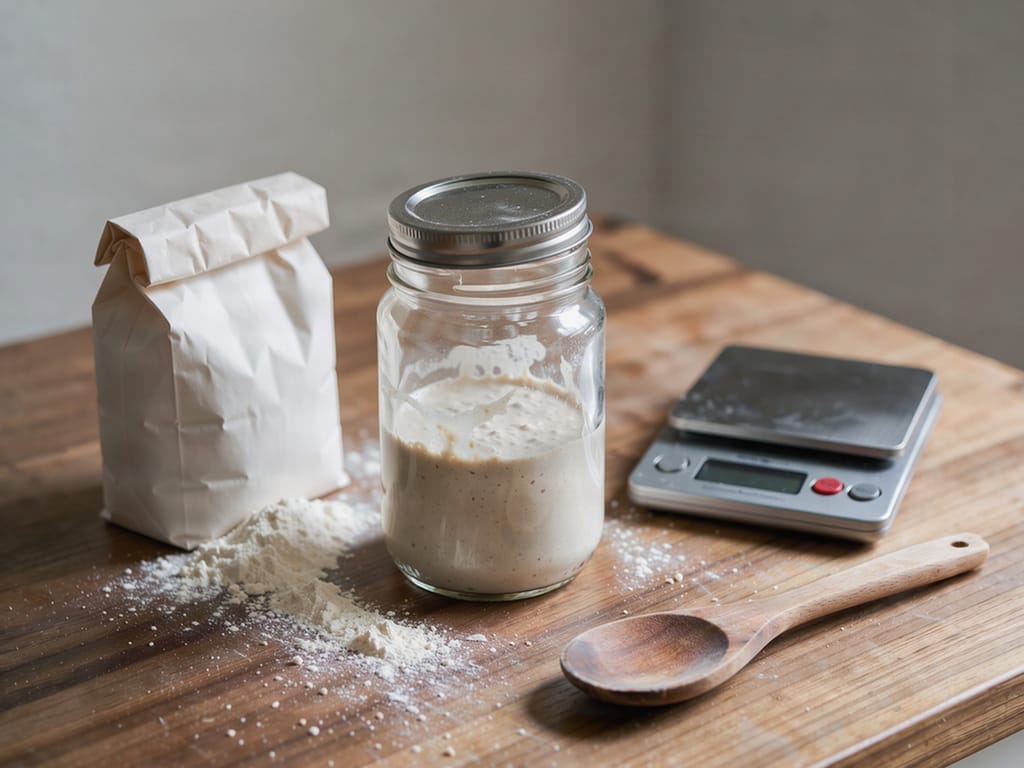
a jar with a capacity of at least 0.5–1 l, so the starter has room to grow (clean, with the lid resting loosely on top)
a kitchen scale – a starter is fed by grams, not spoonfuls
whole grain flour to begin with (rye or wheat), and regular bread flour later
room-temperature water; if your tap water is heavily chlorinated, let it stand for a few hours
a rubber band or marker for the jar, so you can see how high the starter rose after feeding
Seasonal baking plans, tested recipes and kitchen tricks that save you time. Unsubscribe in one click.
For a beginner, a rye starter is the safer bet – it gets going faster and more reliably, because whole grain rye flour carries more food for yeast and bacteria and brings plenty of microbes of its own. A wheat starter is milder and better for light wheat bread, pizza or baguettes.
Rye starter – a thick paste that doesn't form an elastic gluten network (rye does contain gluten, it just doesn't behave like wheat gluten). It doesn't look airy, but it leavens brilliantly. It's tangier and smells of bread crust and fruit. For traditional Czech rye-wheat bread it's the foundation: according to baking literature, the acidity of rye dough holds back the enzymes that would otherwise break down the starch and leave the crumb gummy.
Wheat starter – stretchy, with gluten forming a network; it climbs upward and makes big bubbles. The flavour is milder and more yogurt-like.
You don't have to decide for good. You can turn a rye starter into a wheat one by feeding it wheat flour for a few feedings in a row (and the other way round). Many bakers start with whole grain rye and then feed a mix.
You make a starter by mixing equal weights of whole grain flour and water, then from day 3 feeding it twice a day: you discard most of it and top up with fresh flour and water. The method below is based on King Arthur Baking's instructions, scaled down to a smaller batch. Keep your starter at around 21 °C (70 °F) – a bit warmer is fine, cooler slows everything down.
Day 1 – mix 50 g whole grain flour (rye or wheat) and 50 g water into a thick paste. Cover loosely and leave for 24 hours at room temperature.
Day 2 – discard half, add 50 g flour and 50 g water to the remaining 50 g, stir, and leave for 24 hours. From day 2 you can also feed with bread flour or plain wheat flour if you want a wheat starter.
Day 3 – switch to feeding twice a day, about 12 hours apart. Each time, keep only 50 g of starter, discard the rest and add 50 g flour and 50 g water.
Days 4–5 – keep feeding twice a day. The starter should begin to at least double in volume, with bubbles and a pleasantly sour smell.
Day 6–7 and beyond – keep feeding until it rises dramatically and regularly: at least double within 6–8 hours of feeding. According to King Arthur, this can take up to a few weeks – in a cold kitchen, 10–14 days is quite normal.
You don't have to throw the discard away – after a few days, once it smells sour, it works well in pancakes, crackers or waffles as a flavouring. It won't leaven the batter, though, so keep the leavening agent in the recipe.
The big surge on day two isn't caused by yeast but by gas-producing bacteria – it's a false start, and the quiet few days that follow are normal. Microbiologist Debra Wink, who studied the phenomenon, found that the first burst of bubbling comes from these bacteria (such as Leuconostoc), not from yeast. When acidity rises (pH around 4.5), these bacteria stop, and the yeast only takes off in a more acidic environment, around pH 3.5. In between, the starter looks dead for a few days.
What to do about it:
Don't throw it out – keep feeding on schedule. After a few quiet days it will rise again, this time with the "right" yeast.
Don't worry that you've overfed it – during the quiet spell, patience helps more than adding extra flour.
If the false start keeps bothering you, Wink recommends using unsweetened pineapple juice instead of water for the first three days: the acidity suppresses the bacteria from the early days, and the yeast takes hold sooner.
A starter is fed in a starter : flour : water ratio, most often 1:1:1 by weight – for example 50 g starter, 50 g flour and 50 g water. The more fresh flour you add relative to the starter, the longer it takes to peak.
1:1:1 – peaks in roughly 4–8 hours at room temperature. The standard for daily feeding on the counter.
1:2:2 – peaks in about 8–10 hours. Handy when you want to feed in the morning and bake in the evening.
1:5:5 – peaks in 12 hours or more. Good for overnight feeding or a warm kitchen, where the starter would otherwise race past its peak.
Times are approximate – they depend on temperature, flour and the strength of your starter. Warmth speeds things up, cold slows them down.
Consistency: equal weights of flour and water (100% hydration) give a thick paste that's easy to work with and that most recipes describe. A stiffer starter (say 100 g flour to 50–60 g water) works more slowly and, in common baking practice, tends to turn sharper, more vinegary. A runnier starter is faster and has a milder, more milky flavour.
How much to keep: 50–150 g is enough. A big starter means big feedings and lots of discard. For bread, prepare the day before as much as the recipe calls for, plus a small reserve for the next feeding.
On the counter at room temperature, a starter is fed at least once a day, ideally twice (12 hours apart); in the fridge, roughly once a week – both according to King Arthur Baking's recommendations.
On the counter (room temperature, around 21 °C / 70 °F) – feed at least once every ~24 hours, ideally every 12 hours. Worth it if you bake several times a week.
In the fridge – once a week, take the starter out, discard the excess, feed it equal weights of flour and water, leave it on the counter until it starts to bubble (usually 1–2 hours, or longer until you see bubbles), and put it back.
Before baking from the fridge – feed it and leave it at room temperature, repeating the feeding every 12 hours until it doubles (or triples) in volume again within 6–8 hours. After a week in the fridge, 1–2 feedings are usually enough; after a longer break it can take more.
A grey or dark liquid on the surface (called "hooch" in English) is alcohol from fermentation. According to King Arthur, it doesn't mean your starter is in danger – it's just hungry. Pour it off or stir it in (stirring it in adds tanginess) and feed.
A starter is ready when it reliably doubles in volume within 6–8 hours of feeding, is full of bubbles and smells pleasantly sour. Reliably means two to three days in a row, not once by chance.
How to tell:
The doubling test – right after feeding, mark the level on the jar with a rubber band or marker. After 6–8 hours the starter should reach at least double. It's the most reliable test you have.
The peak – at its peak the surface is domed or flat and dotted with bubbles. If it's sinking in the middle and you can see a line on the glass where it reached, it's past its peak. Add it to the dough at the peak or just before.
Structure – a wheat starter is web-like inside and stretches; a rye starter is more of a thick, bubbly foam, like wet sand.
Smell – mildly sour, yogurty, fruity or beery. A sharp acetone smell usually just means it's very hungry: feed it more often or at a larger ratio.
If your bread then comes out flat, don't blame the starter right away – it's often a short rise or weak shaping. And when you're choosing what to bake first, you'll find inspiration among our bread and baking recipes.
The float test isn't reliable, and you can safely skip it. The idea: you drop a spoonful of starter into water – if it floats, it has enough gas in it.
King Arthur Baking tested it and the verdict is clear: if the starter sinks, it's definitely not ready. If it floats, that guarantees nothing – a starter that is still rising and isn't ripe will float too.
If you want to use the test, treat it only as a supplement to the doubling test, never a replacement.
A starter most often doesn't rise because it's cold, too runny, hungry, being fed too much white flour, or is only a few days old and going through the quiet phase. Work through it in this order:
It's cold. Below ~20 °C (68 °F) everything drags. Put it in the oven with just the light on, or somewhere warmer in the kitchen (at around 55–60 °C / 131–140 °F, though, yeast dies – so no heater directly under the jar).
It's too runny. The bubbles escape and the starter "doesn't rise" even though it's active. Add 10–20% more flour.
It's hungry. If you haven't fed it in a long time, it needs 2–3 regular feedings to recover.
The flour is too white. At the start, it helps to feed at least partly whole grain rye flour.
It's only a few days old. Within 7–14 days, quiet is normal. According to King Arthur Baking, wrong feeding won't permanently ruin your starter – fix the ratio and carry on.
You revive a dried starter by soaking the flakes in twice their weight of water, and once they dissolve, feeding them with flour and water in a warm place until the starter reliably rises again. It's the best insurance for holidays and a backup in case your live starter goes wrong.
To dry a starter, spread it thinly over parchment paper while it's active, let it dry completely at room temperature, and store the flakes airtight. The method is based on King Arthur Baking's guidance:
Feed the starter equal weights of flour and water and wait until it's very bubbly and active.
Spread it in a thin layer on parchment paper and let it dry at room temperature – depending on the weather, 1 to 5 days – until it's completely dry and brittle and snaps between your fingers.
Break it into flakes and store airtight, ideally in glass, in a cool, dark place. King Arthur says a well-dried starter keeps essentially indefinitely, and they know of cases where it was still viable after more than ten years. They advise against putting starter in the freezer – freezing can kill it.
You revive a dried starter by soaking it in twice its weight of lukewarm water and then feeding it gradually in a warm place – it usually takes a few days. The ratios are from King Arthur Baking, converted to grams:
Pour 60 g lukewarm water over 30 g dried starter and let it soften and dissolve.
Stir in 30 g flour, cover and put it somewhere warm – 29–32 °C (85–90 °F) (the oven with just the light on).
When it starts to bubble, add 30 g flour and 30 g water (don't discard anything).
After the next rise, add 30 g flour and 30 g water again, still without discarding.
Then keep 120 g of starter, discard the rest and feed it 120 g flour and 120 g water.
Repeat the feedings until the starter once again doubles in volume within 6–8 hours – then it's ready to bake.
The whole revival usually takes a few days. A starter forgotten in the fridge for a few weeks is revived the same way as a regular refrigerated starter – just expect more feedings.
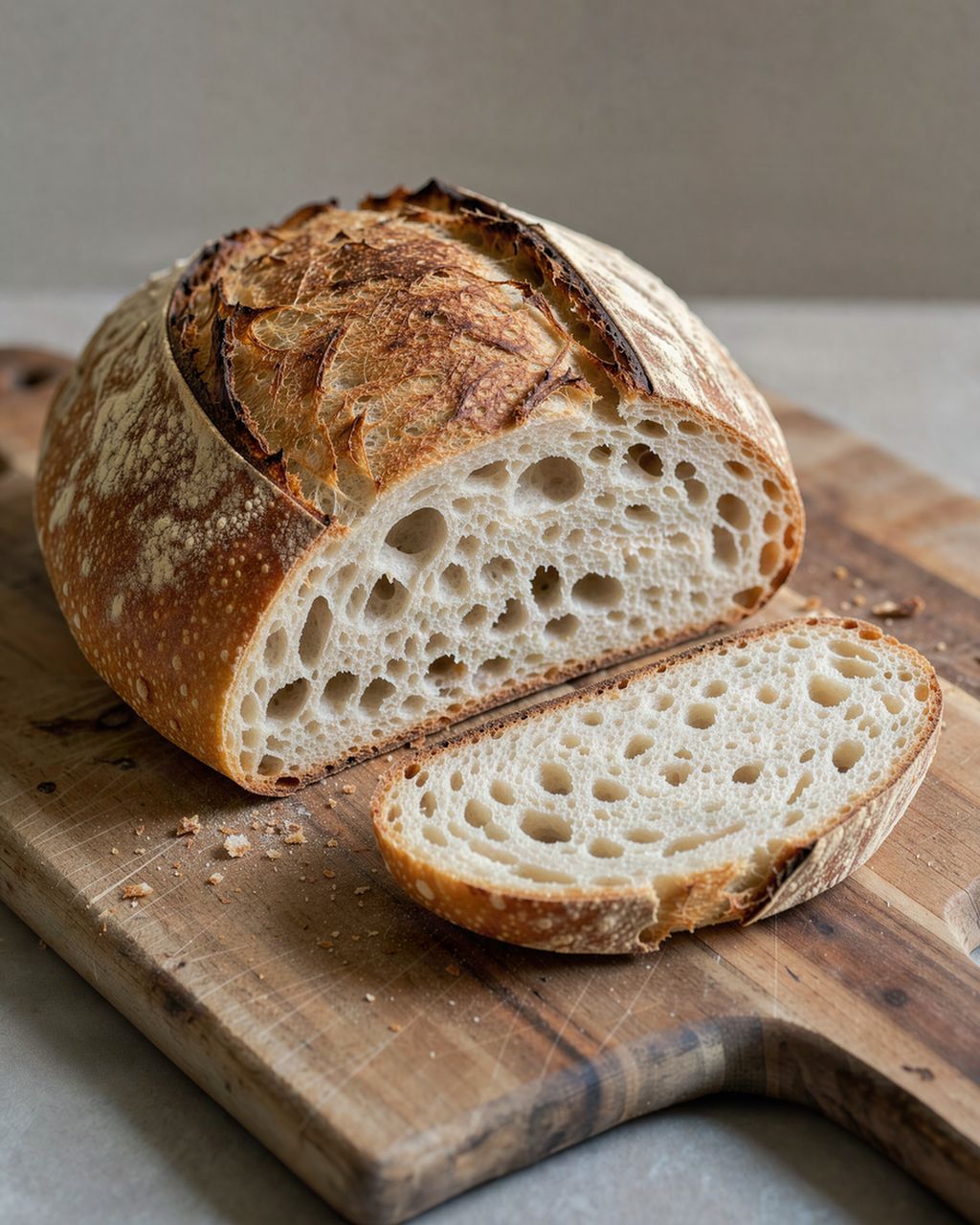
Bake a simple loaf first, one where the starter plays the leading role and nothing overpowers it. Once you feel confident, try an autumn version with vegetables and nuts – sourdough pumpkin bread with walnuts and sage, where the pumpkin adds softness and the starter adds a tang that balances the sweetness.
A wheat starter also works wonderfully in pizza – for how to get the hydration and rise right, see our article pizza dough: how much water, which flour and how long to let it rise.
Autumn pumpkin sourdough bread with walnuts and sage
Sourdough pumpkin bread with walnuts and sage – a recipe for bread made with a sourdough starter
You can, but it will get going more slowly and less reliably than with whole grain flour. Whole grain rye or wheat flour carries more food for yeast and bacteria, plus more microbes, so it's better for the first few days. Once your starter rises regularly, you can switch to all-purpose or bread flour.
Plain drinking water at room temperature is enough. If it smells strongly of chlorine, leave it to stand in an open container for a few hours or use filtered water. Avoid water hotter than about 45 °C (113 °F), since yeast starts dying at around 55–60 °C (131–140 °F).
You do have to discard some. Otherwise the starter grows to an enormous amount and there's too little fresh flour in it for it to stay active. You can add the discard to pancakes, crackers or waffles as a flavouring.
Most recipes call for 10–25% ripe starter relative to the weight of the flour, which means 50–125 g of starter per 500 g of flour. Less starter means a longer, slower rise and milder tanginess. Always take the exact amount from your specific recipe.
For a week or two, feed it before you leave and put it in the fridge. King Arthur Baking recommends feeding a refrigerated starter roughly once a week. For a longer trip it's safer to dry some of it: according to King Arthur, an airtight dried starter keeps at room temperature practically indefinitely.
Yes. In warmth above about 26 °C (79 °F), a starter peaks sooner and quickly turns sour. Feed it at a larger ratio (1:3:3 up to 1:5:5), use colder water, or put it in the fridge for a few hours after feeding.
One recipe worth heating the oven for, one tip, and one deal from the shop. Nothing else.