What Temperature and How Long to Bake a Bundt Cake: Times by Pan and Batter
Why Your Bundt Cake Cracks, Domes or Doesn't Rise: Causes and Fixes
Updated Nov 17, 2026
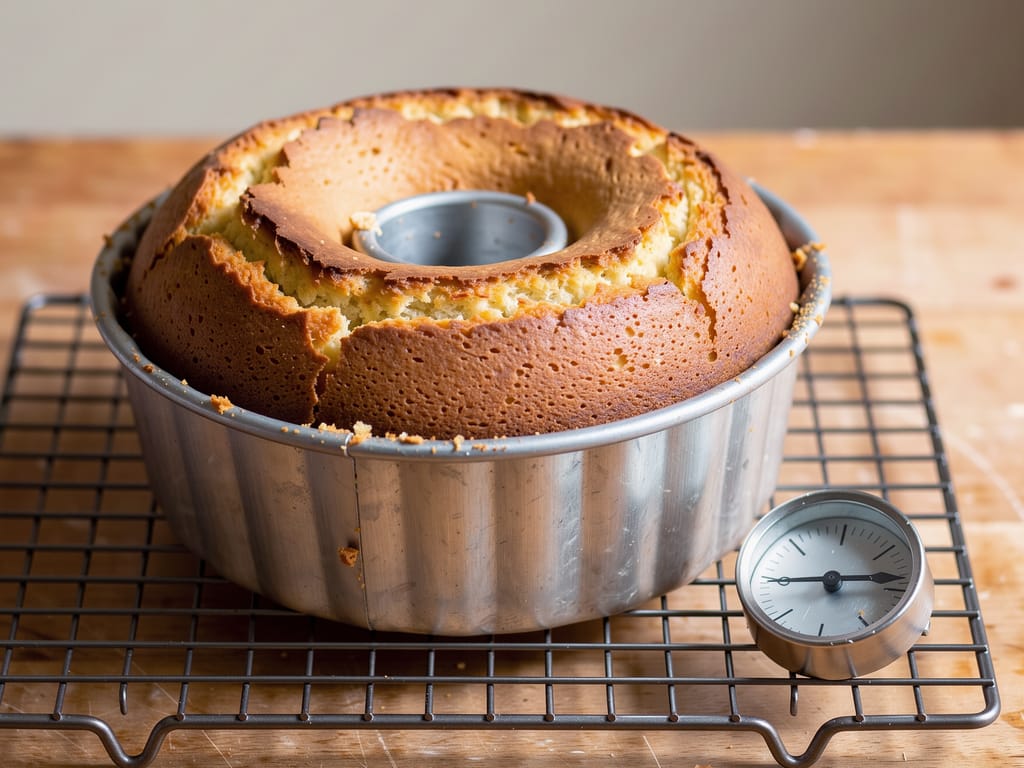
A bundt cake cracks and domes mostly because the oven is too hot or there's too much batter in the pan: the crust sets before the center has finished rising, and the batter breaks through it. With a bundt, though, it often doesn't matter, because the top in the oven becomes the bottom once you turn the cake out. The opposite is worse: a bundt that doesn't rise or isn't fluffy usually has too little air in the batter, old baking powder or a cold oven. Here's which symptom points to which mistake, and how to fix it next time.
The shape of the cake gives away the mistake: a crack and a slight dome are normal, a dome spilling over the edge means too much batter, and a short, dense bundt means too little air or old baking powder. In more detail:
A crack all the way around, but otherwise a nice cake → normal oven spring, the batter rose well. Nothing to fix.
A deep split, dark crust, a dome like a volcano → the oven is hotter than the dial says, or the cake is too high in the oven.
The dome spills over the rim of the pan → too much batter for that pan.
The dome is on one side only → there's a hot spot in the oven (usually at the back wall or near the fan).
The cake didn't rise and is short and dense → too little air in the batter (beaten too briefly, or it curdled), old baking powder, or the batter sat around for a long time before baking.
It rose, but it's tough and rubbery inside → the batter was overmixed after the flour went in.
It rose, then fell → the opposite problem, which we cover separately in why a bundt cake sinks in the middle.
Seasonal baking plans, tested recipes and kitchen tricks that save you time. Unsubscribe in one click.
A bundt cracks because the surface sets before the center does. Heat reaches the batter from the walls of the pan and from above, so the crust tightens while the inside is still rising. The gas from the baking powder and the steam have to go somewhere, so they split the crust. In a bundt, the crack usually runs along the middle of the ring, where there's the most batter and the center takes longest to bake.
What leads to it:
The oven runs hotter than it says. Home oven thermostats commonly drift from the real temperature, and the "preheated" signal is, according to the bakers at King Arthur Baking, rather unreliable. The only way to find out is a separate oven thermometer on the rack in the middle of the oven.
The cake is too high up. The top third of the oven is hotter, and the top bakes sooner. Move the rack to the middle or one level lower.
Too much baking powder. The batter shoots up fast and hard, the crust can't keep up and splits. Stick to the recipe; "an extra teaspoon just in case" doesn't help.
Fan oven without lowering the temperature. The fan sets the surface faster. If the recipe is written for conventional (top and bottom) heat, you usually reduce the temperature by about 10–20°C (20–35°F) for a fan oven and check the cake 10 minutes early. You'll find specific temperatures for different bundts in bundt cake: baking temperature and time.
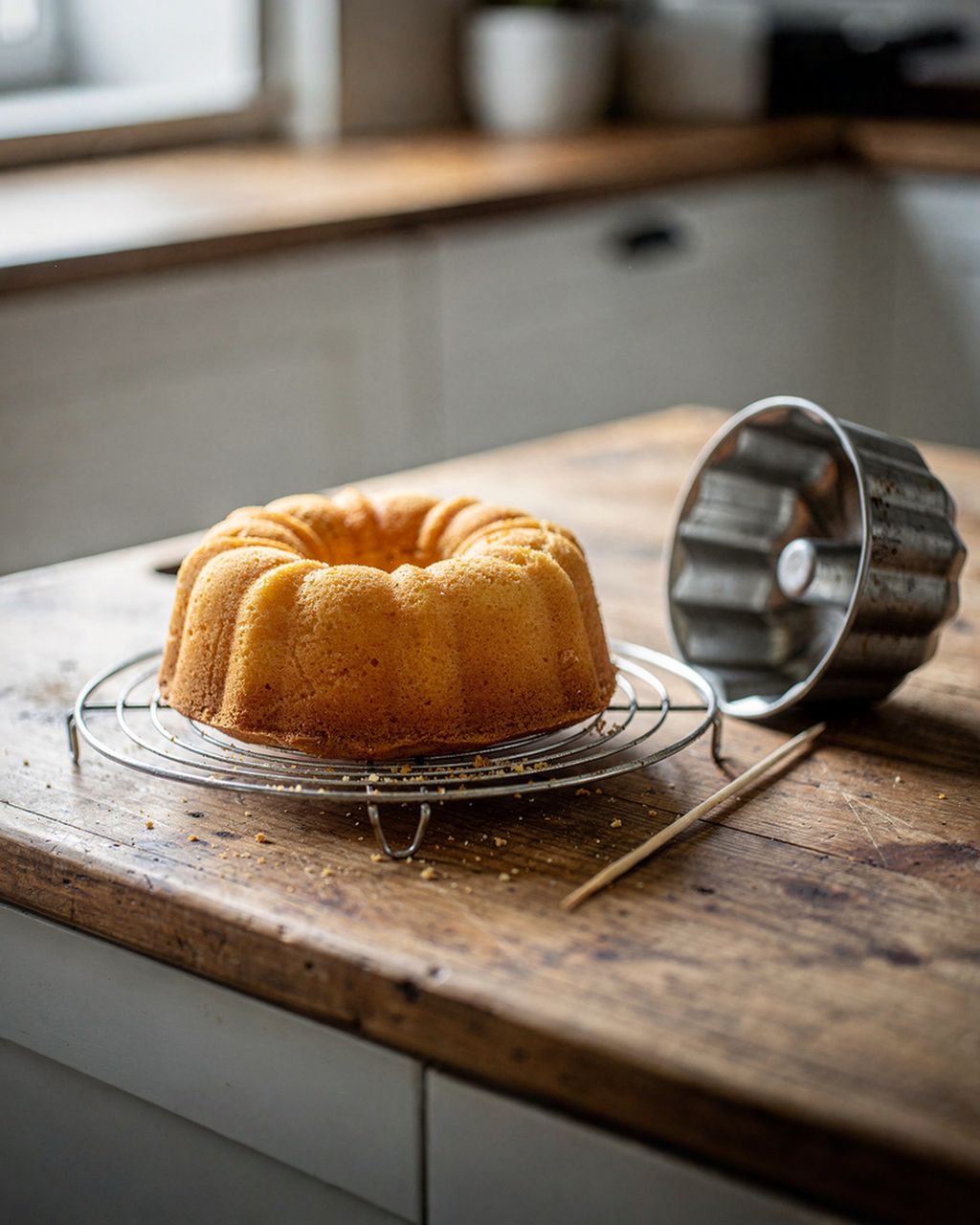
When a crack is fine: when there's just one, it's even, the crust is golden and a skewer comes out dry. It's a sign the batter had the strength to rise. You turn the bundt out, the crack ends up at the bottom on the plate, and nobody ever sees it.
A bundt domes when the center keeps rising longer than the edges: in a metal pan the edges set quickly, so the batter only keeps growing where it still can, in the middle of the ring. A slight dome is normal. It's only a problem when:
it spills over the rim of the pan – the cake is then hard to turn out and doesn't sit level,
the dome is high and the inside near it is damp – this means heat didn't reach the core in time and the surface baked too soon,
it's on one side only – your oven bakes unevenly, so next time turn the pan 180° halfway through baking (not earlier, or the batter may fall).
How to level the cake: let it cool in the pan for about ten minutes so it firms up, then slice off the domed top with a long serrated knife, level with the rim of the pan. The turned-out bundt stands flat, and the offcut is the cook's reward. Exactly when to turn it out so it doesn't fall apart is covered in when to turn out a bundt cake.
The batter should reach about two thirds of the way up the pan, never to the rim. The remaining third is the space the cake rises into. If the pan is full, the batter has nowhere to go and either overflows or pushes up a high dome that doesn't bake through.
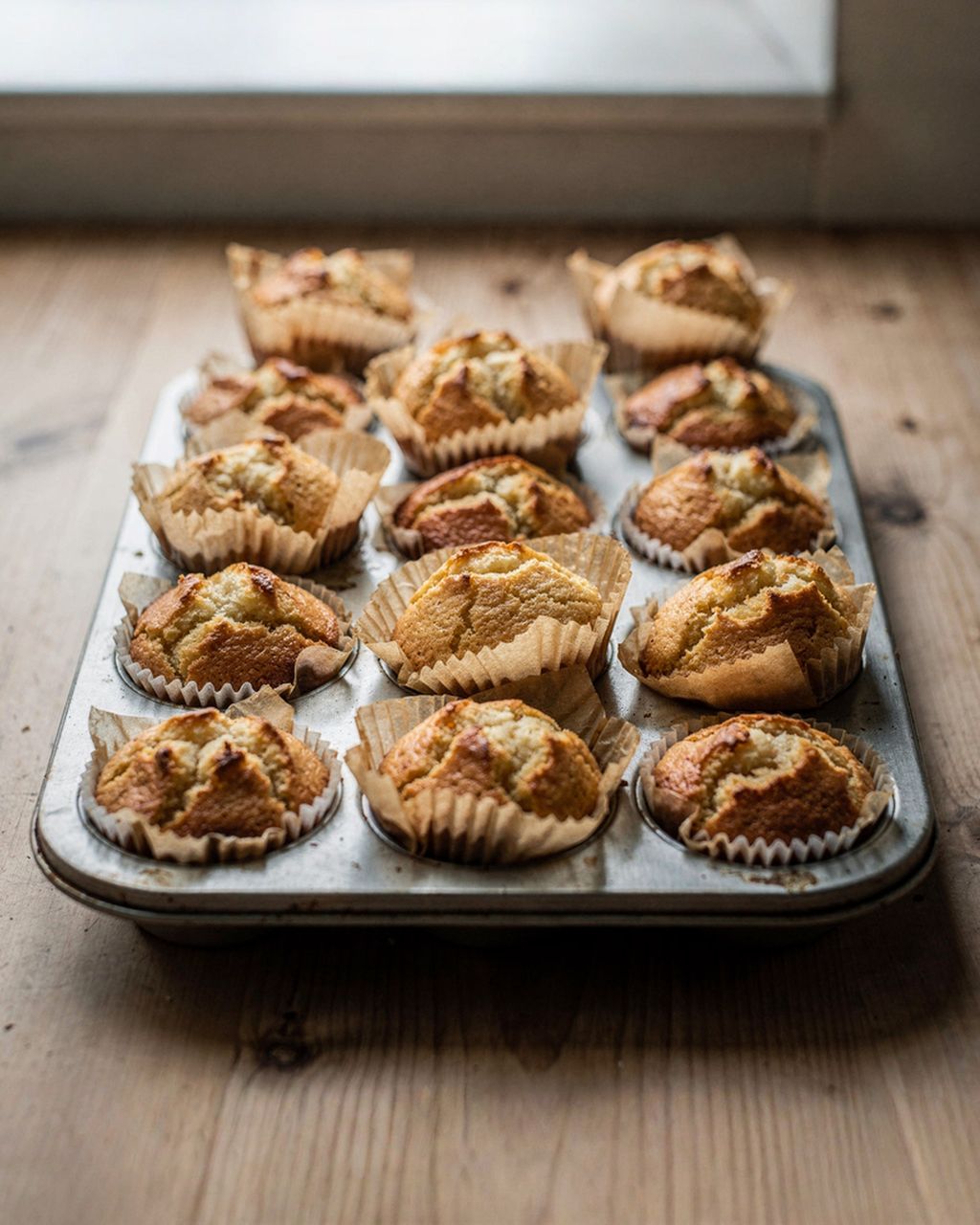
Have extra batter? Don't squeeze it into the pan "so it doesn't go to waste". Bake the extra as a few muffins: fill the liners only two thirds full and bake them for a much shorter time than the bundt.
Recipe written for a different pan? Bundt pans differ in volume, so measure it: fill the pan with water to the rim and measure the water. Two thirds of that volume is the ideal amount of batter.
Wide, shallow pan vs. narrow, tall pan: in a tall pan the batter takes longer to bake and rises more toward the center, so it cracks more. If this keeps happening to you, reach for a pan with a wider ring – you can choose among pans and baking tools.
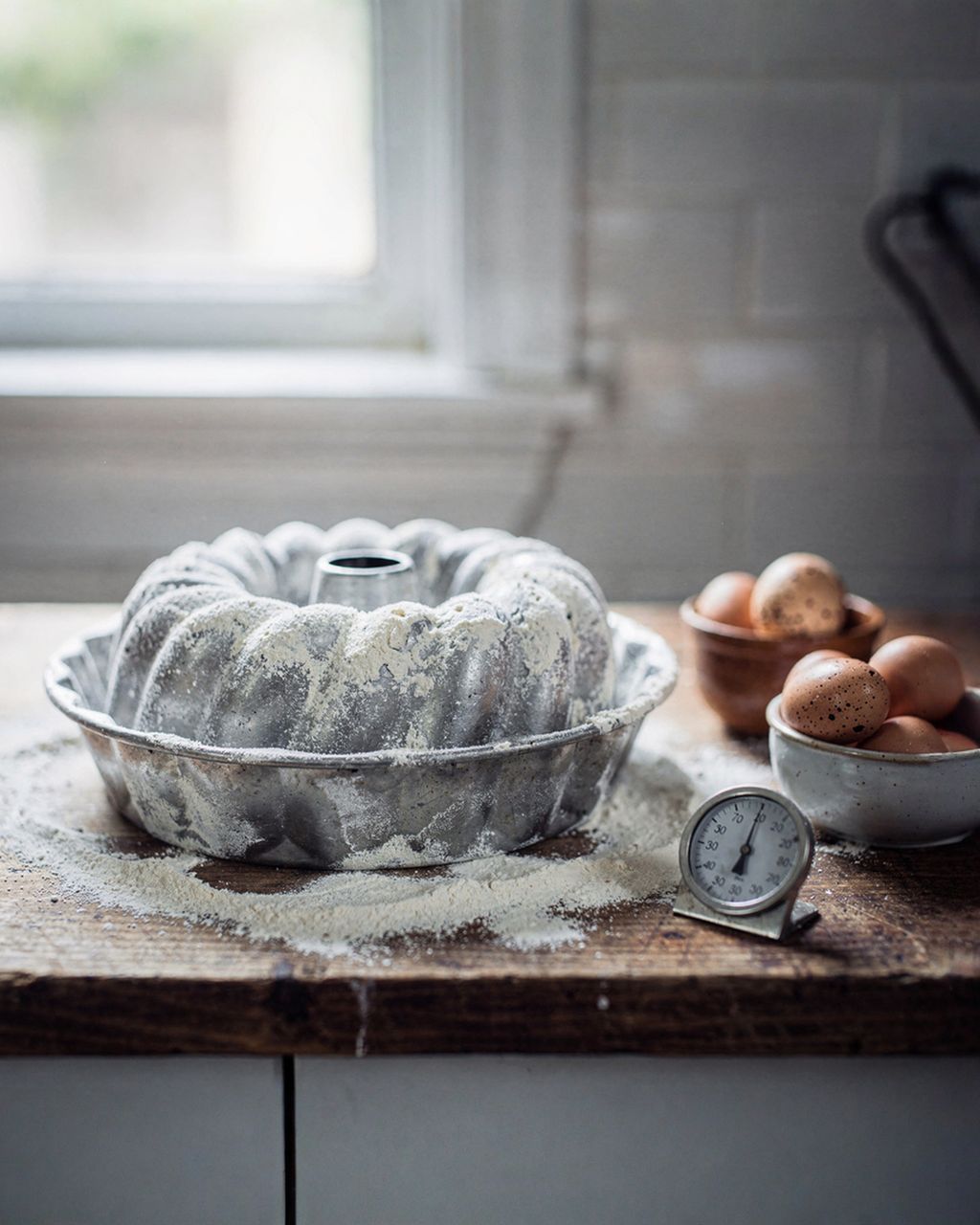
The pan also needs to be well prepared: wherever the batter sticks, it won't rise evenly. How to do it is covered in what to coat a bundt pan with so the cake doesn't stick.
A bundt doesn't rise when the batter lacks the gas to lift it: either you haven't got enough air into it, or the baking powder isn't working, or the gas escaped before the batter set in the oven.
The most common causes:
Expired or damp baking powder. Quick test: sprinkle a teaspoon of baking powder into a little hot water. If it doesn't fizz vigorously, throw it out.
The batter sat for a long time before baking. Baking powder starts reacting as soon as it meets moisture. The oven should be preheated before you start mixing, and the batter goes straight in.
Cold oven. A bundt put into an oven that hasn't finished heating rises slowly, and the gas escapes in the meantime. Wait until the thermometer in the oven shows the target temperature – the indicator light tends to be ahead of reality.
Under-whipped base. Butter with sugar, or egg yolks with sugar, must become a pale, fluffy foam, not just a mixed mass. That air does a big part of the work.
Deflated whipped egg whites. If the recipe uses whipped egg whites, fold them in with a spatula in several additions, with a circular motion from the bottom up. Stirring with a whisk will kill them.
Too many heavy add-ins. A lot of nuts, chocolate or fruit weighs the batter down. Stick to the recipe, or use less of them.
A bundt that rose but is dense or rubbery inside usually has an overmixed batter. As soon as you add flour to the wet mixture, gluten starts to form – the longer you mix, the tougher and denser the crumb. So mix in the flour only until the dry streaks disappear, and no further.
Other culprits:
Cold ingredients. Cold eggs or milk make the creamed butter seize up, and the air escapes from the foam. Take them out of the fridge ahead of time so they reach room temperature.
Butter that's too hard or too soft. Hard butter won't cream into a foam, and melted butter can't hold air. The butter should be soft enough that a finger leaves a dent in it, but not greasy and shiny.
Too much flour. Flour scooped straight from the bag with a cup gets packed down, and you end up with more than the recipe wanted. Weigh it.
If the bundt is fluffy but dries out quickly, that's a different chapter – it's covered in why a bundt cake is dry.
You can fix a cracking or non-rising bundt in six steps: measure the real oven temperature, bake in the middle, fill the pan two thirds full, measure the baking powder exactly, beat the base into a foam and don't open the oven for the first 30 minutes. In detail:
Measure the real oven temperature. Place the Patisse oven thermometer on the rack in the middle, preheat the oven and compare after 20 minutes with the dial. Write down the difference and adjust the setting by it next time.
Bake in the middle of the oven, not the top third.
Fill the pan two thirds full and bake the extra batter separately.
Use baking powder exactly as the recipe says, and test it if the package is older.
Beat the base into a pale foam and mix in the flour briefly.
Don't open the oven for the first 30 minutes – a sudden drop in temperature stops the rise.
A tried-and-true recipe to test all this on is the marble bundt cake with buttermilk and vanilla, or the tender Dvěstěpadesátka quark bundt cake with chocolate and almonds (made with quark, tvaroh, a Czech fresh curd cheese).
A done bundt cake pulls away from the sides of the pan, and when you press the surface lightly it springs back instead of leaving a dent. The most reliable method is an instant-read thermometer: at the highest point it should read roughly 95–99°C (203–210°F).
A yeast bundt most often cracks because it went into the oven under-proofed and finished rising in the heat, when the crust was already setting. Leave it to rise in the pan until it has grown by about half and a dent made with your finger springs back only slowly. Don't let it over-proof, though, or it will collapse instead.
You can't make a bundt that hasn't risen go up again, but it's perfectly good to eat. Denser slices are great pan-fried in a little butter and served with fruit or sour cream.
Yes. Silicone conducts heat more slowly than metal, so the cake rises more slowly and tends to be shorter and paler. Set the silicone pan on a baking sheet, bake it a little longer and check doneness with a skewer.
Glossy, wet batter inside the crack means the center of the cracked bundt isn't baked through yet, so leave it in the oven longer. An instant-read thermometer at the highest point gives you certainty: when it reads roughly 95–99°C (203–210°F), the cake is done.
One recipe worth heating the oven for, one tip, and one deal from the shop. Nothing else.