Grandma's two-fifty cottage cheese bundt cake
Bundt Cake Icing: How to Pour It So It Drips in Neat Stripes
Updated Oct 8, 2026
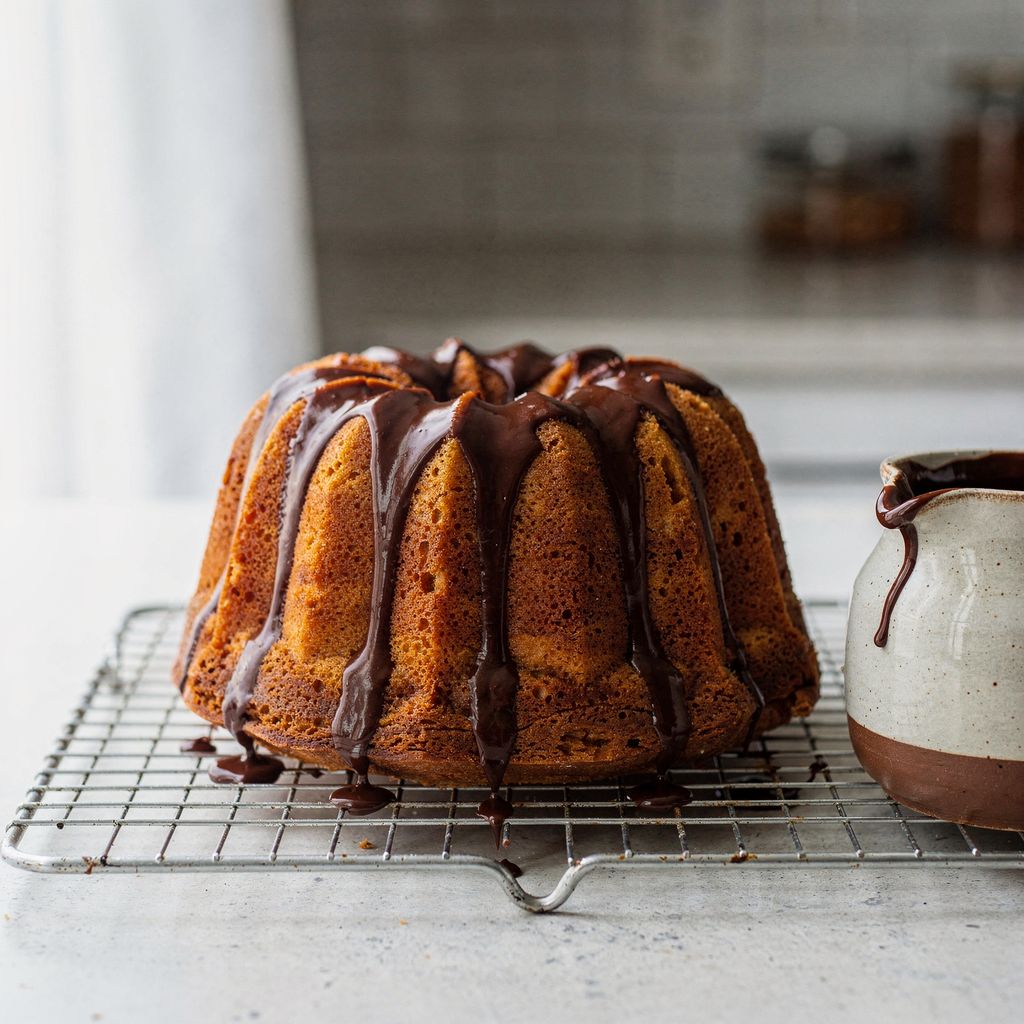
Bundt cake icing drips in neat stripes when it's the thickness of liquid honey, the cake has cooled completely, and you pour it slowly over the top of the crown rather than down the sides. Three things make the difference: how thick the icing is, the temperature of both icing and cake, and the shape of the tin you baked in. Below you'll find the ratios for both sugar and chocolate icing, a simple test for checking the thickness, and what to do if the icing runs straight down onto the plate.
The right icing for a bundt cake runs like liquid honey or thick maple syrup: it falls off a spoon in a steady thread, and when it hits the surface in a bowl, the trail it leaves takes 3–5 seconds to level out. Thinner icing runs straight down and pools, while thicker icing just sits on top like a cap.
The most reliable way to check is the glass test: spoon a little icing onto the outer rim of a dry glass or bowl and watch what happens.
Runs all the way to the bottom within 2 seconds → it's too thin or too warm. Stir in a bit more sugar, or let the chocolate cool a little longer.
Stops roughly halfway to two-thirds down → that's exactly what you want. The stripes on the cake will stop at the same point.
Barely moves at all → it's too thick. Add a drop of liquid, or warm the chocolate briefly.
The test takes 20 seconds and can save the whole cake.
For a bundt cake baked in a 22–24 cm (9 inch) tin, 200 g (1¾ cups) icing sugar and 30–40 ml (2–3 tbsp) liquid — lemon juice, milk, water or orange juice — is enough. Start with 30 ml and thin it out in ½ teaspoon increments: with sugar icing, the line between "too thick" and "too thin" is only a few drops wide.
Lemon juice gives a sharp, zesty icing that firms up and turns slightly matte as it dries. It works best on citrus bundt cakes, such as the orange bundt cake with almonds, cinnamon and cardamom.
Milk or cream give a whiter, opaque icing that makes the stripes stand out more.
A teaspoon of melted butter or a teaspoon of glucose syrup adds shine and softens the icing so it won't crack as much once it dries.
Always sift the icing sugar. A single lump at the tip of a stripe will show up more than you'd like.
Chocolate icing that drips in neat stripes is really just ganache: dark chocolate and 33% cream in a 1:1 ratio, poured at 30–32°C (86–90°F). For a 22–24 cm (9 inch) bundt cake, 100 g chocolate and 100 g cream is plenty. Pastry chefs use this same ratio and temperature for drip icing on cakes too.
Heat the cream to just below a boil and pour it over chopped chocolate or chocolate callets.
Let it sit for 2 minutes, then stir from the centre outward with a spatula until it comes together into a glossy mixture. Don't whisk it, or you'll beat in air bubbles.
Let it cool at room temperature (10–30 minutes) to 30–32°C (86–90°F). It cools unevenly in the fridge, setting at the edges while the middle stays warm.
White and milk chocolate contain little or no cocoa solids, which is what thickens ganache, and more sugar and milk solids, so with the same amount of cream they turn out thinner. For an icing of the same thickness, use white chocolate in a 3:1 ratio (150 g chocolate to 50 g cream) and milk chocolate at roughly 2:1. Pour white chocolate ganache a few degrees cooler, around 28–30°C (82–86°F). You can colour white ganache, but use oil-based or powdered colours on chocolate, never water-based ones. The article food colouring: gel, powder and chocolate-safe colours explains why.
Couverture callets work best for ganache — Callebaut 811 (dark, 54.5% cocoa) or Callebaut W2 (white), for example. They melt evenly, need no chopping and flow predictably. That said, you can make perfectly good ganache with a good-quality chocolate bar from the shop; it just tends to have less cocoa butter, so it sets a bit sooner and with less shine. For a smoother icing that stays glossy longer, a teaspoon of glucose does the trick — the article glucose in ganache explains why it works. Cocoa (fat-based) icings made with vegetable fat flow easily, but they taste waxy and never have the full flavour of real chocolate.
The bundt cake should be completely cool, ideally at room temperature, before you ice it — that means 1.5–2 hours after turning it out of the tin. A warm cake will warm the icing, making it run thin and drip straight down onto the plate. With sugar icing, a warm cake will also soak it into the crust, leaving a translucent, damp film instead of stripes.
The temperature of the cake works as a fine-tuning tool:
Cake at room temperature → stripes run roughly halfway to two-thirds down the side. This is the classic look.
Cake chilled for 20–30 minutes in the fridge → icing sets faster on the cold surface, giving shorter, sharper-edged stripes. This works well for ganache.
If you're not sure when to turn the cake out of the tin without cracking it, check out when to turn a bundt cake out of the tin. And if you'd rather skip icing altogether, say for a cake that's still warm, you'll find syrups, butter and jam ideas in the article what to brush on a bundt cake instead of icing.
Pour the icing slowly, over the top of the crown, and let gravity do the work. Never spread it down the sides with a spoon or spatula.
Set the cake on a wire rack with baking paper underneath. Whatever drips off can be scraped up and reused. On a plate, it would just pool around the base of the cake.
Pour the icing into a small jug with a spout, or into a piping bag with the tip snipped off. A spoon works too, but it's harder to keep the amounts even.
Work your way around the top edge, section by section. Where the tin has a ridge or a peak, let a little extra pool there. The icing will find the groove on its own and run down it.
Ice the outer edge first, then the inner edge around the hole. Finish by using a spoon to top up any spots where a stripe came out too short.
Don't pour more icing onto a stripe that's already running. The second pour will catch up with the first and drag the stripe all the way down.
Let the icing set undisturbed: 30–60 minutes for sugar icing, 20–40 minutes for ganache, at room temperature. Only move the cake once it's set.
For a 22–24 cm (9 inch) cake, 200–250 g of finished icing is enough — don't make more than that. The stripes look best when you can still see the crust peeking through between them.
Icing flows wherever the surface of the cake lets it. Sharply ridged bundt tins split the icing into distinct stripes, while a smooth or shallow-waved cake lets it spread into one flat sheet. So neat stripes don't really start with the icing — they start with the tin.
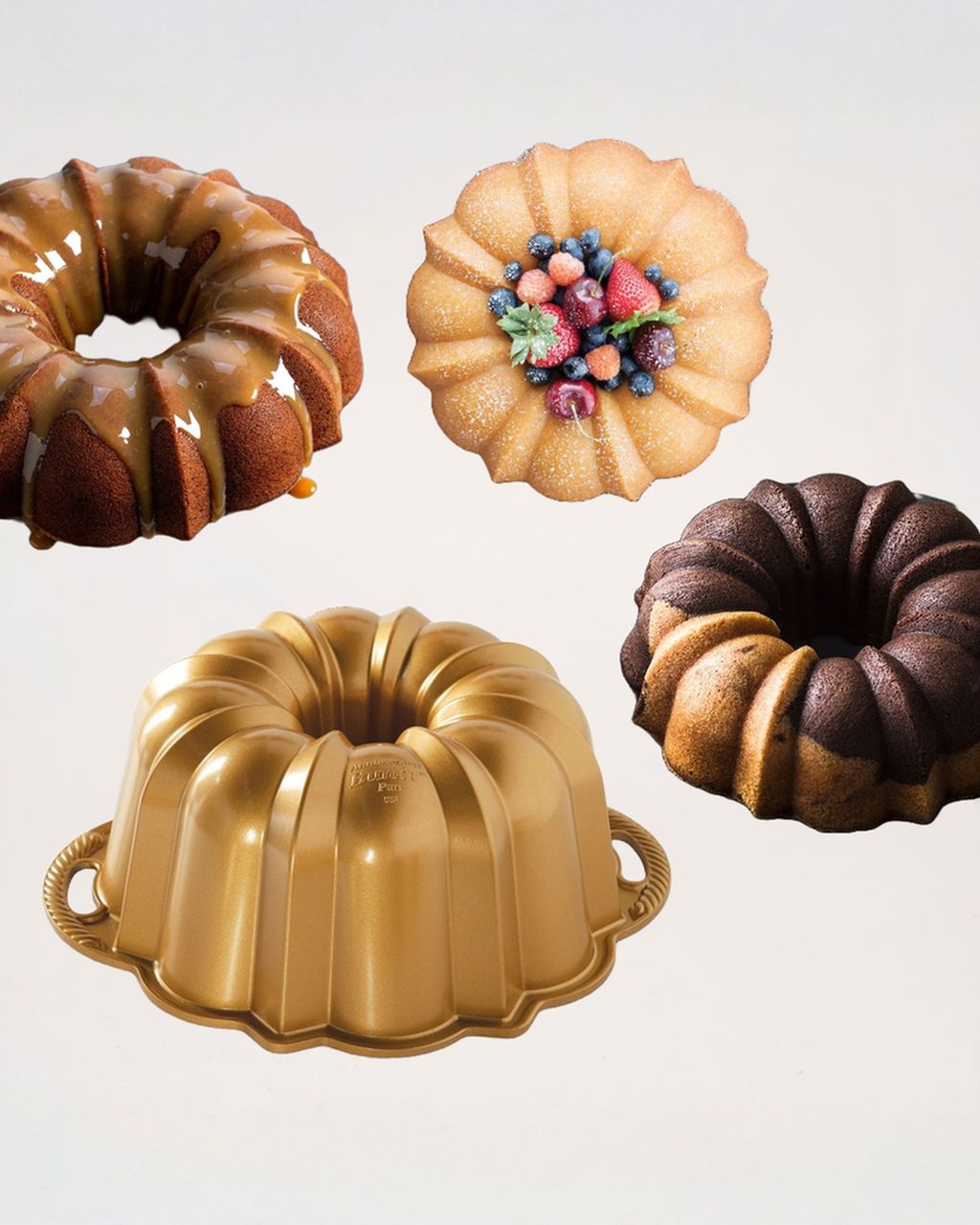
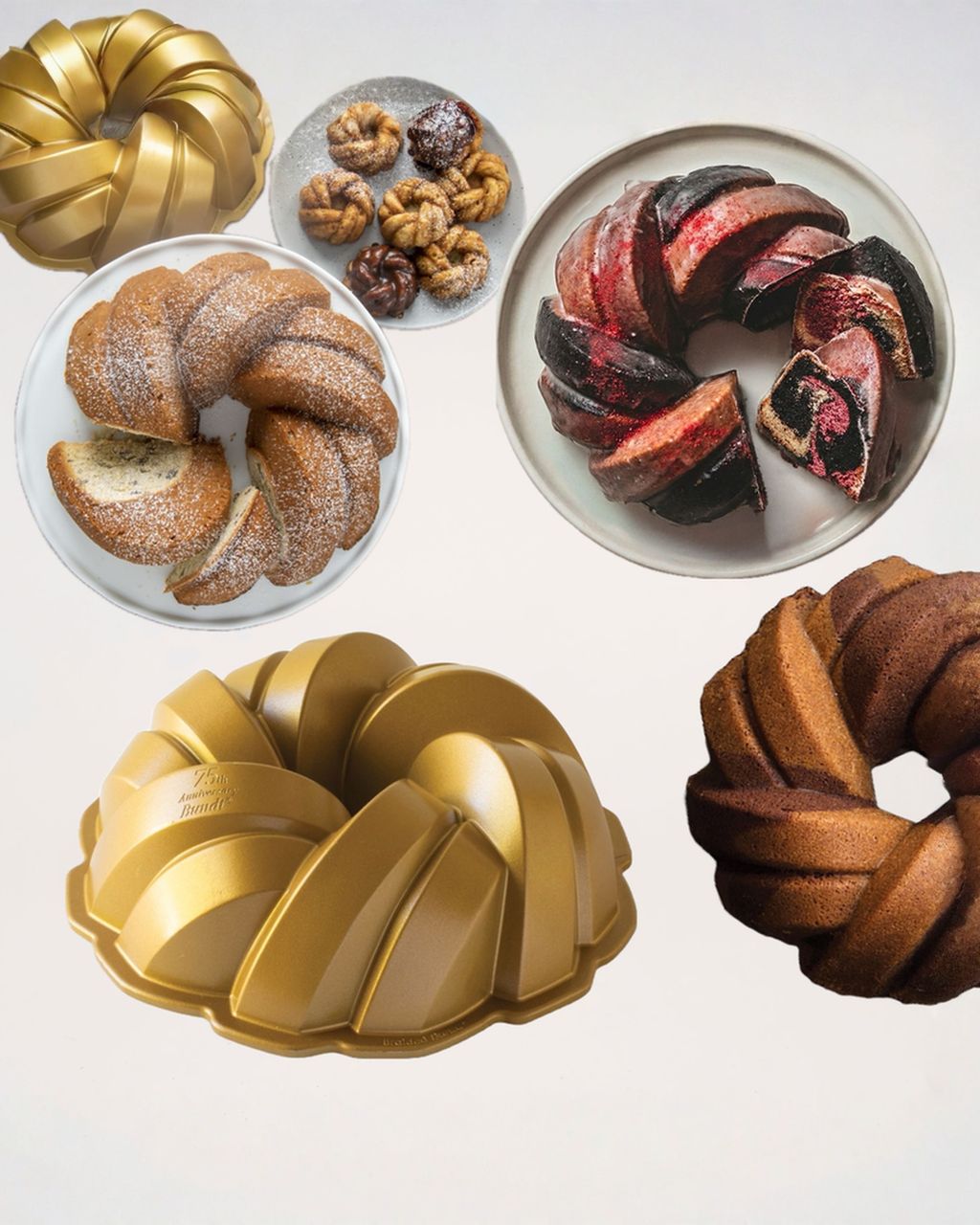
Cast aluminium, such as Nordic Ware: deep, sharply defined ridges and peaks that let the icing run down them like tracks. A cake from a tin like the Nordic Ware Anniversary has pronounced edges, so the stripes separate naturally. Patterned tins like the Nordic Ware Heritage have twisted grooves, so the icing follows the spiral.
A classic enamel or ceramic tin, like your grandmother's: shallower, rounded waves. You can still get stripes, but they tend to merge more. Thicker icing and pouring in smaller amounts helps here.
Silicone tins: the softest outline, and often a matte, slightly "damp"-looking crust. Icing spreads across it and the stripes don't come out with a sharp end point. It's doable, but you won't get crisp definition.
If you're still choosing a tin, you'll find a full comparison of materials in the article bundt tins: ceramic, silicone, cast iron or Nordic Ware. You can also browse the bundt tins we currently have in stock. And to make sure the ridges come out in one piece, the tin needs to be greased properly first: what to dust a bundt tin with so it doesn't stick.
Icing mishaps tend to fall into six categories: it ran all the way down onto the plate, it sat on top like a cap, the stripes are translucent and damp, the ganache is grainy, there are crumbs in the icing, or the stripes are all exactly the same length. Here's what to do about each one.
Icing ran onto the plate → it was too thin, too warm, the cake hadn't cooled down, or you poured too much at once. Thicken sugar icing with a spoonful of icing sugar, let ganache cool by 2–3°C, run the glass test again, and pour in smaller amounts.
Icing stayed sitting on top like a cap → it's too thick, or it had already started to set. Thin sugar icing with ½ teaspoon of liquid; warm ganache briefly in the microwave or over a water bath.
Stripes are translucent and damp → sugar icing soaked into a still-warm crust, or it was too thin to begin with. Let it dry, then add a second, thicker layer just over the top.
Ganache is grainy, or the fat has separated → it overheated, or the cream and chocolate were mixed at too great a temperature difference. Stir in a spoonful of warm cream, working from the centre outward, until it comes back together. More rescue tricks are in the article why ganache splits and how to fix it.
There are crumbs in the icing → the cake wasn't brushed clean before icing, or a spoon that had touched the crust was dipped back into the icing. Brush the cake with a dry pastry brush and always use a clean spoon to scoop from the bowl.
Stripes are all exactly the same length, and a bit dull → pour with a bit of feel: let more pool in some grooves, less in others. Natural-looking irregularity is the goal.
Icing works best on a bundt cake with a firmer, smooth crust it can run down. On a very soft or moist cake, sugar icing soaks in faster, so ganache is the better choice there. These three cakes from our recipes are especially well suited to icing.
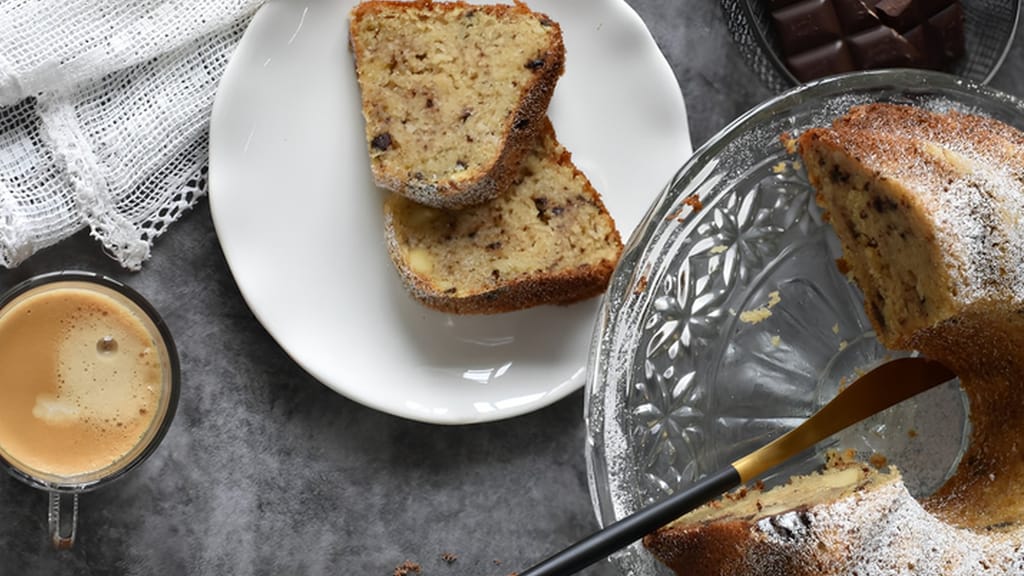
Grandma's two-fifty cottage cheese bundt cake
Two-fifty curd cheese bundt cake, mild in flavour: works well with both lemon sugar icing and dark ganache.
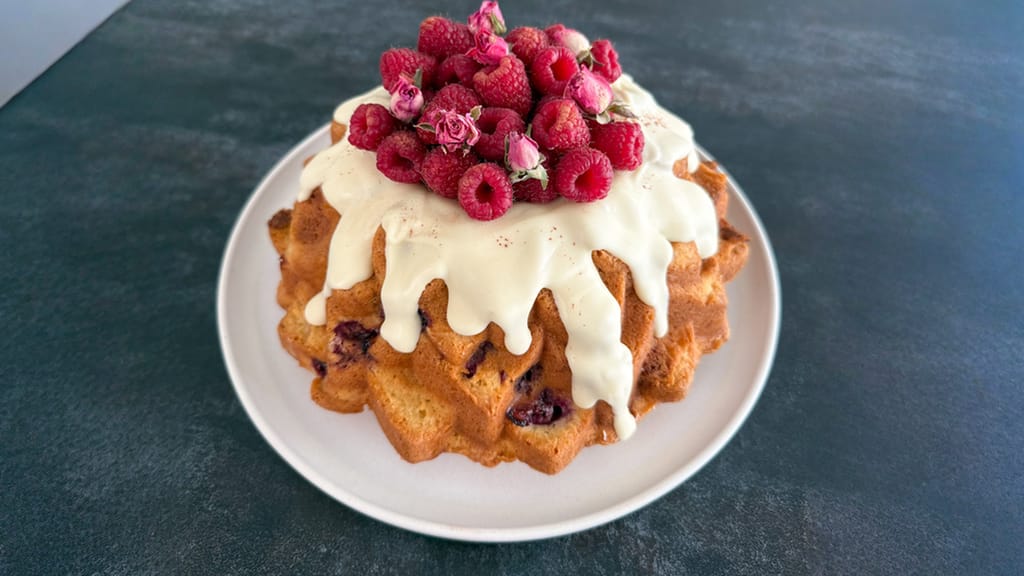
Raspberry bundt cake with white chocolate and sour cream
Raspberry bundt cake with white chocolate: a 3:1 white chocolate ganache is the natural match.
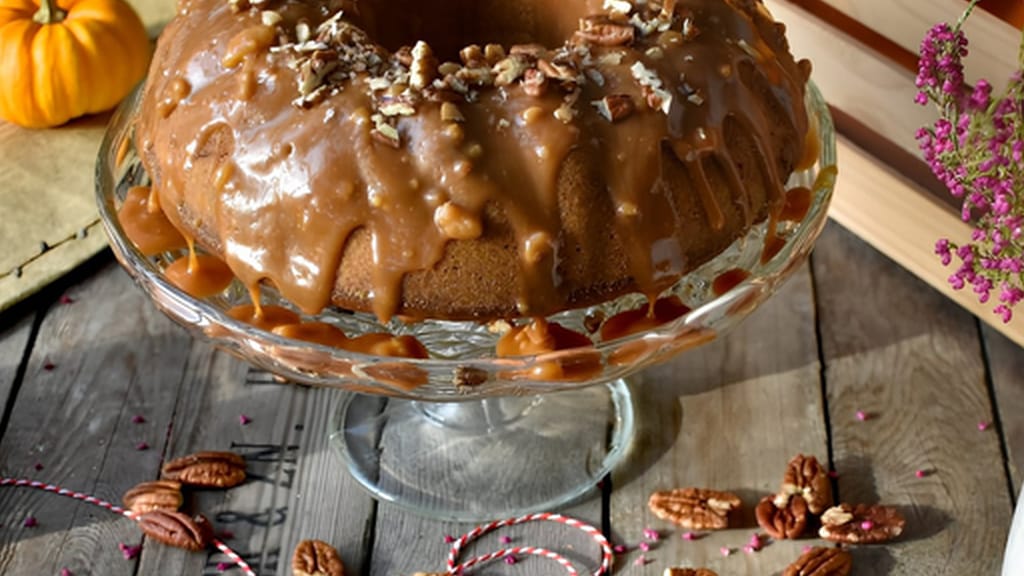
Autumn pumpkin bundt cake with creamy caramel glaze
Pumpkin bundt cake with cream caramel: the same principle applies to caramel too — let it cool to honey-like thickness, then pour it over the top.
Wait until the icing has fully set before slicing or covering a bundt cake with sugar icing — about 2–3 hours at room temperature. Any sooner and the icing will smear on the knife or under a cake dome. Ganache stays soft and creamy even once set, so slice it with a knife warmed in hot water and wiped dry.
Keep a bundt cake topped with ganache under a cake dome at room temperature for 1–2 days. Only refrigerate it if your kitchen is warmer than 24°C (75°F). In the fridge, ganache turns dull and firm, and the cake's crust dries out. Let it come back to room temperature for 30 minutes before serving.
Chocolate icing most often loses its shine when it's poured too cold and has already started to crystallise, or when the cake was refrigerated and condensation formed on the surface. A teaspoon of glucose syrup or 10 g of butter stirred into the warm ganache helps keep the shine, as does letting it set at room temperature.
Cover leftover icing and refrigerate it: ganache keeps for 5–7 days, while sugar icing keeps for 2–3 days under cling film pressed directly onto the surface. Warm leftover ganache to 30–32°C (86–90°F) to use it again, for example on muffins or as a filling. The cling film on the sugar icing stops it from drying out; stir in a drop of liquid before using it again.
Yes, you can ice a bundt cake a day ahead. Sugar icing will set firm and hold its shape overnight, while ganache stays soft. Keep the cake under a cake dome rather than wrapped in cling film, which would stick to the icing and smear the stripes.
One recipe worth heating the oven for, one tip, and one deal from the shop. Nothing else.