Tarte au citron – french lemon tart
How to Blind Bake Shortcrust Pastry Without Shrinking or a Soggy Bottom
Updated Oct 17, 2026
You can blind bake shortcrust pastry without shrinkage or a soggy bottom if you stick to four things: rest the dough twice in the fridge, line the tin with cold, unstretched pastry, support the sides with baking weights or a perforated tart ring, and seal the base before filling. This guide covers a large tart shell of about 24 cm (9½ in) and what happens in the tin and in the oven. For making the dough itself, see the links at the end of the article.
Shortcrust shrinks because the gluten stretched while you rolled the dough, and in the oven it pulls back before the pastry has set. Butter adds to the problem: if it melts before the flour and egg have had time to firm up, the sides slide down to the base.
The most common causes:
the dough wasn't rested after mixing or after lining the tin,
you stretched it into the tin instead of letting it drop in loosely and pressing it into place,
it went into the oven warm, so the butter started running right away,
the oven is cooler than the dial says, so the pastry slowly slumps instead of setting quickly,
nothing supported the sides – no weights and no perforated ring.
Each of the steps below deals with one of these causes.
Seasonal baking plans, tested recipes and kitchen tricks that save you time. Unsubscribe in one click.
Shortcrust needs two rests: at least 1 hour in the fridge after mixing (ideally overnight) and 30 minutes in the fridge, or 15 minutes in the freezer, after lining the tin. The first relaxes the gluten and lets the flour absorb moisture; the second firms up the butter again after it warmed up from handling.
After mixing, flatten the dough into a disc 2–3 cm thick and wrap it in cling film, so it chills faster and more evenly.
Before rolling, let it sit on the worktop for 5–10 minutes so it doesn't crack as you roll.
Don't skip the second rest, even if you're in a hurry. It's the cheapest insurance against shrinkage you have.
A lined shell will keep in the fridge overnight, covered with cling film.
For a 24 cm tart with a 2–2.5 cm rim, roll out about 300–350 g of dough into a sheet 3 mm thick and roughly 30 cm across. Thinner pastry breaks, and thicker pastry won't bake through inside, leaving the base rubbery.
Roll the dough between two sheets of baking paper, so you need almost no extra flour. If it softens, put the sheet in the fridge for 5 minutes.
Wrap it around the rolling pin and let it drop loosely into the tin. Don't pull it.
Lift the edge and use your fingertips to press the dough into the corner between the base and the side. This is where a shell most often tears and shrinks.
Leave 1 cm of overhang above the rim, or trim it straight away with a knife. If you leave the overhang for now, trim it after baking with a sharp knife or a grater.
Keep the offcuts. They'll come in handy as a patch for any crack.
Prick the base with a fork if you're baking in a solid tin with weights: the steam from the dough then has somewhere to escape, and the base won't puff up into a bubble. Pricks about every 2 cm are enough, in the base only – leave the sides intact.
If you're baking on a perforated mat, you don't need to prick the base, as the steam escapes through the holes in the mat. And if you're planning a liquid filling, such as the egg custard in a quiche, be careful with pricking: every hole is a way for the filling to seep under the shell. In that case, sealing the base (see below) is a must.
You can hold up the sides of a shell in two ways: with weights on baking paper in a classic tin, or with a perforated ring on a perforated mat, where you don't need weights. Both work. They differ in what you have at home and how straight and thin you want the rim to be.
In a classic tin (ideally one with a removable base), line the shell with baking paper or foil and fill it with weights right up to the rim, not just across the bottom. It's the weights pressing against the sides that hold them up.
What to use as weights, best first:
ceramic or metal baking beans – they hold heat, last for years, and you can buy them in kitchenware shops,
dried pulses or rice – cheap and work almost as well; don't cook them afterwards, just keep them in a jar as weights for next time,
granulated sugar – it fills even a fluted edge densely, and you can use it later in dough or cream, though it will be slightly caramelised.
Crumple the paper and flatten it out again before using it, so it fits into the corners better. After the first 15–18 minutes, lift out the paper and weights and finish baking the shell without them, so the base turns golden and dries out.
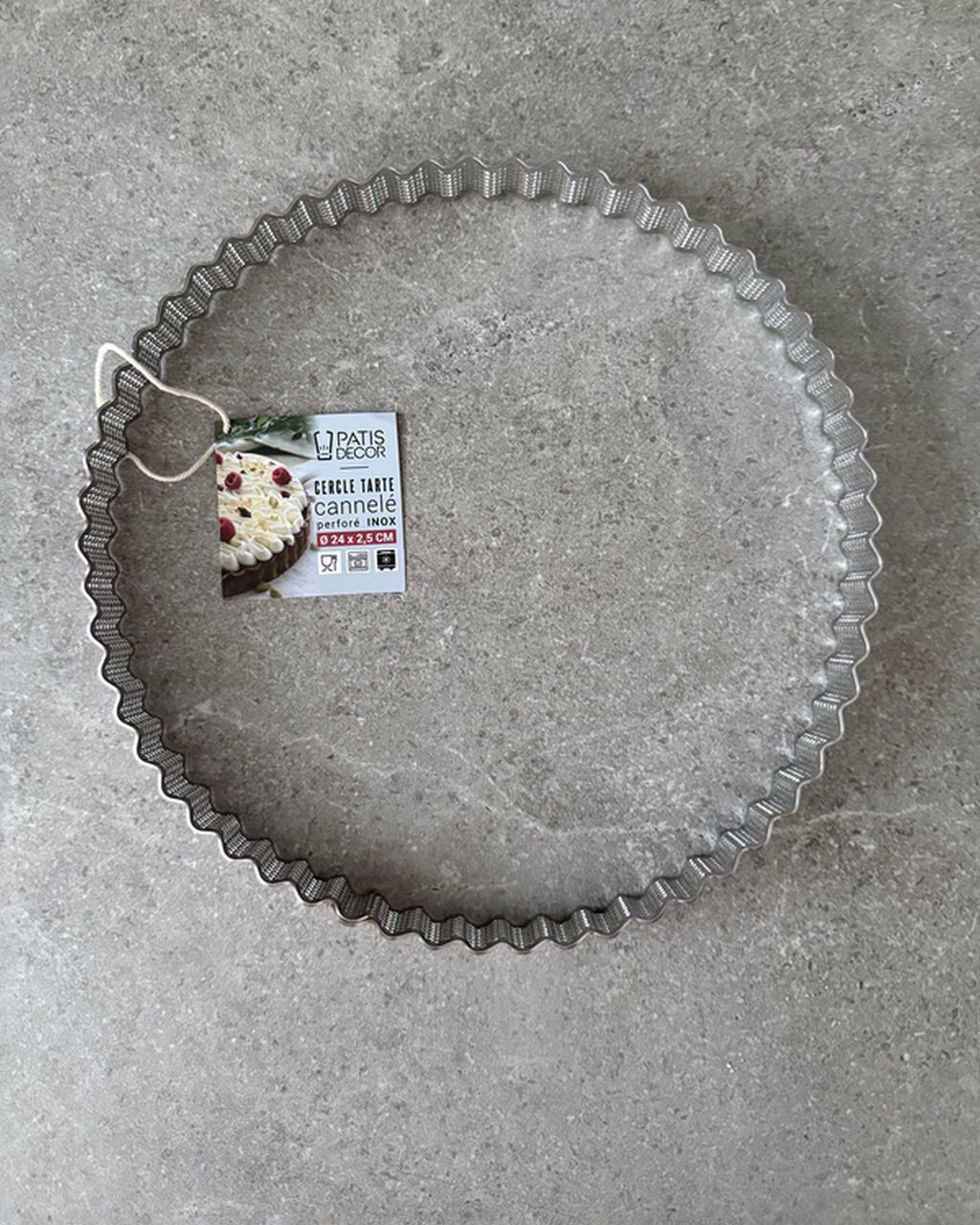
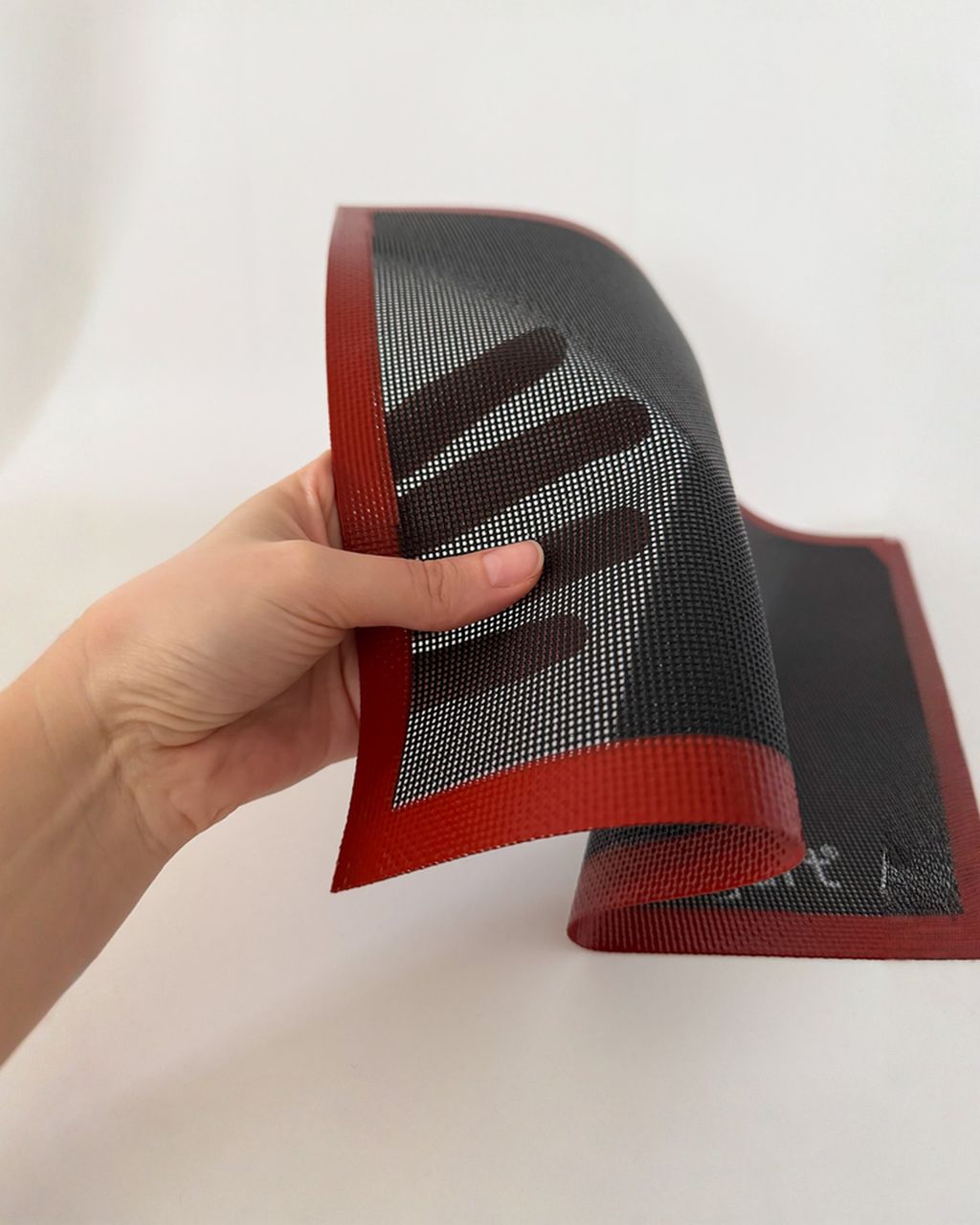
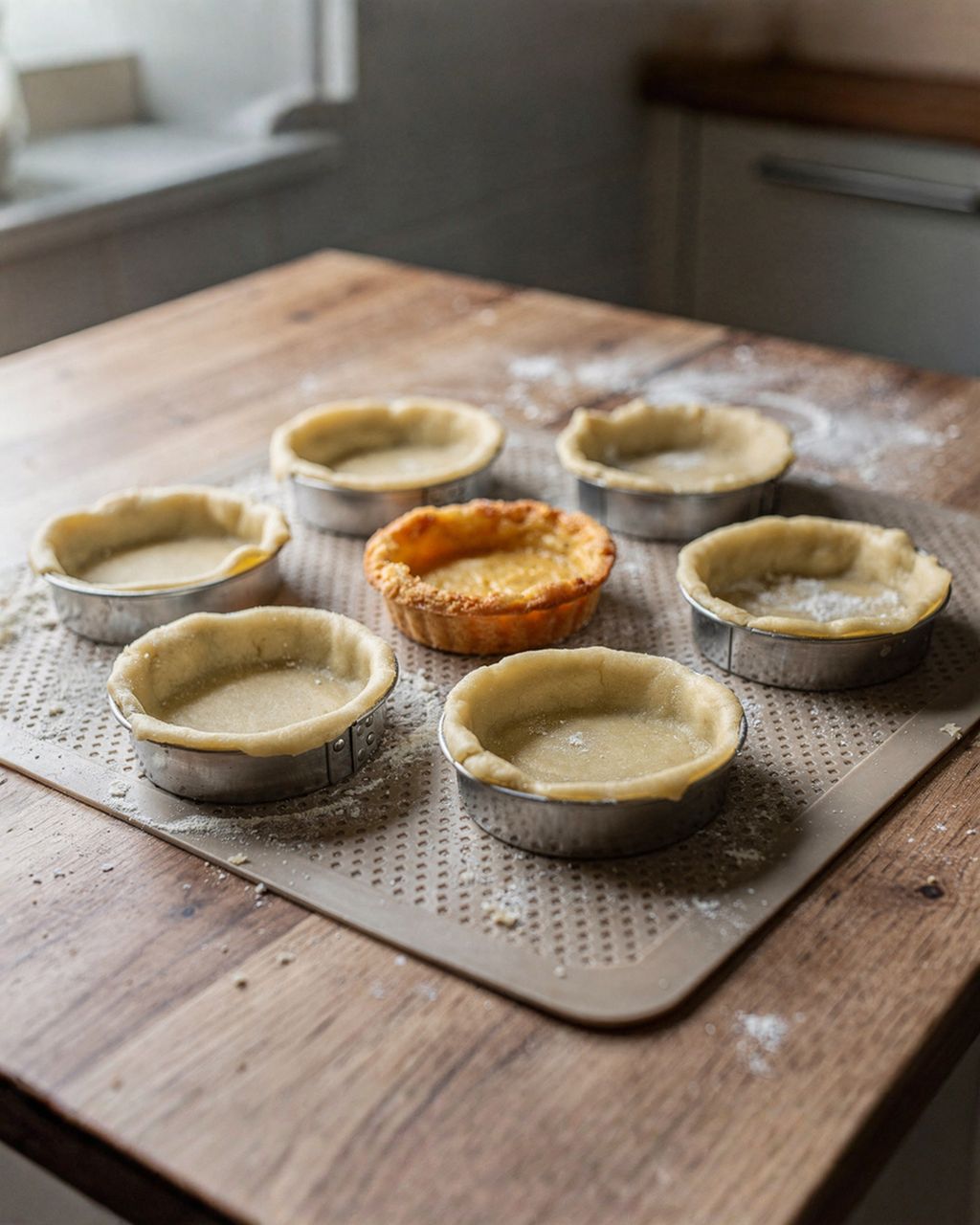
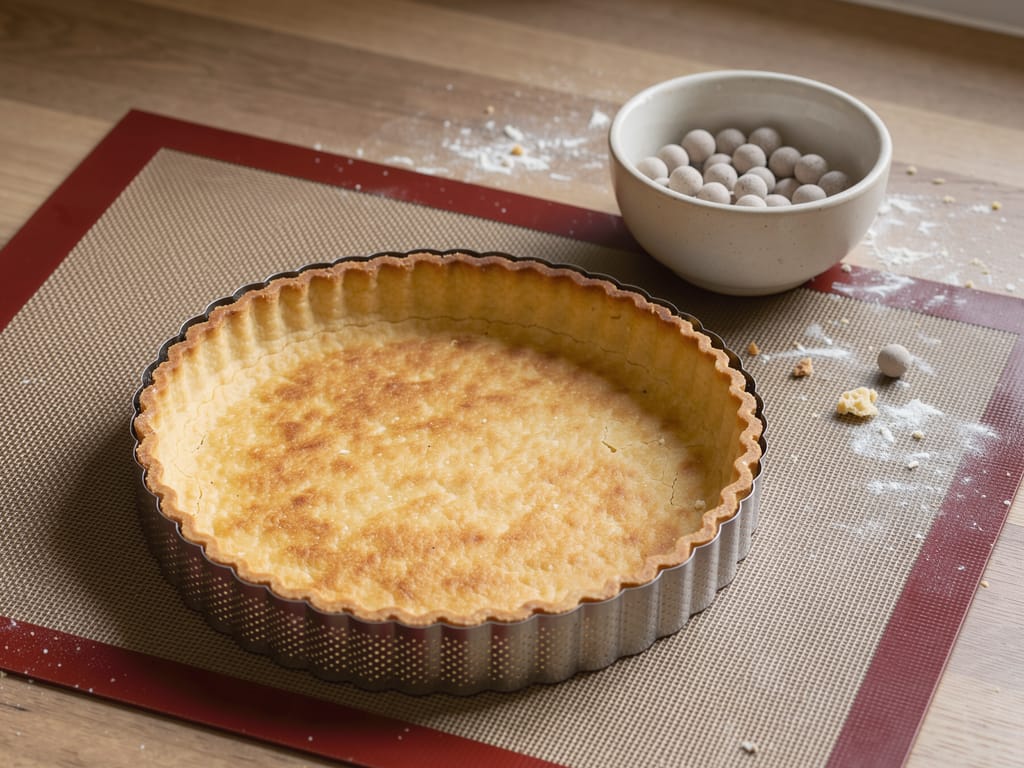
A perforated ring on a perforated mat holds the sides up without weights: cold dough sticks to the stainless steel wall, and steam escapes through thousands of tiny holes in the wall and under the base, so there's nothing to lift the pastry. The result is a straight, thin rim and an evenly golden base – baking the way pastry shops do it.
For a large tart, all you need is a stainless steel perforated ring – Wavy, Ø 24 cm set on a perforated silicone baking mat. The mat is the other half of the system: on a solid tray or paper, the steam from underneath would have nowhere to go and the base could puff up. You'll find other sizes and shapes among the baking rings and mats.
An honest look at where the ring has its limits:
It works best with sablée and sucrée doughs (with sugar and egg). Brisée dough, which has more water, shrinks more, so for the first 10–12 minutes feel free to add paper and weights inside the ring too.
The ring has no base, so you move the baked shell on the mat or on a spatula. A classic tin with a removable base is more convenient for that.
If you already own a tin and don't need a perfectly straight rim, weights will do. A ring pays off if you want a straight rim without weights and you bake tarts often.
For a detailed look at working with a ring, read Perforated tartlet rings: why they have holes and how to bake with them. A large ring is used in exactly the same way; it just takes a little more patience when lining.
Blind bake a 24 cm shortcrust shell at 180 °C (355 °F), conventional (top and bottom heat), in a classic tin with weights, or at 160–170 °C (320–340 °F) fan in a perforated ring on a perforated mat.
Classic tin with weights: 15–18 minutes with weights, then 5–15 minutes without, depending on the filling (see below).
Perforated ring on a mat: without weights, 15–18 minutes for a partial bake, 20–25 minutes for a full bake.
How long you keep baking depends on the filling:
Partial bake for a filling that will bake further (quiche, cheesecake-style, egg custard): in a tin, 5–8 minutes after removing the weights, until the base is just dry and pale golden. Then seal it with egg yolk (see below), and it finishes baking along with the filling.
Full bake for a no-bake filling (cream, ganache, fresh fruit): in a tin, 12–15 minutes after removing the weights, until the base and edges are evenly golden brown and the pastry smells like butter biscuits. A pale base turns soggy under cream within an hour.
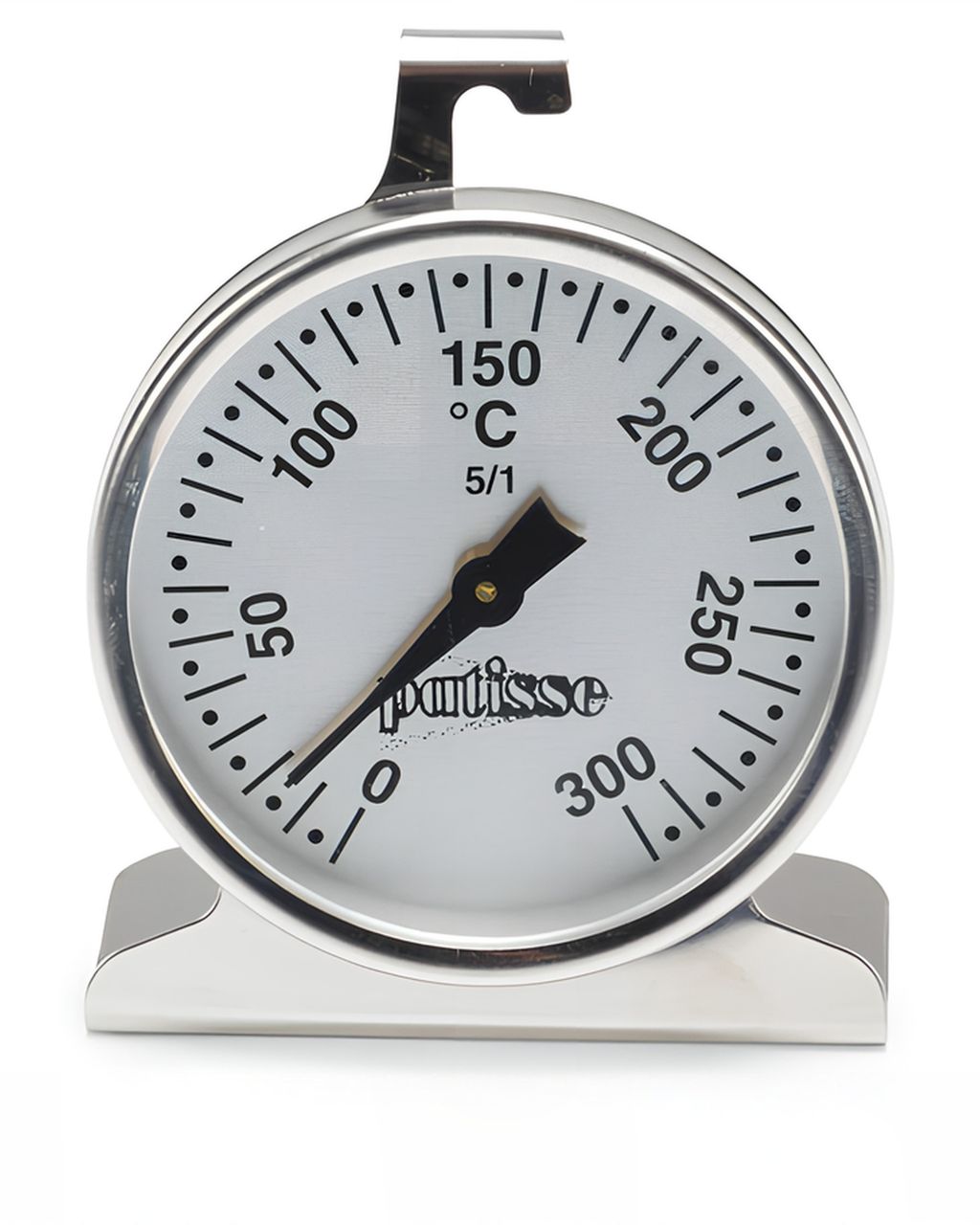
Temperature is critical here: the shell has to set before the butter melts. Home ovens commonly differ from the set temperature by several degrees, even tens of degrees, and in a weak oven the pastry tends to slump rather than bake. Check yours with a Patisse oven thermometer placed in the middle of the rack. Preheat the oven for at least 20 minutes and put the shell in only when the oven has really reached the set temperature (180 °C, or 160–170 °C fan).
You seal the base with a thin layer that stands between the pastry and the moisture in the filling. For baked fillings, that's egg yolk baked for 2–3 minutes; for cold fillings, melted white chocolate or cocoa butter; and under juicy fruit baked in the shell, ground almonds or crushed sponge fingers. Which to choose depends on the filling:
Liquid baked filling (quiche, lemon curd baked in the shell): in a tin, first bake the shell for 5–8 minutes without weights, and only then brush the hot base with beaten egg yolk mixed with a teaspoon of cream and return it to the oven for 2–3 minutes, until matte. In a ring on a mat, where you have no weights, brush the base with yolk after 15–18 minutes of baking, once it's dry and pale golden, and return it for the same 2–3 minutes. It forms a thin film that also plugs the fork holes. It suits, for example, a wholemeal quiche with broccoli and smoked ham.
No-bake cream, ganache or fresh fruit: brush the cooled base with 30–40 g of melted white chocolate or cocoa butter and let it set. Under a dark ganache, dark chocolate works too. This method suits, for example, a chocolate tart with salted caramel.
Juicy fruit baked in the shell (plums, rhubarb): sprinkle 2–3 tablespoons of ground almonds or crushed sponge fingers over the base, which soak up the juice before it reaches the pastry.
And one more free safeguard: add a no-bake filling to the shell as late as possible, ideally a few hours before serving, not the day before.
You can patch a crack in the shell with raw dough from the offcuts: press a small piece onto the hot shell and return it to the oven for 3–5 minutes. Tiny hairline cracks can simply be covered with yolk when you seal the base.
The edge dropped by a few millimetres: trim all the edges to the same height with a sharp knife or a grater and fill only up to this new edge.
The side slid down by more than a centimetre: put less filling in the shell, only up to the new edge, or choose a thicker or set filling that won't spill over. Next time, extend the second rest and check your oven with a thermometer.
The base puffed up: while it's still hot, gently press it back down with a tea towel. For the next shell, prick the base or use a perforated mat.
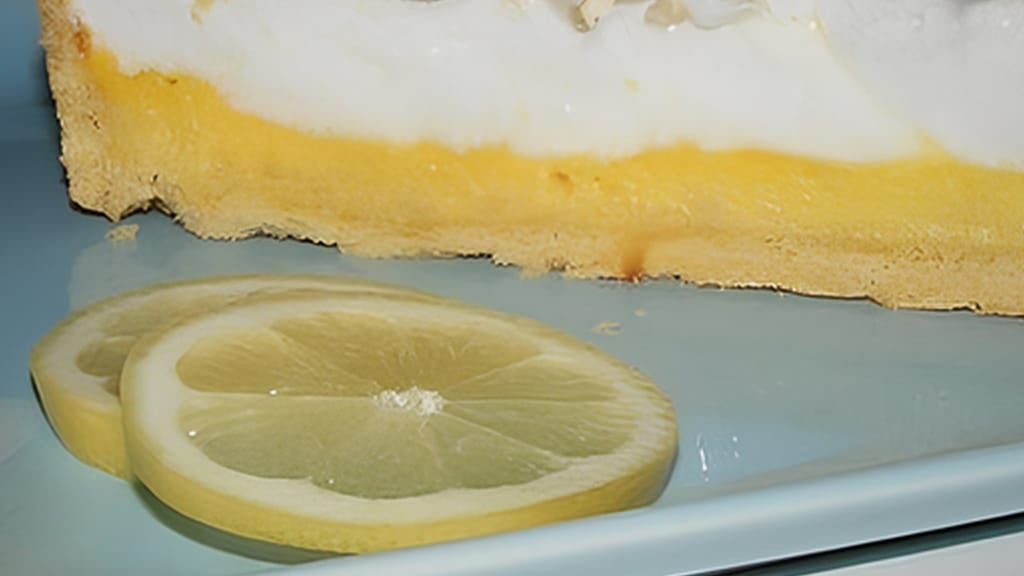
Tarte au citron – french lemon tart
Tarte au citron: a lemon tart with a shortcrust shell, where blind baking and a sealed base pay off most
Blind baking leads on to the dough itself: sablée for sweet tarts and linecké for Czech Christmas biscuits. Puff pastry deals with a similar problem of a raw base.
How the dough is made and why it behaves the way it does: Pâte sablée: buttery shortcrust pastry step by step.
The classic Czech relative and its ratios: Linecké dough 3:2:1: what the ratio means and how to adjust it.
A raw base with puff pastry: Puff pastry, savoury and sweet: how to fill it so the base isn't raw.
Yes. A baked shortcrust shell keeps for 1–2 days in a dry spot at room temperature, loosely covered. Don't put it in the fridge, as it will absorb moisture and turn soft. Brush on the white chocolate seal only on the day you fill the shell, and if the shell goes limp, refresh it for 5 minutes at 160 °C (320 °F).
Yes, a lined shortcrust shell can be frozen for up to a month, well wrapped in cling film. Bake it straight from frozen, without thawing, and allow 3–5 extra minutes. Of all the methods, this one shrinks the least, because the butter stays firm for a long time.
Yes, shortcrust tartlets are blind baked on the same principle, just for a shorter time and with thinner pastry. Roll the dough to 2–3 mm, put the lined moulds in the freezer for 15 minutes, and bake for about 12–16 minutes, until the base and edges are golden. In small perforated rings on a mat you don't need weights; in solid moulds, baking paper with rice is enough.
Yes, store-bought shortcrust is blind baked just like homemade, though it tends to be softer and shrink more. After lining the tin, chill it for 20–30 minutes and always fill the weights right up to the rim, or use a perforated ring with paper and weights for the first 10 minutes.
A hard shortcrust shell is almost always the result of overworked dough or too much flour. Long kneading develops gluten, and extra flour from rolling dries the dough out. Mix only until the dough comes together, and roll it between sheets of baking paper rather than on a floured worktop.
One recipe worth heating the oven for, one tip, and one deal from the shop. Nothing else.