Wild garlic spread
Garlic Spread Without Mayo: Ratios, Texture and Variations
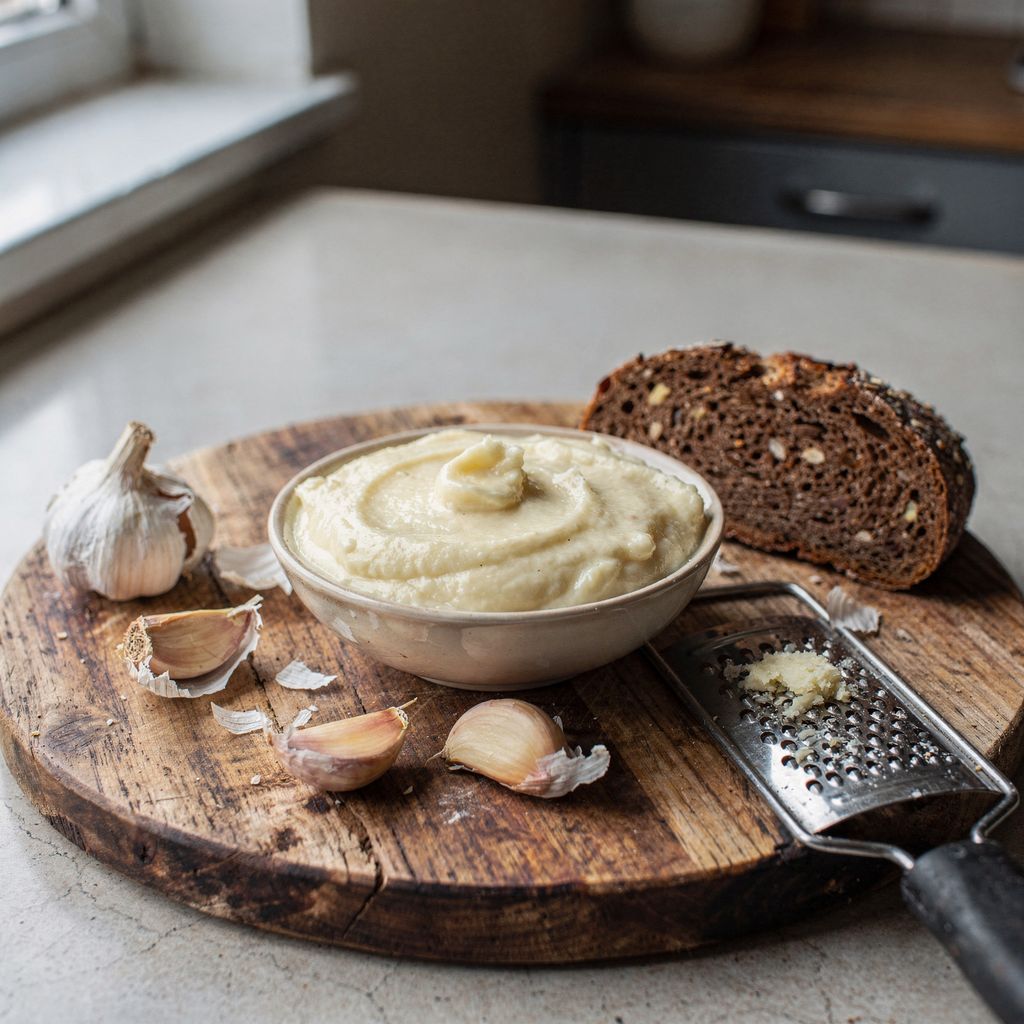
Updated Sep 18, 2026
Garlic spread without mayo is built on a rich dairy base: 250 g of full-fat curd cheese or thick Greek yogurt, 2–4 cloves of garlic mashed with salt, and a spoonful of butter or cream cheese for creaminess. Skip the mayo and you lose nothing — what makes or breaks the spread is the fat content of the base, not what binds it together. Below you'll find the ratios for a 250 g curd cheese base, why the spread sometimes weeps water, how to prep the garlic so it doesn't turn bitter, and how long it keeps in the fridge.
You can replace mayo in garlic spread with full-fat curd cheese, Greek yogurt, sour cream, cream cheese, or soft goat cheese — or, for a dairy-free version, a blended pulse like chickpeas. Mayo is really just an emulsion of oil and egg yolk — it brings fat and thickness, nothing more. A dairy base does both jobs better, and adds acidity on top, which helps tame raw garlic.
What matters is fat content, not the type of dairy:
Full-fat curd cheese (around 10% fat as sold) — the best balance of flavour and price, holds its shape, mildly tangy. Lower-fat curd cheese (3–5% fat) weeps water, and fat-free is unusable for a spread.
Full-fat Greek yogurt (10% fat) — fresh tang, spreadable straight away. Thinner on its own, so it works best combined with curd cheese.
Sour cream (typically 10–17% fat, richer versions exist too) — the mildest flavour, but also the thinnest. By law it needs to be at least 10% fat, so even the richest sour cream alone won't get your finished spread to that 10% fat mark. Treat it as an addition to curd cheese, not the whole base.
Cream cheese, such as Philadelphia-style (around 15–25% fat) — the creamiest, most stable result, but also the richest and priciest option.
Soft goat cheese — a strong flavour of its own, so it can take less garlic.
The percentages given for curd cheese and sour cream refer to fat in the product, i.e. the figure from the nutrition label per 100 g. On curd cheese packaging you'll sometimes see a different, higher number — that's fat in dry matter, calculated differently from fat-in-product. Full-fat curd cheese actually contains around 9–10 g fat per 100 g, even if the tub says 38%.
Aim to keep the finished spread at at least 10% fat. This isn't an official rule, just a practical tip from our own kitchen: below that, the spread tends to go runny, the whey separates out, and it slides right off the bread before it even reaches the table.
The basic ratio is 250 g full-fat curd cheese : 50 g Greek yogurt : 3 cloves of garlic : 4 g salt. This makes about 320 g of spread — enough for ten to twelve slices of bread or twenty canapés.
A tried-and-tested combination, step by step:
250 g full-fat curd cheese as the main base — gives body and a gentle tang.
50–80 g Greek yogurt or sour cream to loosen it up. Add it a spoonful at a time, not all at once.
1 tablespoon (15 g) softened butter or cream cheese — optional, but this is exactly what gives that silky texture people used to reach for mayo to get.
2–4 cloves of garlic (6–20 g depending on size) — depending on how punchy you want it.
4 g salt (a level half-teaspoon) and freshly ground black pepper.
How much garlic is "just right" comes down to taste, but this scale for a 250 g base is a good guide:
1–2 cloves — mild, fine even for kids or a packed lunch.
3 cloves — the classic garlic-on-bread hit, noticeable but not overpowering.
4 cloves — properly punchy, good with a beer or roast meat.
A medium clove weighs 3–5 g, so a "clove" from a big bulb can easily be double what you're counting on. If precision matters, weigh it.
Mash the garlic with the flat of a knife and a pinch of salt into a smooth paste, then let it rest for a few minutes — don't blitz it in a food processor, and don't leave it in lumps in the spread. Salt acts like an abrasive: it breaks the cells down evenly and draws out the juice, so the garlic melts into the spread instead of leaving sharp little chunks behind.
Method:
Crush a peeled clove with the flat side of a knife.
Sprinkle over a pinch of coarse salt and repeatedly drag the flat of the blade across the board until it turns into a creamy paste.
Let it sit for 5–10 minutes before stirring it into the base.
In a whole clove, alliin and the enzyme alliinase are kept apart; crushing brings them together and produces allicin — the sulphur compound behind garlic's characteristic smell and bite. Allicin forms within seconds of crushing. A few minutes' rest just mellows the paste and lets the flavour settle — ten minutes is a comfortable upper limit, not a requirement.
And why not use a food processor: garlic blitzed in a machine tastes sharper and slightly bitter, while a hand-mashed paste gives a cleaner, sweeter garlic flavour. That's our own kitchen experience rather than a lab test — but line up two slices of toast side by side and you'll notice the difference.
One more small detail: if a clove has sprouted, we pop out the green shoot. There's no hard science behind it — it's just our preference — but the shoot itself tastes bitter, and you'll notice it in a raw spread.
Spread weeps water when it's too low in fat and too high in whey — typically from lower-fat curd cheese or thin plain yogurt. Salt also draws liquid out of both the garlic and the dairy base itself, which is why the water often only shows up after a few hours in the fridge, not right after mixing.
What to do about it:
Switch to a richer base. Using full-fat curd cheese (10% fat as sold) instead of a lower-fat version is the single change that fixes most cases.
Let the curd cheese drain. Tip it into a sieve lined with muslin and pop it in the fridge for 2 hours. Some of the whey will drain off and the base will thicken noticeably.
Use Greek yogurt, not regular plain yogurt. Greek yogurt is strained; regular isn't — and that difference in solids matters a lot. Watch out for the difference between strained Greek yogurt and "Greek-style" yogurt (thickened with added protein) — the strained kind holds up better.
Add the salt last, after mixing in the garlic, and pop the spread straight in the fridge to chill.
If the spread still turns runny, pour off any water that pools on top and stir in a spoonful of cream cheese or grated hard cheese. Cheese adds both fat and protein and binds the water. Two tablespoons of grated boiled potato or a spoonful of ground nuts work too, but they'll change the flavour.
Fat and temperature — not a food processor — are what make garlic spread creamier: a spoonful of softened butter or cream cheese per 250 g of base, plus letting the ingredients sit out of the fridge for 20 minutes before mixing. Cold curd cheese stays grainy no matter how much you work it.
Three things that reliably work:
A spoonful of softened butter or cream cheese per 250 g of base. The single most effective trick — and no one will guess it's in there.
Whip the base smooth before adding the garlic. Get a smooth, creamy texture first, then season.
Let the spread rest in the fridge for 2 hours. The proteins absorb moisture, the texture firms up, and the flavours meld. Straight after mixing, the spread tastes rougher and seems thinner than it actually turns out to be.
Soft, tub-style curd cheese can be whipped straight away. Firm, block-style curd cheese needs pressing through a sieve first, or you won't get rid of the lumps.
Add 80–100 g of grated hard cheese to a 250 g base to make a cheesy garlic spread — the cheese thickens it at the same time. Edam, cheddar and gouda all work equally well; grate it finely so it blends right into the base. Along with fat, cheese brings salt and umami, so cut the added salt in the recipe by about half. It's the fastest fix if a batch has turned out too runny.
A whole bulb roasted for 60 minutes at 180°C and squeezed into a 250 g base gives a mild, sweet spread with no bite at all. Slice about a centimetre off the top of the bulb, drizzle with oil, wrap in foil and roast until the cloves are soft enough to mash to a paste. Heat destroys the alliinase along with the bite — what's left is a sweet, caramelised, almost nutty flavour.
Unlike raw garlic, roasted garlic is hard to overdo, and the spread won't get any stronger overnight. Use up any leftover roasted bulbs in a proper garlic soup with potatoes and bacon.
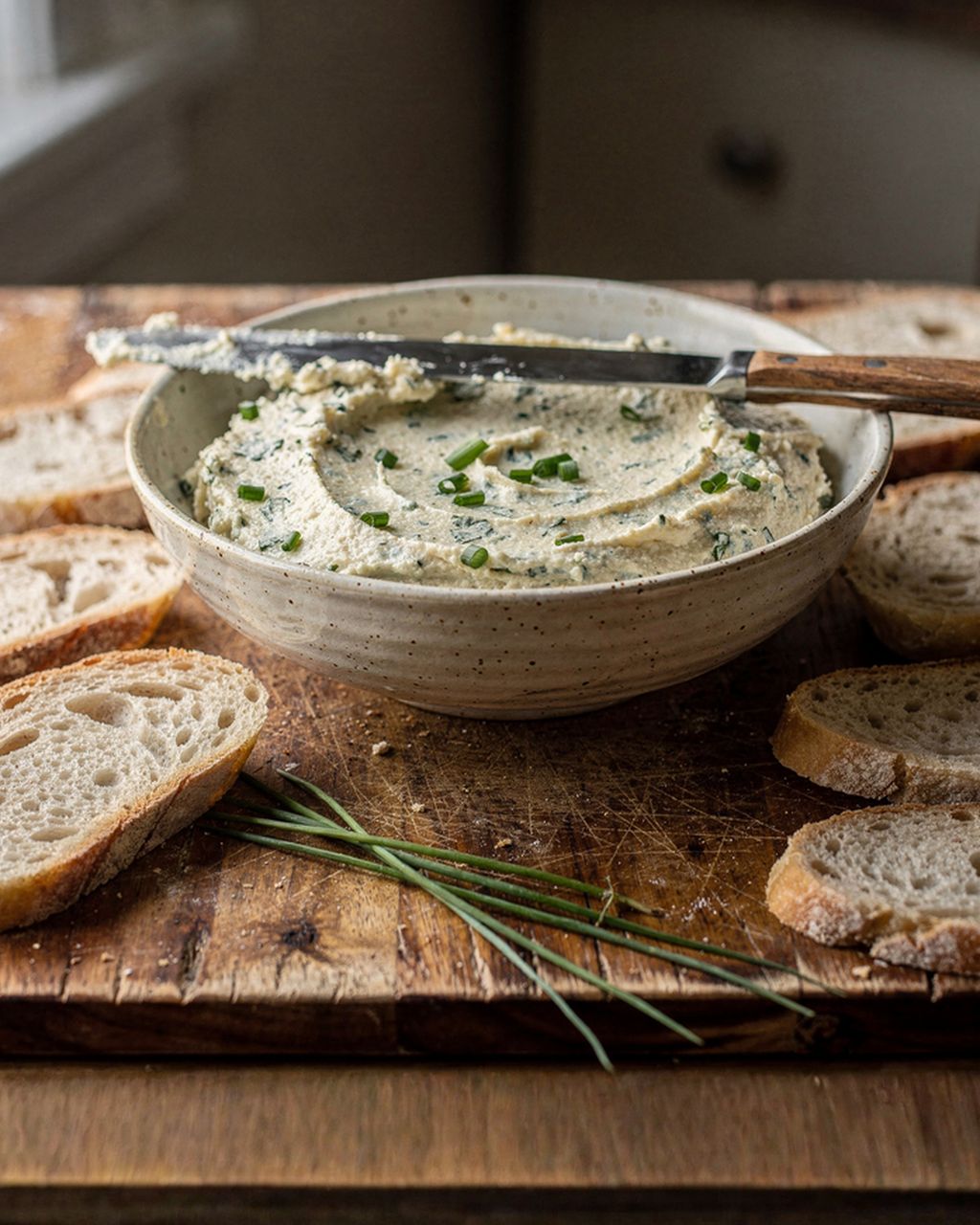
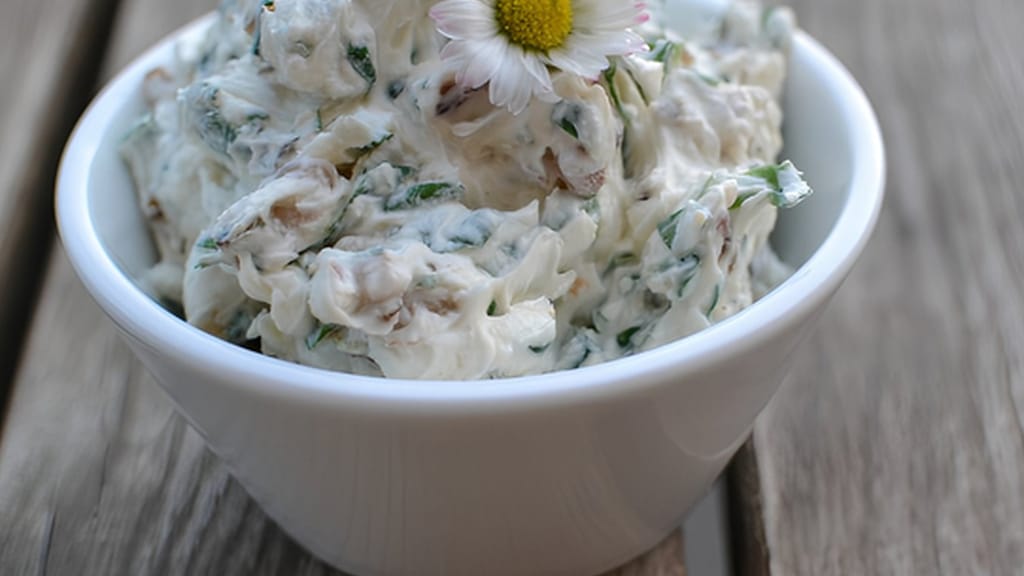
Wild garlic gives the same garlicky flavour with none of the bite and none of the garlic breath. For a 250 g base, use a generous handful of leaves (30–40 g), finely chopped or briefly blitzed with a spoonful of oil. The season is short — roughly March to May, before the plant flowers and the leaves turn bitter.
Wild garlic spread
Wild garlic spread — the spring twist on garlic spread without mayo
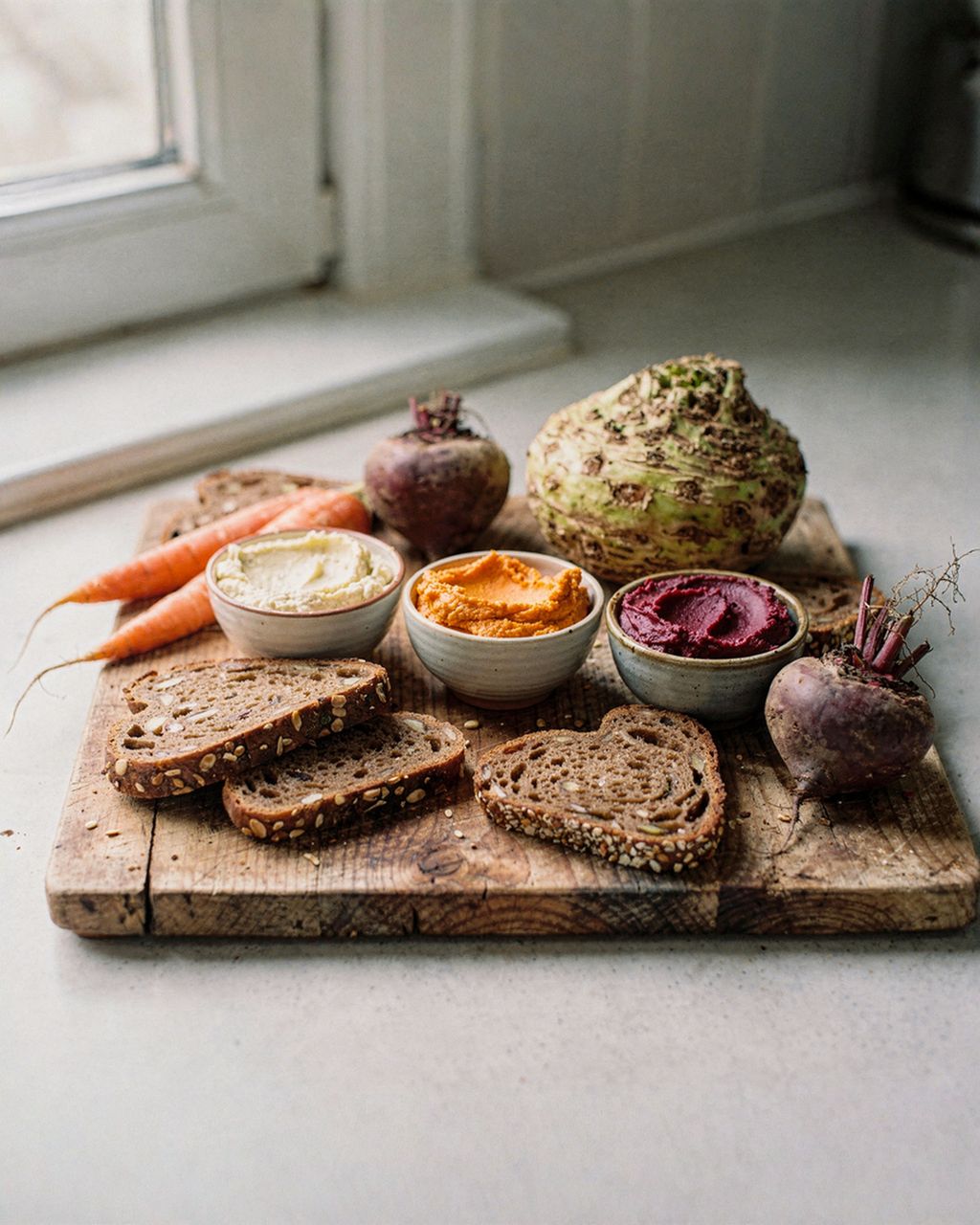
Without dairy, the base is replaced with blended pulses or soaked cashews. Chickpeas with a little tahini and lemon make a thick spread that actually handles garlic even better than yogurt does — essentially, it's hummus. You could also use a ready-made carrot hummus, but keep in mind the carrot changes the flavour quite a bit — it won't give you a neutral base for a plain garlic spread. Cashews soaked for 4 hours and blended with water and lemon give the creamiest result. Plant-based sour cream alternatives work too, but check the fat content: below 8% they turn runny, just like fat-free curd cheese.
Dairy-based garlic spread keeps for 3 days in the fridge at 4°C, in a sealed container. Unlike a mayo-based version, it contains no raw egg yolk, but fresh curd cheese and yogurt are themselves perishable ingredients — three days is a hard limit, not a rough guess.
What to expect during that time:
It's noticeably sharper on day two. Raw garlic keeps working even in the cold, so a spread that was just right in the evening can be too strong by morning. If you're making it ahead, leave out one clove.
A little whey may appear on the surface. Just pour it off and stir — nothing to worry about.
Seal it well. Garlic will happily flavour every stick of butter and block of cheese in the fridge.
Don't freeze it. Curd cheese and yogurt turn grainy on thawing as the water separates out — a creamy spread ends up as a grainy mush. If you want to stock up, freeze mashed garlic paste in spoonful portions in an ice-cube tray instead, and mix up a fresh base each time.
Garlic spread works best on dark sourdough bread and on toast — the warmth releases the aroma, and the tangy crumb balances the fat in the base. A few combinations worth trying:
Toast + garlic spread + a slice of tomato — let the toast cool for half a minute first; on piping-hot toast the spread melts and soaks straight into the crumb.
Canapés — spread it onto a firmer base and top with egg or radish.
Veggie dip — loosen with 2 extra tablespoons of yogurt and serve with carrots, peppers and celery sticks.
Filling for stuffed eggs or halved baked potatoes.
If you're making several spreads at once, build them all on the same base and just vary the seasoning — it saves work and makes the whole platter look pulled-together.
Yes, but the flavour will be different — dried garlic is milder and sweeter, without the bite of fresh. Use 1/4 teaspoon of granulated garlic (or 1/8 teaspoon of garlic powder) per clove, and let the spread sit for at least an hour so the powder can fully hydrate. Don't use garlic salt — you'll hit a sensible salt limit long before you get any real garlic flavour.
The dairy base is naturally gluten-free — curd cheese, yogurt, cream cheese and garlic all contain no gluten, so just watch the bread and any seasonings you add. For a low-lactose version, use lactose-free curd cheese and yogurt (widely available now), or bulk up the base with grated hard aged cheese, which is naturally very low in lactose. For a fully dairy-free version, go with a chickpea or soaked cashew base.
Plan on 25–30 g of spread per slice of bread, or about 15 g per canapé. A 250 g curd cheese base yields roughly 320 g of spread — enough for ten to twelve slices of bread or twenty canapés. For a bigger gathering, scale everything up proportionally, including the garlic — just note that with larger batches, the sharpness builds faster as it sits, so cut back by one clove for every 500 g of base.
Stir in more curd cheese or cream cheese — fat and extra volume dilute sharpness more reliably than anything else. Keep in mind the sharpness intensifies further in the fridge, so it's better to mellow it out right away rather than waiting until the next day. If raw garlic always comes out too strong for you, try roasted garlic next time — it's naturally sweet and won't bite even in larger amounts.
The best fix is to eat something alongside it — a raw apple, lettuce, mint or parsley work better than juice, since fresh produce actively counters both the taste and the smell in your mouth. Eat them right with the meal, not an hour afterwards. Toothpaste only masks it briefly — garlic lingers on your breath for several hours after eating.
One recipe worth heating the oven for, one tip, and one deal from the shop. Nothing else.