Callebaut Dark Chocolate Callets (811) 400g
Callebaut 811, 823, W2 & RB2: What the Numbers Mean and Which Chocolate to Use
Updated Oct 8, 2026
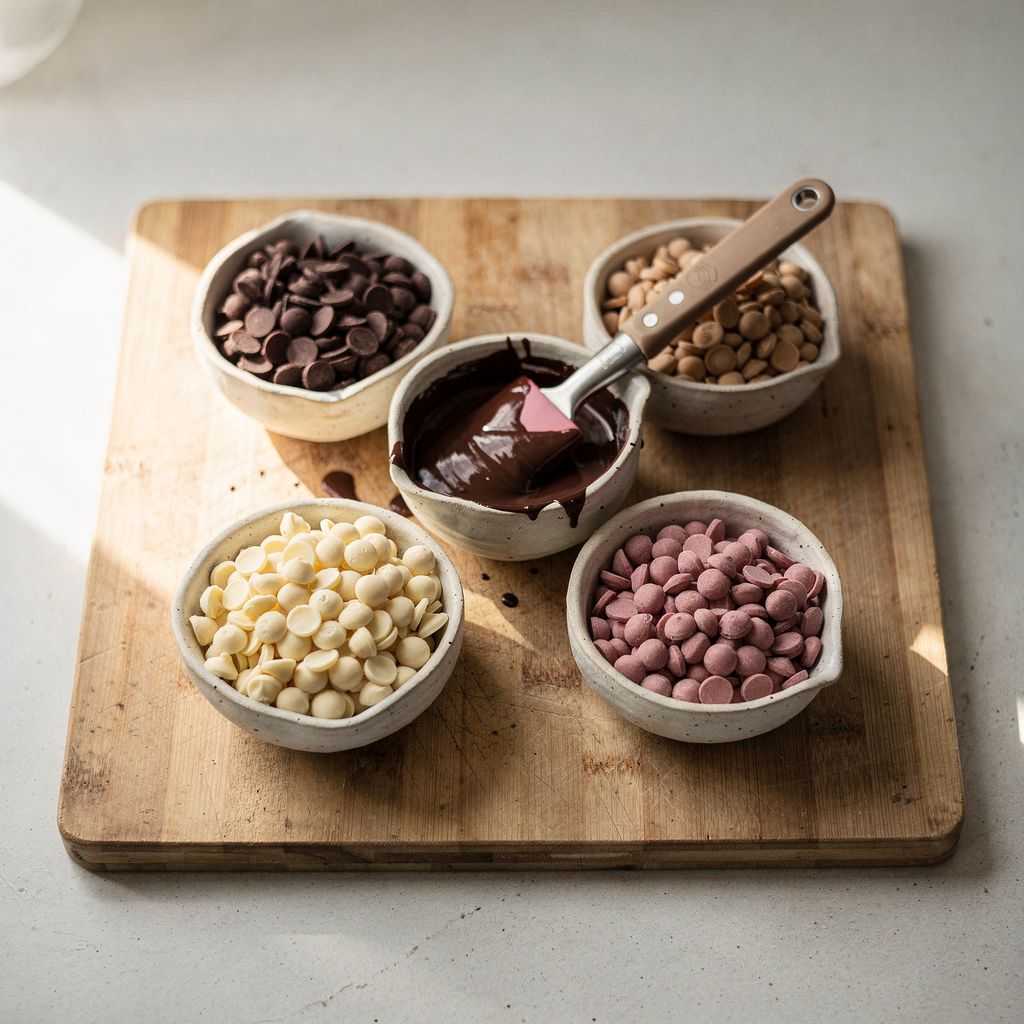
Callebaut 811, 823, W2 and RB2 are the four core recipes in Belgian couverture: 811 is dark (54.5% cocoa), 823 is milk (33.6%), W2 is white (28%) and RB2 is ruby (32.8%). The numbers aren't percentages — they're recipe codes. All four have medium fluidity, so they all handle ganache, dipping and pralines well; for baking, stick to 811 and 823. Below you'll find exactly what those numbers mean, how the four chocolates differ in taste and behaviour, and when it's better to reach for something else.
The number on a bag of Callebaut is a recipe code, not a cocoa percentage. 811 doesn't mean 81% — it means "recipe no. 811," which is a dark chocolate with 54.5% cocoa solids. Here's how to read the codes:
purely numeric codes (811, 823) – classic recipes; the number alone won't tell you the type, but 811 is dark and 823 is milk,
W – white chocolate (W2),
RB – ruby, the pink chocolate (RB2).
The actual cocoa percentage is listed separately on the packaging, e.g. "W2 28%." The other number worth checking is the drop rating — the symbol for fluidity. More on that in the next section.
If you're not sure what sets couverture apart from everyday baking chocolate, start with our article on couverture vs. baking chocolate.
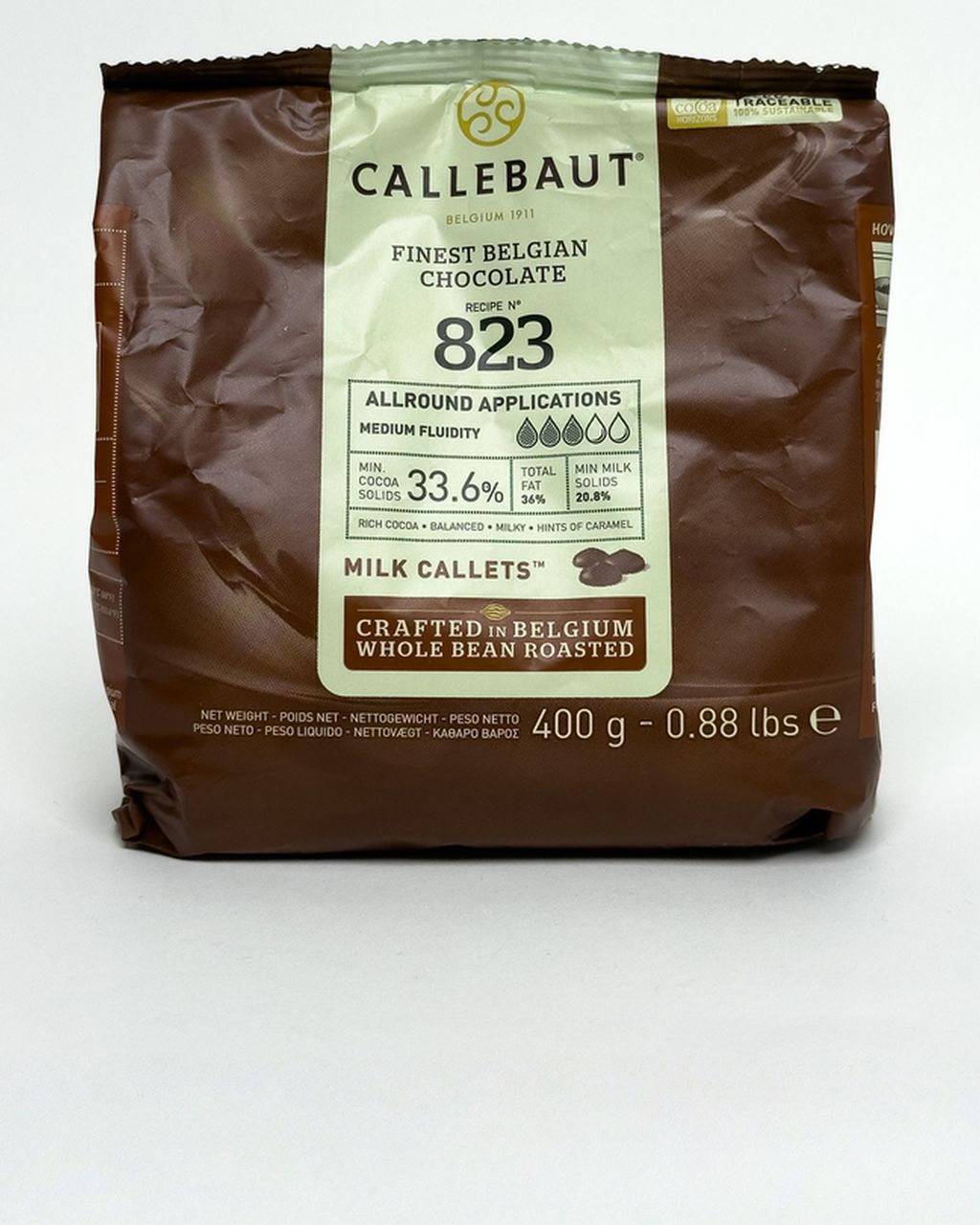
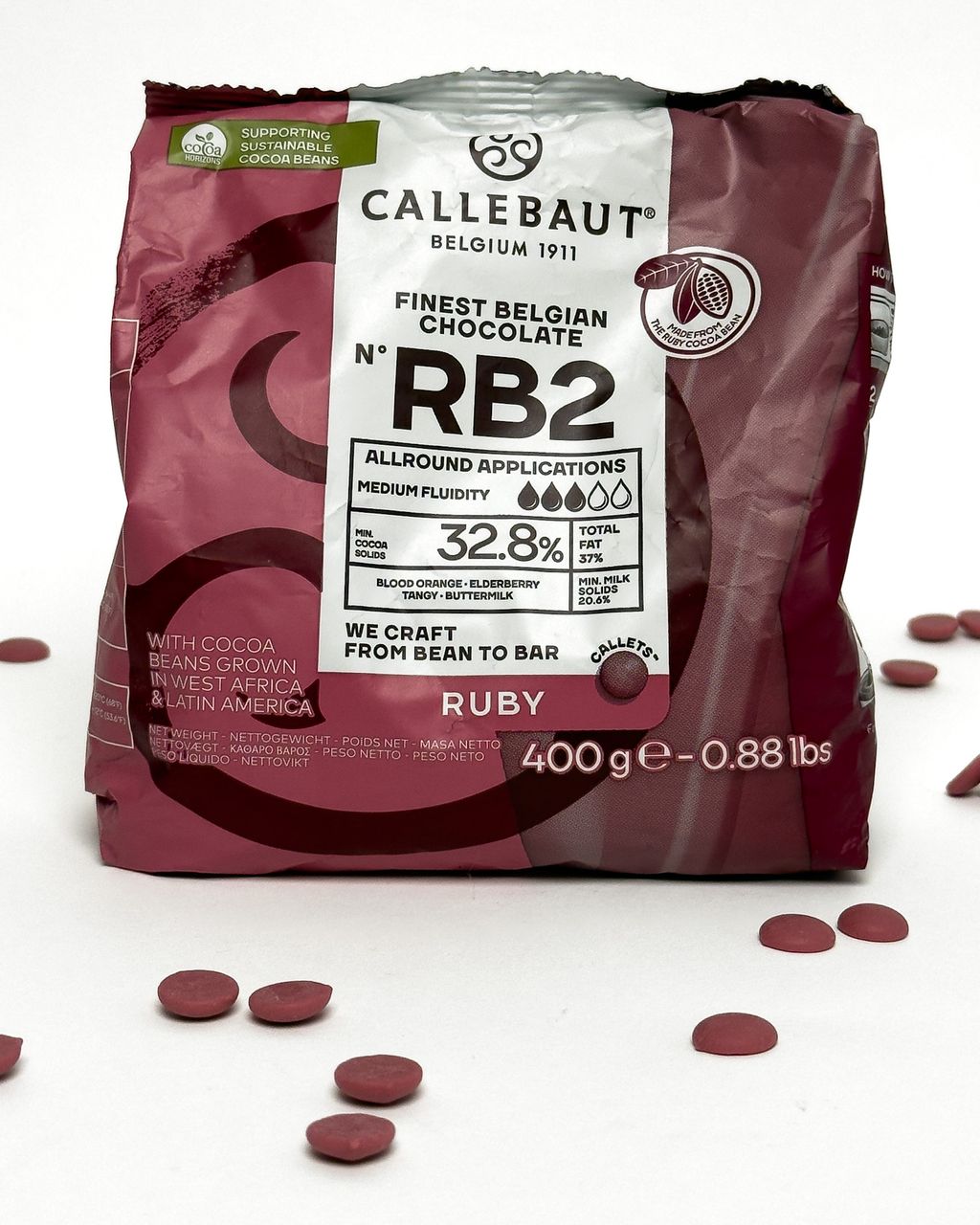
Callebaut 811 has 54.5% cocoa, 823 has 33.6%, W2 has 28% and RB2 has 32.8%; all four sit around 36% fat and carry a 3-drop fluidity rating. According to Callebaut's technical data sheets, in detail:
811 dark: 54.5% cocoa, 36.6% fat, 3-drop fluidity
823 milk: 33.6% cocoa, 36.2% fat, 3-drop fluidity
W2 white: 28% cocoa (cocoa butter), roughly 22% milk solids, 35.8% fat, 3-drop fluidity
RB2 ruby: 32.8% cocoa, 20.6% milk solids, 36.8% fat, 3-drop fluidity
Because their fat content is almost identical, they behave similarly in the kitchen and differ mainly in flavour, sweetness, and the temperature you temper them at. For a broader look at how dark, milk, and white chocolate differ, see dark, milk, and white chocolate: differences in composition and use.
The drops on the packaging (1 to 5) show how thinly the chocolate flows once melted — more drops mean more cocoa butter and a thinner coating. Three drops is medium fluidity, the all-rounder for most home baking.
1–2 drops: thicker chocolate that holds its shape – good for ganache, mousses, and baking into batter.
3 drops: all-purpose – ganache, dipping, pralines, bars, coatings. This is where 811, 823, W2, and RB2 all fall.
4–5 drops: very fluid – for thin praline shells, chocolate fountains, and spray guns.
If your 3-drop chocolate feels too thick for dipping, you don't need to buy a different one. Just thin it slightly with cocoa butter — our article on how to thin chocolate so it flows better explains how.
Callebaut 811 is a dark couverture with 54.5% cocoa — balanced, not sharp and not overly bitter, making it the most versatile chocolate in the whole range. It tastes distinctly of cocoa, yet it's still approachable for people who don't normally go for 70% bars.
What to use it for:
ganache for cakes and tarts – the classic ratio for a sliceable ganache is roughly 1:1 chocolate to cream (33–35% fat), while a pourable glaze works better closer to 1:1.2,
dipping cookies and gingerbread – once tempered, it sets with a glossy shine and a satisfying snap,
pralines, truffles, and bars,
batters and brownies – it brings a solid cocoa backbone without making things too sweet.
For a real-world example, our chocolate tart with salted caramel relies entirely on a dark ganache where 811 works with no tweaking at all.
When 811 falls short: if you want a genuinely bitter edge (an adults-only dessert, or a contrast to sweet caramel), reach for a 65–70% chocolate instead. Callebaut makes a 70-30-38, but we don't stock it — any other good-quality 70% couverture will do the job just as well.
Callebaut 823 is a milk couverture with 33.6% cocoa — notably caramel-like, creamy, and sweeter than the dark 811. It has more cocoa solids than the legal minimum for milk chocolate (25%), which is what many cheap bars rely on, so it actually tastes of chocolate rather than just sugar.
What to use it for:
milk chocolate ganache and whipped creams – milk chocolate has less cocoa solids, so it needs less cream: aim for roughly 2:1 chocolate to cream for a firm ganache,
dipping for kids and sweeter treats,
pralines with nut or caramel fillings,
hot chocolate – for a look at different styles, see Italian, French, and Mexican hot chocolate.
Watch the heat: milk chocolate scorches faster than dark. Melt it at 45–50°C (113–122°F), don't go higher, and stir more often.
Callebaut W2 is a white couverture with 28% cocoa butter, milky and vanilla-forward, but less cloyingly sweet than white chocolate usually is. It's the most sensitive of the four, so keep a close eye on temperature.
What to use it for:
creams and ganache for cakes and cupcakes – for a firm ganache, aim for roughly 3:1 chocolate to cream,
colouring – W2 is the base for coloured glazes and decorations; you just need fat-soluble colouring, more on that in food colouring and chocolate colours,
cheesecakes and mousses,
caramelised white chocolate – W2 can be roasted in the oven until golden.
The most common mistake: overheating. Melt it at 40–45°C (104–113°F) — above 45°C (113°F), white chocolate starts to seize and go lumpy. For how to avoid this, see how to melt white chocolate without it seizing.
Callebaut RB2 is ruby chocolate with 32.8% cocoa — naturally pink, with a fruity, slightly tangy flavour reminiscent of berries. Neither the colour nor the flavour comes from any fruit or colouring; it's down to a special processing of the cocoa beans.
What to use it for:
decorations and dipping – strawberries, macarons, tartlets, anywhere you want that pink to show; find techniques in our article on chocolate decorations at home,
ganache and creams – ruby behaves similarly to white chocolate, so aim for roughly 2.5–3:1 chocolate to cream,
bars with edible flowers and nuts.
What not to use it for: baking. Oven heat, as well as prolonged exposure to light and air, dulls ruby's colour toward brown and fades its fruitiness. Add ruby only to a finished dessert. We cover it in detail in ruby chocolate: what it is and how to work with it.
811 is the most versatile for ganache, dipping, and baking; 823 suits sweeter creams and dipping; W2 works for creams and coloured decorations; RB2 is for pink decorations with no baking involved. By use:
Cake ganache: 811 (roughly 1:1), 823 (2:1), W2 (3:1), RB2 (2.5–3:1).
Dipping cookies and gingerbread: 811 or 823, tempered; W2 and RB2 for decorative stripes.
Pralines and truffles: shells from 811 or 823, filling can be W2 or RB2 — the full method is in homemade chocolate pralines.
In batters (brownies, cake, muffins): 811, or 823 for sweeter batters.
Fondue: 811 or 823 with cream.
Coloured decorations: W2 plus chocolate-safe colouring, or RB2 if you want pink without any added colour.
You'll find the full range of baking and decorating chocolate in our baking chocolate and couverture category.
These four Callebaut classics aren't the right fit for four things: whole chunks in cookies, a quick no-temper coating, strongly bitter desserts, and very thin shells. Here's why, and what to use instead:
Chunks meant to stay whole in cookies: couverture will melt and spread in the oven. For that, use chocolate chips made with less cocoa butter, designed to hold their shape while baking.
A quick coating that sets without tempering: if you don't want to temper and just need a glaze that sets on its own, use a cocoa coating made with vegetable fat. It tastes a bit more waxy but forgives mistakes. Couverture used without tempering sets dull and sticky.
Strongly bitter desserts: 54.5% is middle-of-the-road. For a bitter edge, reach for 65–70%.
Very thin shells and spraying: here you want a chocolate with a 4–5 drop rating, or 811 thinned with cocoa butter.
Temper Callebaut 811 to a working temperature of 31–32°C (88–90°F), 823 to 29–30°C (84–86°F), W2 to 28–29°C (82–84°F), and RB2 to around 29°C (84°F). First melt it — 811 and 823 at 45–50°C (113–122°F), W2 and RB2 at 40–45°C (104–113°F), never above 45°C (113°F) — then cool it down:
811 dark: cool to around 27°C (81°F), work at 31–32°C (88–90°F)
823 milk: cool to around 27°C (81°F), work at 29–30°C (84–86°F)
W2 white: cool to around 25–26°C (77–79°F), work at 28–29°C (82–84°F)
RB2 ruby: cool to around 26°C (79°F), work at around 29°C (84°F)
Follow the temperature curve printed on the packaging.
The easiest method at home is seeding: melt two-thirds of the callets, take off the heat, stir in the remaining third, and keep stirring until the chocolate drops to working temperature and everything has melted in. Callebaut callets are already tempered, so they bring the right crystal structure into the mix. For other methods, see our guide to tempering chocolate.
The test: dip the tip of a knife and set it on the counter. At 18–20°C (64–68°F), it should set glossy and streak-free within 3–5 minutes. If it stays tacky, the tempering didn't work — reheat and try again.
You'll need a probe thermometer; working "by feel" won't cut it with white or ruby chocolate.
No — you don't need to temper Callebaut for ganache, creams, mousses, or batter. Tempering only matters when the chocolate needs to set glossy and crisp on its own, like for dipping, praline shells, bars, and decorations.
For batter and ganache, you can swap Callebaut 811 for a standard dark chocolate with 50–60% cocoa. For dipping and pralines, though, regular bars tend to be thicker since they contain less cocoa butter, so they flow less easily and leave a heavier coating.
Store Callebaut callets in a sealed bag somewhere dry and dark, at 12–20°C (54–68°F), away from the fridge. Dark 811 keeps longer than milk, white, or ruby — follow the date on the packaging. For why chocolate turns grey in the first place, see [how to store chocolate and why it turns grey](/articles/how-to-store-chocolate-why-it-turns-grey).
If a drop of water or steam seized your Callebaut W2, you can save it by treating it like ganache: stir in warm cream a spoonful at a time until it comes back together into a smooth mixture, then use it as a filling or cream instead of for dipping. Overheated W2 (above 45°C/113°F) that's gone lumpy, yellowed, or smells scorched can't be saved — toss it and start over at 40–45°C (104–113°F) this time.
For covering and filling a 22cm cake, plan on roughly 300–400g of ganache, meaning about 150–200g of 811 chocolate with an equal amount of cream. For milk 823 and white W2, use more chocolate and less cream, following a 2:1 or 3:1 ratio respectively.
One recipe worth heating the oven for, one tip, and one deal from the shop. Nothing else.