Why Won't My Fudge Set? Soft-Ball Stage, Beating and How to Fix It
Why Won't My Toffee Harden? The Hard-Crack Stage Explained
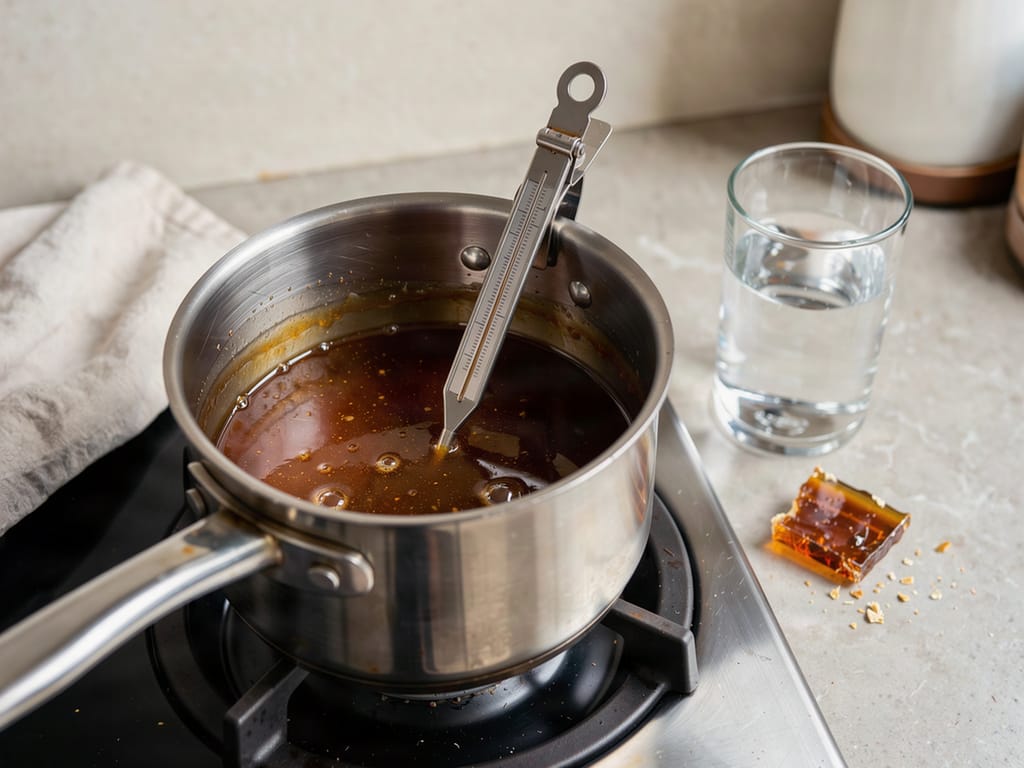
Updated Nov 20, 2026
Toffee that stays soft or chewy didn't reach the hard-crack stage, 149–154°C (300–310°F) at sea level. The usual culprits are a thermometer that reads high, cooking at altitude, or humid weather. Test your thermometer in boiling water, adjust for altitude, and soft toffee can often be re-cooked.
Toffee that stays soft, chewy or bendy almost always didn't get hot enough. Crunchy toffee has to reach the hard-crack stage, 149–154°C (300–310°F), the range given in the Exploratorium's sugar-stage chart. At that point nearly all the water has boiled away (the Exploratorium puts the sugar concentration at about 99%), so the candy sets hard and snaps cleanly.
Stop short of that and there is still water in the sugar. Toffee pulled off at 132–143°C (270–290°F), the soft-crack stage, sets firm but chewy, closer to butterscotch or taffy. Lower still, at the firm-ball stage of 118–121°C (245–250°F), you have soft caramels.
The common reasons toffee doesn't reach hard crack, or seems not to:
The thermometer reads wrong. Many do, by several degrees.
You live at altitude. Water boils at a lower temperature, and so do sugar stages.
The thermometer tip wasn't in the toffee, or it touched the bottom of the pan.
The heat was turned off too early because the toffee looked brown enough.
Humid weather, which can soften candy after it sets.
Too much syrup, honey or milk in the recipe, or a reduced-fat spread instead of butter.
These are the sea-level stages from the Exploratorium's chart, converted to Celsius. Different references disagree by a degree or two, so treat them as ranges.
Thread: 110–113°C (230–235°F). Syrups.
Soft ball: 113–116°C (235–240°F). Fudge, fondant.
Firm ball: 118–121°C (245–250°F). Soft caramels.
Hard ball: 121–129°C (250–265°F). Nougat, marshmallows.
Soft crack: 132–143°C (270–290°F). Butterscotch, saltwater taffy.
Hard crack: 149–154°C (300–310°F). Toffee, brittle, lollipops and hard candy.
Toffee recipes usually name one target inside the hard-crack range. If yours says 149°C (300°F) and your toffee came out chewy, the most likely explanation is the thermometer, not the recipe.
A candy thermometer that is off by 3–5°C (5–10°F) is enough to turn crunchy toffee chewy. Test it before you start:
Bring a pan of water to a full rolling boil.
Clip the thermometer on so the tip sits in the water but doesn't touch the bottom.
Wait a minute and read it.
At sea level, water boils at 100°C (212°F). If your thermometer says 98°C (208°F), it reads 2°C (4°F) low, so cook to 2°C (4°F) below the recipe's target. If it reads 102°C, it reads high, so cook to 2°C above. Higher up, water boils below 100°C even with an accurate thermometer; either way, cook that many degrees below the recipe temperature.
A few more tips:
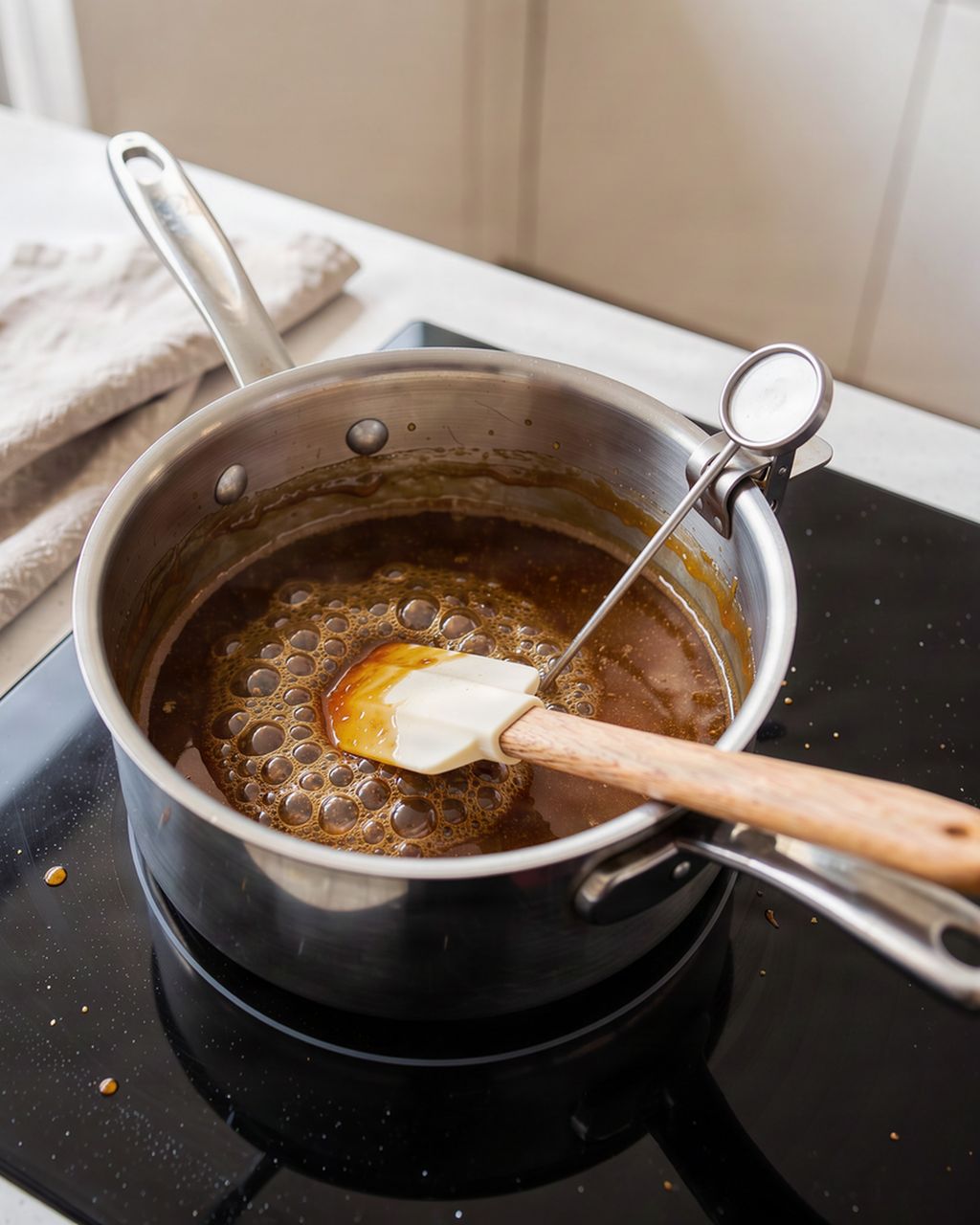
Clip the thermometer to the side of the pan with the bulb or tip fully in the toffee and off the base. The base is hotter than the toffee.
Read it at eye level. Dial and glass thermometers are easy to misread from above.
Use a pan that is the right size. In a wide pan, a small batch may be too shallow to cover the tip. Tilt the pan or use a smaller one.
A digital probe thermometer works too. Stir, then check the middle of the pan.
If you have no thermometer, use the cold-water test: drop a little toffee into a glass of very cold water. At hard crack it sets at once into brittle threads that snap, according to the Exploratorium. Let it cool in the water for a few seconds before you pick it up: the center can still be hot enough to burn. If it bends or feels chewy, keep cooking.
Sugar stages depend on how much water has boiled off, and water boils at a lower temperature the higher you live. The Exploratorium advises subtracting about 1°F for every 500 feet above sea level. Colorado State University Extension gives the same rule as 2°F per 1,000 feet, which works out to roughly 1°C for every 275 meters (900 feet).
At 1,500 m (about 5,000 feet), that means cooking toffee about 5–6°C (10°F) lower than a sea-level recipe says. Colorado State lists brittles at 300–308°F at sea level and 290–300°F at 5,000 feet. This article is about crunchy butter toffee (English toffee); chewy toffees are cooked to a lower stage on purpose.
The boiling-water test handles both problems in one go: if water boils at 95°C on your stove, your thermometer and your altitude together are telling you to cook 5°C lower than a sea-level recipe. Near sea level, as in most of the UK, the difference is negligible, but it matters in mountain areas or in cities like Denver (about 1,600 m / 5,280 ft) or Calgary (about 1,050 m).
Recipe of the week, one tip that saves you time and one deal from the shop. Unsubscribe in one click.
The next issue goes out on Thursday, November 26.
Humidity. Sugar absorbs water from the air. The Exploratorium notes that candy can soften on a humid day after it has cooled, and suggests cooking to the upper end of the stage to counter it. On a damp day, aim for the top of the hard-crack range and store the toffee airtight as soon as it is cool.
Too much syrup or honey. Corn syrup, glucose, golden syrup and honey stop crystals, but they also make sugar more prone to absorbing water. A recipe heavy on them makes softer, stickier toffee.
Spreads instead of butter. Reduced-fat spreads (labeled light, half-fat or simply spread) contain much more water than butter and can make toffee set soft or separate. Use full butter, at least 80% fat.
Going by color. Toffee with a lot of butter browns early. If you stop when it looks like the picture, it may still be well under 149°C (300°F). Trust the thermometer.
Storing it in the fridge. Cold toffee taken out into a warm room collects condensation and turns tacky. Store it at room temperature, in an airtight tin, with parchment between layers.
Yes, if it is soft because it was undercooked.
Break it up and put it back in a heavy pan with a couple of tablespoons of water to help it melt evenly.
Melt it slowly over low heat, stirring gently. If the butter separates, take the pan off the heat and whisk in hot water from the kettle, a tablespoon at a time, until it comes back together. Add it at arm's length and stir: the mixture will bubble up and spit.
Cook it back up to the hard-crack stage, checking with a tested thermometer.
Pour, spread and leave to set.
It will be a little darker the second time. If the toffee has nuts or chocolate on it, re-cooking is messy; it may be better to enjoy it as chewy toffee or chop it into cookies.
Hot sugar burns badly and sticks to the skin. Use a deep pan, long-handled tools and oven gloves, keep children away, and never taste from the spoon. For a burn, the NHS advises cool running water for 20 minutes, as soon as possible (within 3 hours), and no creams, oils or butter; get urgent medical help for a large or deep burn, or one on the face, genitals or bottom, and call NHS 111 (or your doctor) for advice about any burn on a child under 5.
For more about cooking sugar to the right stage, see caramel for Christmas cookies, how to make caramel from sugar without burning it and homemade caramels, which stop at a lower stage on purpose.
Toffee needs to reach the hard-crack stage, 149–154°C (300–310°F) at sea level, according to the Exploratorium's sugar-stage chart. Below that it sets chewy instead of crunchy.
Chewy toffee was taken off the heat too early, usually in the soft-crack stage of 132–143°C (270–290°F), often because the thermometer reads high. Test the thermometer in boiling water and cook to hard crack.
Put it in a pan of water at a full rolling boil. At sea level it should read 100°C (212°F). If it reads 2°C (4°F) low, cook to 2°C (4°F) below your recipe's target; if it reads 2°C (4°F) high, cook to 2°C (4°F) above.
Yes. The Exploratorium advises subtracting about 1°F for every 500 feet above sea level, roughly 1°C for every 275 meters (900 feet).
Yes, with the cold-water test. Drop a little hot toffee into very cold water: at hard crack it sets instantly into brittle threads that snap. Let it cool in the water for a few seconds before touching it.
Yes. Melt it slowly with a couple of tablespoons of water, then cook it back to the hard-crack stage and pour it out again.
One recipe worth heating the oven for, one tip, and one deal from the shop. Nothing else.