Why Is My Pasta Dough Tough? Hydration, Resting and Flour
Why Are My Cinnamon Rolls Raw in the Middle? How to Tell They're Done
Updated Nov 21, 2026
Cinnamon rolls stay raw in the middle when the oven is too hot, so the tops brown before the center bakes, when the pan is crowded with large or tightly packed rolls, or when the rolls go in cold from the fridge. The reliable test is a thermometer: King Arthur Baking and America's Test Kitchen treat about 88°C (190°F) in the center as baked for soft, enriched rolls. Here is how to fix a gooey batch now and avoid it next time.
The outer rolls in a pan always bake first. The middle roll is surrounded by dough on every side, so it heats last. It ends up raw when:
The oven runs hot. The tops look done long before the center is. Many home ovens run hotter or cooler than the dial says, so an oven thermometer is worth having.
The rolls are large or packed tight. Big rolls, or a pan crammed with them, hold a lot of dough in the middle.
The rolls went in cold. Rolls straight from the fridge after an overnight rise need longer in the oven.
The pan is deep or glass. Glass heats slowly, then browns the edges hard. Deep pans hold more dough in the center.
The filling is very wet. Melted butter and sugar pool in the middle and keep the spiral damp.
The rolls were underproofed. Dense dough takes longer to heat through.
Recipe of the week, one tip that saves you time and one deal from the shop. Unsubscribe in one click.
The next issue goes out on Thursday, November 26.
The tops are the least reliable sign. Use one of these:
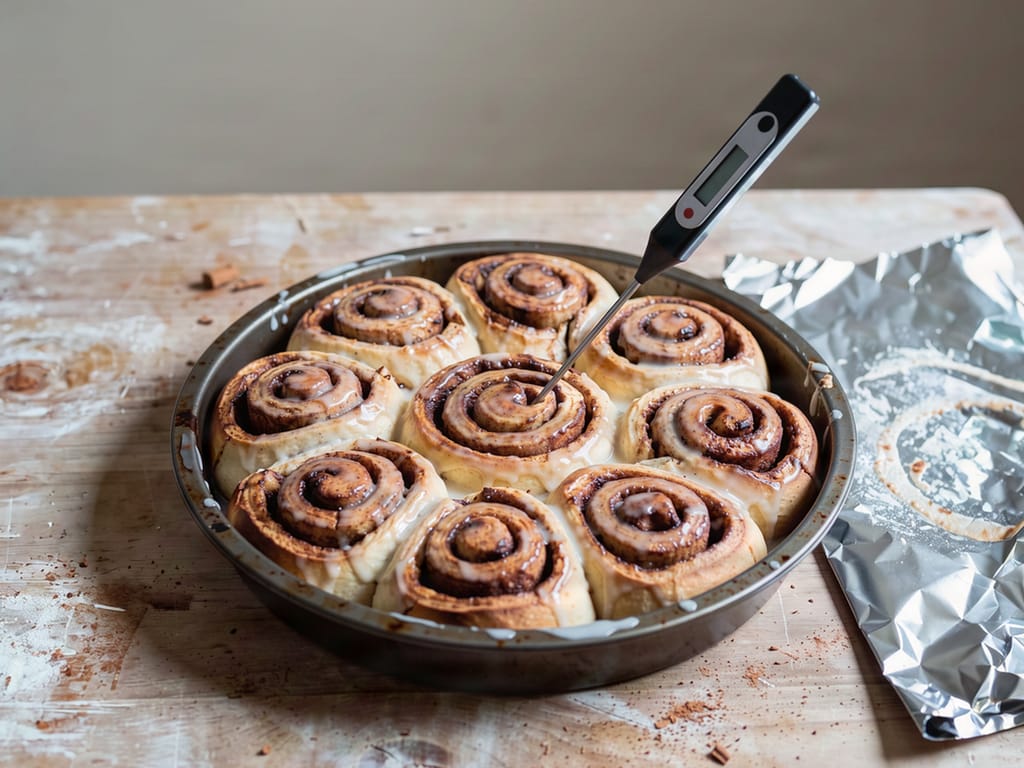
Thermometer (best). Push an instant-read thermometer into the side of the center roll, into the bread rather than the filling. King Arthur Baking says most loaves and rolls are done at about 88°C (190°F) in the center, and America's Test Kitchen uses the same figure for enriched breads. That is a doneness figure for texture: the bread is set but still moist. It is also well above the 71°C (160°F) that USDA FSIS gives for cooked egg dishes. If the dough between the layers still looks wet at 88°C, give it a few more minutes.
The center roll check. Gently pull the middle roll apart with two forks. The dough between the layers should look fluffy and dry, not shiny and wet. A little sticky caramel is fine; pale, damp dough is not.
The spring test. Press the top of the center roll. It should spring back, not leave a soft dent.
If you bake in a fan oven, set it about 20°C lower than a conventional-oven recipe says (US recipes usually say 25°F lower; either works); our oven temperature converter helps you set it.
Caught them straight out of the oven? Put them back right away. If underbaked rolls have sat at room temperature for more than 2 hours (1 hour in a kitchen above 32°C / 90°F), discard them rather than rebaking, as USDA FSIS advises for perishable food left out that long.
Cover the pan loosely with foil, so the tops don't burn.
Bake on the middle rack at the same temperature, in short spells of about 5 minutes.
Check the center roll each time, until it reaches about 88°C (190°F).
If the rolls are already frosted, scrape off what you can or accept softer frosting; the foil will keep most of it in place.
Don't eat the doughy part as it is. The dough contains raw flour and usually raw egg, and the FDA advises against eating raw dough or batter.
Rolls should touch each other after the final rise, because that keeps their sides soft. But there is a difference between touching and crammed.
In a 23 × 33 cm (9 × 13 inch) pan, about 12 rolls is common. Fifteen big rolls in the same pan leave a thick block of dough in the middle.
Leave a small gap between rolls when you set them in the pan, about 1–2 cm (½–¾ inch). They will close it as they rise.
Very large "bakery" rolls bake more evenly in two pans than one.
A light-colored metal pan bakes more evenly than glass or ceramic. If you use glass, check earlier and expect a longer bake for the center.
If your rolls brown before they bake through, don't turn up the heat. Do the opposite:
Bake at the lower end of your recipe's range, often about 175°C (350°F) in a conventional oven, and allow more time.
Bake on the middle rack, not near the top element.
When the tops reach the color you like, lay a sheet of foil loosely over the pan, shiny side up or down, it doesn't matter. Don't seal the edges, or the rolls will steam.
This is the same approach we use for tall Czech holiday breads; our article on underbaked vánočka (braided Christmas bread) walks through it.
Many people love a gooey cinnamon roll, and that's fine, as long as the goo is the filling, not the dough.
Gooey (good): the butter, brown sugar and cinnamon have melted into a soft, sticky caramel between layers of fully baked, fluffy bread.
Raw (not good): the bread itself is pale, damp and pasty, and it sticks to your teeth like uncooked dough.
To get more goo without underbaking:
Use soft butter and brown sugar in the filling, and spread it right to the edges.
Some recipes pour a little cream over the rolls just before baking; it bubbles into a sauce around the base.
Take the rolls out as soon as the center reaches about 88°C (190°F), not long after.
Frost them while still warm, so the frosting melts into the spirals.
Underbaking on purpose isn't the way to do it: the dough contains raw flour and usually raw egg, and the FDA advises against eating raw dough.
Overnight rolls are a common source of raw centers. The FDA advises keeping the fridge at 4°C (40°F) or below, so a pan straight from it goes into the oven much colder than a pan that rose on the counter.
Let the covered pan stand at room temperature while the oven heats, until the rolls look puffy, then expect to bake them a few minutes longer than the recipe says. Use the thermometer, not the timer. Our guide to proofing dough explains how cold slows the rise.
Gooey centers usually mean the rolls came out too early, often because the tops browned fast in a hot oven, the pan was crowded, or the rolls were cold from the fridge. Bake them longer under loose foil until the center roll reaches about 88°C (190°F).
About 88°C (190°F) in the center of the middle roll, the benchmark America's Test Kitchen uses for enriched breads, in line with King Arthur Baking's figure for most loaves and rolls. Push the thermometer into the doughy part, not the sugary filling.
Yes, if you catch it soon after baking, return them to the oven at the same temperature with foil over the top and bake until the center roll reaches about 88°C (190°F). Rebake them as soon as you notice. If underbaked rolls have sat at room temperature for more than 2 hours (1 hour in a kitchen above 32°C / 90°F), throw them away rather than rebaking, as USDA FSIS advises for perishable food left out that long.
No, finish baking them instead. The dough contains raw flour and usually raw egg, and the FDA advises against eating raw dough or batter.
Lay a sheet of foil loosely over the pan once the tops are the color you want, and bake on the middle rack. A slightly lower temperature for a little longer also helps big rolls bake through.
One recipe worth heating the oven for, one tip, and one deal from the shop. Nothing else.