What to Bake With Egg Whites: Cookies, Meringues, Cakes and 12 Ways to Use Up Extra Whites
What Are Laskonky? Czech Meringue Cookies vs French Macarons
Updated Nov 20, 2026
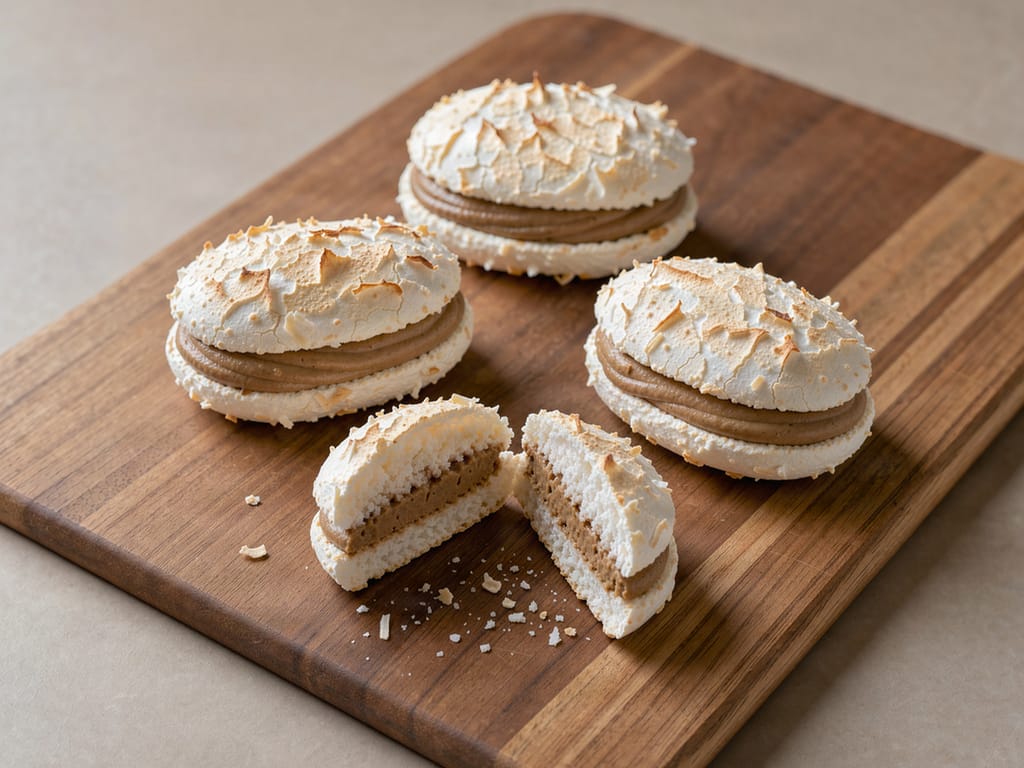
Laskonky are Czech meringue sandwich cookies: two oval shells of coconut or walnut meringue, crisp outside and chewy inside, joined with a thick coffee or caramel buttercream. They look like oversized macarons, but they are made differently and taste different. Here is what they are, where the name comes from, and how they compare with French macarons.
A laskonka (plural laskonky) is a Czech and Slovak pastry-shop classic. Two oval meringue shells, each about the length of your palm, are pressed together around a thick layer of buttercream.
The shells are made of whipped egg whites and sugar with desiccated coconut or ground walnuts folded in. They bake low and slow, so the outside dries to a thin, crackly crust while the inside stays soft and chewy. The buttercream is usually coffee-flavored, though caramel, chocolate and nut creams are common too.
You will find them in almost every cukrárna (Czech pastry shop), often next to větrníky and rakvičky, and in supermarket bakery counters. Many Czech and Slovak families also bake them at home, especially for Christmas and Easter.
The name is older than it looks. Czech etymologist Vít Boček, in a paper for the 2017 Brno Etymological Symposium, explains laskonka as a shortening of laskomin(k)a, an old word meaning appetite or desire, and also a delicacy or dainty.
The root survives in modern Czech as laskominy, the word for tempting treats. So a laskonka is, roughly, “a little treat”. It has nothing to do with láska (love), even though the two look alike and many people assume they are related.
In outline, without a full recipe:
Meringue. Egg whites are whipped with sugar into a stiff, glossy meringue. As with most dry meringues, the sugar weighs roughly twice as much as the whites. If you are new to this, our guide to soft peaks, stiff peaks and overbeating shows what you are looking for.
Coconut or nuts. Finely ground walnuts or desiccated coconut are folded in gently, sometimes with a spoonful of flour or starch to help the shells hold.
Shaping. The mixture is piped or spread into ovals, either freehand or with a laskonky template. Czech shops sell perforated trays and stencils made for the job.
Baking. The shells bake in a low oven until they are dry outside and lift off the paper, then cool completely.
Filling. Two shells are sandwiched with buttercream, and the cookies rest in the fridge so the cream sets.
The shells are where home bakers go wrong: too hot an oven browns them before the inside sets, and too short a bake leaves them sticky.
Czech recipes give everything by weight. If you are converting a US recipe, granulated sugar is 200 g per US cup (236.6 ml) and 211 g per metric cup (250 ml); for coconut and other amounts, use our cups and spoons to grams calculator. Weighing the egg whites too gives the most reliable shells, because egg sizes differ between countries.
Both are traditional, and Czech bakeries usually offer one or the other.
Coconut laskonky: the most common today. Pale gold, sweet, with a chewy, slightly stringy texture from the coconut.
Walnut laskonky: darker, more tender and less sweet-tasting, with a toasty nut flavor that goes well with coffee cream. Some recipes use hazelnuts instead.
If you bake with walnuts, use fresh ones. Rancid walnuts make the whole batch taste bitter. Our guide to shelling walnuts and spotting rancid ones helps.
The classic filling is coffee buttercream: soft butter beaten with a cooked base, usually a vanilla pudding or custard cooked on the stove and cooled, or sweetened condensed milk, then flavored with strong coffee.
Caramel buttercream is the other favorite. Prague's Cukrárna Myšák, for example, fills its laskonky with buttercream and griliáš (crushed caramelized nuts).
The cream has to be firm enough to hold two heavy shells apart. Pudding-based buttercream curdles easily if the butter and the pudding are at different temperatures. Our article on pudding buttercream and why it curdles explains the fix.
Czech writers often call laskonky distant relatives of the macaron. They share an idea, meringue shells sandwiched with cream, but little else.
Laskonky: large ovals, about palm length. Coconut or ground walnuts folded into a meringue. Rough, crackled top, no foot. Crisp crust, chewy center. Thick layer of coffee or caramel buttercream. Forgiving to make.
French macarons: small rounds, a couple of bites each. Almond flour and powdered sugar folded into meringue until the batter flows. Smooth, shiny dome with a ruffled “foot” at the base. Thin crisp shell over a soft interior. Thin layer of ganache, buttercream or jam. Notoriously fussy.
The practical difference: you can make good laskonky on your first try. Macarons usually take a few batches. If you want to try them, see macarons vs meringue.
Recipe of the week, one tip that saves you time and one deal from the shop. Unsubscribe in one click.
The next issue goes out on Thursday, November 26.
Laskonky are eaten by hand or with a fork, usually with coffee. Because the filling is buttercream, they live in the fridge, covered, and taste best taken out shortly before serving, so the cream softens a little and the shells turn chewy again.
The shells soften over time as they draw moisture from the cream. Some people like them best the day after filling, when the shell and cream have melded.
Some pastry shops also sell a larger double laskonka. Cukrárna Myšák in Prague, for example, offers both a regular and a double version.
Laskonky are made of egg-white meringue mixed with desiccated coconut or ground walnuts, baked into oval shells and sandwiched with buttercream. The classic filling is coffee buttercream, with caramel a close second.
No, laskonky are a separate Czech pastry, often described as distant relatives of French macarons. Macarons are small, smooth almond-flour shells with a ruffled foot, while laskonky are larger, rougher coconut or nut meringues with a chewy center.
Laskonka most likely comes from laskomin(k)a, an old Czech word for appetite or a dainty treat. Czech etymologist Vít Boček explains the cookie's name as a shortening of that word.
Walnut laskonky contain tree nuts, and the cream in any laskonka may contain hazelnuts, griliáš or even peanuts. Coconut versions are often made alongside nut ones. With a peanut or tree-nut allergy, read the full ingredient list or ask the bakery for its allergen information, and do not rely on a may-contain line. Laskonky also contain egg and milk, and often a little wheat flour.
Czechs eat laskonky all year, usually bought from a cukrárna (pastry shop) and eaten with coffee. Some families also bake them at home for Christmas or Easter.
One recipe worth heating the oven for, one tip, and one deal from the shop. Nothing else.