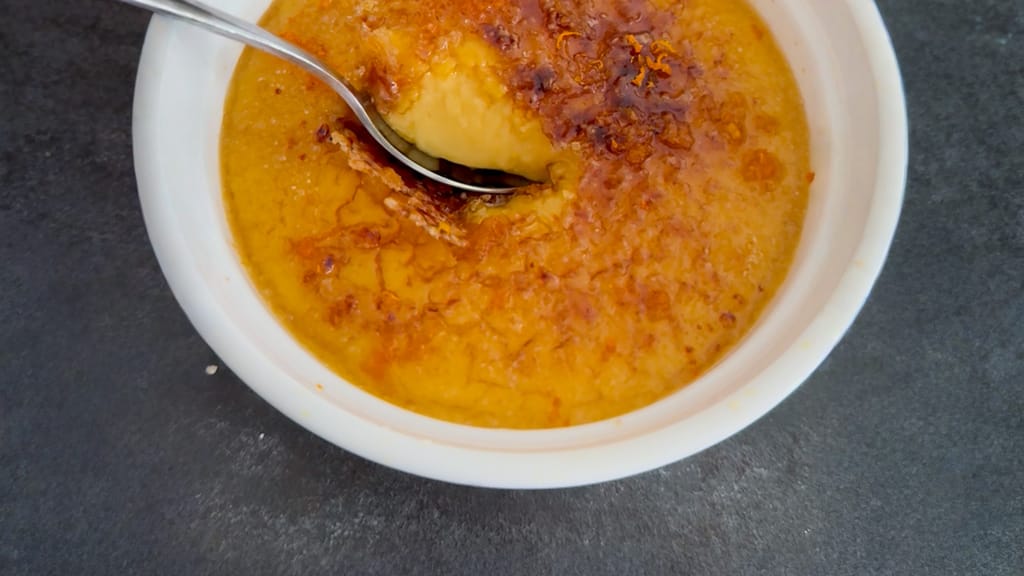
Crema catalana with orange zest and cinnamon

Updated Jul 19, 2026
Spanish desserts rest on a handful of everyday ingredients – eggs, milk, sugar, almonds and citrus – yet from these humble basics the Spanish conjure up flan, churros, crema catalana and almond tarta de Santiago. Here you'll find six classics, what sets them apart, where they come from, and how to make them at home without any special equipment. No fluff: just the technique, the ratios and the tricks that actually matter.
Six classics cover the whole of Spain: flan (caramel custard), churros with hot chocolate, crema catalana, tarta de Santiago (almond tart from Galicia), turrón (Christmas almond nougat), and natillas (egg custard). They're all built from the same small set of ingredients – eggs, milk, sugar, almonds and citrus.
That shared base isn't a coincidence. A great deal of Spanish confectionery traces back to Moorish sweet-making, which is why almonds, honey, cinnamon and citrus zest keep turning up again and again. You don't need any special equipment or exotic ingredients – you can make most of what follows with what's already in your kitchen.
Flan is a baked custard made from milk, eggs and sugar with a layer of liquid caramel, baked in a water bath and turned out onto a plate before serving. The caramel at the bottom of the mould softens as it cools and, once flipped, runs down over the custard like a sauce.
Two things keep the texture silky: gentle heat and patience. A water bath (bain-marie) surrounds the mould with hot water so the eggs set slowly and evenly – without it, the flan curdles and ends up full of bubbles and holes. Bake at a low temperature, around 150–160°C, and take it out as soon as the edges are set but the centre still wobbles slightly; it will finish setting from residual heat. Then chill it in the fridge for at least two hours to firm up, or it will fall apart when you turn it out.
The most common mistake is burnt caramel. Melt the sugar over medium heat and watch the colour closely – golden amber tastes sweet, dark brown is already turning bitter.
Churros are fried strips of choux-style dough (water, butter, flour and eggs), piped through a star-shaped nozzle and fried until golden, then dipped into thick hot chocolate. It's the star-shaped nozzle that creates the signature ridges – they increase the surface area, so the churro crisps up faster.
The result all comes down to oil temperature. Keep it around 180–190°C: oil that's too cool lets the churros soak up too much fat and turn greasy, while oil that's too hot browns them on the outside before they cook through inside. Pipe the dough carefully and snip off lengths with scissors right over the pot.
The origins of churros aren't entirely clear – one version credits Spanish shepherds who needed a pastry that travelled well into the mountains, another links them to Chinese youtiao, brought to Europe by Portuguese sailors. For the full method and tips on getting the chocolate just right, see our article Authentic Churros and the Secret to Perfect Hot Chocolate.
Crema catalana is a custard made from milk, egg yolks and sugar, thickened with starch, cooked on the stovetop and flavoured with cinnamon and citrus zest, topped with a crisp caramelised sugar crust just before serving. It differs from French crème brûlée in three key ways:
Base: crema catalana is made with milk, crème brûlée with cream – which is why the Catalan version is lighter.
Method: crema catalana is cooked on the stovetop and thickened with starch, while crème brûlée is baked in a water bath in the oven with no thickener at all.
Flavour: crema catalana is scented with cinnamon and lemon or orange zest, while crème brûlée relies on vanilla.
You get that crackly crust by sprinkling sugar over the top and torching it – traditionally with a heated iron, but at home a kitchen blowtorch is easiest. We go into more detail on the differences in our article Crema Catalana vs. Crème Brûlée.
Crema catalana with orange zest and cinnamon
Crema catalana with orange zest and cinnamon – the traditional recipe, step by step
Tarta de Santiago is a Galician almond tart made from ground almonds, eggs, sugar and lemon zest – with not a speck of flour, so it's naturally gluten-free. The top is dusted with a stencilled cross of St James in icing sugar.
Its protected geographical status (IGP) requires at least 33% almonds and no flour whatsoever; the signature sugar cross is said to have first appeared at the Casa Mora bakery in Santiago de Compostela in 1924. For the cleanest flavour, use peeled (blanched) almonds – the skins add a slightly bitter note.
Since the tart is built almost entirely on almonds, it's held together by well-beaten eggs rather than gluten. So whisk the eggs and sugar into a pale, airy foam to keep the cake from turning too dense. We cover the full method in our article The Secret to Making Tarta de Santiago at Home.
Turrón is a Spanish Christmas nougat made from almonds and honey, made in two protected (IGP) styles: firm turrón de Alicante, with whole almonds, egg white and a wafer base, and soft turrón de Jijona, made from finely ground almonds. It has roots in Moorish confectionery and is as much a fixture of Spanish Christmas as, say, a festive fruitcake is elsewhere.
The softer version, with honey and nuts, is the easiest to nail at home. The key is whisking the honey, sugar and egg whites into a really well-aerated mixture, and being patient while cooking the syrup – don't rush the temperature, or the nougat will either fail to set or caramelise. Read more about its history and varieties in our article Turrón: The Traditional Christmas Treat and Its Secrets.
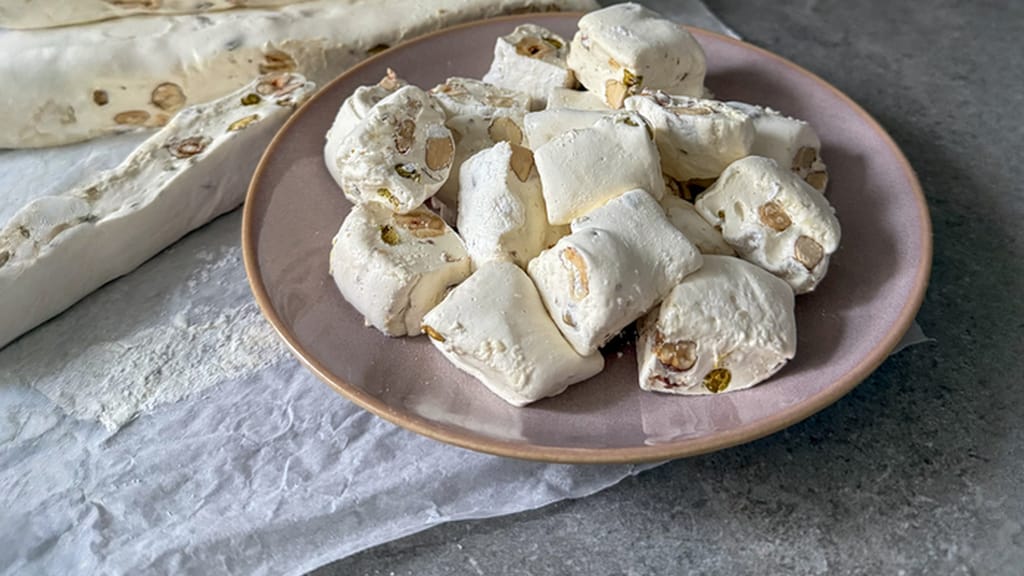
Montélimar nougat – homemade white nougat with honey and nuts
Homemade Montélimar-style white nougat with honey and nuts – a close cousin of Spanish turrón
Natillas is a smooth egg custard made from milk, egg yolks and sugar, cooked on the stovetop, flavoured with cinnamon and lemon zest, and traditionally topped with a Marie biscuit. It's probably the simplest Spanish dessert of all – ready in twenty minutes, no oven required.
Cook the custard over low heat, stirring constantly; as soon as it coats the spoon, take it off the heat right away so the yolks don't curdle.
The best presentation plays on contrast: pale flan or crema catalana really pops against dark chocolate, fresh berries or a sprig of mint. Three moves that work every time:
Colour contrast – pair a creamy dessert with dark fruit or chocolate.
Freshness – orange slices or mint leaves cut through the sweetness.
Texture – a caramel lattice or a few toasted almonds add crunch.
Serve crema catalana in shallow dishes so there's plenty of surface area for that crisp crust, and don't turn out the flan until just before serving.
Natillas is the easiest to master – an egg custard that cooks on the stovetop in twenty minutes and needs no oven or water bath. Simple flan comes next; the only tricky parts are getting the caramel right and baking it in a water bath.
Swap it for finely ground blanched almonds in a 1:1 ratio – it's essentially the same thing, just coarser. Grind the almonds in two batches and sift them so the batter doesn't turn grainy; peel off the skins before grinding, as they add a bitter edge.
Both desserts keep for 2–3 days in the fridge, covered with plastic wrap so they don't pick up other smells. For crema catalana, torch the sugar crust just before serving – after a few hours in the fridge it softens and loses its crunch.
Yes – sprinkle a thin layer of sugar over the top and slide the dessert under a hot oven grill for a few minutes, until the sugar caramelises. Keep the ramekins close to the heating element and watch them closely, as sugar can go from amber to burnt in seconds.
It turned bitter because the sugar cooked too long or over too high a heat – take it off the heat as soon as it reaches a golden amber colour. It will naturally harden at the bottom of the mould, but during baking and chilling, moisture from the custard dissolves it back into a liquid sauce.
One recipe worth heating the oven for, one tip, and one deal from the shop. Nothing else.