Montélimar nougat – homemade white nougat with honey and nuts

Updated Jul 19, 2026
Churros come from Spain, where they began as a simple fried dough of flour, water and salt — though their exact origins are still hotly disputed. We'll walk through three theories about where churros really came from, how Moorish influence reshaped Spanish confectionery, and how a shepherd's snack became a worldwide classic. Plus the stories behind other icons: turrón, the almond cake Tarta de Santiago, and caramel flan.
Churros most likely originated in Spain, but their exact origin is disputed. Historians work with three main theories:
The shepherd's legend – Spanish shepherds high in the mountains fried a simple dough of flour, water and salt in place of fresh bread.
Moorish roots – a fried, sweet dough called zulabiya was already known across the Arab world and in Moorish Andalusia as early as the 12th century.
The Chinese theory – according to a widespread but chronologically shaky version, Portuguese sailors brought the forerunner of churros back from China.
What all three share is the essentials: a runny dough piped through a star-shaped nozzle and fried in hot oil. It's exactly those ridges from the star tip that make the surface extra crisp while keeping the centre soft.
The most popular story credits churros to Spanish shepherds. High in the mountains, with no baker nearby, they made do with the simplest possible ingredients: flour, water, a pinch of salt, and frying over an open fire. That basic mix is still the heart of churros today — even modern recipes rest on the same trio of ingredients.
The oldest traceable clue points to Arab cuisine. Andalusian cookbooks from the 12th century describe a sweet fried dough much like churros, and similar treats are mentioned in even older Arabic texts. Some historians see churros as a direct descendant of zulabiya – the fried dough of Moorish Spain, preserved for us today in the shape of ridged churro sticks.
According to a frequently repeated theory, churros descend from Chinese youtiao, a fried dough that Portuguese sailors supposedly brought back to Europe in the 16th century. It's a tempting story, but the timing doesn't work: the Portuguese didn't have major contact with China until around 1557, whereas recipes for churros-like pastries appear in Andalusian sources earlier than that — and Spaniards were already carrying churros to the Americas around the same time. Many experts treat this version as more myth than history. Youtiao and churros most likely share a distant common ancestor in the Arabic zulabiya, rather than one being a direct descendant of the other.
Spanish colonisers carried churros across the Atlantic to Latin America, where each country gave them its own twist:
Mexico – churros rolled in cinnamon sugar, served with thick hot chocolate for dipping.
Argentina – a filled version with dulce de leche.
USA – a beloved street-food staple at fairs and amusement parks.
The basics stay the same everywhere: a simple dough fried until crisp outside and soft in the middle. We cover how to make authentic churros and the perfect chocolate dipping sauce at home in a separate guide.
The sweet side of Spanish confectionery owes much to the centuries of Moorish rule (8th–15th century). The Arabs brought three things to the Iberian Peninsula that changed Spanish desserts for good: cane sugar, almonds and honey.
Before their arrival, Spain sweetened food mainly with honey; sugar opened the door to a whole new range of sweets. Almonds and pistachios arrived along with sugar — still the backbone of many traditional desserts today — as did the custom of pairing honey with spices like cinnamon or cardamom. That flavour profile of almonds, honey and cinnamon still runs through Spanish confectionery today.
Turrón is an almond nougat with roots in Moorish Spain. It's made from roasted almonds, honey, sugar and egg whites, and the town of Jijona (Xixona) in Alicante became especially famous for it. There are two classic types: soft turrón de Jijona, made from finely ground almonds, and hard turrón de Alicante, with whole almonds set in a brittle base. The earliest documented mention of local turrón dates back to 1484, and today it holds a protected European designation of origin.
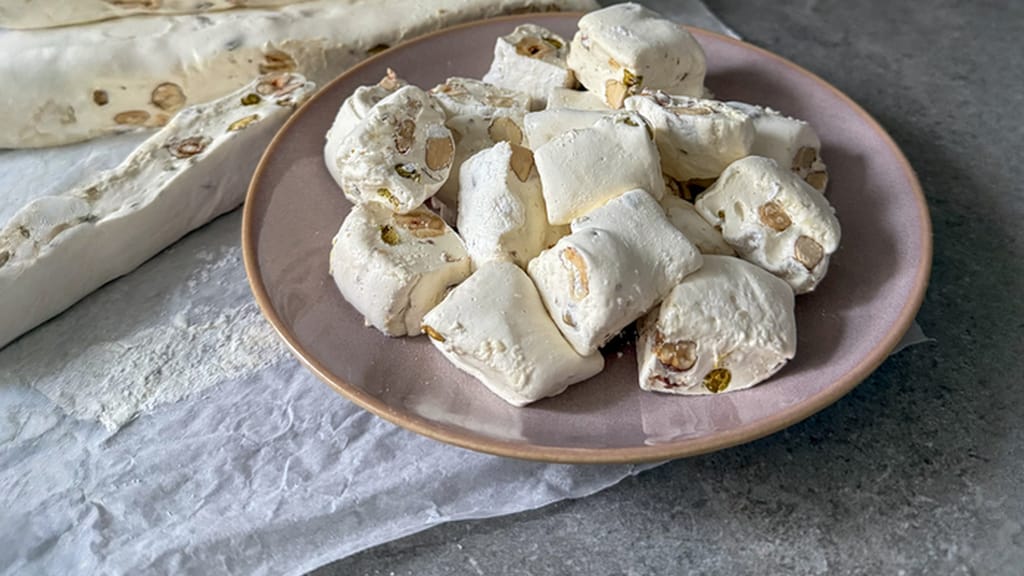
Montélimar nougat – homemade white nougat with honey and nuts
White Montélimar nougat with honey and almonds – a close cousin of Spanish turrón you can make at home
Besides churros and turrón, the icons of Spanish confectionery include the Galician almond cake Tarta de Santiago and caramel flan. Both combine a handful of simple ingredients into something that has lasted for centuries.
Tarta de Santiago is an almond cake from Santiago de Compostela in Galicia, tied to the pilgrimage route of Saint James. It's made from ground almonds, eggs, sugar and lemon zest — no flour at all. Under the protected European designation of origin it received in 2010, it must contain at least 33% almonds. Its trademark is the Cross of Saint James dusted on top in icing sugar, a decorative touch introduced by the Casa Mora bakery in Santiago in 1924, though the cake itself is first mentioned in writing as far back as 1577. We show how to bake Tarta de Santiago step by step at home in a separate guide.
Flan – a caramel custard made from milk, eggs and sugar – has surprisingly ancient roots, tracing back to Roman egg-and-milk bakes. Its name carries a trace of that history too, coming via Old French flaon from a word meaning "flat cake". It was often originally a savoury dish; the sweet, caramel version with citrus and almonds took shape only in the Middle Ages under Moorish influence. The classic method is to pour caramel into the bottom of a mould, top it with a mixture of milk, eggs and sugar, and bake it in a water bath until silky-smooth.
Traditional Spanish sweets live on today in modern forms too — vegan, gluten-free, even experimental — without losing what makes them what they are.
Vegan churros skip the eggs and milk, keeping their crunch and flavour thanks to plant-based swaps like almond milk or coconut oil. For cakes like flan or polvorones biscuits, bakers often swap wheat flour for almond flour, making them suitable for people avoiding gluten. And top-tier kitchens play with texture and presentation using molecular gastronomy — yet the traditional core of almonds, honey and simple dough remains.
Turrón de Alicante is a hard nougat with whole roasted almonds set in a brittle base, while turrón de Jijona is soft and smooth because the almonds are ground into a paste. Both are made from almonds, honey, sugar and egg whites and come from the Alicante region.
Flan and French crème caramel are essentially the same thing — a milk, egg and sugar custard baked in a water bath and topped with caramel. Crema catalana is different: it's thickened with starch, cooked on the stovetop, and finished with a crunchy burnt-sugar crust, making it closer to crème brûlée.
Finely ground walnuts or hazelnuts give the closest result, since like almonds they add both fat and structure. Keep in mind, though, that the protected Tarta de Santiago designation requires at least 33% almonds — swap in another nut and you've got a loose variation, not the original.
Churros are best within a couple of hours of frying, while they're still crisp. Revive stale ones with a few minutes in an oven heated to 180°C (355°F) or in an air fryer; the microwave, on the other hand, will make them soft and rubbery.
Porras are churros' thicker, softer sibling: baking soda goes into the dough, and it's shaped into a fatter ring, giving a fluffier interior. Churros are thinner, crisper, and ridged from a star-shaped nozzle. In Spain, both are dunked in thick hot chocolate for breakfast.
One recipe worth heating the oven for, one tip, and one deal from the shop. Nothing else.