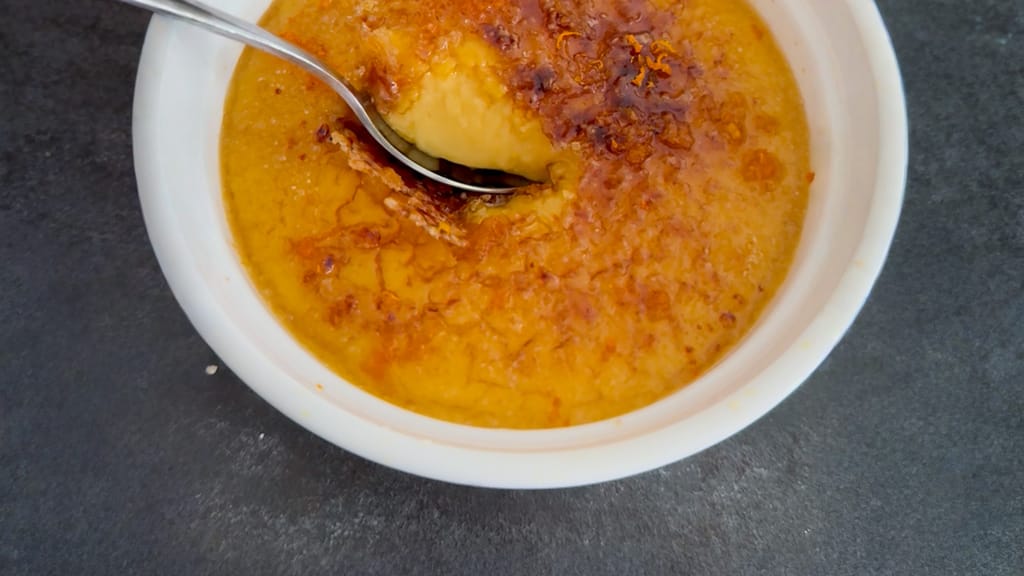
Crema catalana with orange zest and cinnamon
Crema Catalana vs. Crème Brûlée: What's the Real Difference?

Updated Jul 19, 2026
Crema catalana and crème brûlée look almost identical – a silky custard hidden under a crackling caramel crust – but they're actually two very different desserts. Crema catalana is a Spanish custard made with milk, thickened with starch, cooked on the stovetop, and flavoured with cinnamon and citrus zest. Crème brûlée is a French baked custard made with cream and egg yolks, flavoured only with vanilla. Below you'll find exactly how the base, the method and the flavour differ – plus how to make crema catalana at home.
The quick answer: crema catalana is lighter and citrusy, while crème brûlée is richer and vanilla-forward. Here it is in five points:
Base: crema catalana = milk thickened with starch and egg yolks; crème brûlée = cream and egg yolks, no starch at all.
Method: crema catalana is finished on the stovetop; crème brûlée is baked in a water bath in the oven.
Flavour: cinnamon and lemon and orange zest vs. pure vanilla.
Texture: crema catalana is thinner and lighter; crème brûlée is dense and velvety.
Origin: Catalonia (first records date back to the 14th century) vs. France (first recorded recipe in 1691).
What they share is the best part: a thin layer of caramelised sugar that shatters with the first tap of a spoon. Everything else sets them apart.
The key difference lies in the base. Crema catalana is built on whole milk thickened with cornstarch and egg yolks, while crème brûlée relies on whipping cream (ideally 30–35% fat) and egg yolks alone, with no starch whatsoever.
That's exactly why crème brûlée is so much richer and denser – the fat in the cream gives it that velvety heaviness. Crema catalana, thanks to the milk, is lighter and more refreshing; the starch is what stabilises it, letting it hold its shape without ever going near an oven.
The aromatics differ too. The milk for crema catalana is infused with a whole cinnamon stick and lemon and orange zest – which is where that warm, citrusy flavour comes from. The cream for crème brûlée gets just the scraped seeds of a vanilla pod. One dessert is spiced and bright, the other purely vanilla.
Crema catalana is finished on the stovetop, while crème brûlée is baked in the oven – and for home cooks, that's the biggest practical difference between the two.
Crema catalana: warm the milk with cinnamon and citrus zest, let it infuse for a while, then strain it. Whisk the egg yolks with sugar and starch, temper with the hot milk, then return everything to low heat. Cook while stirring constantly until the custard thickens (to the texture of a loose pudding) – no water bath, no oven needed. Pour into dishes, chill in the fridge, then sprinkle with sugar and caramelise just before serving.
Crème brûlée: warm the cream with vanilla, temper it into egg yolks whisked with sugar, strain the mixture and pour it into ramekins. Bake in a water bath at 150°C (300°F) for about 30–40 minutes – until the edges have set but the centre still has a slight wobble (an internal temperature of around 77–80°C/170–176°F). Chill in the fridge for at least 4 hours, then sprinkle with sugar and caramelise.
Why does crème brûlée need a water bath and low heat? It protects the egg yolks from overheating – without it, the custard curdles and turns grainy. Crema catalana doesn't have this problem, since the starch holds it together.
Crema catalana is one of the oldest custards in Europe, while crème brûlée first appears centuries later at the French royal court. Yet both desserts share the same core idea: a silky custard sealed under a crackling caramel crust.
Crema catalana's roots trace back to Catalonia in northeastern Spain; historians point to early versions of the recipe appearing in medieval Catalan cookbooks as far back as the 14th century. It's mentioned by name as crema catalana in a cookbook from 1745.
It's also traditionally known as crema de Sant Josep – Saint Joseph's cream – because it's served on Saint Joseph's Day (19 March). Today it's considered Catalonia's national dessert.
The earliest known recipe for crème brûlée was published in 1691 in the cookbook Cuisinier royal et bourgeois by François Massialot, a chef connected to the court of Louis XIV. The name literally means "burnt cream", capturing exactly that thin layer of caramel sitting on a smooth vanilla custard. The recipe has barely changed since – still just cream, egg yolks, sugar and vanilla.
Crema catalana with orange zest and cinnamon
Crema catalana with cinnamon and orange zest – a traditional Spanish stovetop custard, step by step
Choose based on your taste and your kitchen setup. Fancy something lighter and fresher, spiced with cinnamon and citrus, that you can make entirely on the stovetop without turning on the oven? Go for crema catalana. Craving a rich, velvety vanilla custard and don't mind baking in a water bath? Make crème brûlée.
Both desserts share a common ancestor in the family of baked and cooked custards – which also includes the perfect flan, step by step, a soft caramel custard that differs from both in that it's topped with a runny caramel sauce instead of a crackling crust. If you want to try the comparison for yourself, start with the crema catalana above – it's more forgiving and doesn't need an oven.
Yes. Traditionally, crema catalana is scorched with a heated iron disc (a "ferro") pressed onto the sugar; at home, a hot metal spoon or your oven's top grill works too (just place the dish right under the heat and watch it closely). A blowtorch is the easiest option, but it's not essential.
The custard itself keeps covered in the fridge for about 2–3 days. Always caramelise the sugar just before serving, though – the crust starts to soften and dissolve into the custard within half an hour of being torched.
Yes, it's actually ideal to make both custards a day in advance so they have plenty of time to chill and set firmly in the fridge. Just add the caramel crust right before serving, otherwise it won't stay crunchy.
This usually happens when the oven is too hot or the custard bakes too long – the egg yolks overheat and curdle. Bake in a water bath at 150°C (300°F) and take the custard out as soon as the edges have set but the centre still has a slight wobble (an internal temperature of around 77–80°C/170–176°F).
Neither dessert is made with flour. Crema catalana is thickened with cornstarch, and crème brûlée doesn't need any thickener at all, so both can naturally be gluten-free – just double-check the label on your specific starch and sugar to be sure.
One recipe worth heating the oven for, one tip, and one deal from the shop. Nothing else.