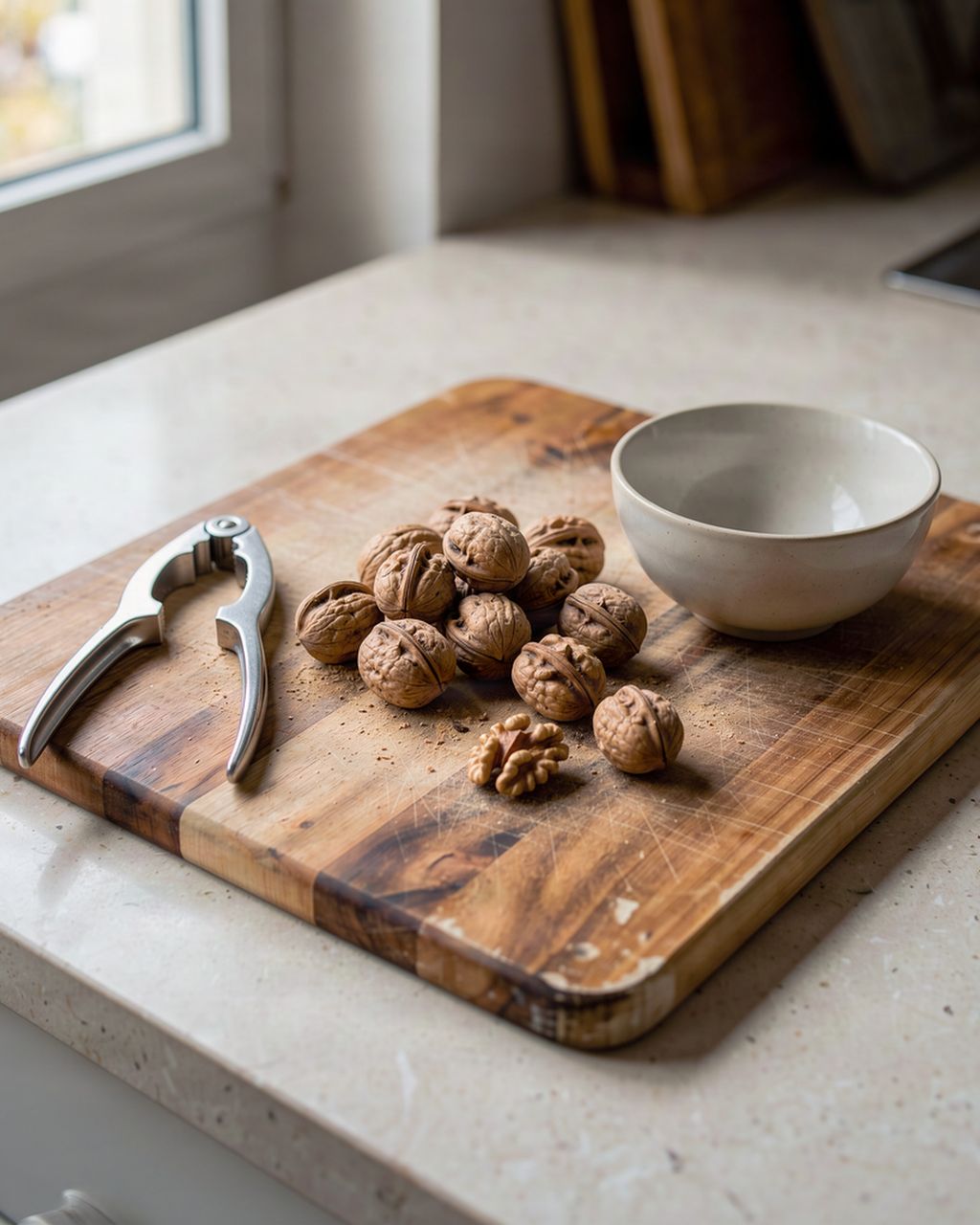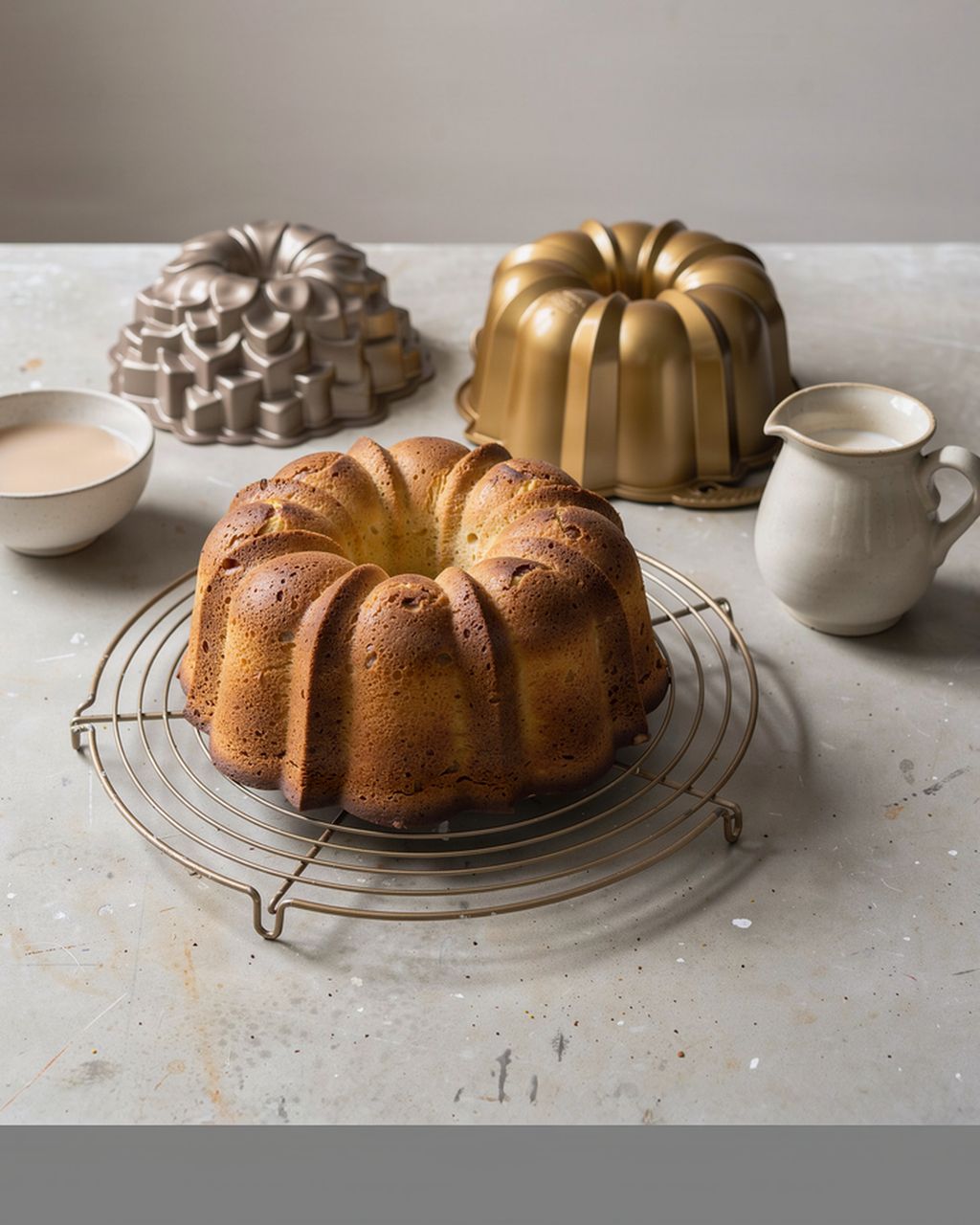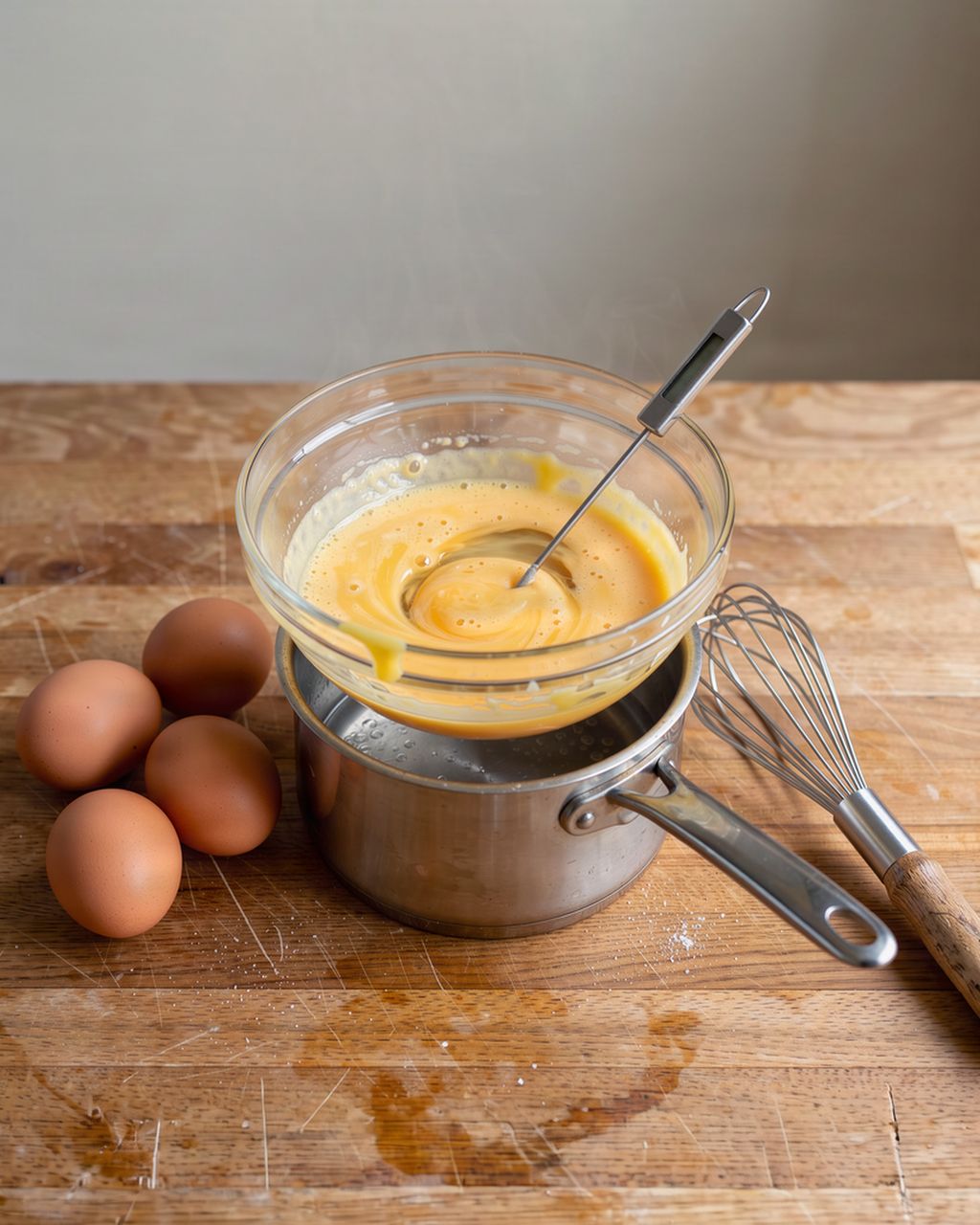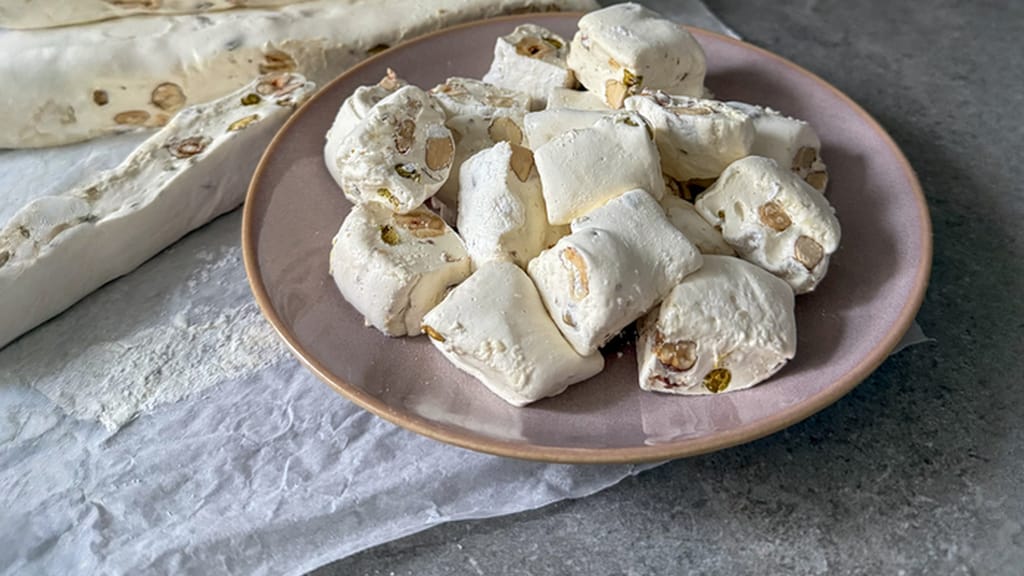
Montélimar nougat – homemade white nougat with honey and nuts
Turrón: Spain's Christmas Nougat, Its Varieties and How to Make It at Home

Updated Jul 19, 2026
Turrón is Spain's traditional Christmas nougat, made from toasted almonds, honey, sugar and egg white. In Spain, Christmas simply isn't Christmas without it – and one taste is all it takes to understand why. It comes in two classic forms: the hard turrón de Alicante studded with whole almonds, and the soft, creamy turrón de Jijona. In this article you'll discover where it comes from, what sets each variety apart, how to make it at home, and why, five centuries on, it's still the star of Spanish festive tables.
There are two classic varieties with protected status: turrón de Alicante (hard, with whole almonds) and turrón de Jijona (soft, made from finely ground almonds). Both hold a protected designation of origin and share the same base – honey, sugar, egg white and almonds. The main difference is texture. Alongside these, a range of modern variations has sprung up: chocolate, toasted nut, coconut and candied fruit versions.
The almond ratio isn't left to chance: under the designation of origin rules, turrón de Jijona must contain at least 64% almonds, and turrón de Alicante around 60%. The more almonds, the bolder the flavour – and the higher the quality.
Turrón de Alicante is a firm block of whole toasted almonds set in a brittle honey-and-sugar mixture bound with egg white. It's hard and crunchy, snaps when broken, and smells of honey. Top and bottom are traditionally protected by oblea – a thin, edible wafer paper. It comes from the town of Xixona (Jijona) in Alicante province, which has been linked to turrón-making since at least the 15th century.
Turrón de Jijona is soft, creamy and melts on the tongue. The almonds are toasted, then ground into a fine paste – the oil released from them is what gives the mixture its smoothness. The mix is then slowly cooked once more (a step known as boixet), which makes it smooth and free of any lumps. That's exactly why you won't find whole almond pieces in it, unlike in the hard version.
Modern turrones chase new flavours: the most popular is chocolate (turrón de chocolate), often studded with crunchy rice or whole nuts. You'll also come across versions with hazelnuts, pistachios, coconut, candied fruit or toasted pralines. The base, though – honey, whipped egg white and nuts – stays the same.
Turrón grew out of the Arab tradition of combining honey and nuts, brought to Spain during the Moorish period (711–1492). Historians believe a sweet very similar to today's turrón was already being made in what is now Alicante province in the late Middle Ages, and the town of Xixona has been linked to it since at least the 15th century; written records become more frequent in the 16th century.
A fact most people don't expect: the original recipe contained no sugar at all – it was sweetened with honey alone. According to historical sources, sugar wasn't added to turrón until the early 20th century. Turrón also has close relatives across the Mediterranean: Italian torrone and French nougat from Montélimar are both built on the same trio of honey, egg white and nuts, pointing to a shared Mediterranean lineage.
Traditional turrón rests on four ingredients: honey, sugar, egg white and toasted almonds. Each plays its own role:
Honey and sugar form the mixture that, once heated, binds everything together and sets firm as it cools.
Egg white whips up the mixture, aerates it, and gives turrón its characteristic pale colour.
Almonds are the star of the show – in Spain most often the Marcona variety – shaping both flavour and texture.
A pinch of vanilla or a little lemon zest just rounds things off. Less is more here: the quality of each ingredient shows immediately in the final result.
At home, you can pull off turrón in six steps: toast the almonds, cook a honey-and-sugar syrup, whip the egg white, combine everything, cook briefly, then leave it to set under weight. The keys are good honey, fresh almonds and a sugar thermometer.
Toast the almonds. Spread them on a tray and bake at around 175°C (350°F) for about 10 minutes, until golden and fragrant. Toasted almonds make all the difference to the final flavour.
Cook the syrup. Heat the honey (and sugar, if using) slowly over gentle heat. For a softer turrón, a lower temperature is enough; for a hard one, take the syrup all the way to the hard-ball stage (around 145–150°C/293–302°F). Without a thermometer, you're working blind.
Whip the egg white. Whisk it to soft peaks, then, while whisking constantly, pour in the hot syrup in a thin stream.
Combine and cook through. Keep heating the mixture gently while stirring constantly, until it thickens and turns glossy. Test it by dropping a little into cold water – for the hard version, it should firm up.
Fold in the almonds. Whole for the hard version; finely ground into a paste for the soft one.
Shape and weigh it down. Transfer into a mould lined with wafer paper, top with another sheet, weigh it down, and leave to rest overnight at least, so the mixture binds and slices cleanly.
Montélimar nougat – homemade white nougat with honey and nuts
Montélimar nougat – a homemade white nougat with honey and almonds, turrón's closest cousin, and one you can easily make at home
Low-quality honey. Honey is the main flavour here – a cheap, flavourless one shows immediately in the finished turrón.
Overcooked syrup. Heating too fast burns the honey and turns it bitter; go slowly and keep an eye on the thermometer.
Coarsely ground almonds in the soft version. Without a fine paste, turrón de Jijona won't be creamy.
Not enough resting time. Turrón that doesn't rest under weight crumbles and is hard to slice.
Turrón crossed Spain's borders long ago – you'll find it in Italy and right across Latin America, where Spanish colonists brought it. Everywhere it landed, it was adapted to local ingredients.
In Italy it's known as torrone and is just as much a Christmas staple as it is in Spain. It tends to be a touch softer and often includes candied fruit or chocolate; every region has its own version.
In Latin America, turrón has taken on its own identities. In Argentina, there's turrón de maní – peanuts standing in for almonds. In Peru, the feast of the Lord of Miracles (Señor de los Milagros) is marked with turrón de Doña Pepa, a layered cake flavoured with aniseed and molasses. These variations simply reflect what was locally available.
Turrón belongs to Christmas mainly thanks to tradition and nostalgia: in Spain it's passed down through generations and served as the sweet finishing touch after Christmas Eve dinner. Its familiar taste and smell carry people back to childhood and family gatherings – exactly what we look for in festive food. It's practical, too: turrón packages beautifully and makes an easy gift, so it naturally becomes part of the season's giving. Seasonality does the rest: it appears in shops as the year draws to a close, a clear sign that the holidays are just around the corner.
Turrón is an energy-dense treat – reckon on roughly 450–500 kcal per 100 g, since it combines honey, sugar and rich almonds. At the same time, thanks to its high almond content, it supplies unsaturated fats, protein, fibre and magnesium; almonds have long been linked in studies to benefits for heart health. As a festive treat in a sensible portion, turrón is perfectly fine – just not something to snack on every day. (The traditional mixture itself is gluten-free, but the oblea wafer paper usually contains wheat – see the FAQ.)
The turrón mixture itself (honey, sugar, egg white and almonds) is naturally gluten-free, but watch out for the thin wafer paper – called oblea – used to line hard turrón, which is usually made from wheat. With store-bought turrón, always check the label for a "gluten-free" mark; for homemade versions, use gluten-free wafer paper instead.
Store turrón somewhere cool and dry, well wrapped and ideally in a sealed container away from direct light. Unopened, it will happily keep for several months right up to its best-before date; once opened, eat it within a few weeks, before the almonds start to turn yellow. Don't put it in the fridge – it picks up moisture and turns needlessly hard.
You can swap almonds for other nuts – peanuts (as in Argentina's turrón de maní), hazelnuts, walnuts or pistachios. The flavour and colour will change, but keep the nut ratio around 60% so the mixture still holds together.
Yes – in fact that's the original method, since the earliest turrón was sweetened purely with honey, with sugar only added in the 20th century. Made with honey alone, though, the mixture is stickier and sets less firmly, so cook it to a slightly higher temperature and expect a softer result.
Turrón, Italian torrone and French nougat from Montélimar are close cousins from the same family – all built on honey, whipped egg white and nuts. Turrón is the Spanish version, based mainly on almonds (in both hard and soft styles); French nougat de Montélimar tends to be white, soft and studded with pistachios; while Italian torrone often includes candied fruit.
One recipe worth heating the oven for, one tip, and one deal from the shop. Nothing else.