Swedish almond cake

Updated Jul 19, 2026
Tarta de Santiago is a traditional Galician almond cake made from just three ingredients — ground almonds, sugar and eggs — without a speck of flour. You'll recognise it by its moist, dense crumb with a bold almond flavour and the powdered-sugar cross of St James dusted on top. You can make it at home in an afternoon with no fancy baking kit. Let's go through what makes this cake authentic, the ratio of ingredients that holds it together, how to bake it step by step, and what to serve alongside it so it tastes like the real thing from the streets of Santiago de Compostela.
Tarta de Santiago is a flourless Galician almond cake, baked from nothing but ground almonds, sugar and eggs, and finished with a powdered-sugar cross of St James on top. You'll find it under its Spanish name Tarta de Santiago all across Spain, but its true home is Galicia in the country's northwest, where the Way of St James pilgrimage route comes to an end.
How to spot a genuine Tarta de Santiago:
No flour – it's held together by almonds, sugar and eggs alone, making it naturally gluten-free.
Roughly a 1:1:1 ratio – equal parts ground almonds, sugar and eggs.
A moist, dense crumb with an intense almond flavour, not a light, airy sponge.
The cross of St James dusted on top in icing sugar.
Protected PGI status – the genuine article may only be baked in Galicia and must contain at least 33% almonds.
Tarta de Santiago originated in medieval Galicia along the Way of St James, with the earliest written record dating back to 1577. According to the documentation behind its protected status, it appears in notes on what was eaten at the University of Santiago de Compostela around that time. The earliest surviving recipes, however, are more recent — dating only from 1838, when the cake was still known simply as Tarta de Almendra, or almond cake.
In the Middle Ages, almonds and sugar were luxuries only the wealthy could afford, and Galicia's port towns had access to them earlier than inland areas thanks to trade. The cake's iconic St James's cross arrived surprisingly late: local tradition credits the Casa Mora confectionery with first dusting it onto the cake in 1924. The cake was then granted Protected Geographical Indication (PGI) status by the European Union in 2010 – since then, the name Tarta de Santiago may only be used for a cake baked in Galicia using the prescribed ratio of ingredients.
Curious how the Spanish coax big flavour out of just a handful of ingredients? Take a look at Spanish desserts made with simple ingredients.
A genuine Tarta de Santiago rests on four ingredients: ground almonds, sugar, eggs and lemon zest – no flour, no baking powder. Almonds, sugar and eggs go in at roughly equal amounts; the zest and any flavourings simply round things out. That's exactly why the quality of each ingredient matters so much – there's nowhere to hide.

Almonds are the heart of this cake and make up the bulk of it. Traditionally, Spanish Marcona almonds are used – rounder and sweeter – but any good-quality almonds will do the job. Just watch two things: peel the almonds (or buy them already blanched) so the skins don't turn the cake bitter, and grind them coarsely. If you grind them into too fine a powder, or rely purely on store-bought almond flour, the cake will end up drier and less fragrant. Ideally, grind blanched almonds yourself into a coarser, semolina-like texture.
Sugar isn't just here for sweetness. It balances out the lemon's acidity, keeps the crumb moist, and caramelises slightly during baking, giving the cake depth and a golden colour. Whisked together with the egg yolks, it also helps keep the cake moist. Stick to regular caster or granulated sugar here – save the icing sugar for the finishing cross.
Eggs are the cake's only binder – they stand in for both flour and fat. Whisked into a pale foam, they aerate the batter and set into a delicate yet compact crumb as it bakes. Use room-temperature eggs – they whisk up more easily and gain more volume. The more thoroughly you whisk the eggs, the lighter the cake will be.
Grated lemon zest brings a freshness that cuts through the sweetness and richness of the almonds – without it, the cake tastes flat. Grate only the yellow part; the white pith is bitter. Traditional Galician recipes sometimes add a pinch of cinnamon or a splash of sweet wine, brandy, or orujo (a Spanish grape spirit), which deepens the almond flavour further. Treat these as optional flourishes, not essentials.
To make Tarta de Santiago, whisk eggs with sugar into a foam, fold in ground almonds and lemon zest, then bake at 170°C (340°F) for about 30–35 minutes. No kneading, no proving – the whole process takes about 15 minutes of hands-on work. Below is the traditional ratio and method that keeps the ingredient proportions true to form.
For a cake in a 24 cm (9-inch) cake tin (about 8 servings):
250 g (2½ cups) blanched ground almonds
250 g (1¼ cups) sugar
5 eggs (room temperature)
zest of 1 lemon
1 teaspoon ground cinnamon (optional)
icing sugar, for dusting the cross
a paper stencil of the cross of St James (you can print one from the internet)
Preheat the oven to 170°C (340°F) and line the tin with baking paper, or grease it with butter and dust with almonds.
In a bowl, mix the ground almonds with the cinnamon (if using).
In a separate bowl, whisk the eggs with the sugar until pale and fluffy – give it a good 3–5 minutes. This step is what gives the cake its lightness.
Fold in the lemon zest, then fold in the almonds gradually. Mix gently and only until combined, so you don't knock the air out of the batter.
Pour into the tin, smooth the top, and bake for 30–35 minutes, until the top is golden and springs back to the touch. A skewer inserted into the centre should come out clean.
Let the cake rest in the tin for 10 minutes, then turn it out onto a wire rack and let it cool completely before decorating.
Once the cake has cooled completely, place the paper stencil of the St James's cross in the centre and dust the top generously with icing sugar. Lift the stencil straight up carefully so you don't smudge the cross. Add the sugar only just before serving – on a warm or damp cake it soaks in and the pattern disappears.
The base recipe for Tarta de Santiago is simple, which means it takes well to experimenting – as long as you keep the ratio of almonds, sugar and eggs, you can play around with nuts, spices and flavourings. Three tried-and-tested directions are swapping in other nuts, adding spice (cinnamon, vanilla), and modern shapes. We'll go through each below.
You can swap part of the almonds for other nuts to shift the flavour. Hazelnuts bring a toasty, nutty note, walnuts add a more intense, slightly bitter edge, and pistachios contribute a gentle sweetness along with a greenish tint. Keep at least half the almonds so the cake keeps its character.
A pinch of cinnamon brings out the sweetness of the almonds and suits the colder months; vanilla softens the flavour and rounds it out. Both work well together, too. Go easy, though – they should complement the almonds, not overpower them.
These days, bakers sometimes add chunks of dark chocolate to the batter for extra richness, or extra citrus zest (orange, say) for freshness. You can also bake the cake in small individual tins as bite-sized portions. Curious which flavours pair well in Spanish desserts? Take a look at the best flavour pairings for Spanish desserts.
Do you love almond cakes in general? Try another almond classic:
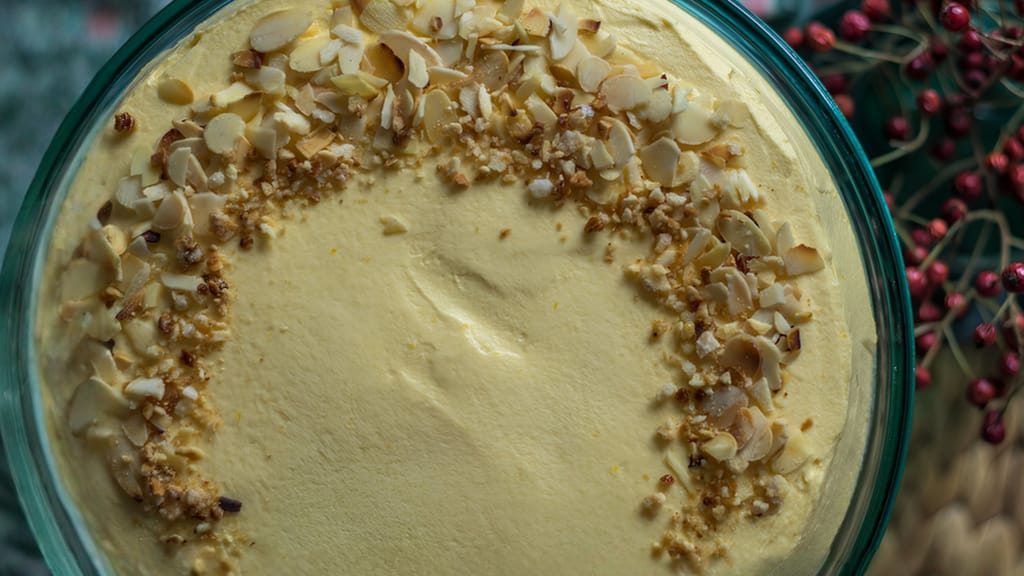
Swedish almond cake
Swedish almond cake – another moist cake with bold almond flavour
Tarta de Santiago pairs best with a sweet dessert wine or strong coffee, both of which balance out its rich almond flavour. Reach for Pedro Ximénez or Amontillado sherry, Spanish cava, Galician orujo spirit, or simply a shot of espresso. If you love almonds, a glass of Amaretto liqueur is a treat, too.
The cake tastes most authentic alongside a sweet sherry – rich, raisiny Pedro Ximénez or drier, nutty Amontillado complement the almonds like old friends. For contrast, pour a sparkling cava: its fine bubbles and acidity cut through the sweetness. A shot of Galician orujo spirit also goes nicely with afternoon coffee.
Outside Spain, a light, aromatic white wine like Moscato d'Asti or Riesling works well, with their fruity, floral notes. For something bolder, try Amaretto, whose almond flavour meets the cake on the same wavelength. And if you'd rather skip the alcohol, a good espresso or unsweetened black tea does the job just fine.

Tarta de Santiago proves that three ingredients can add up to a dessert with five hundred years of history behind it. Stick to the 1:1:1 ratio, use blanched almonds, whisk the eggs properly, and don't overbake – the rest is just a powdered-sugar cross and a little patience while it cools. Bake it, decorate it, and serve it with a glass of sherry.
Yes, a genuine Tarta de Santiago is naturally gluten-free – it contains no flour at all, held together by ground almonds, sugar and eggs alone. Just make sure your almonds and icing sugar haven't been cross-contaminated with gluten if you're baking for someone sensitive to it.
Yes, use blanched (peeled) almonds for Tarta de Santiago. The skins contain bitter compounds that give the cake an unpleasant, sharp aftertaste. Either buy ready-blanched almonds, or scald them in boiling water and peel off the skins before grinding.
You can, but expect a finer, denser cake. Store-bought almond flour is ground very fine, so it holds less air and tends to be drier. Traditional Tarta de Santiago is made with coarsely ground almonds – if you're grinding your own, aim for a coarser, semolina-like texture.
A dry cake usually means it's overbaked – without flour it dries out fast, so take it out as soon as a skewer comes out clean and the top springs back. A gooey middle, on the other hand, means it's underbaked or the eggs weren't whisked enough; beat them with the sugar into a pale foam for 3–5 minutes and bake until a skewer comes out clean.
Covered at room temperature, Tarta de Santiago keeps for 3–4 days and, thanks to the almonds and sugar, actually gets moister over time. In the fridge it keeps up to a week, but let it come back to room temperature before serving. You can also freeze it for up to two months – just dust on the powdered-sugar cross after thawing, right before serving.
One recipe worth heating the oven for, one tip, and one deal from the shop. Nothing else.