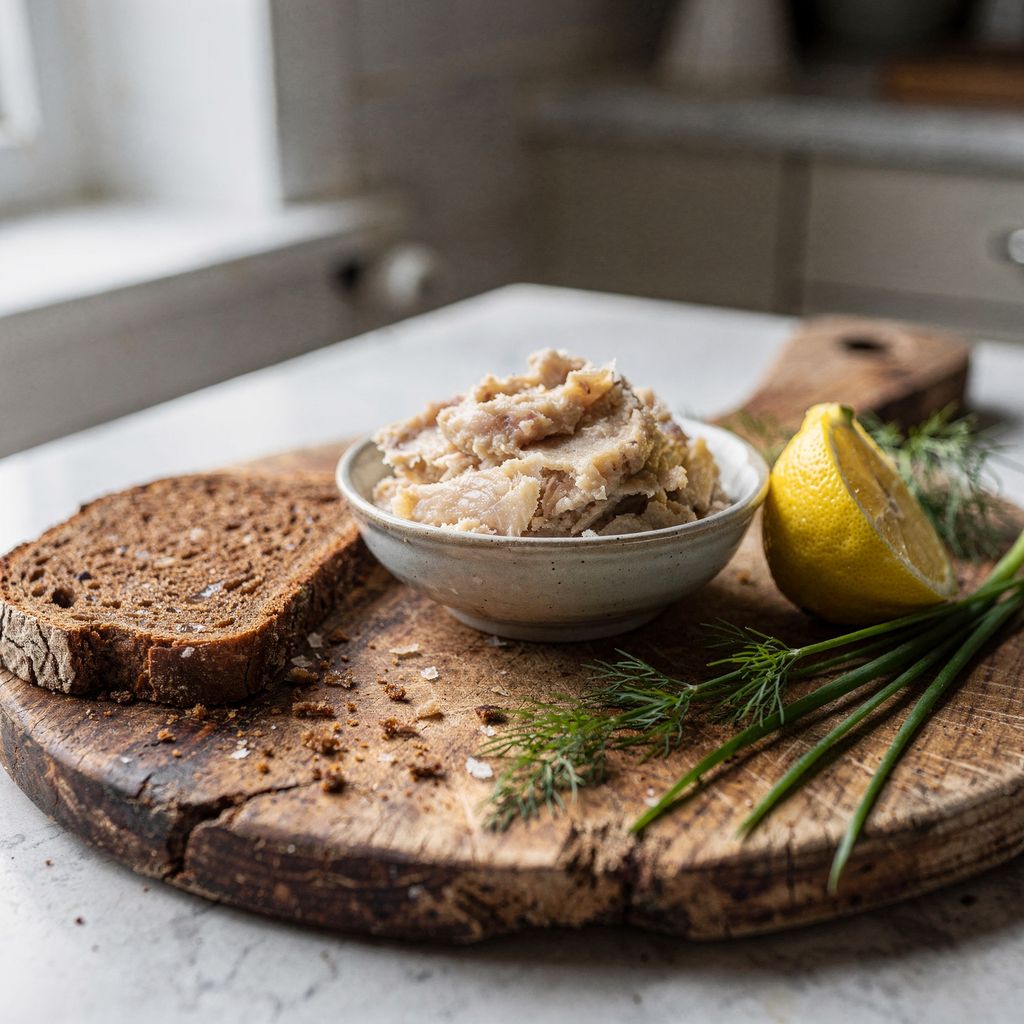
Smoked salmon spread
Fish & Tuna Spread: Which Fish to Use and Why
Updated Sep 18, 2026
For a fish spread, richer, big-flavoured fish work best — smoked mackerel, sardines and smoked salmon. For a tuna spread, reach for light tuna in water when you want a clean flavour and firm flakes, or tuna in oil when you want creaminess without mayo. Fish behaves differently in a spread than it does in a pan: what matters is fat content, flake size, and whether it's smoked or not. Below you'll find what each fish does to flavour and texture, what ratio to mix it with your base, and how long the finished spread keeps.
The best choices for a spread are smoked mackerel, sardines, smoked salmon and tuna in water or oil — the fattier the fish, the less base it needs.
Light tuna in water – neutral, firm flakes, the leanest of these fish. A good base for a light spread.
Tuna in oil – more tender and fuller-flavoured, holds a creamy texture even without mayo.
Sardines in oil – the boldest flavour, with soft edible bones that add calcium.
Smoked mackerel – the richest and most aromatic, thick enough on its own to make a dense paste.
Smoked or canned salmon – delicately sweet flavour, a lovely colour, great for canapés.
The fat rule has a direct practical effect: smoked mackerel needs no more than a few spoonfuls of curd cheese, while drained tuna in water is dry and crumbly without some added fat.
Tuna is the most versatile fish for a spread because it tastes mild and won't overpower whatever you add to it. A 140–160 g can gives you roughly 100–112 g of fish once drained, enough for two to three servings. Drained tuna has around 20 g of protein per 100 g, and tuna in oil comes in even higher after draining — up to 29 g — making it a light, high-protein base.
How it behaves in the kitchen depends on how it's cut. Chunks (steak or fillet style) hold their shape and give you a spread with visible flakes; flaked/shredded tuna blends down smooth. If you want texture, break the tuna up with a fork and never put it in a blender — it'll turn into wet mush.
Sardines and sprats give the boldest flavour of all the tinned fish: sardines bring soft edible bones, sprats bring smoky depth and more salt. Sardines are the classic base for the traditional Czech-style fish spread with egg, butter and onion.
Nutritionally, they're notable precisely because of those bones: tinned sardines with bones contain roughly 240–380 mg of calcium per 100 g depending on the packing liquid (tomato sauce tends toward the lower end, while USDA data puts drained oil-packed sardines as high as 382 mg), plus around 1 g of EPA and DHA omega-3s per 100 g. Mash them with a fork, bones and all — just remove the spine if it's thick.
With sprats, which are smoked and saltier, cut back on the salt and add a touch more acid (lemon, pickle), otherwise the spread ends up tasting heavy.
Smoked mackerel is the fattiest of the commonly available fish and makes a thick spread almost on its own. Nutritional tables put it at around 2–4 g of EPA and DHA per 100 g depending on how it's processed — the highest of the fish covered here.
Peel off the skin, lift the flesh off the spine and feel through it with your fingers — mackerel has thin pin bones along the sides that won't mash down. For 200 g of flesh, 80–100 g of curd cheese or sour cream plus a spoonful of grated horseradish is plenty. Any more base just dilutes its flavour needlessly.
Salmon is the mildest option and works best where you want the spread to complement, not dominate. Smoked salmon just needs chopping with a knife and folding into cream cheese; canned salmon behaves similarly to tuna, only richer and sweeter.
Handle it carefully: smoked salmon is already salted, so add salt only at the end, after tasting. Dill, lemon zest and a touch of black pepper do the rest.
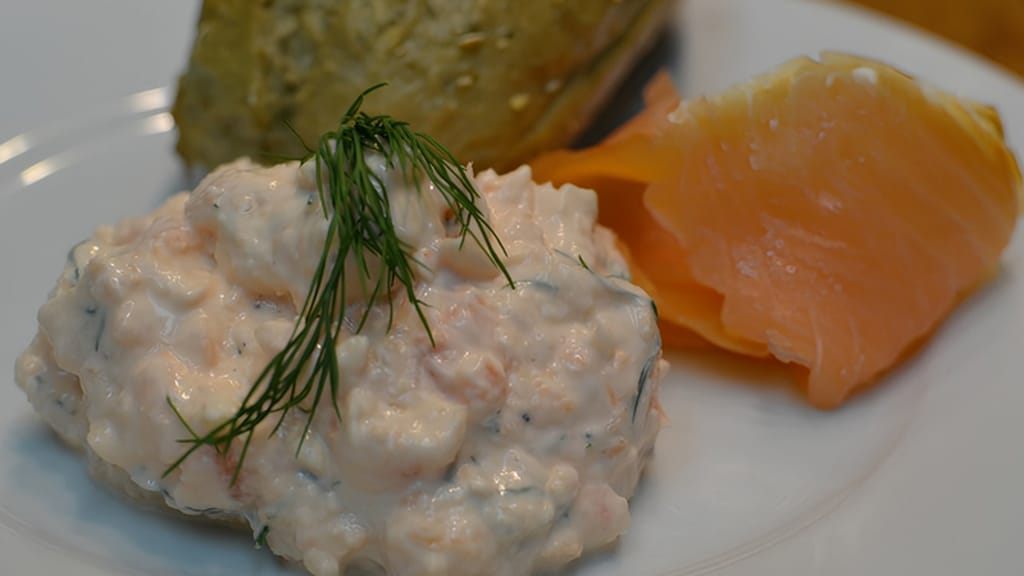
Smoked salmon spread
Salmon spread – a full recipe for a delicate fish spread made with salmon
Choose tuna in water when you want a light spread and a clean fish flavour; choose tuna in oil when you want creaminess without mayo. The main difference is fat and energy — tuna in water sits somewhere between 85–110 kcal and under 1.5 g of fat per 100 g depending on the source, while drained tuna in oil comes in around 190 kcal per 100 g. Drained tuna in oil actually has more protein per 100 g too, simply because it loses more water.
There's one more practical difference: the liquid you decide to keep. Sunflower oil from the can is bland and adds nothing to the spread, so drain it off. Olive oil from a good-quality can, on the other hand, is worth keeping — two spoonfuls of it can replace half the mayo.
Light spread with curd cheese → tuna in water, well drained
Creamy without mayo → tuna in olive oil, keep some of the oil
For kids and canapés → tuna in water, milder flavour
Don't skimp on draining. Let the tuna sit 2–3 minutes in a sieve and press it gently with a spoon. Leftover liquid is the number one reason a spread turns watery within the hour.
A ratio that works well is 2:1 — two parts drained fish to one part fatty base, by weight. So for 200 g of fish, roughly 100 g of curd cheese, cream cheese or butter.
Adjust from there depending on the fish:
Tuna in water – 2:1 up to 1.5:1, needs the most base
Sardines and salmon – 2:1
Smoked mackerel – 2.5:1, since it's already rich on its own
Add the base a spoonful at a time and mix until the spread holds on a knife without running. The finished texture should be spreadable straight from the fridge, cold — if you have to wait for it to soften, there's too much butter in it.
The most reliable base for a fish spread is curd cheese as the starting point, plus a spoonful of mayo or olive oil: the curd cheese gives it body, the fat gives it glide on bread. But every base changes the texture and flavour differently:
Curd cheese (full-fat or medium-fat) – the best balance of flavour and lightness, holds its shape, doesn't weep water. The default choice.
Cream cheese – the creamiest, gently tangy, ideal with salmon.
Butter (softened, not melted) – traditional with sardines, but firms up in the fridge. Use it for no more than half the base.
Sour cream (15–18%) – smooth without feeling heavy, but it thins the spread out; combine it with curd cheese.
Greek yoghurt – the lightest, noticeably tangy; let the spread rest for 30 minutes, then adjust the salt.
Mayonnaise – gives that smooth, deli-style texture, but shortens the shelf life the most.
Two bases together almost always work better than one alone — curd cheese with cream cheese for salmon, butter with curd cheese for sardines.
A fish spread needs three things: acid, sharpness, and salt added last. Fish and a fatty base are both mild flavours — without contrast, the spread ends up flat.
Acid – lemon juice (1 teaspoon per 200 g of fish), chopped pickles or capers. Acid also tones down any fishiness.
Sharpness – spring onion, shallot, horseradish with mackerel, mustard with sardines. Finely chop raw onion and let it sit in lemon juice for 5 minutes to soften its bite.
Herbs – dill with salmon, chives with tuna, parsley with sardines.
Salt only at the end. Smoked fish, capers and mustard already bring salt with them — season to taste, not in advance.
And most importantly: let the spread rest in the fridge for at least 30 minutes. The flavours come together and the texture settles — it's usually a bit thicker after resting.
Eat fish and tuna spread within 2 days, and if it contains mayo or cream cheese, aim for 24–36 hours. Fish spreads, along with meat-based ones, spoil the fastest — vegetable spreads keep considerably longer.
What extends shelf life:
Store in a sealed container below 5°C, not in the fridge door
Always scoop with a clean spoon, never one you've licked
Smooth the surface flat and press it down — less air means slower oxidation
Lemon and salt extend shelf life slightly, but they don't replace refrigeration
Don't freeze fish spread. Curd cheese, sour cream and mayo all split once thawed, and the spread separates into water and fatty solids. The only thing you can freeze ahead is the smoked fish on its own.
Five things most often ruin a fish spread: undrained fish, a blender, too much mayo, salting too early, and cold curd cheese.
Undrained fish. The liquid dilutes the base and the spread turns watery within the hour. Sieve it, 2–3 minutes, press gently.
A blender. It breaks down the fibres and turns the fish into a wet paste with no texture. A fork is the better tool.
Too much mayo. It overpowers the fish and shortens the shelf life. Use it as a supporting player alongside curd cheese, not the main base.
Salting too early. Smoked fish, capers and mustard are already salty on their own. Taste first, then season.
Cold curd cheese straight from the fridge. It won't mix in smoothly. Let it sit on the counter for 15 minutes so it blends evenly, and you won't have to beat it into the fish.
The closest swap for tuna is canned salmon or smoked mackerel — both have a similar flaky texture, just a stronger flavour, so cut back on the seasoning. For a fish-free version, mashed chickpeas with a splash of caper brine and a pinch of ground nori work well, giving a sea-salty edge; match the texture using the same 2:1 ratio with your base as you would with fish.
Jarred tuna usually comes as whole muscle loins or fillets in olive oil, while canned tuna tends to be smaller pieces or flakes — jars cost more but give you firmer, bigger flakes. The practical upside of a jar is that you can see the size of the pieces and the colour of the flesh before you buy; cans, on the other hand, travel and store better. Nutritionally they're comparable — it's the packing liquid that matters, not the container.
Yes, and it often tastes better. Use poached or baked salmon, trout or cod — cook the fish to an internal temperature of 62–65°C, let it cool, then flake it apart. Keep in mind that fresh fish is less salty than tinned, so you'll need more salt and acidity, and you should eat the finished spread within 24 hours.
Freezing is a no — the bread turns soggy once thawed and the spread splits into water and fat. You can prep the components a day ahead: keep the flaked fish, chopped spring onion and boiled eggs separate in the fridge, mix the spread in the morning, and don't spread the sandwiches until 3–4 hours before serving. Keep finished sandwiches covered with plastic wrap so the bread doesn't dry out.
Reckon on roughly 25–30 g of spread per canapé and 40–50 g per slice of bread. One can of tuna (140–160 g, about 100–112 g once drained) plus 60 g of curd cheese makes around 170 g of finished spread — enough for about six canapés or four slices.
The fishy smell comes from trimethylamine (TMA), which is released from the fish flesh on contact with air — the longer the spread sits open, the stronger it gets. Acid helps, since lemon juice or vinegar binds it chemically, as does an airtight container with the surface smoothed flat and no air pockets. If the smell turns sharply ammonia-like, don't eat the spread.
One recipe worth heating the oven for, one tip, and one deal from the shop. Nothing else.