Popping Candy Crackling Sugar
Popping Candy: What It Is and How to Use It in Desserts
Updated Oct 8, 2026
Popping candy is a hard sugar sweet with bubbles of carbon dioxide trapped inside under pressure — once saliva dissolves it, those bubbles burst, and you can hear and feel it happening right in your mouth. You can add it to almost any dessert, but one rule governs everything: fat protects it, water kills it. That's why it keeps popping for weeks in chocolate but only a few minutes in whipped cream. Here's how it works, where it belongs, how much to use, and when to add it so it's still popping at the table — not in the fridge.
Popping candy is a sugar mixture cooked into a hard caramel, into which carbon dioxide (CO₂) is forced under high pressure. Production descriptions put that pressure at around 40 bar (600 psi) — many times more than you'd find in a bottle of sparkling water.
Here's what happens, step by step:
Making it: sugars (sucrose, glucose syrup, and sometimes lactose) are boiled down and carbonated with CO₂ under pressure.
Cooling: the mixture hardens fast, trapping the gas inside tiny bubbles within the glassy sugar.
Releasing the pressure: the hardened sugar is shattered into crystals, each one packed with little pressurised bubbles.
In your mouth: saliva dissolves the sugar, the bubble walls give way, and the gas escapes with an audible pop.
So it's pure physics, not a chemical reaction — nothing is "exploding" inside you, it's just a bit of gas being released, much like when you take a sip of soda.
It was patented by General Foods chemists William A. Mitchell and Leon T. Kremzner (patent filed in 1961), and hit shelves as Pop Rocks in the mid-1970s.
Popping candy stops popping once it comes into contact with moisture — it dissolves before you get to eat it, and the gas escapes for nothing. Sugar is highly hygroscopic, so it pulls in moisture even from the air around it.
In practice, that means:
Water = game over. Whipped cream, fruit purée, curd cheese, jelly, syrup, wet batter — the candy fizzles out within minutes in any of these.
Fat = protection. Chocolate, cocoa butter, or coconut oil coat the crystals and seal them off from moisture. Chocolate contains only around 1% water, which is why candy mixed into it keeps popping for weeks.
An open bag is a ticking clock. In a humid kitchen, the crystals clump together after a few days and lose their fizz. Once opened, seal the bag tightly — ideally transfer it to a screw-top jar.
Heat alone won't destroy it, but oven-baked batters contain water and steam — that's why popping candy is never baked.
Popping candy performs best in chocolate and on dry surfaces, less well in creams, and worst of all in batter. Here's a quick guide to how long the pop actually lasts:
Chocolate, chocolate bars, pralines, chocolate lollipops: weeks. The most reliable use by far.
A cake or cupcake edge dipped in chocolate: days, as long as the candy stays embedded in the chocolate and doesn't touch the filling.
Buttercream: a few hours. Butter contains around 16% water, so the candy gradually loses its fizz.
Ganache and caramel: hours to a day, depending on the cream content.
Whipped cream, mascarpone, cream cheese frosting, ice cream, fresh fruit: minutes. Sprinkle it on only right before serving.
Baked batter: never. The pop disappears completely in the oven.
Stir popping candy into chocolate once it's cooled to working temperature (around 31–32°C/88–90°F for dark, 29–30°C/84–86°F for milk, and 28–29°C/82–84°F for white), then pour it straight away. It sets quickly, so the candy doesn't have time to sink to the bottom, and the chocolate keeps its shine. For tips on tempering chocolate so it comes out glossy, see our guide on dipping sweets in chocolate so they shine and don't smudge.
How much to use: 10–15 g of popping candy per 100 g of chocolate. Less and the pop gets lost; more and the chocolate turns crumbly.
There are two ways to add popping candy to chocolate: stir it through the mixture, or sprinkle it on the surface.
Stirred into the mixture: every bite pops. Great for pralines and lollipops.
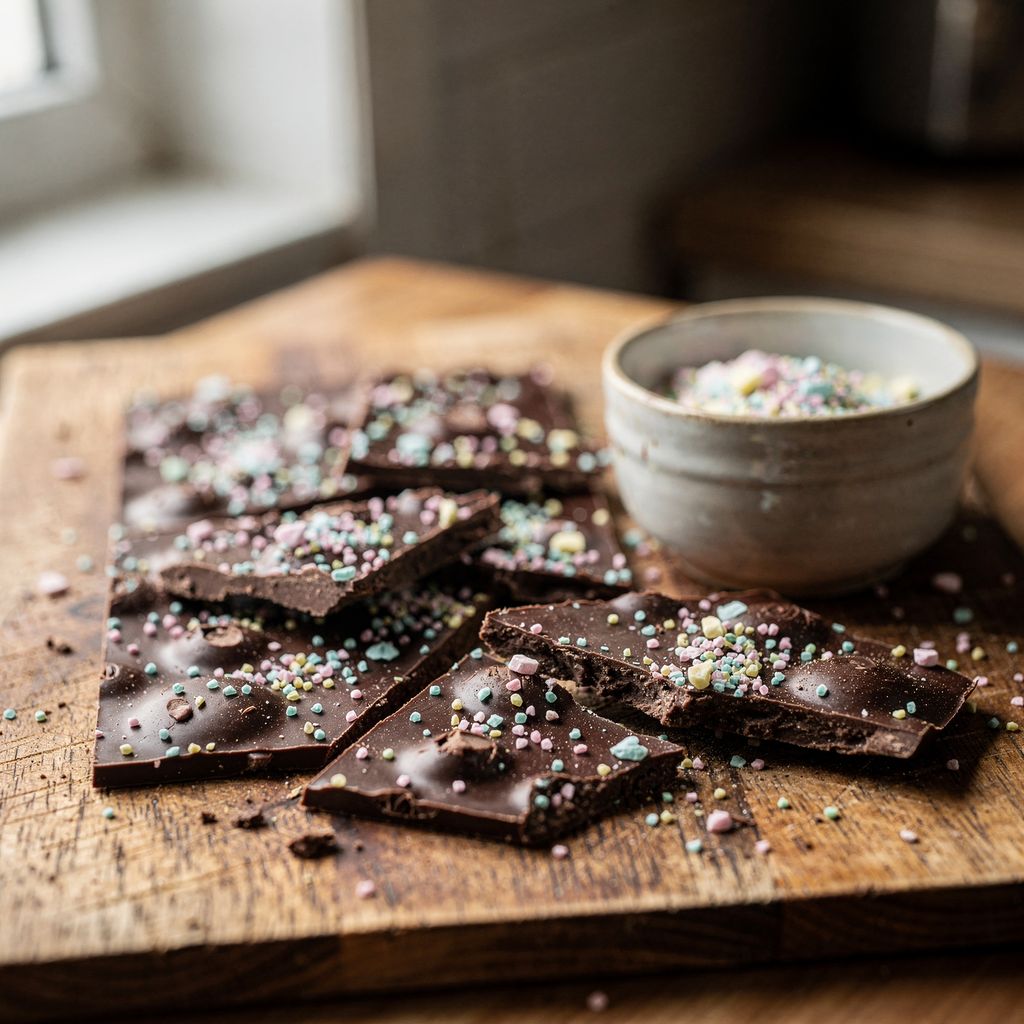
Sprinkled on top: pour the chocolate onto baking paper in a 3–5 mm layer and scatter the crystals over it while it's still liquid. Press them in gently so they stick. This looks better and gives you a pop from the very first bite.
For giftable bars with a sprinkled topping, try our homemade chocolate bars with edible flowers and nuts — just add popping candy as an extra layer. For guidance on which chocolate suits which job, see Callebaut 811, 823, W2 and RB2: what the numbers mean.
On cakes and cupcakes, add popping candy right at the end of decorating, and always over a layer of fat — chocolate is best. Added directly to whipped cream or frosting, it only lasts a short while.
What actually works:
Chocolate-dipped edge: dip the edge of a decorated cupcake into melted chocolate and immediately roll it in popping candy. The chocolate acts as a barrier between the candy and the frosting.
Chocolate shards with popping candy: pour a thin chocolate bar studded with popping candy, break it into shards, and stick them into the frosting. On a cake, it'll keep popping until the next day.
Last-minute sprinkle: only sprinkle it onto frosting right before the cake goes to the table. For a cupcake, 1/2 teaspoon (about 2 g) is enough.
Coated in cocoa butter: mix the crystals with a little melted cocoa butter or coconut oil (about 1 teaspoon per 20 g of candy) and let it set. This thin fat coating buys you several extra hours of popping once it's in the frosting.
Try it on chocolate cupcakes with caramel frosting or along the edge of a simple chocolate cake. For more decorating ideas that pair well with it, check out our cake and cupcake decorating page and our roundup of edible cake decorations.
Sprinkle popping candy onto ice cream, mousse, or fruit only once it's plated, right before serving — in a wet environment it fizzles out within minutes. That short burst of popping is exactly the point: a one-shot moment on the very first spoonful.
To make it last a little longer, coat the ice cream first in a thin layer of chocolate shell that sets on contact with the cold (chocolate melted with coconut oil, roughly 100 g chocolate to 30–40 g coconut oil), and scatter the popping candy into it. This works beautifully on salted caramel ice cream, for instance.
Popping candy also makes a fun surprise element for kids' parties, catching them off guard right from the first spoonful. For more themed dessert ideas, see our article on cupcakes for a kids' birthday party.
Popping candy adds sound and fizz, while crispy pearls add a crunch that lasts far longer. Four different toppings, four different effects: popping, long-lasting crunch, caramel crunch, and plain colour:
Popping candy: pops and fizzes on the tongue, sweet and often fruit-flavoured. It's the most sensitive to moisture — a few hours in buttercream, just minutes in whipped cream.
Crispy pearls (chocolate-coated cereal pieces): crunchy, chocolatey, and thanks to their chocolate coating they'll hold up in frosting for a day or two. They don't pop.
Praline brittle (nuts in caramel): crunchy and fragrant, but in a humid environment it turns sticky and soft. Store it dry and add it at the very last moment.
Classic sugar sprinkles: colour and a light crunch, no sensation in the mouth beyond that.
You can combine both effects: layer crispy pearls underneath popping candy for two kinds of crunch at once. For tips on keeping crispy pearls from going soft, see our article on crispy pearls on cakes and sweets.
Store popping candy somewhere dry, in a tightly sealed container, at a cool temperature (ideally 15–20°C/59–68°F). An unopened bag keeps until the date on the packaging; once opened, it's best used within a few weeks.
Don't put it in the fridge — moisture condenses on the cold crystals as soon as you take them out.
Finished chocolate containing popping candy should be wrapped in foil or kept in an airtight container, stored somewhere cool and dry (15–18°C/59–64°F). It'll keep popping for weeks.
Based on available information, popping candy mixed with cola isn't dangerous — the "exploding stomach" story is a myth. A single small Pop Rocks pack (about 9.5 g) releases less carbon dioxide than half a can of soda. This is general food information, not health advice.
Not really — popping candy is made by carbonating melted sugar with CO₂ under roughly 40 bar (600 psi) of pressure, which isn't something you can safely replicate in a home kitchen. At home, just buy it ready-made and work with it: stir it into chocolate or sprinkle it over a finished dessert.
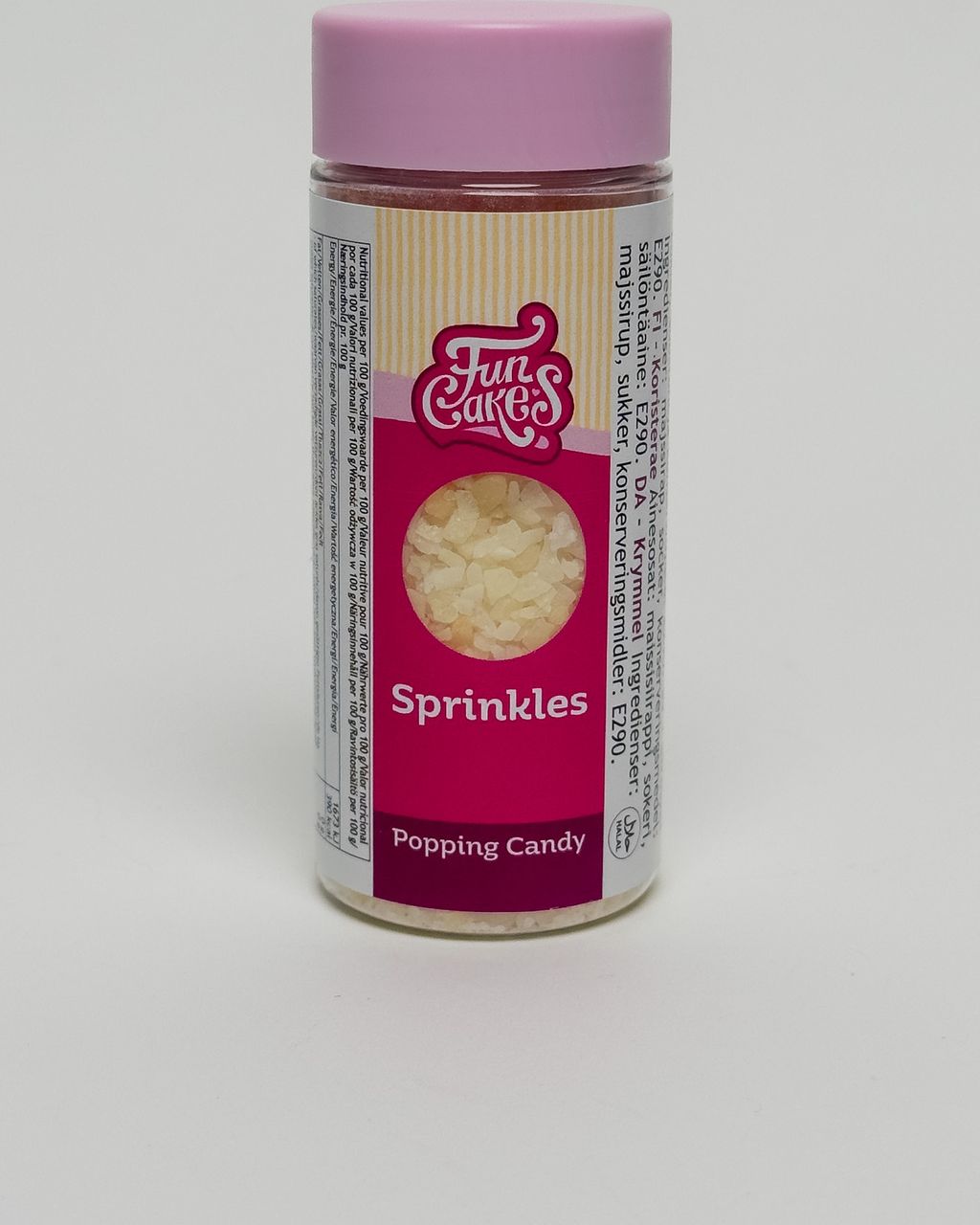
It depends on the brand: classic Pop Rocks contain lactose, while FunCakes Popping Candy doesn't and is labelled vegan. It typically doesn't contain gluten, but always check the ingredients and allergen info on the packaging.
A 70 g bag of popping candy, for example, is enough for roughly 5–7 chocolate bars (100 g each), or for topping around 35 cupcakes. Plan on 10–15 g per 100 g of chocolate, and about 2 g per cupcake.
Break up clumped popping candy with your fingers and use it in chocolate, where you'll still notice some popping; for cream or ice cream, open a fresh bag instead. Clumping is a sign the candy has absorbed moisture and will only pop faintly now.
One recipe worth heating the oven for, one tip, and one deal from the shop. Nothing else.