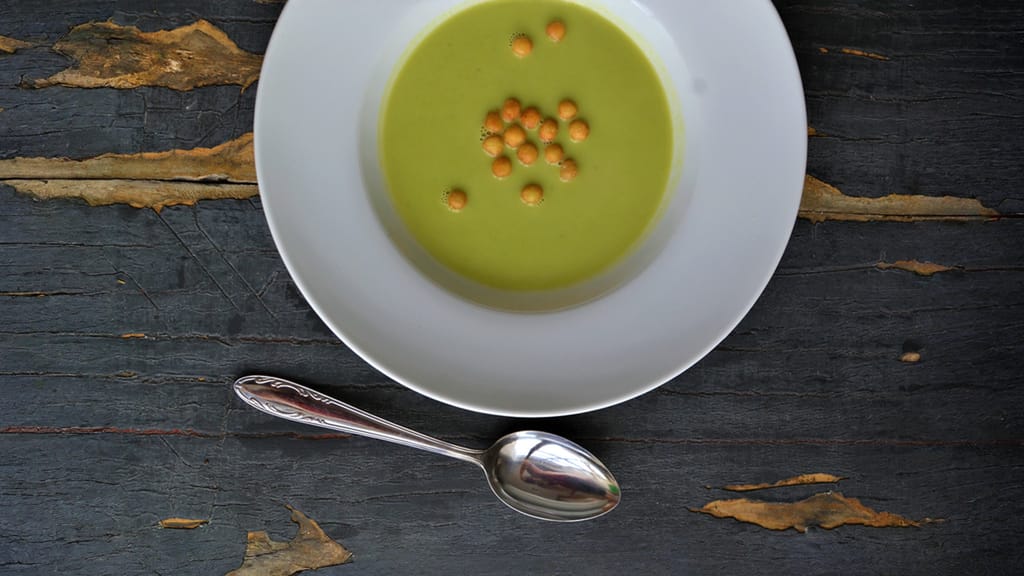
Fresh pea soup with sour cream
Pea Soup: How to Make a Vivid Green Cream of Pea Soup, Step by Step

Updated Aug 30, 2026
Cream of pea soup is a smooth soup made from young green peas, onion and stock that comes together in twenty minutes — and the secret is not to overcook it. Peas only need three to five minutes in hot stock; any longer and they lose both their sweetness and their colour, turning a bright green soup into an olive-grey mush. Below you'll find the ratio of ingredients, the exact method, the chemistry behind that green colour, and the five most common mistakes that stop pea soup turning out right at home.
Cream of pea soup is made from green peas — young, sweet seeds picked while still unripe. Split pea soup is made from dried yellow split peas, the same seeds left to ripen fully and dry out. It's the same plant (Pisum sativum), but in the kitchen they're two completely different ingredients.
This distinction isn't just academic — it dictates the whole method:
Green peas — sweet, bright green, cooked for 3–5 minutes. No soaking needed. The result is fresh and vividly coloured.
Yellow split peas — starchy, earthy, soaked overnight and cooked for 60–90 minutes. The result is thick, hearty and beige.
So if you come across a recipe for "pea soup" that calls for overnight soaking, it's a different dish entirely. This article is all about green peas.
For pea soup, reach for frozen peas — for most of the year they're actually the better choice flavour-wise compared to "fresh" peas from the shop, and that's not a compromise.
The reason lies in what happens to peas after picking. The moment they're picked, an enzyme starts converting their sugars into starch — a process that takes hours, not days. Peas destined for freezing are picked at peak ripeness and typically flash-frozen within a few hours of harvest, which halts that conversion. "Fresh" peas in the pod that have spent three days travelling to the shop shelf are measurably less sweet and starchier by comparison.
Fresh peas make sense in two situations:
You've got your own garden or a farmers' market and shell them the same day.
It's peak season — in the UK, roughly from late May to July. Outside that window, "fresh" peas from the shop are almost always a worse choice than frozen.
Frozen peas also don't need thawing — just tip them straight into boiling stock. Thawed peas release water and turn mushy faster.
The basic ratio that works: 500g peas to 700–800ml stock. That makes four servings of a medium-thick soup.
500g frozen green peas — the star ingredient, don't skimp on it
1 small onion or 2 shallots (about 80g), finely chopped
20g butter or a tablespoon of olive oil
700–800ml vegetable stock — good quality, ideally homemade
salt and freshly ground black pepper
optional: 50–100ml double/heavy cream (31%+) or coconut milk
You can adjust the thickness with the stock: 600ml gives a thick soup that holds its shape on a spoon, 900ml a light, brothy soup. Add the stock gradually — it's always easier to add more than to take it away.
One rule for the stock: it should taste slightly weaker than you'd want to drink it on its own. Cream of pea soup gets blended, which mutes flavours, so a strong or over-salted stock will overpower the finished soup. If you're using a shop-bought one, choose a reduced-salt version and season with salt only at the end.
Just remember to let the onion turn translucent, not golden. Caramelised onion is lovely in French onion soup, but here it gives the soup a brownish tinge and a sweetness that clashes with the peas.
Pea soup comes together in six steps: soften the onion, add the stock, cook the peas for 3–5 minutes, blend, sieve, and season — done in 20 minutes.
Soften the onion. In butter or oil, cook the onion over medium heat for 4–5 minutes until translucent. It shouldn't take on any colour.
Add the stock and bring to the boil. The stock needs to be properly boiling before the peas go in.
Add the peas and cook for 3–5 minutes. Start timing once the stock returns to the boil. The peas are done when tender to bite but still vividly green.
Blend immediately. Don't dawdle — every extra minute in the pot drains away colour. Blend while hot, either with a stick blender directly in the pot or in batches in a jug blender, for 60–90 seconds until completely smooth.
Push it through a fine sieve. Most people skip this step, which is a shame: pea skins never blend down completely, and they're what gives the soup its slightly grainy texture. Pushed through a sieve, the soup becomes silky smooth.
Season only now. Salt, pepper, and cream if using, off the heat. Any acid — lemon, vinegar — right at the very end (more on why below).
The colour comes down to chlorophyll, the green pigment in peas, which breaks down during cooking in two ways. The chlorophyll molecule has a magnesium atom at its centre; when a hydrogen ion displaces it, it forms pheophytin — which is an olive grey-green. That's exactly the colour of overcooked pea soup.
Two things speed up this reaction: prolonged cooking and acidity. Which gives us three practical rules:
Keep the cooking time short. Three to five minutes. Chlorophyll is heat-sensitive, and the breakdown continues the whole time the pot is on the heat.
Add acid only off the heat. Lemon juice, vinegar or white wine all improve the flavour, but added to boiling soup they'll knock the colour out within minutes. Add a squeeze in the bowl instead.
Cool it quickly if serving cold. Set the pot in a sink of iced water and stir. A soup left to cool slowly on the stove for an hour will keep turning greyer.
And one tip we'd actually advise against — a pinch of baking soda genuinely does keep the colour green, because an alkaline environment stabilises chlorophyll. But it also destroys some of the vitamin C, breaks down the cell walls into a mushy texture, and leaves a soapy aftertaste. A short cooking time gives you the same colour without any of those three downsides.
If your pea soup hasn't turned out right, it's almost certainly one of these five things: overcooking, adding acid too early, skipping the sieving step, adding too much stock at once, or boiling the cream in the soup.
You're cooking it too long. The most common mistake, and the only one you can't fix. Twenty minutes of boiling turns peas into grey mush. Three to five minutes is all it takes.
You're adding lemon to the pot. A good idea in principle, wrong in execution. Acid added while hot converts chlorophyll into pheophytin. Save it for the bowl.
You're skipping the sieve.Even a powerful blender can't fully break down the skins. Without sieving, the soup will be slightly grainy — that's the difference between a home-cooked soup and a restaurant one.
You're pouring in all the stock at once. A thin soup can only be thickened by cooking it longer, and that's exactly what damages the colour. Add the stock in stages instead.
You're boiling the cream. Cream can curdle in boiling soup, especially if there's acid in it. Stir it in off the heat, into soup that's below boiling point.
Fresh pea soup with sour cream
Fresh pea soup with soured cream — a tried-and-tested pea soup recipe with all the ratios
The basic pea soup takes well to four tried-and-tested variations: vegan with coconut milk, mint and lemon, curried with ginger and chilled summer version. They all start from the same base — only the fat and seasoning change.
Swap the butter for olive oil and the cream for 80–100ml full-fat tinned coconut milk (not the carton drinking kind — that's too thin). Coconut gives the soup a silky texture and a gentle sweetness that pairs surprisingly well with peas. Stir it in off the heat and finish with lime and a pinch of coriander (cilantro).
Pea soup is naturally gluten-free with no extra tweaks needed, as long as you use a gluten-free stock — always check the label if you're buying one.
For mint pea soup, add a handful of leaves (about 10g) to the blender with the finished soup, not into the pot — mint boiled in stock turns bitter and loses its aroma. Add the zest of half a lemon, and save the juice for a squeeze in the bowl.
Mint and peas work so well together because they share a fresh, grassy aroma — mint doesn't mute the sweetness of the peas, it draws it out.
Fry a teaspoon of curry powder with the onion in the fat before adding the stock — spices need fat and heat to release their aroma; cooked in water alone they stay dusty and flat. Add a knob of grated ginger (about 10g) and finish with coconut milk.
This version can take chilli too, but go easy: peas are delicate, and chilli heat easily overwhelms them.
Make the soup following the basic method, then chill it over an ice bath rather than slowly in the fridge. Cold dulls flavours, so season only once it's fully chilled — it'll need more salt and more acid than you'd expect. Serve chilled to 8–10°C with a spoonful of Greek yoghurt and a drizzle of olive oil.
Serve pea soup warm, at 60–65°C — boiling-hot soup scalds the tongue and kills off the peas' delicate aroma, while lukewarm tastes flat. And add one creamy and one crunchy element to the bowl, no more.
Creamy: a spoonful of soured cream or Greek yoghurt, swirled in. As well as flavour, it gives a nice visual contrast against the green.
Crunchy: homemade croutons, toasted pumpkin seeds, or for non-vegetarians, crispy bacon bits.
Aroma: a few mint leaves, a drizzle of good olive oil, freshly ground black pepper.
Deep white bowls show off the green colour best. And pour the soup only just before serving — pea soup quickly forms a skin on the plate.
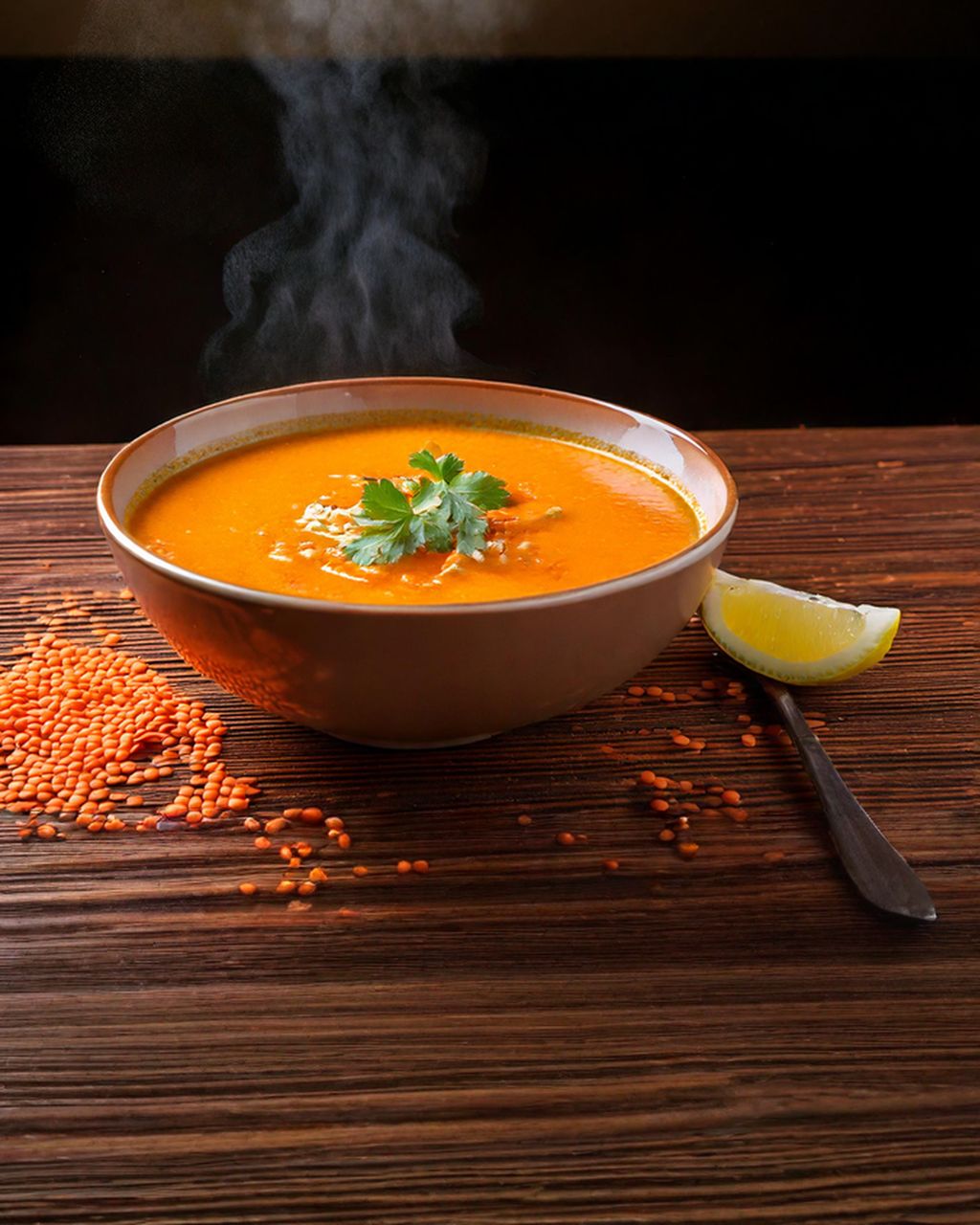
Looking for more soups to add to your repertoire? Red lentil soup is made in a similar way, just with a longer cooking time and no need to worry about colour.
Pea soup isn't thickened with a roux or potatoes — its calorie content mainly comes down to the fat and cream you add to it. Green peas are high in protein and fibre — 5.4g of protein and 5.7g of fibre per 100g. According to the USDA database, raw green peas contain roughly, per 100g:
81 kcal
5.4g protein
5.7g fibre
around 40mg vitamin C
approximately 25µg vitamin K
With vitamin C, it's worth being honest: it's water-soluble and heat-sensitive, so some is lost during cooking. As it happens, the short cooking time we recommend for colour also preserves more vitamin C than twenty minutes of simmering would — and since you don't drain the soup, whatever leaches into the stock stays in the pot.
That said, the finished soup is no longer the same as raw peas. What matters most is the fat you add: 100ml double/heavy cream (31%) adds roughly 31g of fat to the whole pot, while the same 100ml full-fat tinned coconut milk (typically around 20% fat) adds roughly 20g. So the vegan version isn't automatically lighter or richer — it depends on the amount used.
If you're managing a specific dietary restriction or health condition, treat these as approximate figures and check with a nutrition professional.
In a sealed container, pea soup keeps for 3 days in the fridge and 3 months in the freezer. Always freeze it before adding cream, though — the milk fat can separate once thawed and turn grainy. Thaw it in the fridge overnight, reheat just until hot (not boiling), and stir the cream in only at this point. Expect the thawed soup to be a shade darker than fresh; it won't affect the flavour.
You can use tinned peas for pea soup, but the result is noticeably worse and needs a different method. Tinned peas are already cooked and have faded to an olive colour, so just warm them through in the stock for about a minute and blend straight away — any more cooking only loses more quality. Drain and rinse the peas first, as the brine is usually quite salty. They'll lack sweetness, so season with a pinch of sugar to compensate. Frozen peas are always the better choice for pea soup.
The simplest fix is to add more peas and less stock — peas have enough starch of their own to give the soup body. If the soup is already made and too thin, a handful of blended white beans or chickpeas (about 100g), a spoonful of ground cashews, or a couple of spoonfuls of cooked rice blended in all work well. All three options are vegan and gluten-free. We wouldn't recommend thickening with a flour-based roux — it kills the fresh flavour that's the whole point of pea soup.
Pea soup can be made without a stick blender — mash the peas with a potato masher or pass them through a food mill, then push the soup through a fine sieve. In this case, the sieve isn't just there for smoothness — it does most of the work: push the soup through with the back of a ladle and take your time. The texture will be slightly less velvety than with a blender, but the difference is smaller than you'd expect.
Pea soup thickens on cooling because of starch retrogradation from the peas — the starch molecules rearrange themselves and bind water. This is completely normal and nothing to worry about. On reheating, most of the original texture comes back; just give it a stir and add a splash of stock or water if needed.
One recipe worth heating the oven for, one tip, and one deal from the shop. Nothing else.