Gluten-Free Vánočka and Mazanec: How to Bake Them Soft, Not Crumbly
Gluten-Free Bread in a Bread Machine: Why It Collapses and How to Fix It
Updated Sep 25, 2026
Gluten-free bread collapses in a bread machine mainly because gluten-free dough has no elastic structure to hold the gas the yeast produces. The loaf rises higher than it can support, then the middle sinks during baking or cooling. The usual culprits are too much water, too much yeast, a program with two rise cycles, or an underbaked center. The good news: you can identify each of these mistakes by the shape of the loaf and fix it the very next time you bake.
Gluten-free bread collapses for six main reasons: too much liquid, too much yeast (or sugar), over-proofing on the wrong program, too little binder, an underbaked center, and slicing while still warm.
In wheat dough, gluten holds the gas bubbles in place — it's an elastic network that stretches and then firms up once baked. Gluten-free flours, like rice, buckwheat, or corn flour, along with starches, can't form that kind of network. A binder has to do that job instead, most often psyllium or xanthan gum, but it's still a weaker, less resilient structure. That's why gluten-free dough tolerates far smaller mistakes: a couple of extra tablespoons of water or twenty extra minutes of rising, and the loaf won't hold its shape.
It pays to fix only one thing at a time. If you change the water, the yeast, and the program all at once, you won't know what actually helped.
You can identify five types of failed gluten-free loaves by their shape: a crater (too much water or underbaking), a sunken top (over-proofing), collapse on the cooling rack (underbaking or slicing too soon), caved-in sides (steaming in the pan), and a short, dense loaf (too little water or dead yeast).
A crater in the middle with a damp, gummy, sticky center: there's too much water in the dough, or it didn't bake through. Cut 20–30 ml of liquid, or extend the baking time.
The loaf first rose all the way to the lid, then sank, leaving coarse, holey air pockets under the crust: the dough over-proofed. Use less yeast, or pick a shorter program.
It looked fine straight out of the machine but sank once on the cooling rack: the center wasn't fully baked, or you sliced it too soon.
The sides caved in while the top held up: the crust turned damp because the bread stayed in the pan after baking and steamed.
The loaf is short, dense, and hasn't collapsed: here the problem runs the other way. There's too little water, the yeast is old, or it came into contact with water that was too hot.
Gluten-free dough made with psyllium needs roughly 90–110 g of water per 100 g of flour (depending on the blend and how much psyllium you use), which is far more than wheat dough needs. For 500 g of flour blend, 5–7 g of dried yeast is usually enough. Exact figures vary by blend, though, so treat these as a starting point and adjust from there.
Weigh the liquid — don't measure it in a cup. With gluten-free bread, a 30 ml difference is the difference between a proper loaf and a crater.
Consistency: gluten-free dough doesn't knead into a ball. It should be a thick, sticky batter that holds the mark of a spatula but doesn't pour. If it spreads in the pan like pancake batter, it's too thin.
Yeast: if your bread has been collapsing from over-proofing, start by cutting the yeast by a quarter. For a 7 g packet, that's roughly 5 g.
Sugar and salt: sugar speeds up the yeast, salt slows it down. Don't skip the salt — without it, the yeast takes off too fast and the loaf collapses.
Lukewarm, not hot: use lukewarm liquid, around 25–30°C. Hot water will kill the yeast.
If your machine's manual tells you a loading order (usually liquids first, then flour, with yeast on top), stick to it. That way the yeast doesn't touch the salt or water before mixing starts.
For gluten-free bread, choose the Gluten Free program, and if your machine doesn't have one, use a quick program with a single rise. The gluten-free program mixes once, rises once, and skips any dough-reworking between rises — exactly what gluten-free dough needs.
A standard bread program is built around gluten: it kneads the dough, lets it rise, mixes it again, then lets it rise a second time. That strengthens wheat dough. It won't help gluten-free dough at all — a second rise just gives the weak structure more time to hold an ever-growing amount of gas, and the loaf over-proofs.
If you don't have a gluten-free program:
Try a quick program with a single rise, or set up a custom program if your machine allows it (roughly 15–20 min mixing, 40–60 min rising, 60–70 min baking).
Another option is to let the machine just mix the dough, then transfer it to a loaf pan and bake it in the oven, where you can keep an eye on the rise yourself.
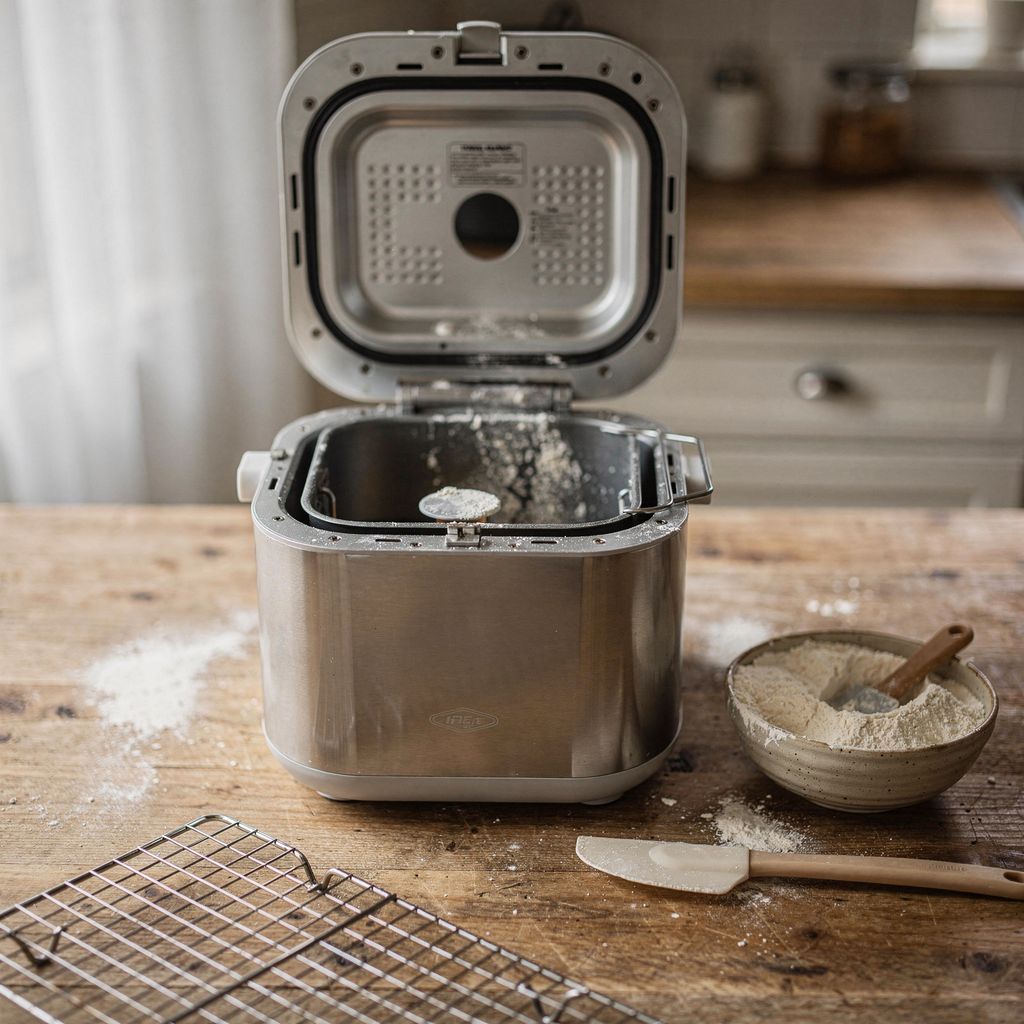
Scrape down the dough during the first few minutes of mixing. Gluten-free dough sticks to the corners of the pan, leaving lumps of dry mix behind. Use a silicone spatula to pull it back in. Then close the lid and let the kneader do its job.
A binder is what holds gluten-free bread together — the most reliable ones are psyllium (a soluble fiber from the husks of Plantago ovata seeds), xanthan gum and eggs. Without a binder, gluten-free bread crumbles or collapses.
Psyllium binds water into a gel and gives the crumb elasticity. Studies on gluten-free bread suggest it improves both volume and structure, and the bread stays fresh longer as a result. As a starting point, try roughly 4–5% of the flour's weight, meaning 20–25 g per 500 g; some blends may need more. Ground psyllium binds water more strongly than whole husks.
Xanthan gum is needed in much smaller amounts: start around 1% of the flour's weight, and don't go above 2%. Too much will make the bread rubbery.
Egg or egg white adds protein that sets during baking and firms up the loaf.
Watch out with ready-made bread mixes: most of them already contain a binder. Check the ingredients before adding extra psyllium. A double dose gives you a heavy, wet center that collapses just like an over-hydrated dough.
Making your own blend from individual flours? The same principle applies as with gluten-free sweet baking: starches give lightness, whole-grain gluten-free flours give flavor and structure. We break down how different gluten-free flours and starches behave in our article What to Use Instead of Flour in Gluten-Free Cookies.
Gluten-free bread is done when its internal temperature reaches 96–99°C (205–210°F). Check this with an instant-read thermometer inserted into the center of the loaf. The tap-on-the-bottom test that works for wheat bread isn't reliable here — a gluten-free crust sounds hollow even over an underbaked center.
Bread machines often underbake gluten-free bread. If the center is below 96°C (205°F), run the Bake Only program for another 10–15 minutes.
Take the loaf out of the pan as soon as it's done baking and set it on a cooling rack. Left in the pan, it will steam, the crust will turn damp, and the sides will cave in.
Let it cool for at least 2 hours, ideally completely. The starch in the crumb only fully sets as it cools. If you cut into warm bread, the steam escapes, the crumb gums up, and the knife presses it into a rubbery layer.
Gluten-free bread goes stale faster than wheat bread, so it's best stored sliced in the freezer, with slices thawed straight in the toaster. At room temperature, keep it wrapped in a tea towel or bag for 1–2 days. Don't put it in the fridge — that's where it hardens fastest.
You can bake gluten-free sourdough in a bread machine, but only using the Bake Only setting, since the rise has to happen outside the program. Gluten-free sourdough rises more slowly and less predictably than yeast dough, and the program's timing won't match it. Let the dough rise outside the machine — you can do this right in the machine's own pan — and only then start the baking cycle.
Only oat flour labeled "gluten-free" belongs in gluten-free bread, since regular oats are often contaminated with wheat during growing and processing. Some people with celiac disease can't tolerate even pure oats. If you're baking for someone like that, check with their doctor or dietitian first. Oats add a pleasant flavor to bread, but they hold together less well, so combine them with starch and a binder.
Yeast doesn't normally contain gluten, but baking powder can, since wheat starch is sometimes added to it. Check the ingredients and look for a "gluten-free" label on both. This also applies to flavored or "bread improver" yeast blends with added enhancers.
One recipe worth heating the oven for, one tip, and one deal from the shop. Nothing else.