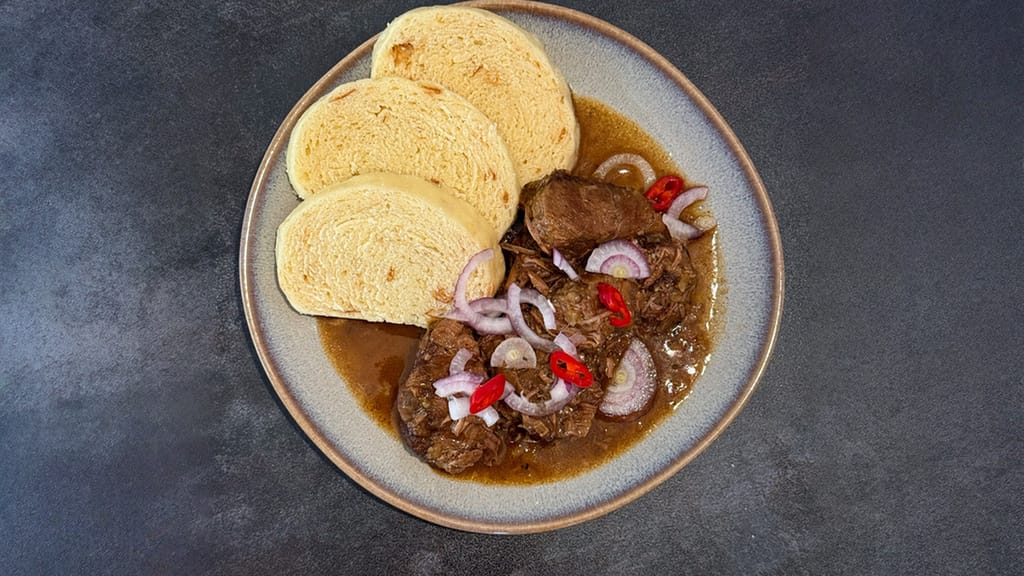
Classic beef goulash with chilli and bread dumpling
Freezer Before Christmas: What to Freeze, When and How to Plan It
Updated Oct 6, 2026
Plan your freezer before Christmas in three steps: clear it out and list what's in it during October, in November load it with cooked basics that keep for 2–3 months (stock, soups, sauces, goulash), and leave a quarter of it free in December for cold cuts, last-minute buys and baked treats. The order isn't set by the calendar but by how long each food keeps its quality in the freezer. Below you'll find specific timeframes from the US food safety authority (USDA/FSIS), a list of what shouldn't go in the freezer, and how to thaw everything safely: starting 20–23 December, move things into the fridge gradually — biggest cuts of meat first.
A freezer lets you spread Christmas cooking over six weeks instead of three days. Whatever you cook in November and freeze properly, start moving into the fridge from 20–23 December, biggest cuts of meat first.
According to the USDA/FSIS, food stored continuously at 0°F (−18°C) or below stays safe indefinitely. The timeframes they give are about quality, not safety — after that point food dries out and loses flavour and texture, but it doesn't become unsafe. So you plan your freezer schedule around quality: whatever keeps for the shortest time goes in last.
So the first step is checking your freezer really does hold 0°F (−18°C). Leave an ordinary thermometer in overnight. A freezer compartment inside the fridge that gets opened often or can't hold 0°F is only good for short-term storage, says the FSIS — for a six-week stockpile you need a proper separate freezer or a freezer section with its own door.
Start clearing out in October, cook into the freezer in November, and spend the last two weeks before Christmas Eve just topping up. This schedule follows USDA/FSIS quality timeframes:
October — clear out and make a list. Use up anything that's been sitting in the freezer for over six months, and write a list on paper or in your phone. Aim to free up at least half the space for November.
Early November onwards — raw meat cuts and poultry. These have the longest window, so stock up now if there's a good deal.
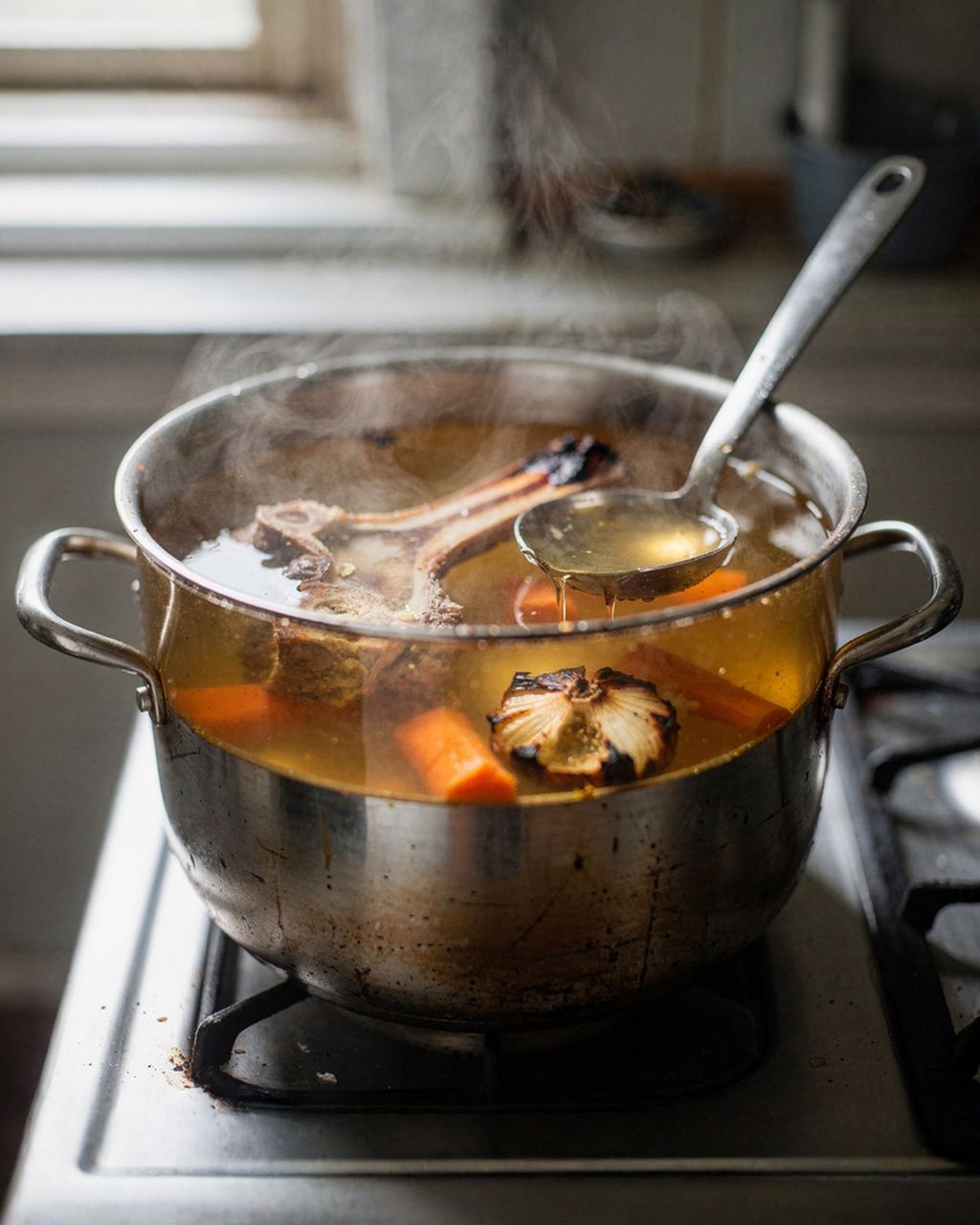
From mid-November — cooked basics. Stock, soups, sauce bases, stew. These keep their quality for 2–3 months, so anything cooked from mid-November will still be at its best at Christmas, with some margin to spare.
November to early December — doughs for Christmas biscuits. For how to wrap and thaw them without them going soggy, see our guide to freezing Christmas biscuits and dough.
Last 14 days — just topping up. Cold cuts, ham and bacon have the shortest window (bacon 1 month, cold cuts and ham 1–2 months), so buy these last. Keep a quarter of the freezer free for last-minute buys and baked biscuits.
Stock, soups, sauces, braised meat and raw meat cuts freeze best. Quality timeframes at 0°F (−18°C) from USDA/FSIS and FDA tables — notice that raw meat holds its quality in the freezer longer than cooked:
Whole raw poultry: 12 months
Raw poultry pieces: 9 months
Raw meat: roasts 4–12 months, steaks 6–12 months, chops 4–6 months
Raw minced meat: 3–4 months
Soups and stews (goulash, ragù): 2–3 months
Cooked meat and meat dishes: 2–3 months
Meat sauces and stock: 2–3 months
Cooked poultry: 4 months
Ham, sausages, cold cuts: 1–2 months
Bacon: 1 month
Home-baked casseroles are best frozen for no more than 2–3 months.
In practice, this means: a beef goulash cooked in mid-November will be perfectly fine on Boxing Day. Our article on how long goulash keeps explains why it often tastes even better after thawing. For your Christmas Eve soup, you can prepare mushroom soup ahead of time, or at least its stock.
For homemade svíčková, freeze the sauce before adding the cream — the FSIS lists cream-based sauces among the foods that can separate when frozen. Stir the cream in only after reheating.
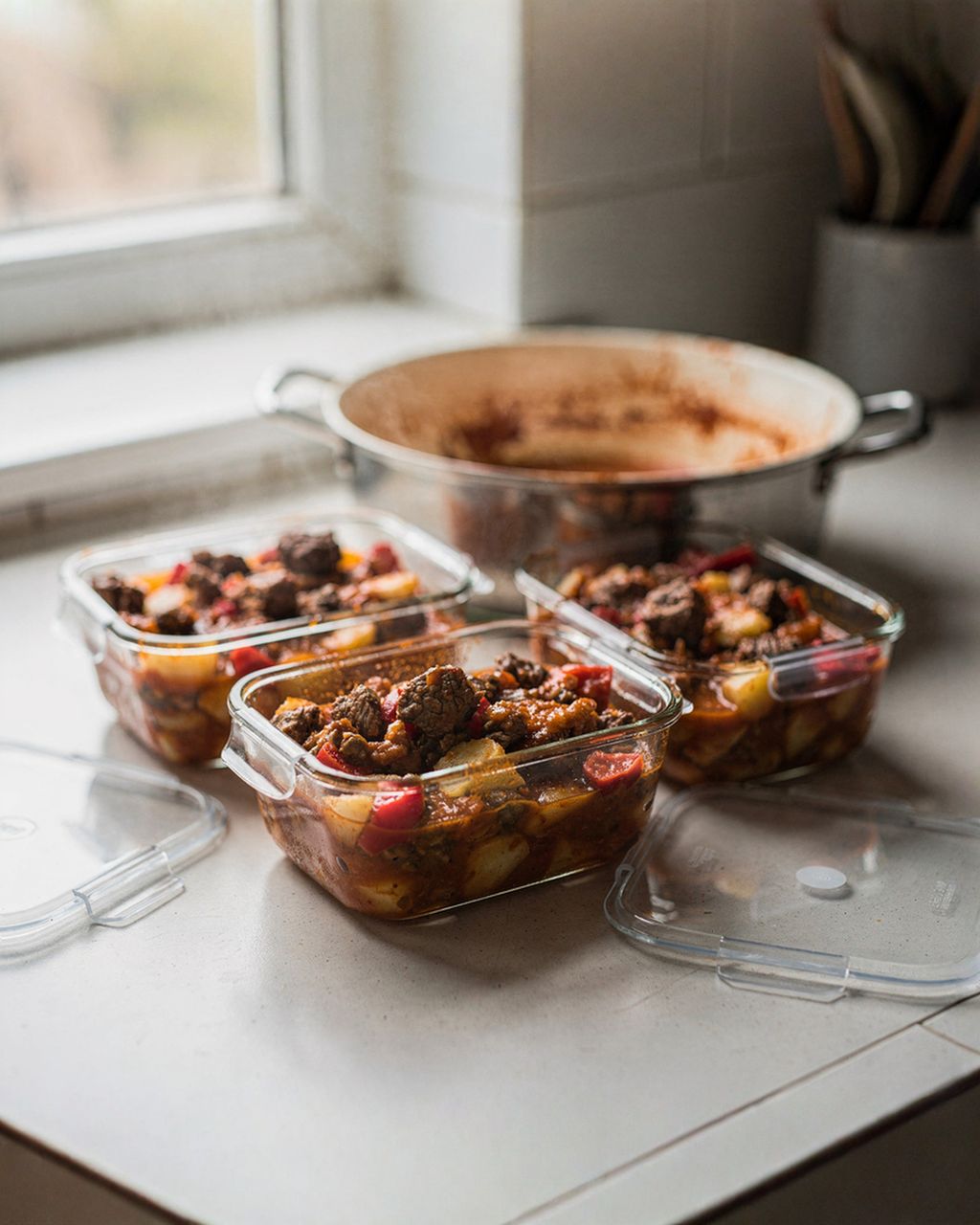
Classic beef goulash with chilli and bread dumpling
Beef goulash for the freezer, ready for Christmas
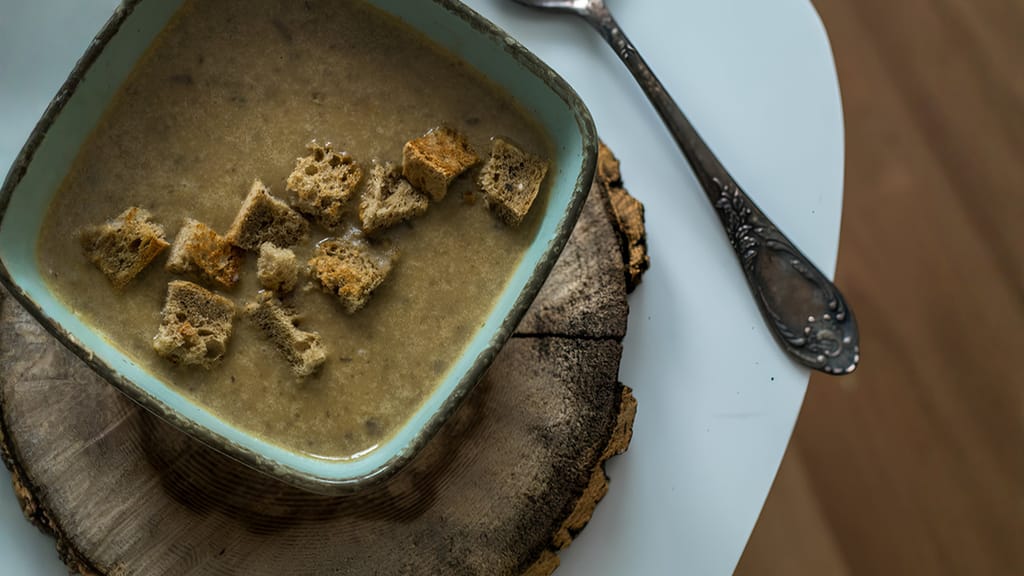
Mushroom soup
Mushroom soup for Christmas Eve, cooked ahead
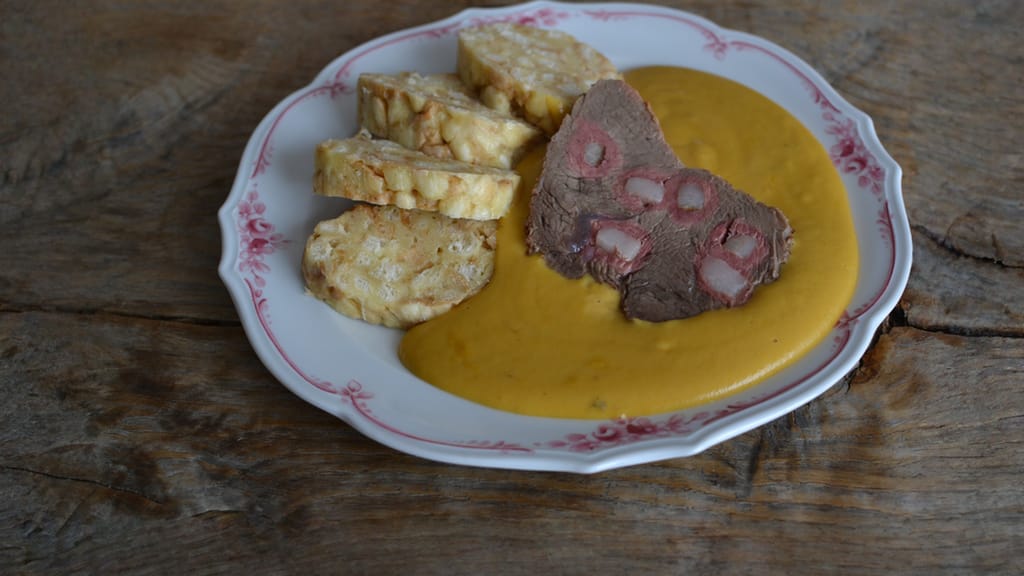
Sunday lunch: perfect homemade beef sirloin in cream sauce
Homemade svíčková — freeze the sauce before adding the cream
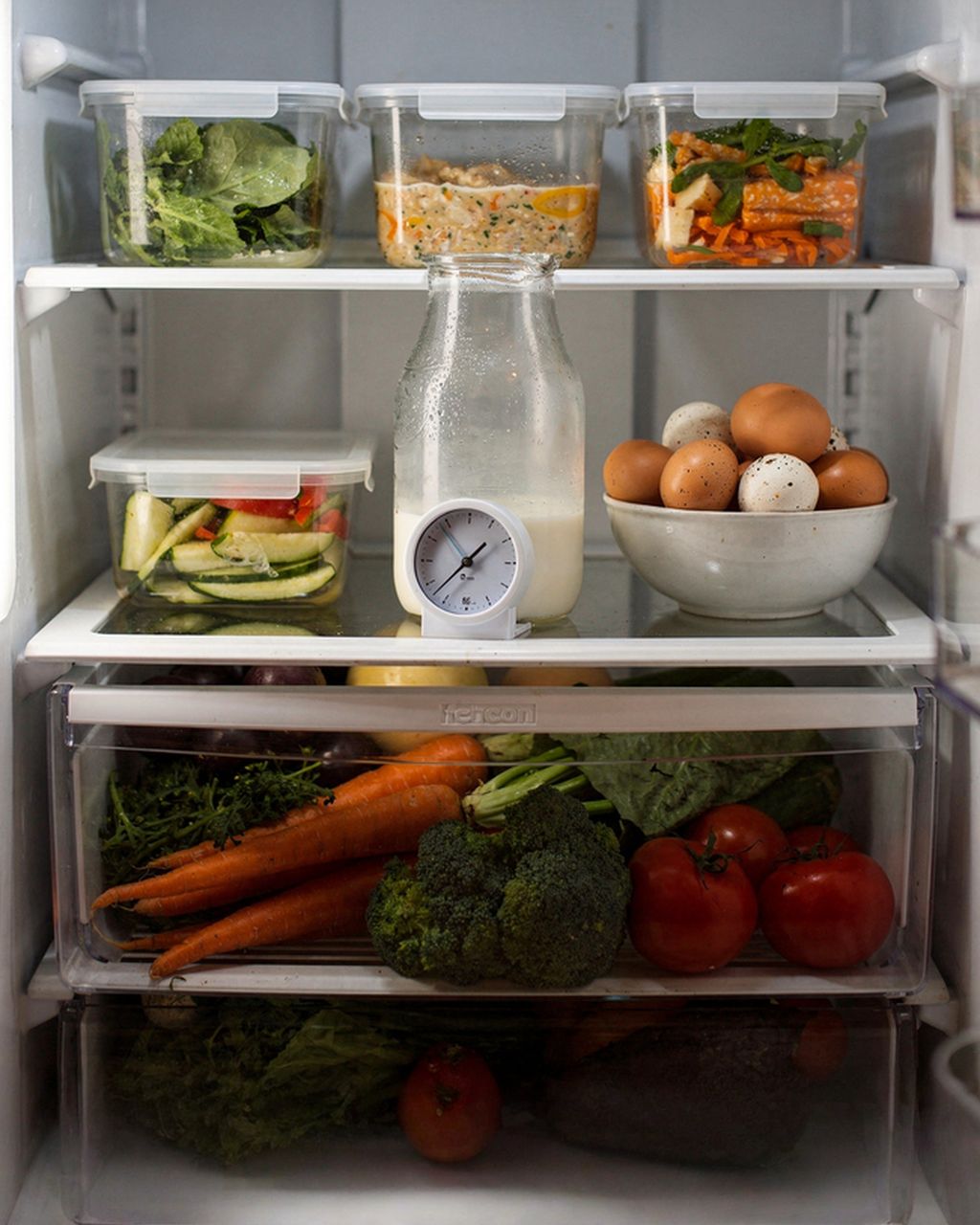
Don't freeze potato salad, eggs in their shell, hard-boiled eggs, mayonnaise, cream sauces or lettuce. It's not a safety issue but a quality one — after thawing they fall apart, separate or turn rubbery:
Potato salad and other mayonnaise-based salads — according to the FSIS, mayonnaise separates after thawing and the salad turns watery. Make your Christmas Eve potato salad fresh, even the evening of 23 December.
Deli-style salads (egg, tuna, pasta) — the FDA lists these as "don't freeze." A classic Russian-style vegetable salad will fare the same way.
Open sandwiches/canapés — the mayonnaise and lettuce fall apart after thawing, and the bread goes soggy. Make these on the day you're serving them.
Eggs in the shell — they expand when frozen and the shell cracks. The FSIS recommends throwing out any egg that's cracked after freezing.
Hard-boiled eggs — the whites turn rubbery and watery after thawing (FDA: don't freeze).
Cream sauces and custards — they split. Freeze the base and add the cream afterwards.
Lettuce and other fresh raw vegetables — they turn mushy.
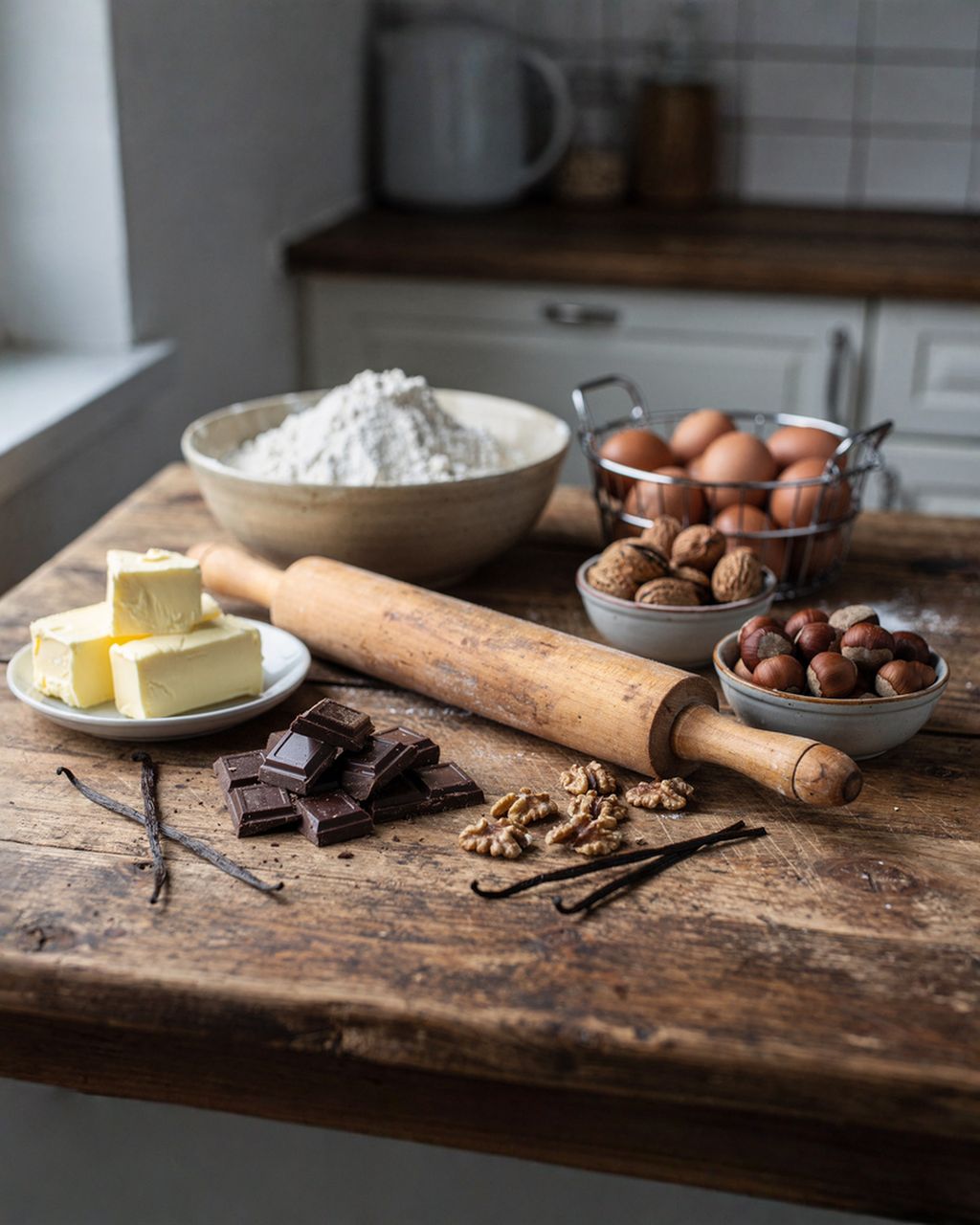
Raw egg whites and yolks, out of the shell, can be frozen and keep for up to 12 months (FDA, FSIS). This is handy for leftovers from baking — you'll have whites left over from Linzer biscuits and vanilla crescent cookies, and yolks left over from meringues.
Egg whites: freeze without any problem and whip up just like fresh ones after thawing. Freeze them in portions so you know how many are in each bag.
Egg yolks: thicken after thawing and are harder to mix in. For what to do with them, see our article on what to do with leftover yolks.
Pasteurised liquid eggs, unopened: 12 months (FDA). Opened: don't freeze (FDA).
Thaw dough made with raw eggs in the fridge, and don't taste it raw — freezing doesn't kill bacteria, it just puts them to sleep (see the box below).
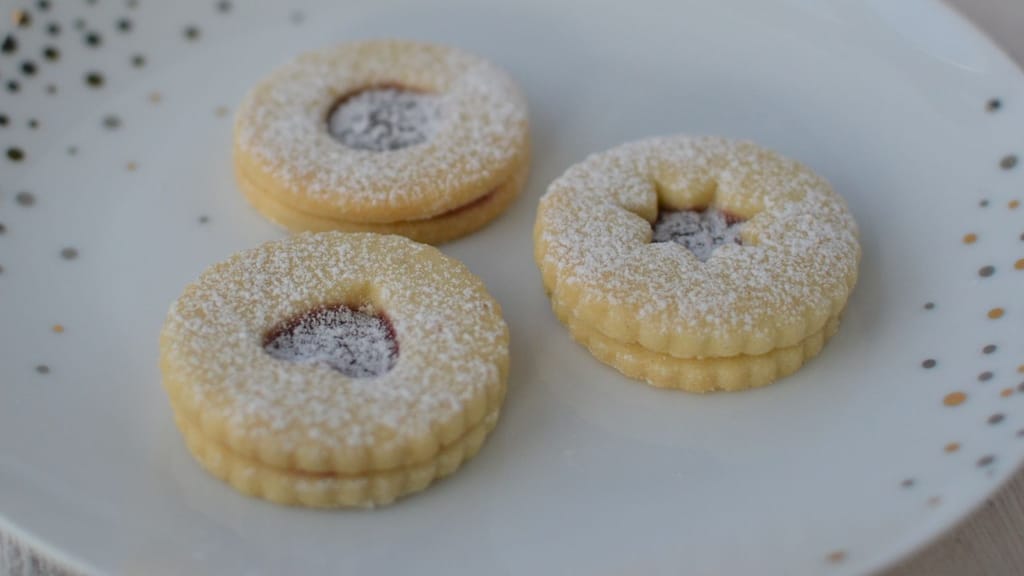
Classic christmas cookies: delicate linzer cookies
Crumbly Linzer biscuits — the whites left over are perfect for freezing
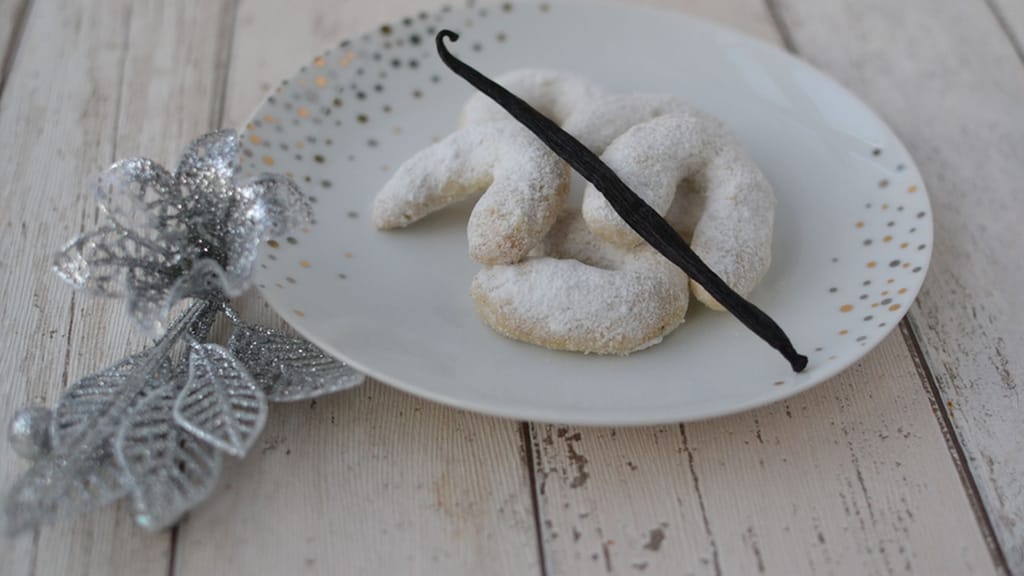
The best christmas cookies? vanilla crescents, of course!
Vanilla crescent cookies — the dough can be frozen ahead
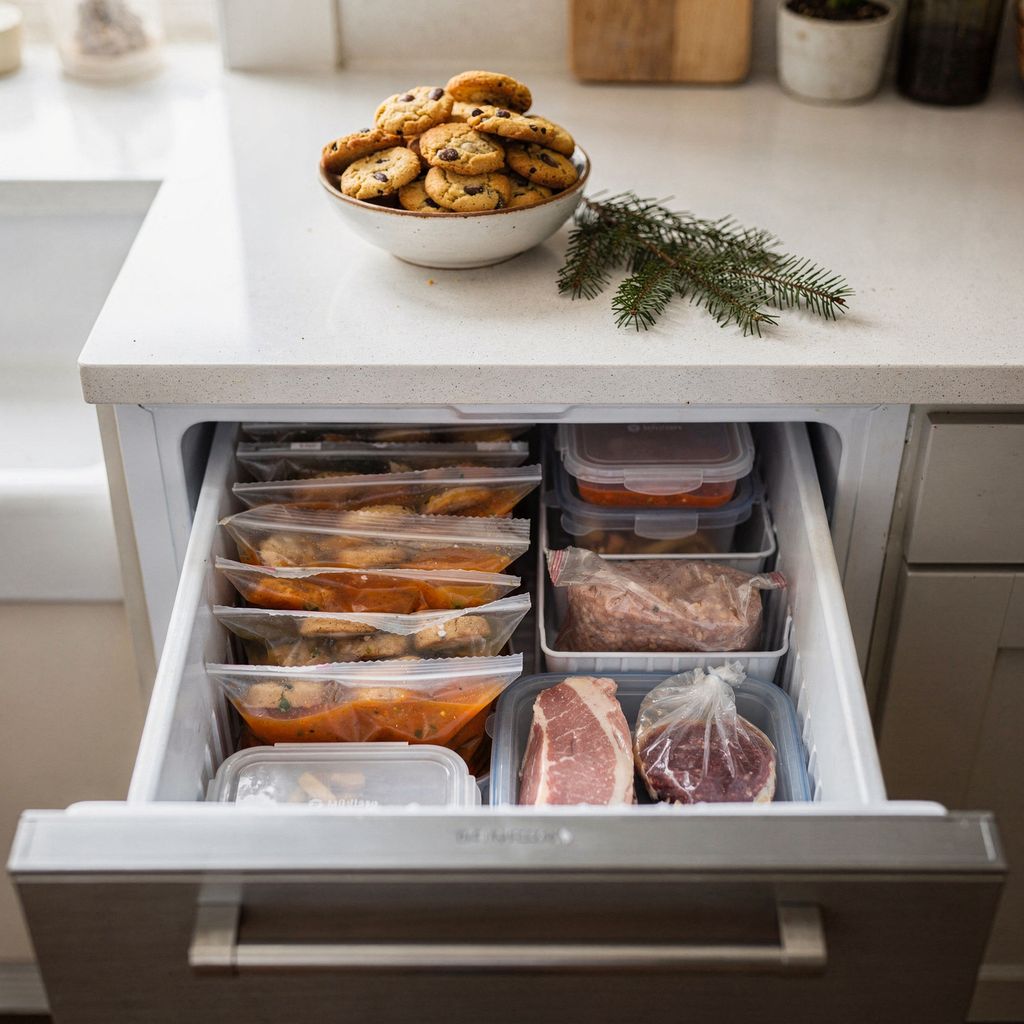
Five rules that free up the most space: zone by drawer, freeze flat, portion for one meal, label with the date, and keep a list on the door.
One drawer, one category. Raw meat at the bottom (so leaking juices don't drip onto anything else), cooked food in the middle, dough and biscuits on top.
Freeze soups and sauces flat in bags. Once frozen, stand them up like files. A bag frozen flat takes up far less room than a container.
Portion for one meal. 500 ml of soup for two, 1 litre for four. You won't thaw more than you'll eat.
Label every package — what it is, how many portions, and the date it was frozen. Without a date, you won't tell stock from sauce six weeks later.
Keep a list on the door. Cross off what you take out. It saves you leaving the door open while you search, which only wastes the freezer's cold.
If store-bought meat is going to sit in the freezer longer than 2 months, wrap it in foil or a freezer bag over its original packaging.
For details on how to wrap specific foods so they don't dry out, and what happens to them in the freezer, see our article on storing food in the freezer.
Freeze in small batches, in a single layer — fast freezing forms small ice crystals, so food won't leak juice later. The FSIS says food 5 cm thick should ideally freeze in around 2 hours. Freeze it slowly, and large ice crystals form that tear the cells apart, so meat "weeps" after thawing.
Don't stack fresh packages on top of each other. Spread them in a single layer across different shelves, and only stack them once they're frozen solid.
Chill large pots in shallow containers first, so the freezer doesn't have to fight a warm batch and end up thawing what's already in there.
Only freeze as much at once as your freezer can handle — in November, it's better to cook smaller batches over two weekends than one huge one.
Thaw in the fridge, in cold water, in the microwave, or cook straight from frozen — the FSIS doesn't consider other methods safe.
In the fridge (best): small packages overnight, most food a day or two, a large cut of meat roughly 1 day for every 2.3 kg (5 lb) (FSIS). Move Christmas Eve soups and sauces to the fridge on 22–23 December; move a whole turkey or large roast even earlier, depending on weight.
In cold water (faster): submerge the food in a leak-proof bag in cold water and change the water every 30 minutes. Cook it straightaway afterwards.
In the microwave: only if you're cooking it right after — the edges start to heat up during thawing.
Straight from frozen: raw and cooked meat and casseroles can be reheated or baked without thawing first, but allow for about 1.5 times longer (FSIS).
A balcony isn't a fridge. Even below freezing outside, the FSIS warns that sunlight can thaw food, and outdoor temperatures swing hour to hour. On a balcony, you also have no real control over your food.
Keep the door closed: according to the USDA/FSIS, a full freezer keeps food frozen for about 2 days, a half-full one for about 1 day. Push packages close together so they keep each other cold. Once power's back, you can refreeze anything that still has ice crystals or is as cold as if it came from the fridge (under 4°C/40°F). Throw out anything that's been above 4°C/40°F for more than 2 hours.
Yes — according to the USDA/FSIS, meat thawed in the fridge can be refrozen even without cooking it first, though it will lose a bit of juiciness. The same applies to cooked food thawed in the fridge. Anything thawed in water or the microwave should be cooked first, then frozen.
Yes — according to the USDA/FSIS, so-called freezer burn is a quality issue, not a safety one. The grey-brown leathery patches form where air has reached the food. Just cut them away before or after cooking, and if there's a lot of it, use the food in soup or discard it for the sake of taste.
Yes, baked vánočka freezes well — just make sure it's completely cool before wrapping. Wrap it tightly in cling film and then a freezer bag so it doesn't dry out or pick up freezer odours. Unlike meat and cooked dishes, you can thaw it at room temperature while still wrapped, so any condensation forms on the wrapping rather than on the crust.
According to the FDA and USDA, cooked meat, meat dishes, soups and stews keep in the fridge at 4°C/40°F for 3–4 days, while stock and sauces keep for 1–2 days. It's best to freeze them as soon as they've cooled, though — the fresher the food when you freeze it, the better it tastes once thawed.
One recipe worth heating the oven for, one tip, and one deal from the shop. Nothing else.