Crema catalana with orange zest and cinnamon
Ensaimada: How to Bake Authentic Mallorcan Spiral Pastry at Home
Updated Oct 24, 2026
Ensaimada is a light, fluffy spiral pastry from Mallorca, stretched with pork lard into paper-thin layers and dusted with powdered sugar. You can make it at home. You don't need a bakery, just a high-gluten flour, patience while it proofs, and one trick: the lard-brushed dough is stretched until it's almost see-through, and only then coiled into a spiral. The whole bake takes 11–16 hours, but only about an hour of that is hands-on work, because the overnight proof does the rest. Here you'll find exact weights for one large spiral or 6–8 small ones, a timeline, how to tell when each stage is done, filled versions, and what to do when something goes wrong.
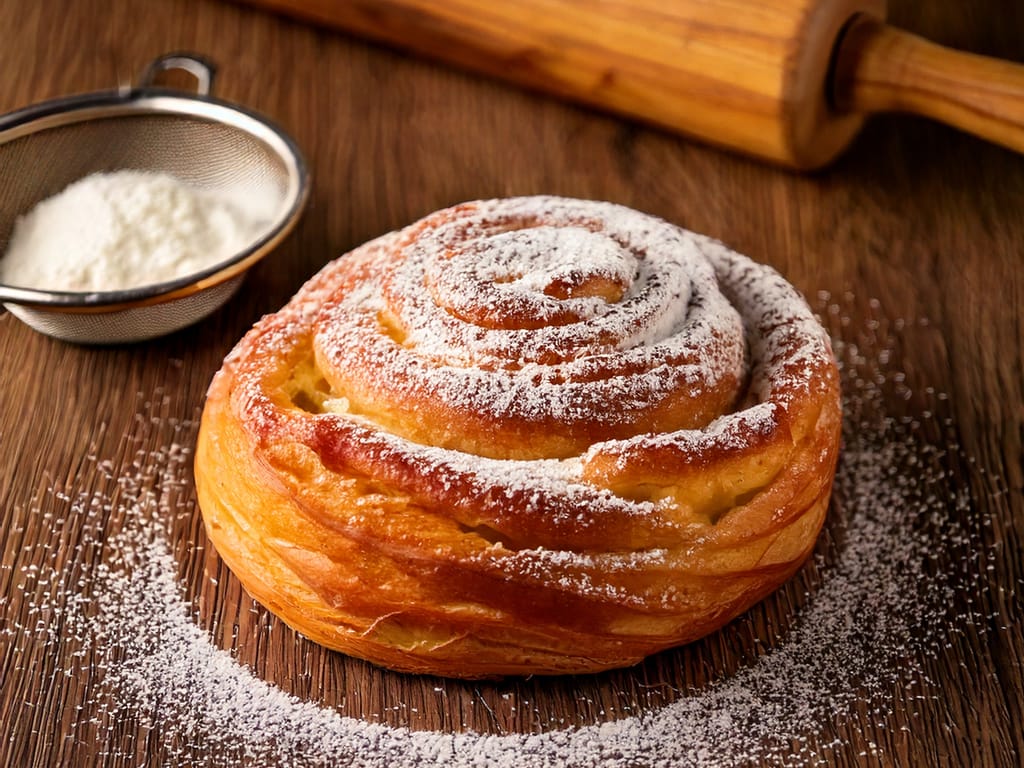
Ensaimada (Catalan ensaïmada) is a sweet yeasted pastry from Mallorca, shaped into a loose spiral and made from stretched dough brushed with pork lard, called saïm in Mallorcan, which is where the name comes from. Once baked, it's delicate and golden on top, and soft and finely stringy inside, like pull-apart brioche, finished with a dusting of powdered sugar.
Traditionally it comes in two forms:
Ensaïmada llisa – plain, with no filling, just sugar on top.
Ensaïmada de cabell d'àngel – filled with cabell d'àngel (Spanish cabello de ángel), a sweet filling made from cidra squash strands cooked with sugar.
Sizes range from a single serving (around 60–100 g) to giant festive spirals for sharing that can weigh over a kilo. It's one of Spain's best-known sweets. For another classic you can make from just a few ingredients, see our roundup of Spanish desserts you can bake at home.
Seasonal baking plans, tested recipes and kitchen tricks that save you time. Unsubscribe in one click.
Ensaimada comes from Mallorca, where the first written mentions appear in the 17th century. Some say the technique of stretched, spiral-coiled dough has roots in Arab cuisine, which left its mark on the island over centuries of Arab presence, but that's more theory than certainty. The word saïm (lard) itself comes from Latin, from the Vulgar Latin sagimen.
It's also often said that the model was a sweet bread of Mallorca's Jewish community, similar to challah and kneaded with olive oil. After the forced conversions, the conversos are said to have replaced the oil with pork lard to deflect the Inquisition's suspicion, giving ensaimada the flavor it has today. Whether or not that part is legend, lard remains what sets a true Mallorcan ensaimada apart from ordinary sweet bread.
Ensaïmada de Mallorca (also Ensaimada mallorquina) has been an EU Protected Geographical Indication (PGI) since 2004, registered under Commission Regulation (EC) No 297/2004. In the Balearic Islands it had already been protected as a specific designation (denominación específica) since 1996.
What that means in practice:
Only an ensaimada baked in Mallorca to the approved specification may be sold under this name.
The specification recognizes only two types: plain (llisa, 60–2,000 g) and filled cabell d'àngel (100–3,000 g). Ensaimadas with cream, chocolate or sobrasada are baked and sold on the island all the time, but they don't carry the protected designation.
The ingredients are fixed: high-gluten flour, water, sugar, eggs, sourdough starter (masa madre) and pork lard. Butter and margarine have no place in a true ensaimada.
You can spot the real thing by the seal and numbered label of the regulatory council on the packaging.
So what you bake at home can't be called "Ensaïmada de Mallorca", but you can follow exactly the same method and ingredients.
Ensaimada rests on six main ingredients (high-gluten flour, liquid (water or milk), sugar, eggs, yeast and pork lard) plus a pinch of salt. There's no butter in the dough and no magic. Quality and proportions matter more than the length of the list.
Flour: a fine, high-gluten flour with 12% protein or more (you'll find the figure in the nutrition information on the pack). Look for bread flour, strong baker's flour or Manitoba-type flour. Ordinary all-purpose flour (around 10%) tears when stretched.
Sugar: fine granulated sugar, about 20% of the flour weight. It dissolves smoothly and feeds the yeast at the same time.
Eggs: fresh, large. They give color and softness. Count roughly one egg per 250–300 g of flour.
Liquid: Mallorcan tradition and the protected-designation specification call for water. At home, milk gives a slightly softer, more fragrant crumb. Either works, as long as it's lukewarm.
Yeast: fresh or dried, about 2% of the flour weight. Feel free to use less than you're used to, since ensaimada benefits from a long, slow proof. Mallorcan bakers add sourdough starter as well, but at home that isn't necessary.
Lard (saïm): pork lard, soft, at room temperature. A small amount goes into the dough and most of it is for brushing the stretched sheet. That's what creates the thin layers and the characteristic stringy crumb.
Lard can be replaced with soft butter or coconut oil, but expect the flavor and tenderness to shift: butter gives a richer note, coconut a slightly exotic one. For a plant-based version, the egg can be replaced with a flax or chia "egg" (1 tablespoon of seeds + 3 tablespoons of water per egg), though the dough will be a little denser.
For one large ensaimada you need 300 g of flour and about 80 g of lard in total. For 6–8 small ones, 500 g of flour and 125–145 g of lard. Both batches use the same proportions and differ only in size.
For 1 large spiral (⌀ 28–30 cm / 11–12 in after baking, 6–8 servings, about 540 g of dough):
300 g high-gluten fine flour (12% protein or more)
60 g granulated sugar
1 large egg (about 60 g without shell)
100 ml lukewarm milk or water (up to 37 °C / 99 °F)
6 g fresh yeast (or 2 g dried)
3 g salt
15 g pork lard for the dough
60–70 g soft pork lard for brushing
powdered sugar for dusting
For 6–8 small spirals (⌀ 12–14 cm / 5–5½ in after baking, about 920 g of dough):
500 g high-gluten fine flour
100 g granulated sugar
2 large eggs (about 120 g)
160 ml lukewarm milk or water (up to 37 °C / 99 °F)
10 g fresh yeast (or 3 g dried)
5 g salt
25 g pork lard for the dough
100–120 g soft pork lard for brushing
powdered sugar for dusting
Divide the dough for the small spirals into 8 pieces of about 115 g each (or 6 larger ones of about 150 g). Weigh out the lard ahead of time and let it soften at room temperature. For brushing, you want it the consistency of cream, not liquid.
Ensaimada takes 11–16 hours in total, of which only about 60–75 minutes is hands-on work. Most of the time the dough is proofing, so the most convenient plan is to start in the evening and bake in the morning.
Dough: 20–25 minutes (including 10–15 minutes of kneading).
First proof: 1–2 hours at about 25 °C (77 °F), until the dough has doubled in volume.
Dividing and resting: 20–30 minutes. The gluten relaxes and the dough stretches more easily afterward.
Stretching with lard: 10–15 minutes for the large sheet, 3–5 minutes for each small one.
Shaping the spiral: 5–10 minutes.
Second proof: 8–12 hours at 20–24 °C (68–75 °F), typically overnight.
Baking: 18–25 minutes for the large one, 10–14 minutes for small ones, at 180 °C (350 °F) (plus 15 minutes to preheat the oven).
Cooling and sugar: 15–30 minutes.
For example: you start the dough at 7:00 pm, by 9:30 pm the spirals are coiled on the baking sheet, at 8:00 am you bake, and at 8:45 am you're having breakfast.
Good ensaimada dough is smooth, elastic and slightly sticky, the kind that can be stretched thin without tearing. Keep all ingredients at room temperature so the dough proofs evenly.
Dissolve the yeast in slightly warm milk or water (37 °C / 99 °F at most: lukewarm to the touch, not hot, or you'll kill the yeast).
Mix the flour with the sugar in a large bowl and make a well in the middle. Add the salt to the flour on the opposite side from the yeast.
Add the egg and yeast to the well and gradually work in the flour until a rough dough forms.
Knead until smooth: 10 minutes on medium speed with a dough hook in a stand mixer, or 12–15 minutes by hand on a lightly floured surface. The dough is ready when it's elastic and, when pulled, doesn't tear right away but gives.
Work in a small amount of lard (15 g for the large one, 25 g for the small ones) directly into the dough for softness and knead for another 2–3 minutes until the dough absorbs it completely. The main layer of lard comes later, during stretching (see below).
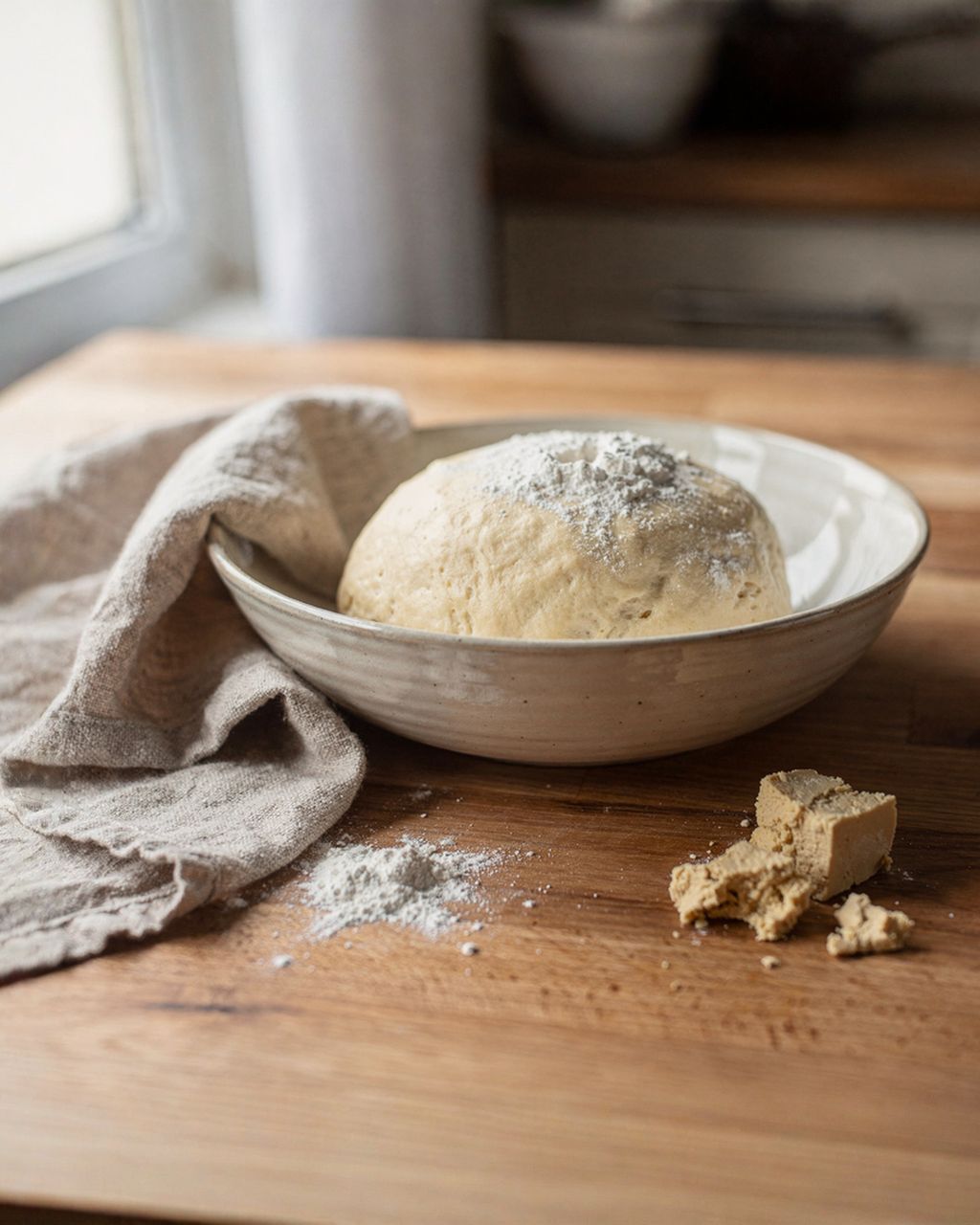
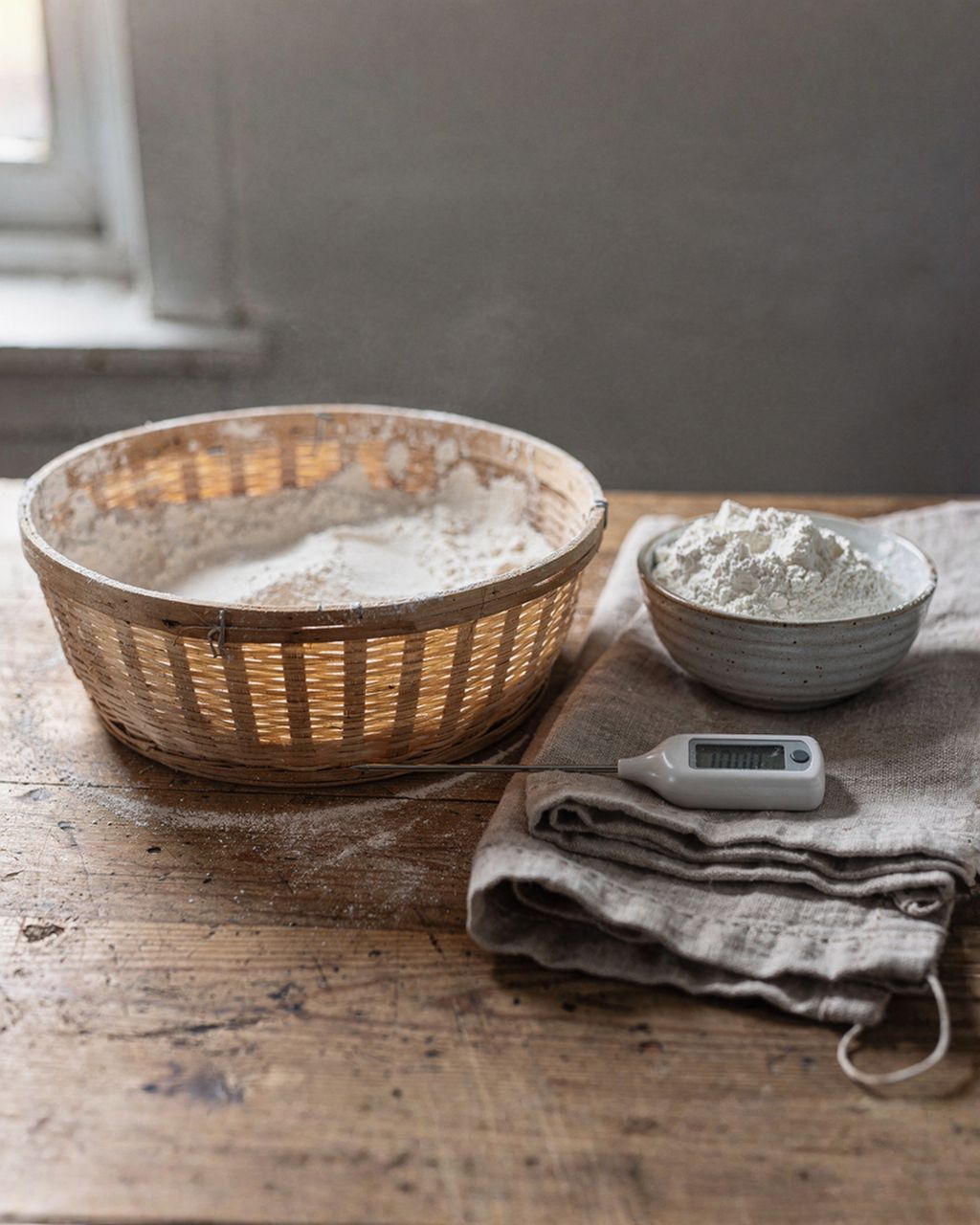
Let it have its first proof in an oiled bowl, covered with plastic wrap, at room temperature (around 25 °C / 77 °F) for 1–2 hours, until doubled in volume. Why temperature matters so much and how to recognize well-proofed dough is covered in our article on proofing dough: temperature, time and proofing basket.
How to tell the dough is kneaded enough – the windowpane test: pinch off a piece the size of a walnut and slowly stretch it between your fingers. If it stretches into a thin membrane you can see light through without tearing, the gluten is developed. If it tears right away, knead for another 2–3 minutes and try again.
How to tell the first proof is done: the dough has roughly doubled in volume, and a dent made with a floured finger springs back only slowly and halfway. If it bounces straight back, let it proof longer.
After it's brushed with soft lard, ensaimada dough is stretched by hand into an almost translucent sheet, and the thin layers of lard and dough create the stringy crumb. The method: divide the proofed dough, let the pieces rest for 20–30 minutes, roll each into a thin sheet, brush generously with soft lard, and then stretch it by hand into a large, almost see-through rectangle. The goal isn't strength but patience: you let the dough slide over the lard and gradually pull it out from the edges until you can nearly see the table through it.
Why it works: the thin layer of lard between the stretched dough turns into dozens of delicate layers in the oven, which gives that characteristic stringy, pull-apart crumb. Skip the stretching and you get an ordinary sweet bun in the shape of a spiral. Don't confuse it with puff pastry, though: there, layers come from folding in cold butter, and there's no yeast (you'll find the differences in our article puff pastry: store-bought, homemade or rough puff). Ensaimada is a yeasted dough that is stretched once, brushed and rolled up.
How big a sheet to expect: from the dough for the large spiral (about 540 g) you stretch a sheet of roughly 70 × 100 cm (28 × 40 in), so plan on the whole table. A small piece (about 115 g) makes a sheet of about 30 × 50 cm (12 × 20 in).
How to tell the sheet is thin enough: it's see-through like tracing paper, so you can see the grain of the tabletop or your fingers placed underneath. Thick spots at the edges don't matter, since they end up inside when you roll it up.
A few tips to help you succeed:
Work on a large, lightly oiled or lard-brushed surface, not on flour. Flour slows the stretching and dries out the dough.
Pull from the center toward the edges and keep turning the sheet so it's evenly thin. It works best with the backs of your hands and fingertips, not by pinching.
If a hole appears, don't worry. Carry on next to it, and it will be hidden when you roll.
If the dough springs back, let it rest for 5–10 minutes so the gluten relaxes.
The lard must be soft like cream, not melted. Melted lard runs off and no layers form.
Roll the stretched sheet up along the longer side into a thin rope (about 2–3 cm thick for the large spiral), then coil it loosely into a spiral. The key word is loosely: leave gaps between the coils about a finger wide (1–1.5 cm) so the dough has room to grow during the second proof and doesn't tear.
Filled version: before rolling up the sheet, spread a thin strip of filling along the longer edge (more in the section on filled ensaimada below). Spread it evenly, or the spiral will burst at one spot.
Coiling: place the spiral on a baking sheet lined with parchment paper or a baking mat and tuck the end of the rope underneath so it doesn't unwind. The large spiral is about 18–20 cm (7–8 in) across once coiled, the small ones about 8–9 cm (3–3½ in). Leave at least 5 cm (2 in) between the small ones on the sheet.
The second proof is long: cover loosely with plastic wrap (it mustn't press on the dough) and let it proof for 8–12 hours, overnight is fine, at 20–24 °C (68–75 °F), until nicely puffed up. At 26 °C (79 °F) or more it goes faster (4–6 hours), but the lard starts to soften and leak out, so a cooler, longer proof is safer. This slow second rise is what makes ensaimada light, so don't rush it.
How to tell the spiral is proofed: it has doubled to tripled in size, the gaps between the coils have almost closed, and when you give the baking sheet a gentle shake, the dough wobbles like a pillow. If the coils are still clearly separate and the dough is firm, give it another 1–2 hours.
For filled ensaimada, the filling is spread in a thin strip along the longer edge of the stretched sheet, which is then rolled up, so the filling runs through the whole spiral. Count on 200–250 g of filling for a large spiral and 25–30 g for a small one. The three most common are:
Cabell d'àngel (Spanish cabello de ángel): a translucent, stringy preserve made from cidra squash flesh cooked with sugar, and the only filling recognized by the protected designation. Outside Spain you'll mostly find it in Spanish shops and online stores. A thick pumpkin jam is close in flavor but lacks the stringy texture.
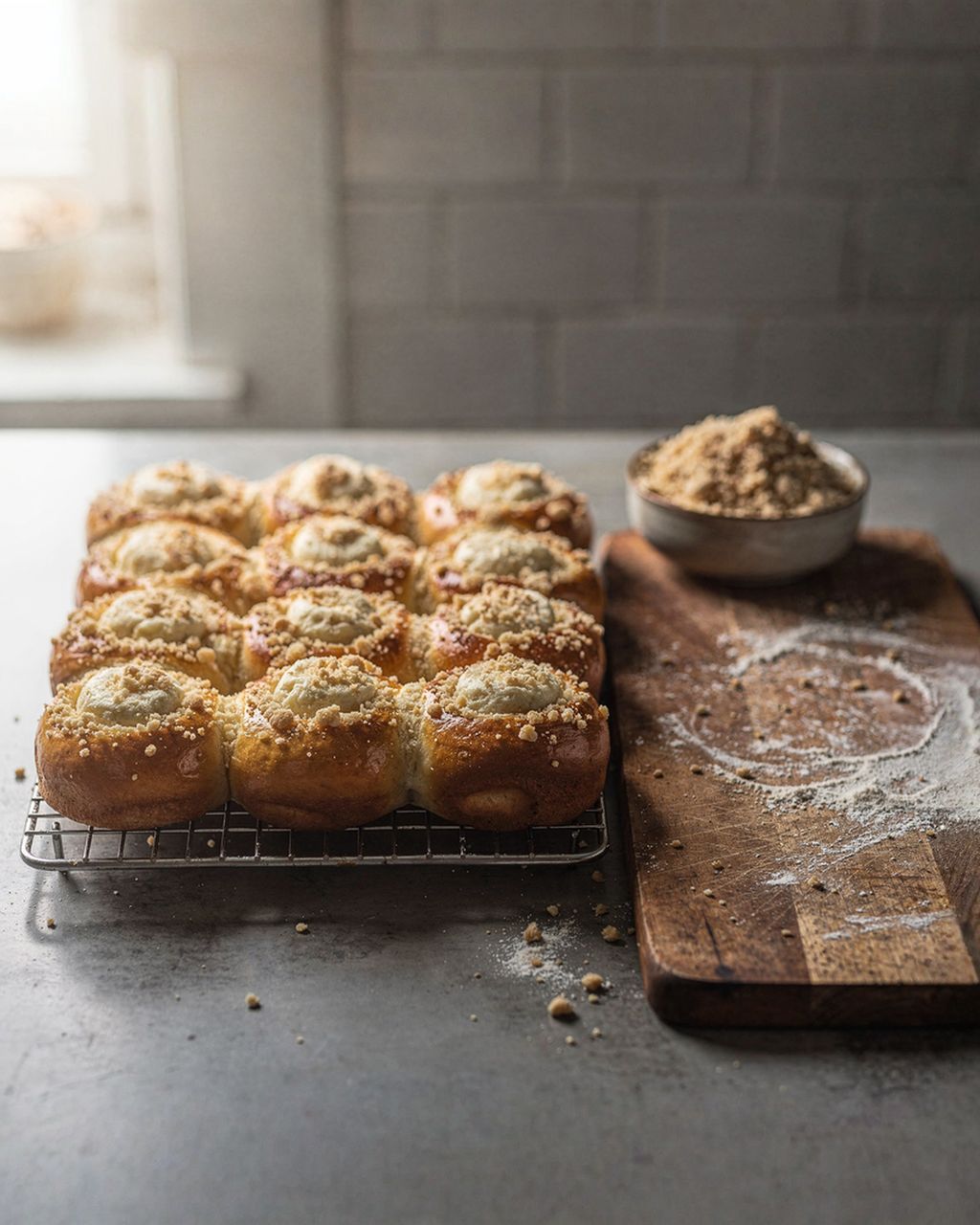
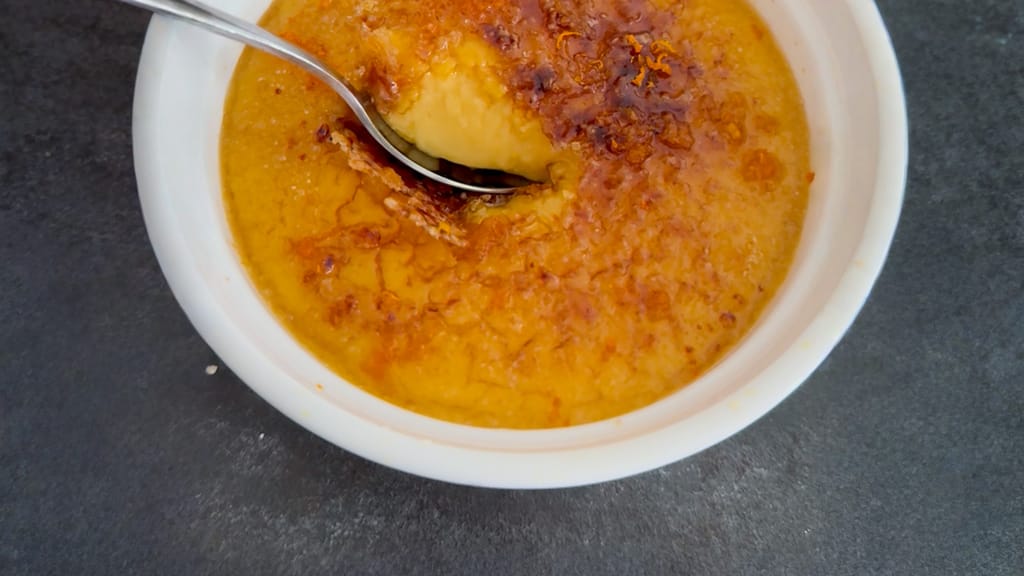
Cream (crema): a thick egg-based pastry cream. It must be chilled and thick enough to hold its shape on a spoon, since thinner cream runs out during proofing. Crema catalana with orange zest and cinnamon works well as a base, just cook it thicker (with a little more starch) and let it cool completely.
Sobrasada: Mallorcan spreadable paprika sausage. Ensaimada with sobrasada, often topped with slices of sweet squash (tallada), is typical of carnival season and plays on the contrast of salty and sweet. Spread the sobrasada in thin slices or small pieces, not in a solid layer.
On the island you'll also find ensaimadas with chocolate, nougat (turrón) or apricots, but the plain one and the one with cabell d'àngel remain the classics.
Crema catalana with orange zest and cinnamon
Crema catalana with orange zest and cinnamon – a thick Spanish custard as a filling for ensaimada
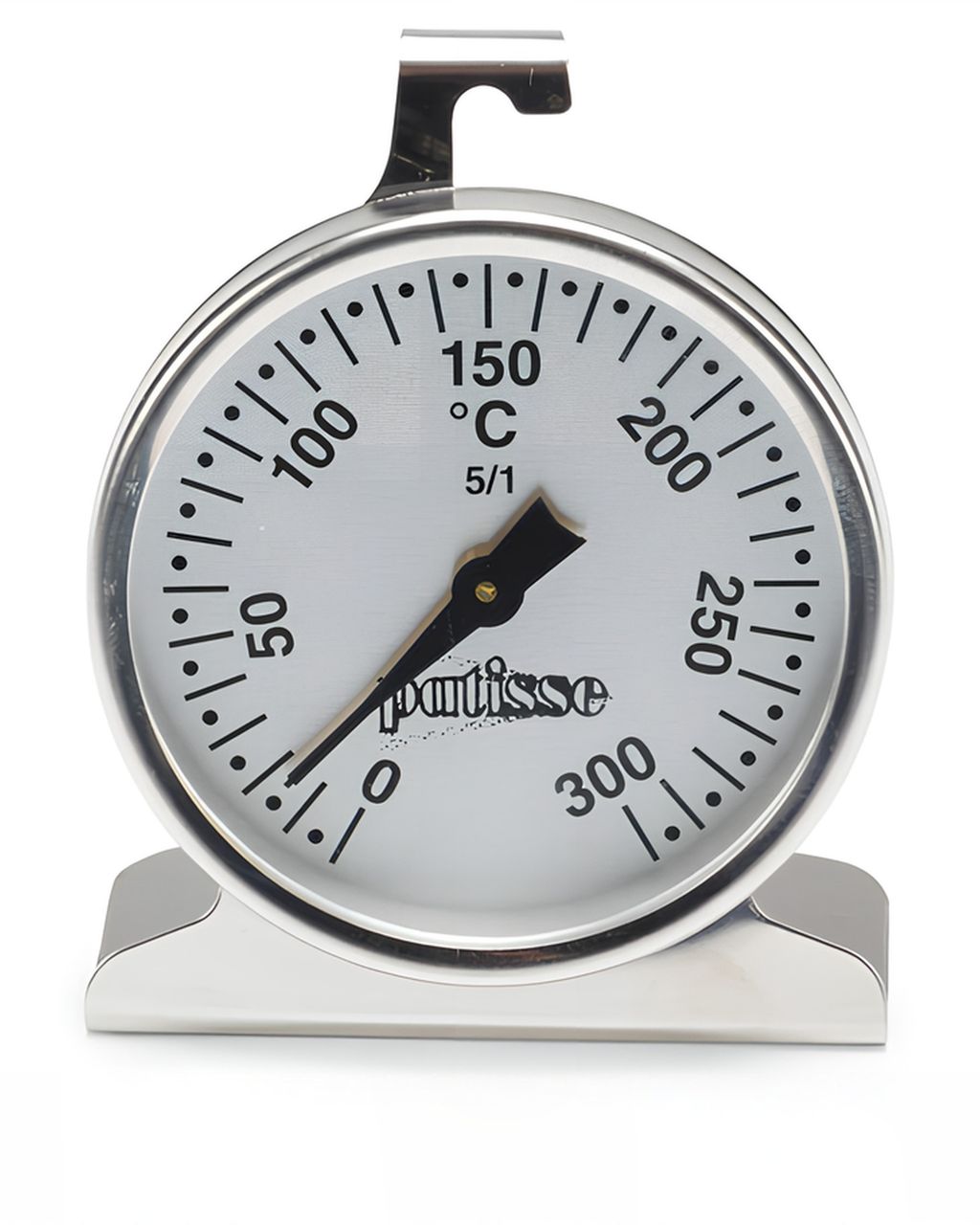
Bake ensaimada in an oven preheated to 180 °C (350 °F), top and bottom heat: 18–25 minutes for the large one and 10–14 minutes for the small ones, until evenly golden. Preheat the oven for at least 15 minutes, because a cold oven means uneven baking and a loss of fluffy texture. Many ovens run 10–20 °C (20–35 °F) off from what the dial says, so an oven thermometer is worth it here. You'll find baking equipment in the baking pans and tools category.
How to tell it's done: the surface is a deep golden color, the underside is golden too when you lift it (not pale), and the spiral feels light when you tap it gently. If you have a probe thermometer, the center of the large spiral is around 90 °C (194 °F).
What to watch out for:
Don't brush true ensaimada with egg. It's not a glossy bun. Instead of a shine, it's lightly sprinkled with water before baking and dusted with powdered sugar only after baking, on pastry that is cooled or just lukewarm (on a hot one the sugar melts).
Go by color, not just time. A pale spiral isn't done. If it darkens too fast, lower the temperature by 10–15 °C (20–25 °F) or cover with foil.
Don't open the oven door in the first 10 minutes. The drop in temperature knocks down freshly proofed dough.
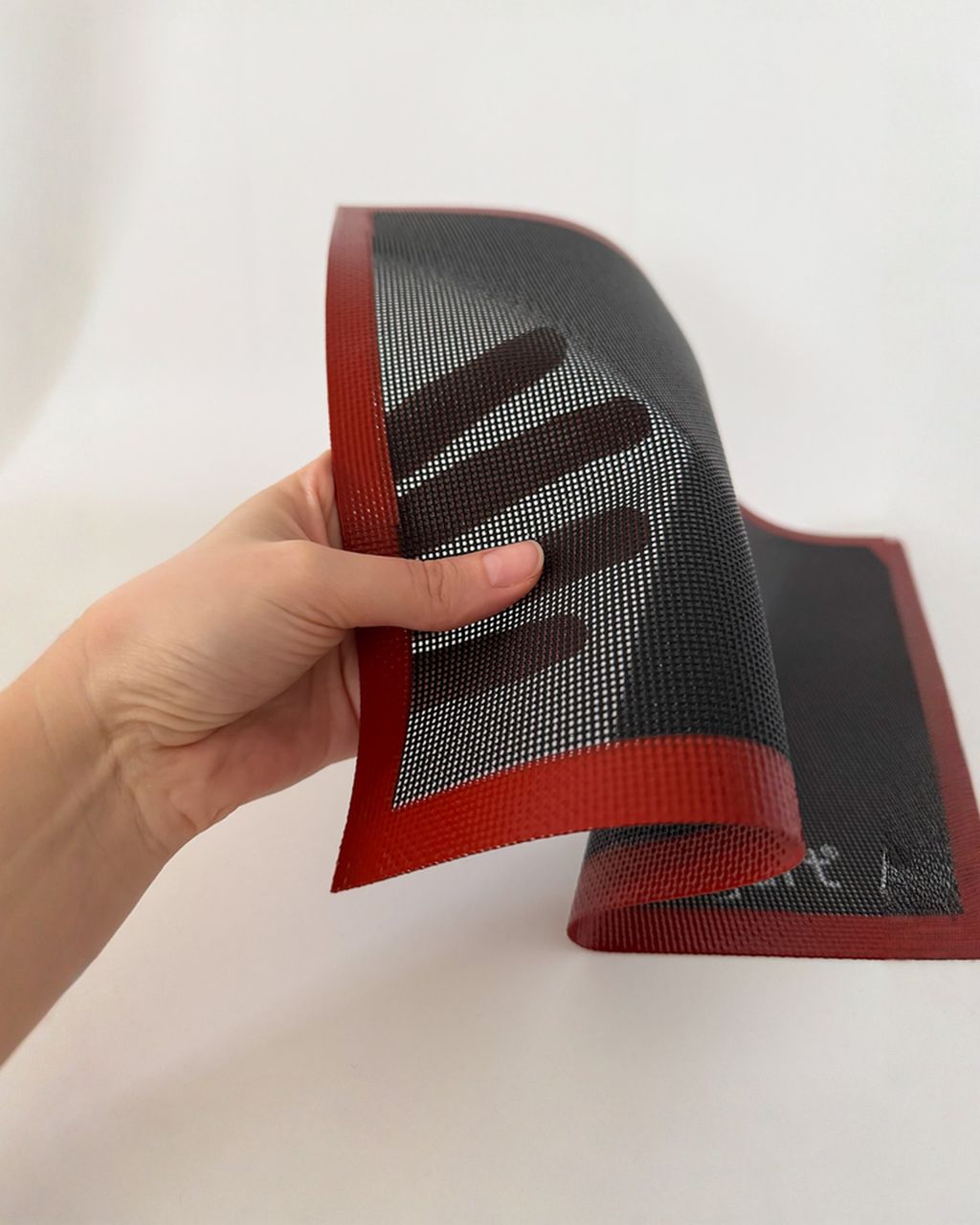
A dark baking sheet conducts more heat than a light one, so on a dark one watch the bottom so it doesn't burn. A perforated mat lets hot air reach the bottom and moisture escape, so it bakes evenly.
Let the finished ensaimada cool on the baking sheet for 10 minutes, and only then move it carefully to a wire rack. Fresh from the oven it's fragile and easily loses its shape. Move the large one together with its paper or mat.
Failures most often come down to four things: low-gluten flour or under-kneaded dough, lard that's too warm, a shortened or overlong second proof, and overbaking. Here's how to identify the cause and what to do about it.
Ensaimada dough most often tears when stretched because of weak flour, under-kneaded dough, or dough that hasn't rested.
Cause: weak flour (around 10% protein), underdeveloped gluten, or dough that hasn't rested, so the gluten is tight and refuses to stretch. Dough dried out by flour on the table tears too.
Fix: use flour with 12% protein or more, knead until the dough passes the windowpane test, and after dividing, let the pieces rest under plastic wrap for 20–30 minutes. Work on a lard-brushed surface, not on flour, and stretch with the backs of your hands. Small holes don't matter, since they disappear in the spiral.
Lard leaks out of ensaimada when it's melted at brushing, when there's too much of it, or when the second proof takes place in a room that's too warm.
Cause: the lard was melted when brushed on, or there was too much of it. Or the second proof happened in warmth above 26 °C (79 °F) and the lard ran out of the spiral before baking.
Fix: brush on the lard soft like cream (room temperature around 20–22 °C / 68–72 °F), in a thin, even layer, not a puddle. Let the second proof happen in a cooler room, for example overnight. A little lard on the baking sheet after baking is normal.
A spiral unwinds mainly because of overproofing or an untucked end of the rope, and it fails to rise when hot milk has killed the yeast, the yeast is old, or the room is too cold.
Cause of unwinding: the spiral is overproofed (proofed too long in the warmth), the dough is too soft, or the end of the rope wasn't tucked in and the spiral unrolled.
Fix: judge the proof by appearance, not by the clock. Bake as soon as the gaps close and the dough wobbles. Always tuck the end of the rope under the spiral.
Cause of not rising: hot milk killed the yeast, old yeast, or a cold room (below 18 °C / 64 °F). A lot of sugar and fat also slows proofing down.
Fix: liquid up to 37 °C (99 °F), fresh yeast and a warmer spot (22–25 °C / 72–77 °F). If the spiral looks nearly the same in the morning as it did the night before, give it another 2–3 hours in the warmth before you write it off.
Ensaimada turns out hard or dry most often from overbaking, extra flour worked in while shaping, or a sheet that wasn't stretched enough.
Cause: overbaking (the oven runs hotter than it says), too much flour worked in while handling, a sheet that wasn't stretched enough so the layers are thick and dense, or a spiral coiled too tightly. Ensaimada stored in the fridge also hardens.
Fix: check the oven temperature with a thermometer and take the ensaimada out as soon as it's golden. Work without dusting with flour, stretch until translucent and coil loosely. Store at room temperature, wrapped.
Ensaimada is best on the day it's baked. Wrapped at room temperature it stays soft for 1–2 days, and frozen it keeps for 2–3 months.
Room temperature: let it cool completely, then put it in an airtight container or a large box, or wrap it loosely in plastic so it doesn't dry out. Don't dust it with sugar for storage, because moisture will make it damp.
Fridge: don't put plain ensaimada in the fridge, as pastry goes hard quickly in the cold. The exception is the cream-filled version, which belongs in the fridge and should be eaten by the next day.
Freezing: wrap the cooled, sugar-free ensaimada tightly in plastic and put it in a freezer bag or box so it doesn't get squashed. Plain and cabell d'àngel freeze best, while the cream-filled one turns runny after thawing.
Thawing and reheating: let it thaw wrapped for 2–3 hours (about an hour for small ones) at room temperature, then warm it in the oven at 150–160 °C (300–320 °F): 6–8 minutes for the large one, 3–4 minutes for small ones. The crust crisps up again. Dust with powdered sugar only at the end.
Serve ensaimada at room temperature or just lukewarm. That brings out its softness and gentle sweetness, and the powdered sugar on top stays put. In Mallorca it's a classic breakfast: a torn or sliced spiral with strong coffee, a cappuccino, café con leche or hot chocolate. Unsweetened tea balances the sweet filled version nicely too.
It's a pastry for company: the large spiral is torn into pieces and shared at the table. Serve it fresh, ideally on the day it's baked, when the crust is at its most delicate.
Yes, you can swap the lard for soft butter or coconut oil, but the result won't be traditional and can't be called Ensaïmada de Mallorca. Butter gives a richer, creamier flavor and coconut oil a slightly exotic note. Neither holds the layers as well as lard, and butter softens sooner during proofing, so the crumb will be a little less stringy. Let the second proof happen somewhere on the cool side.
Yes. You can proof the shaped ensaimada in the fridge for 12–16 hours, but in the morning it needs another 2–4 hours at room temperature to finish rising. The lard firms up in the cold and proofing nearly stops. Bake once the spiral has doubled in size and the gaps between the coils have closed. It's handy when your kitchen is above 25 °C (77 °F).
No. Store-bought puff pastry or croissant dough can't replace the real thing. It's laminated with butter and lacks the sweet, egg-enriched yeast dough and the lard. You can bake a similarly shaped spiral from it, but it will be crisp and flaky rather than soft and stringy. Store-bought brioche dough comes closer, but it can't be stretched until translucent.
A genuine Ensaïmada de Mallorca carries the Protected Geographical Indication seal and a numbered label from the regulatory council on the packaging. It must contain pork lard, not butter or margarine. Only two types are protected: plain (llisa) and the cabell d'àngel filled one. At Mallorca airport it's sold in the typical octagonal boxes, but the box alone doesn't guarantee authenticity.
A large homemade ensaimada made with 300 g of flour weighs about 500 g after baking and serves 6–8 people for breakfast or with coffee. Under the specification, Mallorcan bakeries make plain ensaimadas from 60 g to 2 kg and filled ones up to 3 kg. As a rule, count one small ensaimada of 60–100 g per person.
One recipe worth heating the oven for, one tip, and one deal from the shop. Nothing else.