Plum crumble mug cake
Cup Recipe to Grams: How to Convert Mugs & Spoons (with Chart)
Updated Oct 6, 2026
You can convert a cup-measure recipe to grams in two steps: find out how many millilitres your mug holds, then multiply the grams from the table below by the ratio your mug's volume / 250. A standard mug holds 250 ml, which takes roughly 130 g of fine flour, 150 g of semi-coarse flour, or 210 g of granulated sugar. Tablespoons and teaspoons get their own table, since what matters most there is simply whether the spoon is level or heaped.
To convert a cup recipe to grams, follow 3 steps: measure your own mug's volume, look up the ingredient in the table, and multiply the grams by the ratio your mug's volume / 250.
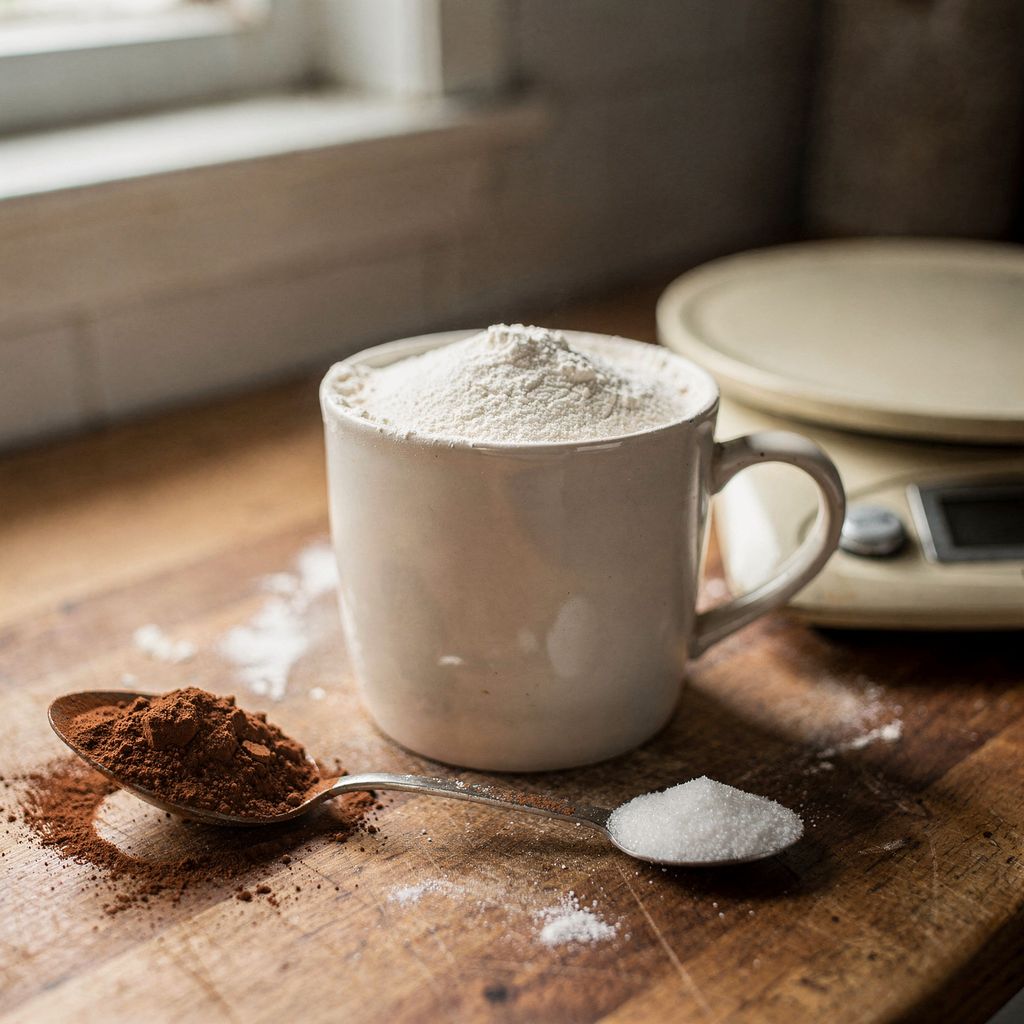
Measure your mug's volume. Put an empty mug on the scale, zero it out, and fill it with water to the rim. Whatever it weighs in grams is how many millilitres it holds (1 g water = 1 ml).
Find the ingredient in the table. The figures below are for a 250 ml mug.
Convert to your own mug. Multiply the grams from the table by the ratio your mug's volume / 250. So a 300 ml mug means 1.2× more, a 200 ml mug 0.8× less.
Example: a typical mug cake calling for 2 mugs of fine flour, 1 mug of sugar, 1 mug of milk and ½ mug of oil works out, with a 250 ml mug, to 300 g flour, 210 g sugar, 250 ml milk and 125 ml (about 115 g) oil. Eggs, baking powder and vanilla sugar stay as they are — those aren't measured by the mugful.
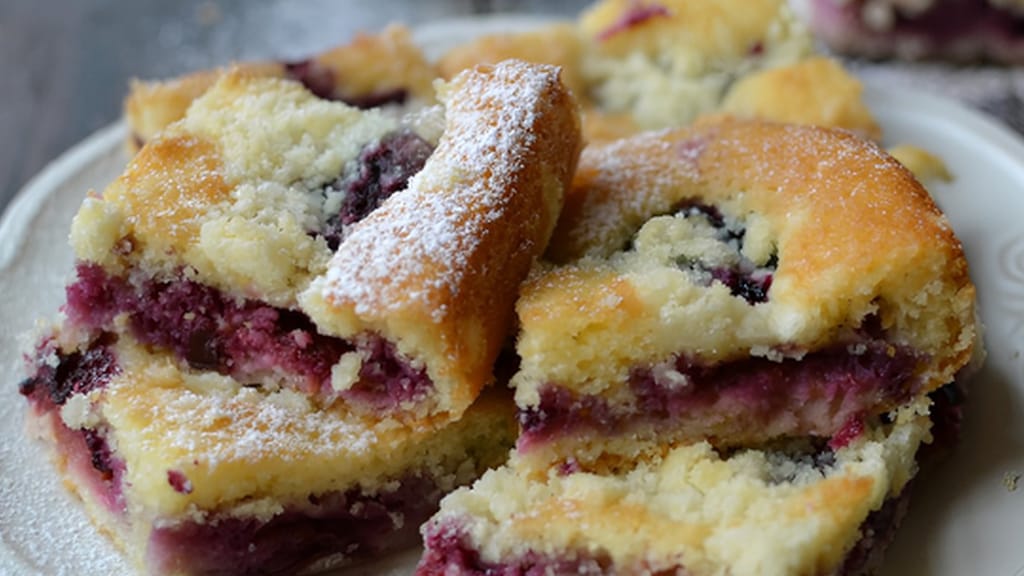
Plum crumble mug cake
Plum mug cake — a cup-measure recipe perfect for practising the conversion
In Czech recipes, a "hrnek" (mug) means 250 ml. Real mugs at home, though, typically hold anywhere from 200 to 400 ml — so it's worth measuring yours once with water and jotting the result down.
Mug in a Czech recipe: 250 ml
US cup: treat it as 240 ml (236.6 ml exactly) — about 4% smaller than a Czech mug, so multiply the grams from the table by 0.96
UK and Australian cup: 250 ml
Large coffee mug: easily 350–400 ml — not suitable for a cup-measure recipe unless you convert it first
The good news: as long as you measure the whole recipe with one and the same mug, the ratios between ingredients hold even if the volume differs. The batter just comes out bigger or smaller. The trouble starts with ingredients that aren't measured by the mugful — eggs, a stick of butter, a sachet of baking powder. Those don't scale with your mug's size: a bigger mug makes the batter drier and denser, a smaller one makes it runnier.
A mug (250 ml) of fine flour weighs about 130 g, semi-coarse flour 150 g, coarse flour 165 g, and granulated sugar around 210 g. These figures are for the ingredient spooned in and levelled off with a knife, not packed down.
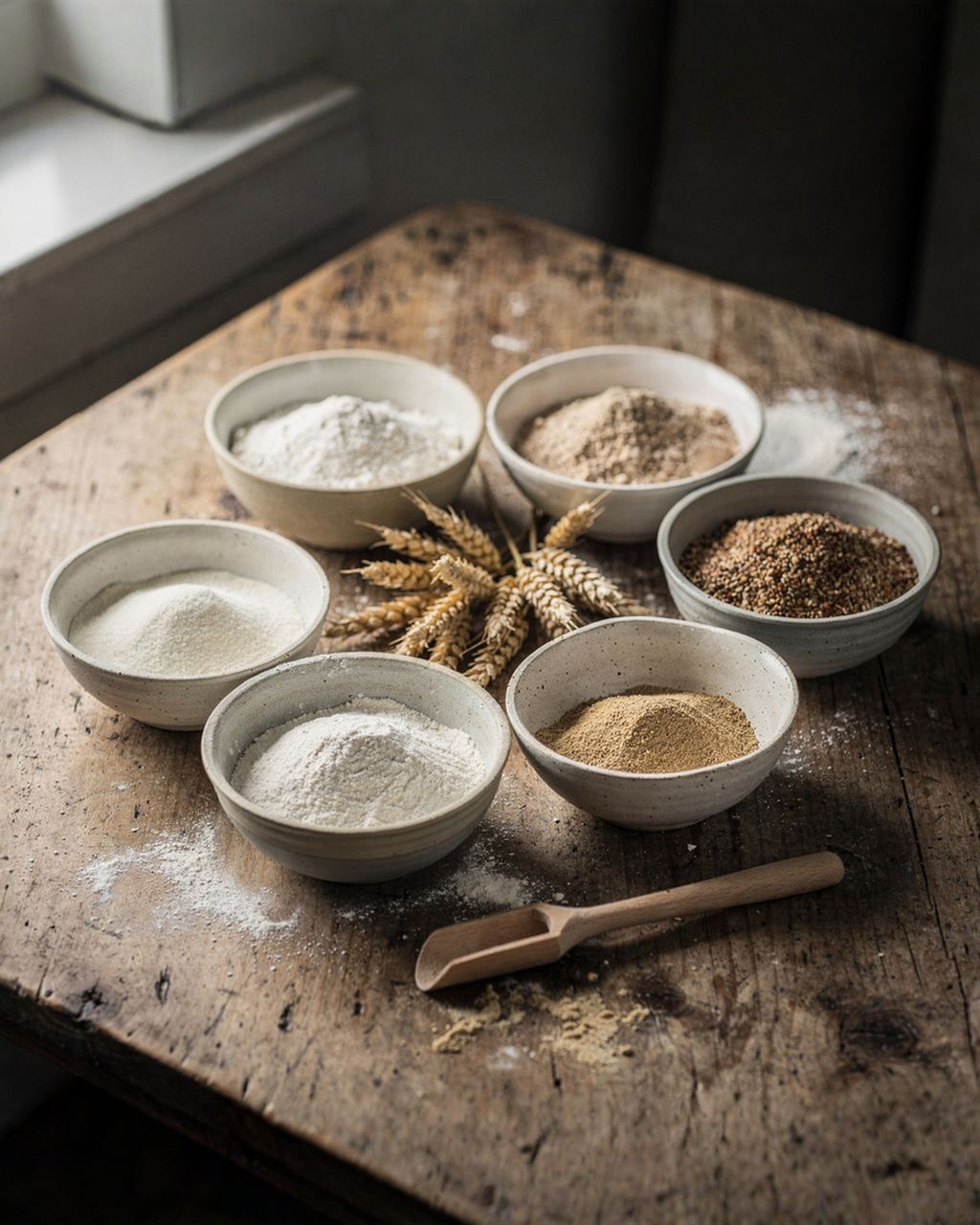
A mug (250 ml) of fine flour weighs about 130 g, semi-coarse flour 150 g, and coarse flour 165 g. Flours and grains in one 250 ml mug:
Fine (plain) flour: about 130 g
Semi-coarse flour: 150 g
Coarse flour: 165 g
Wholemeal flour: 125 g
Fine semolina: 170 g
Oat flakes: 90 g
Rice (raw): 200 g
Breadcrumbs: 110 g
The differences between flour types are worth noting: a mug of coarse flour is a quarter heavier than a mug of fine flour. That's why you shouldn't swap flours mug-for-mug in a cup-measure recipe.
A mug (250 ml) of granulated or caster sugar weighs around 210 g, icing sugar about 125 g. Sugars and other dry ingredients in one 250 ml mug:
Granulated sugar: 210 g
Caster sugar: 210 g
Icing sugar: 125 g (unsifted, loosely spooned)
Brown sugar (lightly packed): 220 g
Cocoa powder: 85–90 g
Ground nuts: 100–110 g
Desiccated coconut: 80 g
Sugars vary much like flours do — granulated, caster and icing sugar each have their place; find out more in Types of sugar for baking: granulated, caster, icing, and when to use which.
A mug (250 ml) of water weighs 250 g, oil and melted butter around 230 g, and honey about 350 g. Liquids and fats in one 250 ml mug:
Water: 250 g
Milk: 255 g (practically 250 ml)
Oil: 230 g
Melted butter: 230 g
Sour cream / yoghurt: 250–260 g
Honey: 350 g
With liquids, it's simplest not to bother with grams at all and just measure by millilitres with a jug.
A level tablespoon (15 ml) of fine flour weighs about 8 g, granulated sugar 13 g, and cocoa powder 5 g. A heaped spoon is roughly half as heavy again. If a recipe doesn't specify which it means, assume a heaped spoon.
A tablespoon (15 ml) of fine flour weighs about 8 g level, 12–15 g heaped. Figures below are given as level / heaped tablespoon:
Fine flour: about 8 g / 12–15 g
Semi-coarse flour: 9 g / 14–16 g
Granulated / caster sugar: 13 g / 20 g
Icing sugar: 8–9 g / 14 g
Cocoa powder: 5 g / 8–10 g
Cornflour / starch: 9 g / 15 g
Salt: 18 g / –
Butter: 15 g
Oil: 13–14 g
Honey: 20–21 g
A level teaspoon (5 ml) of fine flour weighs about 3 g, granulated sugar 4–5 g, and baking powder 4 g. Figures given are for a level teaspoon:
Fine flour: 3 g
Granulated sugar: 4–5 g
Icing sugar: 3 g
Cocoa powder: about 2 g
Salt: 5–6 g
Baking powder: 4 g (a 12 g sachet ≈ 3 teaspoons)
Bicarbonate of soda: 5–6 g
Dried yeast: 3 g (a 7 g sachet ≈ 2 teaspoons)
Ground cinnamon: 2–3 g
Spoons from the cutlery drawer vary more than you'd think — a "tablespoon" can range from 10 to 20 ml. For salt, bicarbonate of soda and baking powder, where a few grams can make or break the flavour and the rise, reach for a proper measuring spoon or a scale instead.
How much a mug of flour weighs depends mainly on how you fill it — scooping it straight from the bag can weigh 20–30% more than spooning it in loosely. Flour holds a lot of air, and scooping compresses it.
Scooping with the mug straight from the bag packs the flour down. Instead of 130 g, you can easily end up with 160–170 g, and the cake turns out dry and dense.
Spooning it in and levelling with a knife gives you the figures in the table. Do it this way if you don't have scales.
Sifted flour is slightly lighter.
Brown sugar is traditionally measured lightly packed — it should hold the mug's shape when tipped out.
Icing sugar and cocoa powder settle and clump over time; stir them with a fork before measuring.
The American flour maker King Arthur Baking notes that a mug scooped straight from the bag holds considerably more flour than one filled by spoon — which is why they recommend spooning flour into the mug and levelling it off. Weighing on a scale erases this variation entirely, which is another reason grams are more reliable for baking.
You convert a US recipe the same way as a Czech one — treat 1 cup as 240 ml, 1 stick of butter as 113 g, and convert °F by subtracting 32 and dividing by 1.8. Multiply the grams from the tables above by 0.96 (240 / 250).
1 cup = 240 ml
½ cup = 120 ml, ⅓ cup = 80 ml, ¼ cup = 60 ml
1 tablespoon (tbsp) = 15 ml
1 teaspoon (tsp) = 5 ml
1 stick of butter = 113 g (½ cup)
1 oz = 28 g, 1 lb = 454 g
350 °F = 175°C, 375 °F = 190°C, 400 °F ≈ 200–205°C
Watch out for flour: American all-purpose flour corresponds most closely to our fine (plain) flour, while cake flour is even finer and lower in protein. US oven temperatures are also usually given for conventional (top-and-bottom) heat — if you're baking with a fan oven, knock off about 20°C.
If you're baking a cup-measure recipe exactly as written and measuring everything with one mug, you don't need to convert anything. A cup recipe is built on ratios, not absolute grams.
Converting is worth doing when:
you want to double or halve the recipe and a mug alone won't cut it,
your mug is significantly bigger or smaller than 250 ml and the recipe includes eggs or a sachet of baking powder,
you're working from a US recipe and want to translate it into ingredients as sold here,
the recipe turns out differently every time — the culprit is almost always flour scooped by the mugful.
Once you've converted a recipe to grams, write it down. Next time you just weigh everything out, and the result will be the same every time.
Yes, but swap by weight, not by the mugful. A mug of semi-coarse flour weighs about 150 g, a mug of plain flour 130 g — if you swap mug for mug, you'll add 15% more flour to the batter and the cake will turn out drier. So instead of 1 mug of plain flour, use about 130 g of semi-coarse flour.
A block of butter (250 g) equals roughly 1 mug plus 2 tablespoons of melted butter. One 250 ml mug of melted butter weighs around 230 g. If a recipe wants softened butter measured by the mugful, it's simpler to just weigh it directly.
Divide the grams by the weight of one mug of that ingredient from the table. For example, 300 g of semi-coarse flour ÷ 150 g = 2 mugs, 105 g of sugar ÷ 210 g = ½ mug. Round the result to the nearest quarter mug — you won't measure any more precisely than that with a mug anyway.
Wipe the mug first with a drop of oil, or measure the oil from the same recipe in it first — then the honey or syrup will slide out cleanly. A mug of honey (250 ml) weighs about 350 g, so if you have scales, it's easier to just weigh it straight into the bowl.
Beat the eggs and weigh out half — a size-M egg without its shell weighs about 50 g, so from 3 eggs (about 150 g) you'd take 75 g. Just divide everything else by two: ½ mug instead of 1 mug, half a sachet of baking powder (about 6 g) instead of a whole one. Without scales, 1 whole egg plus 1 yolk also works. To double the recipe, simply multiply everything by two and swap a smaller tin for a baking tray.
One recipe worth heating the oven for, one tip, and one deal from the shop. Nothing else.