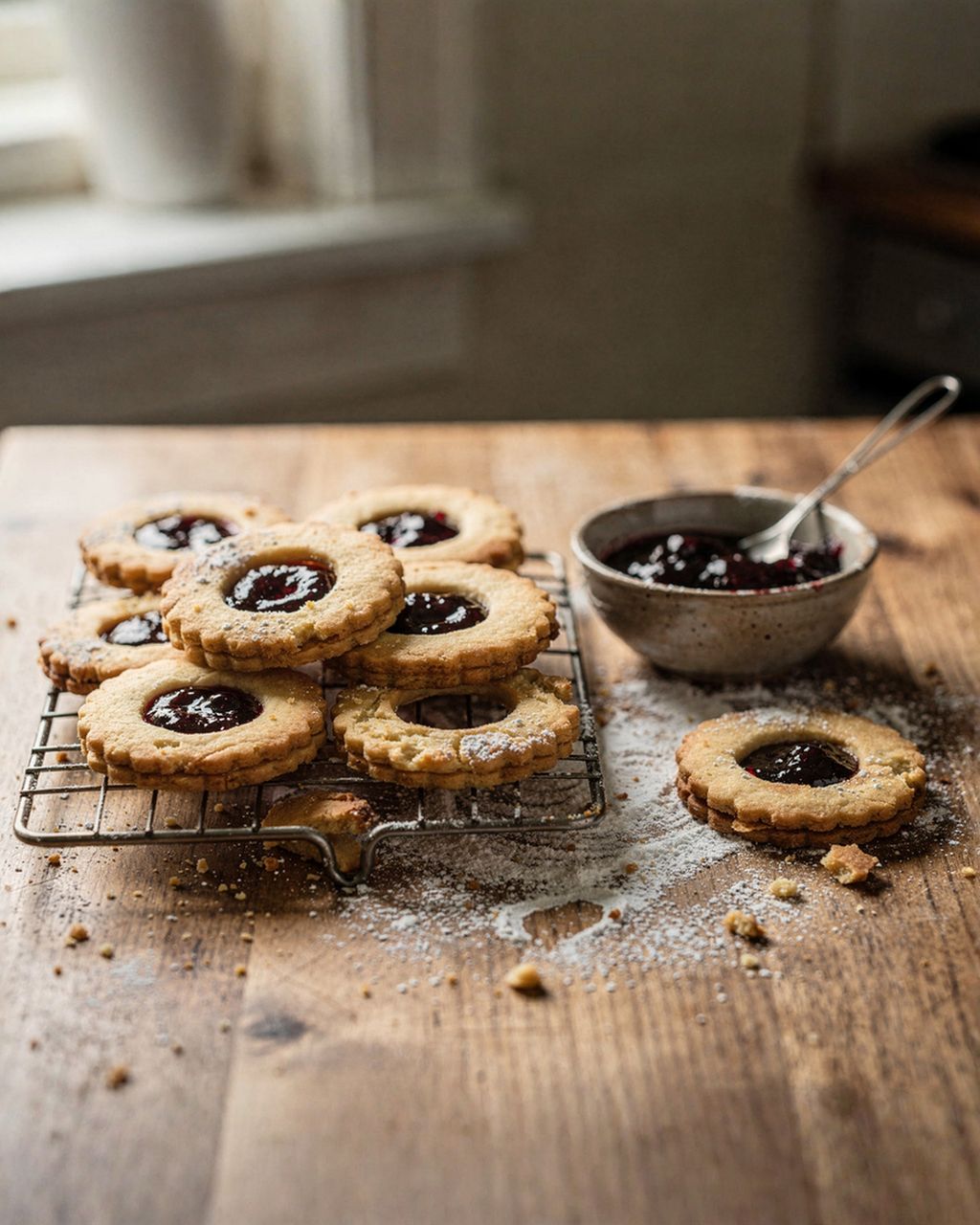
Classic christmas cookies: delicate linzer cookies
Crumbly Linzer Dough: Why It Happens and How to Fix It
Updated Aug 29, 2026
Linzer dough almost always crumbles for one of four reasons: there's too much flour in it, not enough fat, the butter is too cold, or you kneaded it a minute longer than you should have. The good news is that all four are fixable — even when the dough is falling off the board in chunks and your cutter is turning it into nothing but a pile of crumbs. Below you'll find how to figure out which cause is yours, how to rescue the dough, and exactly what times and temperatures it needs so it doesn't tear next time at all.
Crumbly Linzer dough has four main causes — and nine times out of ten, it's one of these:
Too much flour — the most common culprit, whether from inaccurate measuring or from dusting the board too heavily while rolling.
Not enough fat — below a ratio of 2:1 (flour to butter), the dough simply has nothing to hold it together.
Butter that's too cold — below about 15°C (59°F), fat turns hard and loses its pliability, so the dough cracks under the rolling pin.
Overworked dough — long kneading warms the fat, which coats the flour and then has no way to bind properly.
You can tell which one is yours by how the dough behaves in your hands. Let's go through them one by one.
Excess flour is the most common reason Linzer dough crumbles, and it sneaks in from two directions: inaccurate measuring and dusting the board too much.
Measuring flour "by the cup" is risky for Linzer dough — depending on how you scoop it and whether you pack it down, the weight of the same volume can vary by 20–30%. For a dough built on a precise ratio of ingredients, that's the difference between rolling smoothly and ending up with a pile of crumbs. Use a scale, not a cup.
The other half of the problem is dusting. When you sprinkle flour on the board and rolling pin as you go, the dough soaks it up — over the course of one batch of pastries, you can unknowingly add several dozen extra grams of flour you never weighed. That throws off the ratio right at the point where there's nothing left you can do about it.
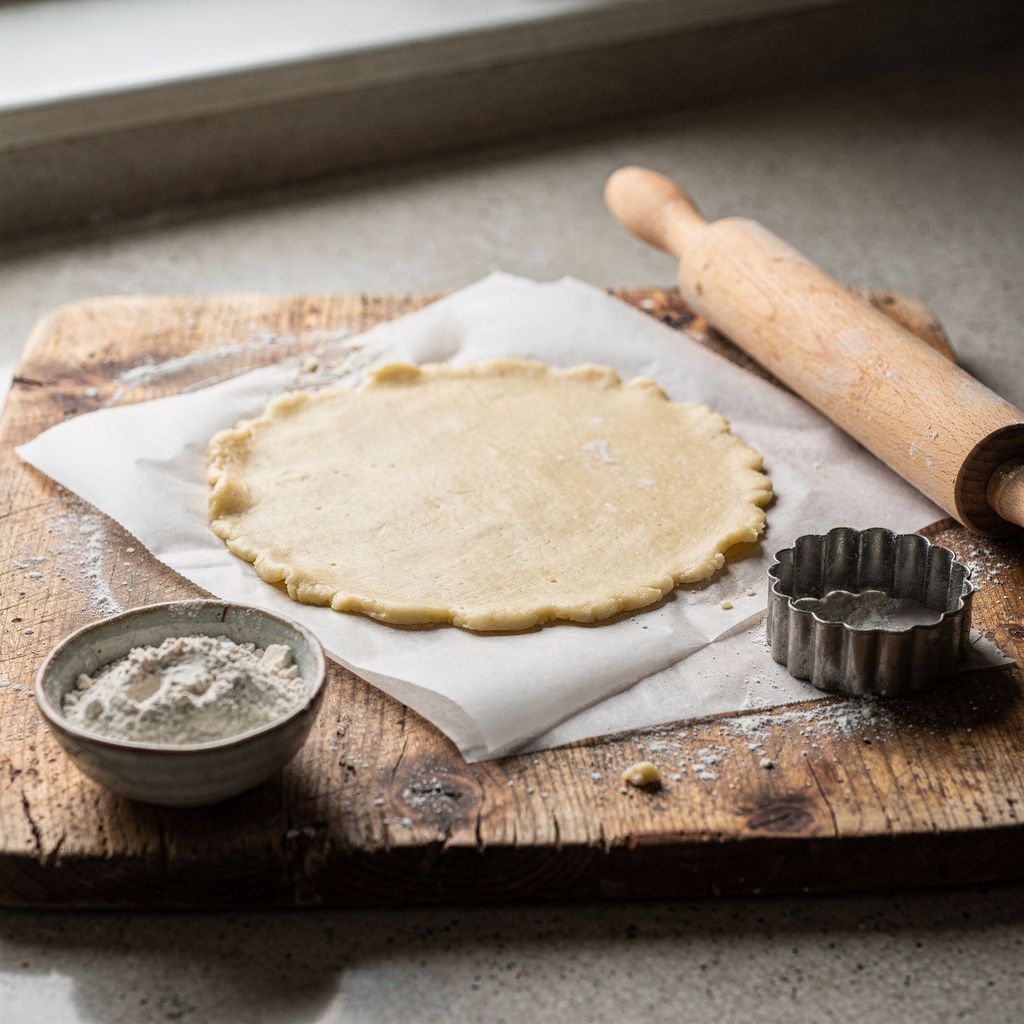
The fix is simple and works instantly: roll the dough between two sheets of parchment paper. You won't need a speck of dusting flour, the dough won't stick to the rolling pin, and you can pop the rolled sheet, paper and all, straight into the fridge.
The classic ratio for Linzer dough is 3:2:1 — 300 g plain flour, 200 g butter, 100 g sugar, meaning flour to butter is 3:2. Drier versions go as low as 2:1 (200 g flour to 100 g butter) — and below that ratio, the dough simply doesn't have enough fat to coat the flour and bind it into a cohesive mass, so it falls apart under the rolling pin.
Fat in Linzer dough isn't just there for flavour. It coats the flour particles, prevents them from forming gluten, and physically holds the dough together — which is exactly why Linzer pastry is short and crumbly rather than elastic. Cut back on it and you lose both at once: the raw dough crumbles, and the baked result turns out tough.
Watch out for two sneaky fat thieves:
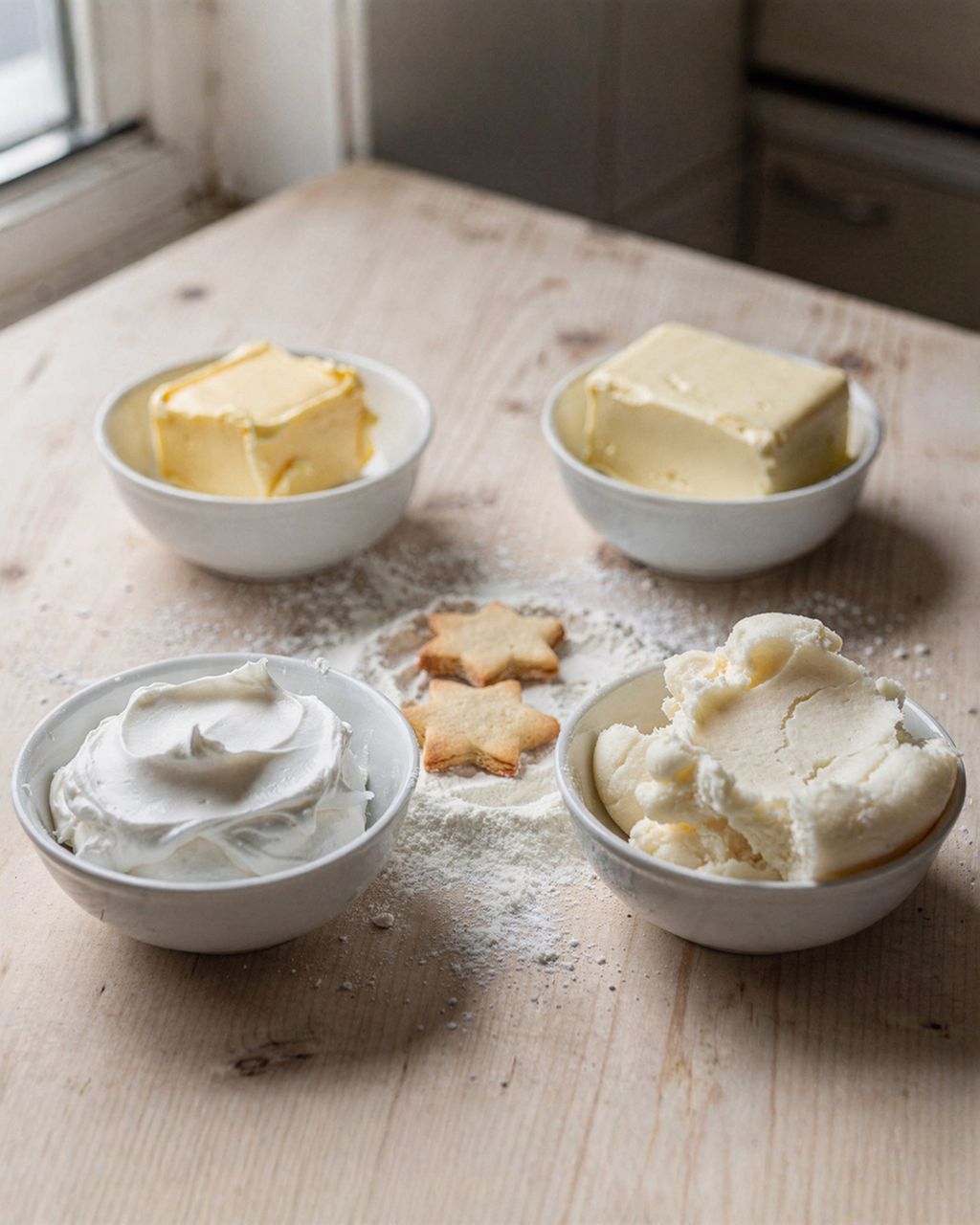
Products that look like butter but aren't quite. Under EU rules, butter must contain at least 80% and less than 90% fat (Czech butter is usually 82%). Reduced-fat butter (75%) sits at 60–62% fat, and half-fat spreadable butter at 39–41%. Dairy spreads labelled with a percentage cover the ranges outside these bands (under 39%, 41–60%, or 62–80% fat) — always check the fat content on the label. All three are pure dairy fat, just with more water than proper butter. Margarines and blended spreads, which aren't allowed to be labelled "butter" at all, also contain vegetable fat on top. Either way, weighing out 100 g gets you noticeably less actual fat in your dough.
Swapping butter for margarine or a hard vegetable fat 1:1. Different fats have different fat content and different melting points, and they behave noticeably differently in Linzer dough.
Dough straight from the fridge crumbles because at 4°C (39°F) butter is brittle rather than pliable — it cracks under the rolling pin instead of spreading out.
Butter has the narrowest workable temperature range of any baking fat — roughly 15–20°C (59–68°F). Above about 22°C (72°F) it softens and starts to turn greasy, making the dough sticky; below 15°C it hardens, loses its pliability, and the sheet cracks apart under pressure. Margarine and hard fats have a noticeably wider range, which is why dough made with them tends to be more forgiving to roll — though the resulting texture is different.
This is also the most commonly overlooked cause, because it looks like a mistake in the recipe when really it's just a matter of patience. Take the dough out of the fridge 15–20 minutes before you plan to roll it (in a cold kitchen, even 30 minutes is fine), and let it come to temperature in one piece, still wrapped. In plenty of cases, the crumbliness sorts itself out completely, without adding a single drop of anything.
The longer you knead Linzer dough, the crumblier it gets — not smoother. That's the opposite of how bread dough behaves, which is exactly why so many people pick up crumbly Linzer dough and try to "work it into shape," finishing it off for good.
Here's the mechanism: the warmth of your hands softens the fat until it turns almost oily. Fat in that state coats far more flour particles than it should, so the flour has no way left to bind with the liquid in the recipe, and the sheet ends up dry and won't hold together. At the same time, gluten starts developing, so on top of the crumbliness you also get toughness after baking.
A practical rule of thumb: bring the ingredients together into a ball and stop right there — for Linzer dough, that's about 30 seconds of work. The dough is allowed to look slightly uneven, even with visible flecks of butter; resting it in the fridge will even everything out on its own. And work it with your fingertips or a scraper rather than your whole palm.
The same rule applies to scraps: every extra time you re-roll offcuts, you warm and dry out the dough a bit more. Never re-roll it more than twice.
You rescue crumbly Linzer dough by first letting it come to temperature, and only adding a small amount of liquid if that doesn't work — half a teaspoon at a time, never by the tablespoon — then bringing it together by smearing it across the board with your palm, not by kneading. Work through these steps in order and stop as soon as the dough holds together:
Let it come to temperature for 15–20 minutes. Wrapped, at room temperature. The most common cause of crumbling is cold fat, not dry dough — and this step costs nothing and can't make anything worse.
Try pressing a handful of it together. If you can squeeze a handful of crumbs into a ball that holds its shape, the dough has enough moisture and just needs bringing together. Skip ahead to step 5.
If it still falls apart when pressed, add an egg yolk. It's the best binder Linzer dough has: it brings water and fat at the same time, and the lecithin in the yolk helps bind both together. For a batch made with 300 g flour, one yolk is enough.
Or add cold cream, milk, or water, ½ teaspoon at a time. Always drizzle it in, stir with a scraper, then try pressing it together. Only consider another half-teaspoon after that.
Bring the dough together by smearing, not kneading. Set it on the board and use the heel of your hand to smear it forward across the surface a few times, as if spreading it across the board, then gather it back into a pile with a scraper. This motion (bakers call it fraisage) spreads the fat through the flour and brings the dough together without developing the gluten.
Wrap it, chill for 30 minutes, then try again. In that time the flour will finish absorbing the liquid, and the sheet will roll out completely differently.
Linzer dough needs at least 30 minutes in the fridge, ideally 1–2 hours. A too-short rest shows up as crumbling while rolling; a longer rest isn't a problem, it just means the dough will need to come back to temperature before rolling.
Here's what happens to the dough during that time:
The flour finishes absorbing liquid. The starch and proteins fully hydrate with the water from the egg yolk and butter — this is the main thing happening, and there's no way to rush it.
The fat firms back up into solid little crystals, so the sheet holds its shape and doesn't turn greasy.
The gluten relaxes, so the cut-out shapes shrink and warp less in the oven.
Rough guide to timing:
30 minutes — the bare minimum before you start rolling.
1–2 hours — ideal for both rolling and flavour.
Overnight — perfectly fine, and even improves the flavour; just let the dough come to temperature for 20–30 minutes first, or it'll crack.
More than 2 days — better to freeze it, as the butter starts picking up fridge odours after that.
Watch out for a confusing paradox: both an under-rested dough and an over-chilled one will crumble. The first is because the flour hasn't fully hydrated yet, the second because the fat is too hard and brittle. If you're not sure which one you're dealing with, let the dough come to temperature — it helps with both causes, or at worst does no harm.
Roll Linzer dough chilled, but not ice-cold — the dough itself should sit at around 18–20°C (64–68°F), which corresponds to a kitchen at around 20–22°C (68–72°F) and dough that's been out of the fridge for about 15–20 minutes. 18–20°C is the sweet spot; between 15 and 22°C it's still rollable, just needs more care. Outside that range:
Below about 15°C the fat hardens and loses pliability: the sheet cracks sideways under the rolling pin and the edges tear.
Above about 22°C the butter softens and turns greasy, the dough sticks to the board and cutter, and you end up rescuing it with extra flour — which just sets you up for crumbling in the next sheet.
Instead of a thermometer, use the thumb test: press the edge of the chilled sheet. If it leaves a dent and the surrounding edge stays smooth, the dough's ready. If it cracks around the dent, give it another 5–10 minutes at room temperature. If your thumb sinks in with no resistance and leaves a greasy mark, it's too warm — pop it back in the fridge for 10 minutes.
And in a hot kitchen (summer baking, an oven running hot right next to the board), split the dough into two or three portions and always keep whichever one you're not currently working with in the fridge.
Linzer dough won't tear while rolling if you roll it between two sheets of parchment paper to an even 3–4 mm, work outward from the centre, press the cutter straight down without twisting it, cut the shapes close together, and re-roll the scraps no more than twice. These six habits keep the sheet in one piece:
Roll it between two sheets of parchment paper. Zero dusting flour needed, and you can pop the rolled sheet, paper and all, straight into the fridge whenever you like.
Roll it to an even 3–4 mm. Thinner edges crack, and they'll also brown too fast in the oven.
Roll outward from the centre, turning the sheet a quarter-turn every few strokes so the thickness evens out.
Press the cutter straight down, don't twist it. Twisting tears the edge and warps the shape in the oven.
Cut the shapes close together — the fewer scraps left over, the less re-rolling you'll need.
Re-roll scraps no more than twice, letting them chill for 15 minutes before each re-roll. A third re-roll gives you tough, crumbly pieces.
If the sheet tears anyway, don't pull it back together — just press the edges together with a finger and smooth over with the rolling pin. Pulling will only tear it further.
The fastest way out of crumbly dough is to start from a recipe with ratios that actually work. This is our go-to: a classic short Linzer pastry with the ratio, exact gram amounts, and the resting time discussed above.
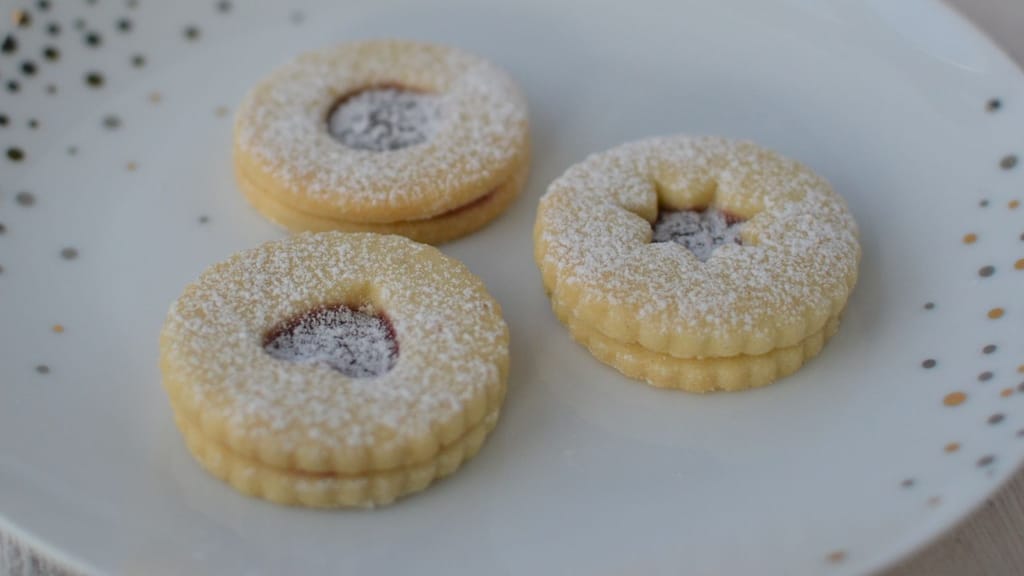
Classic christmas cookies: delicate linzer cookies
Classic Christmas cookies: short Linzer pastry — a basic recipe with a tried-and-tested flour-to-butter ratio
Both filled and nut-based Linzer cookies use the exact same dough, so the same ratios, resting time, and rolling temperature apply — only the filling and flavour change.
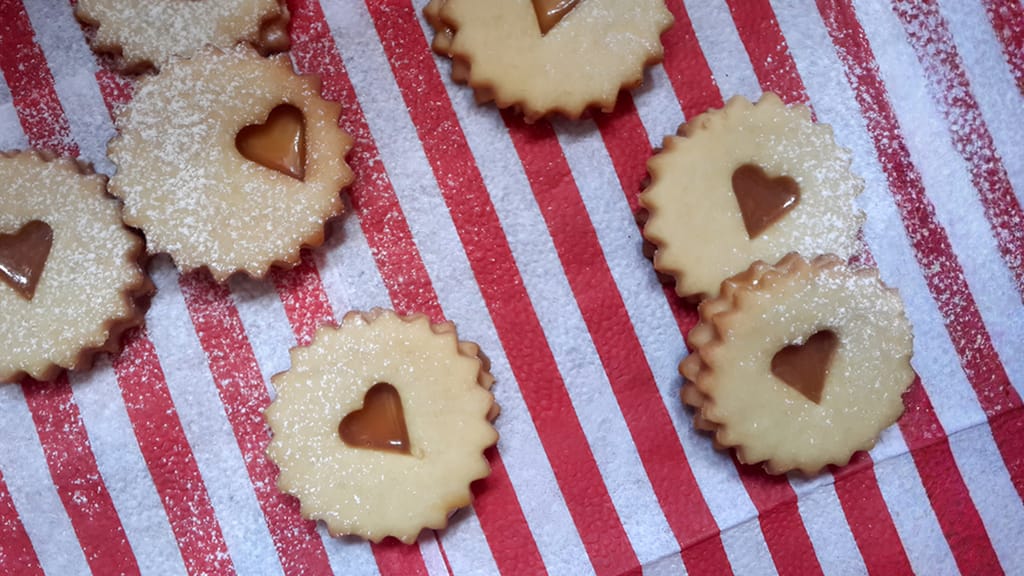
Linzer cookies filled with salted caramel
Salted caramel Linzer cookies — classic Linzer dough with a caramel filling

Unconventional linzer cookies with pistachios
Pistachio Linzer cookies with a twist — Linzer dough with a nutty variation
Gluten-free Linzer dough crumbles because it's missing gluten, which — even in a delicate dough — normally helps hold the sheet together at least a little, so you need to replace it with a binder. For 300 g of gluten-free flour blend, add about a teaspoon of psyllium or half a teaspoon of xanthan gum plus one extra egg yolk, and let the dough rest for at least an hour, since gluten-free flours and starches absorb liquid more slowly than wheat flour does. Always roll it between two sheets of parchment paper — a torn sheet is much harder to patch up by pressing than with wheat dough.
A teaspoon of vinegar won't fix crumbling — that's a myth built on the idea that vinegar adds a bit of liquid to the dough. Acid is credited with slowing gluten formation, but in a delicate dough like this that effect is negligible; the real problem with crumbly Linzer dough is too little fat or water, not too much gluten. If you're reaching for a liquid anyway, egg yolk or cream will do far more, since they bring fat along with the liquid.
Yes, but freezing on its own won't fix the crumbliness — correct the ratio now, and only freeze the dough once it's properly combined. Wrap it in plastic wrap and a freezer bag and it'll keep for 3 months; thaw overnight in the fridge and let it come to temperature for 20–30 minutes before rolling. You can also freeze an already-rolled sheet between sheets of parchment — just let it soften slightly before cutting shapes.
Yes — shape it by hand instead of rolling it. Form the crumbly dough into walnut-sized balls, flatten them gently on the baking sheet with a fork, and bake them just like Linzer rounds; the warmth of your palms softens the fat enough that the dough holds together in your hands, even if it wouldn't hold together as a sheet. Another option is to crumble it onto a baking sheet like a streusel and use the baked crumble as a topping for a dessert.
Baked Linzer falling apart when you lift it off the tray is usually down to too much fat, flour that's too finely milled, or the pastry still being warm — that's a different issue from raw dough crumbling. Always let the tray cool for at least 10 minutes before removing the pieces, and use a wide spatula to move them. If it still falls apart once cooled, cut back slightly on the butter next time or swap part of the plain flour for a coarser (semi-fine) grind.
Better not to — a stand mixer is the fastest route to overworked dough. The paddle warms the fat and kickstarts gluten development before you can react, turning crumbly dough into tough dough. If you do use one, mix on the lowest speed in short pulses and stop the moment the mixture starts breaking into large clumps; finish bringing it together by hand, smearing it across the board with your palm.
One recipe worth heating the oven for, one tip, and one deal from the shop. Nothing else.