How to Make Caramel from Sugar Without Burning It: Temperature, Method & Common Mistakes
Caramel Glaze for Větrníky: How to Make It Set Firm and Glossy
Updated Nov 17, 2026
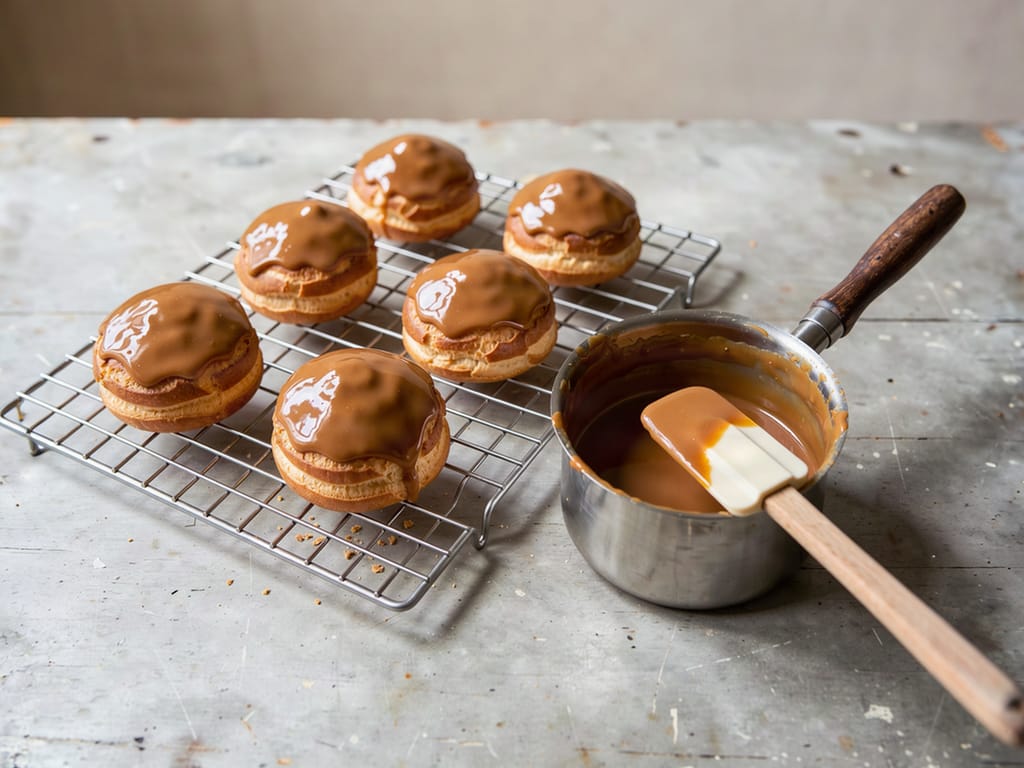
The caramel on větrníky (Czech caramel-glazed cream puffs) is really a caramel fondant: a sugar syrup with glucose cooked to the soft-ball stage (113–115°C / 235–239°F), worked until smooth and applied lukewarm, at 35–40°C (95–104°F). That's how it sets into a glossy, softly sliceable layer that neither runs nor cracks. Plain sugar caramel (160–170°C / 320–338°F) works too, but it sets into a glassy, crunchy crust that quickly turns damp in the fridge. Below you'll find both methods, the temperatures, the most common mistakes, and how the glaze differs from the caramel cream inside.
A classic bakery větrník is topped with caramel fondant, not plain caramel. The difference is what happens to the sugar as it cools: fondant crystallizes into tiny crystals, giving a fine, soft, glossy mass, while caramel stays glassy and hard.
Caramel fondant – syrup cooked to 113–115°C (235–239°F, soft-ball stage), worked cold into a cream and applied at 35–40°C (95–104°F). Result: a smooth, glossy, softly sliceable layer that holds up the next day in the fridge. Effort: about an hour including cooling.
Sugar caramel – sugar cooked to an amber color, 160–170°C (320–338°F), applied immediately while hot. Result: a glassy, crunchy crust like on croquembouche. Effort: 15 minutes. Weak point: sugar draws in moisture, so in the fridge it turns damp and sticky.
These temperatures match standard pastry sugar-stage charts; fondant is for a proper větrník, caramel for a quick version for the table right now.
Basic sugar caramel (dry method, just melting the sugar) is covered in detail in the article how to make caramel from sugar without it turning bitter. Here the focus is on a glaze that has to set on choux pastry and look good.
Seasonal baking plans, tested recipes and kitchen tricks that save you time. Unsubscribe in one click.
Caramel fondant is made by first caramelizing part of the sugar to a color, dissolving it in water, and only then cooking it like ordinary fondant to 113–115°C (235–239°F). For about 20 větrníky:
500 g granulated sugar
150 ml water
50 g glucose syrup (about a tenth of the weight of the sugar)
Color. In a heavy-bottomed pot, melt 150 g of the sugar dry and let it turn the color of a hazelnut. Darker caramel = stronger flavor, but also bitterness.
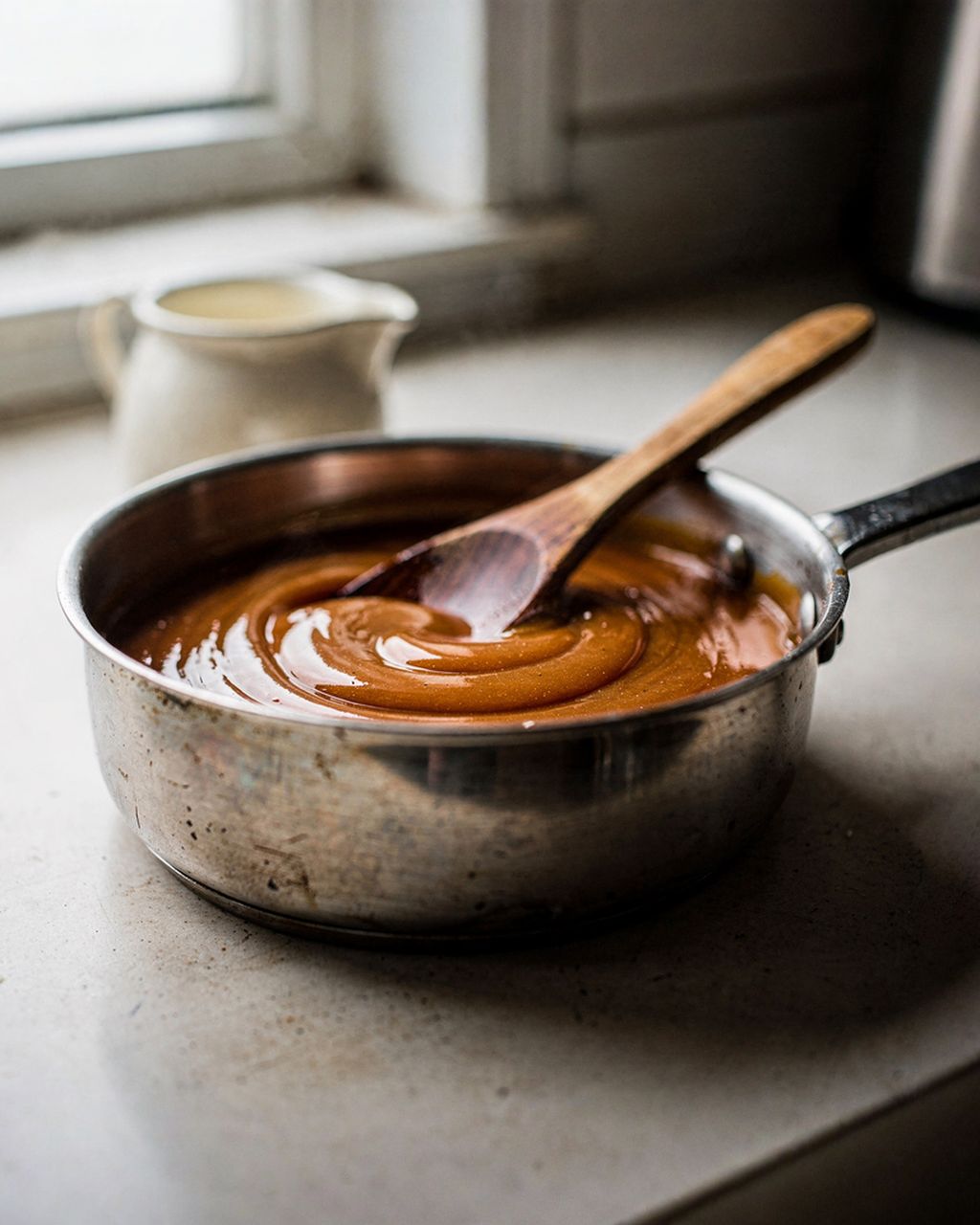
Dissolving. Take it off the heat and add hot water a little at a time (in cold water the caramel would seize into lumps). Stir until the caramel dissolves completely.
Cooking. Add the remaining 350 g sugar and the glucose syrup, stir until dissolved, and then stop stirring. Wipe the sides of the pot with a brush dipped in water so no crystals stay behind. Cook to 113–115°C (235–239°F).
Cooling. Pour the syrup onto a dampened marble slab or into a wide bowl and leave it undisturbed to cool to 40–43°C (104–109°F). Don't touch it – stirring too early makes coarse crystals.
Working. With a scraper or wooden spoon, push the syrup back and forth. After a few minutes it thickens, turns lighter and suddenly sets into a matte mass – that's right. Knead it smooth with your hands.
Resting. Wrap the fondant tightly in plastic wrap and let it rest at room temperature until the next day. It softens and warms more easily.
Both the cooking temperature (113–115°C) and the cooling temperature before working (to 40–43°C) match food-technology literature on fondant making – the cooler the syrup when you start working it, the finer the crystals and the smoother the glaze.
FunCakes glucose syrup (375 g) is your insurance against crystallization here: it disrupts the regular structure of sucrose crystals so the fondant stays fine and glossy. You'll find more sugars and syrups for baking in the baking sugars and syrups category.
For measuring you need a candy (probe) thermometer that can be immersed in syrup and reads up to 200°C (390°F). An oven thermometer, such as a Patisse one, won't do – it measures the air in the oven, not a liquid.
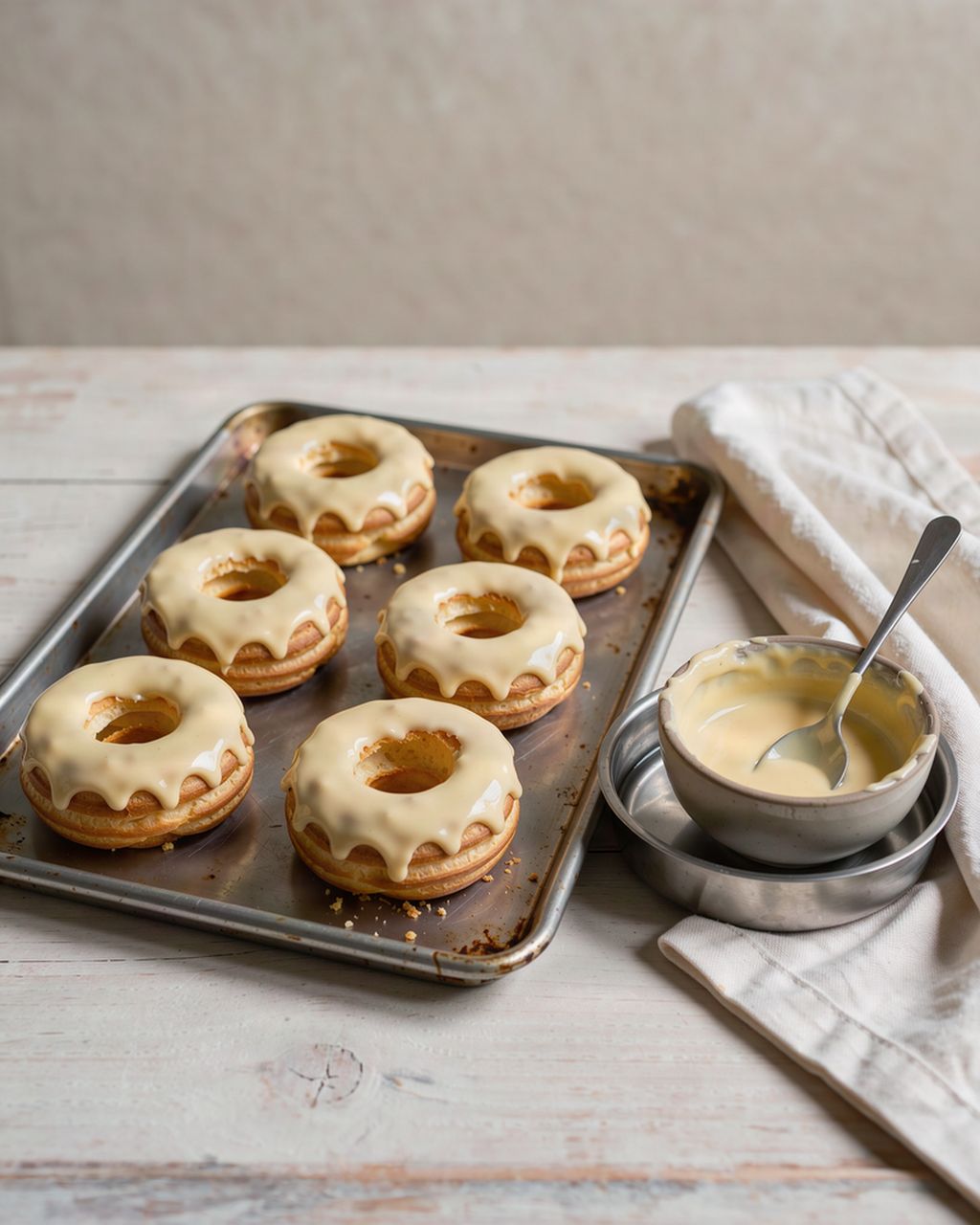
Warm the fondant in a water bath to 35–40°C (95–104°F), thin it to the consistency of heavy cream, and dip completely cooled shells into it. That's the whole secret to the shine.
Temperature. 35–40°C (95–104°F), just slightly above body temperature – it should feel lukewarm on your lip. Pastry chefs agree that above about 40°C the tiny crystals dissolve, grow back larger as it cools, and the glaze turns dull and gray.
Consistency. If the fondant is too thick, add water or glucose syrup drop by drop. The right consistency: it runs off a spoon in a continuous ribbon, and the trail on the surface smooths out within a few seconds.
Shell. The choux shell must be cold and dry. A warm shell heats the fondant, which thins and runs down the sides.
Dipping. Hold the shell by its base, dip the top about half a centimeter (¼ inch) deep, lift slowly and let the excess drip off. Wipe the drip from the edge with a finger and turn it glaze side up.
Setting. Let the glaze set at room temperature; don't put the větrníky straight into the fridge. Only then cut the shell open and fill it.
The principle is the same as for white and chocolate fondant on věnečky (Czech cream-filled choux rings), covered in detail in the article fondant for věnečky: how to warm it so it stays glossy. And if your shells crack or collapse, have a look at what oil, lard or butter does to choux pastry.
Glaze on větrníky fails for five reasons: it runs (too warm or too thin), it dulls (overheated above 40°C), it's grainy (crystallized too early), it won't set (undercooked) or it cracks (layer too thick). Most of these can be rescued.
Runs off the shell. The fondant is too thin or too warm, or the shell hasn't cooled yet. Let the fondant cool below 40°C (104°F), or mix in a bit of stiff fondant.
Dull and grayish. You overheated the fondant above 40°C (104°F). You can't save this glaze, but you can save the rest of the fondant: let it cool, knead it, and watch the temperature next time.
Grainy, crunchy. The syrup crystallized too early – you stirred it while cooking, crystals stayed on the sides, or you started working it while hot. Dissolve grainy fondant with a little water, recook it to 113–115°C (235–239°F) and start again from the cooling step.
Won't set, sticky. The syrup was cooked to a lower temperature, or you added too much water when thinning. For a glaze meant to stay runny that's fine – see liquid caramel without cream – but not for a větrník.
Cracks. The layer is too thick or the fondant too stiff. Thin it and dip only once.
Plain caramel is the quick option for větrníky: cook sugar with a little water and glucose to 160–170°C (320–338°F, light amber), dip the tops in, and in a minute you're done. You get a glassy, crunchy cap.
Put 200 g sugar, 60 ml water and a tablespoon of glucose syrup in a pot. Dissolve, then stop stirring and just swirl the pot to even out the color.
As soon as the caramel reaches 160–170°C (320–338°F) and a honey color, dip the bottom of the pot in cold water for a few seconds to stop the cooking.
Hold the shell by its base, dip the top, and set it upside down on a silicone mat. The top will be perfectly flat and glossy.
If the caramel in the pot thickens, gently reheat it over low heat.
Sugar is hygroscopic, so a caramel crust softens and turns sticky in the damp of the fridge. Fill and serve větrníky with sugar caramel the same day.
Apart from the flavor, the cream inside a větrník has nothing in common with the glaze: the glaze is pure sugar, while the cream is a pudding base with caramel, butter and usually whipped cream. It must be soft and supple, not stiff.
Base. Sugar caramel is dissolved in warm milk or cream, and a pudding or cream of egg yolks and starch is cooked in it. For flavor you can also build it on homemade caramel sauce from 4 ingredients.
Butter. Softened butter is whipped into the cooled cream – this thickens it so it holds its shape.
Whipped cream. A classic větrník also has a layer of whipped cream, on which the glazed lid sits.
Shortcut. A thick caramel cream can also be made from cooked, thickened sweetened milk (in shops often sold as condensed milk) – the method and how to cook the can safely are described in the article condensed milk for caramel.
Make sure the cream is completely cold before filling. Warm cream softens the shell and seeps under the glaze.
Větrníky with cream belong in the fridge. A cream made with milk, eggs and whipped cream is a perishable food.
Room temperature: according to the US food safety agency USDA FSIS, 2 hours at most, or just 1 hour when the temperature is above 32°C (90°F).
Fridge: USDA gives 3–4 days in the fridge at up to 4°C (40°F) for desserts with a cream or pudding filling. The fondant keeps its shine over that time, but the shell gradually softens – they're best by the next day.
Freezer: don't freeze filled větrníky; after thawing, the cream and whipped cream release water and the shell turns soggy.
If you want to bake ahead, store the empty shells and the fondant separately, and fill and glaze only on the day you serve them.
Without a thermometer, use the cold-water test: caramel fondant syrup is ready when a drop in a glass of cold water forms a soft ball that flattens between your fingers. That corresponds to 113–115°C (235–239°F). Test every half minute, because the temperature rises quickly at the end of cooking. It's less accurate than a candy thermometer, so expect the fondant to turn out slightly firmer or softer.
Yes. Instead of glucose syrup you can add a few drops of lemon juice: the acid breaks down some of the sugar and slows crystallization. It works, but less reliably: the fondant tends to be grainier and loses its shine faster. While cooking, be even more careful not to stir and not to leave any crystals on the sides of the pot.
Yes, ready-made pouring (glazing) fondant is the quickest route to a caramel glaze. Warm it in a water bath to 35–40°C (95–104°F) and stir in one or two teaspoons of thick, dark caramel until it reaches the color you want. Caramel thins the glaze, so add it gradually. Note that rolling fondant for covering cakes isn't suitable for dipping – it's a different product.
Wrap leftover caramel fondant tightly in plastic wrap so it doesn't dry out or form a crust, and keep it at room temperature. Before using it again, just knead it and rewarm it in a water bath to 35–40°C (95–104°F). If it gets too stiff, thin it with water, a few drops at a time.
Yes, you can darken and flavor caramel fondant, ideally when you rewarm it before dipping. For a darker color and a stronger flavor, let the sugar caramelize to a darker amber in the first step, but not to a brownish black, because that turns bitter. For a coffee glaze, thin the fondant drop by drop with strong espresso or instant coffee dissolved in a teaspoon of hot water instead of plain water. For salted caramel, dissolve a pinch of fine salt in that same thinning liquid; coarse flakes would stay in the glaze as grains. Add the liquid carefully so the glaze doesn't thin out and run.
One recipe worth heating the oven for, one tip, and one deal from the shop. Nothing else.