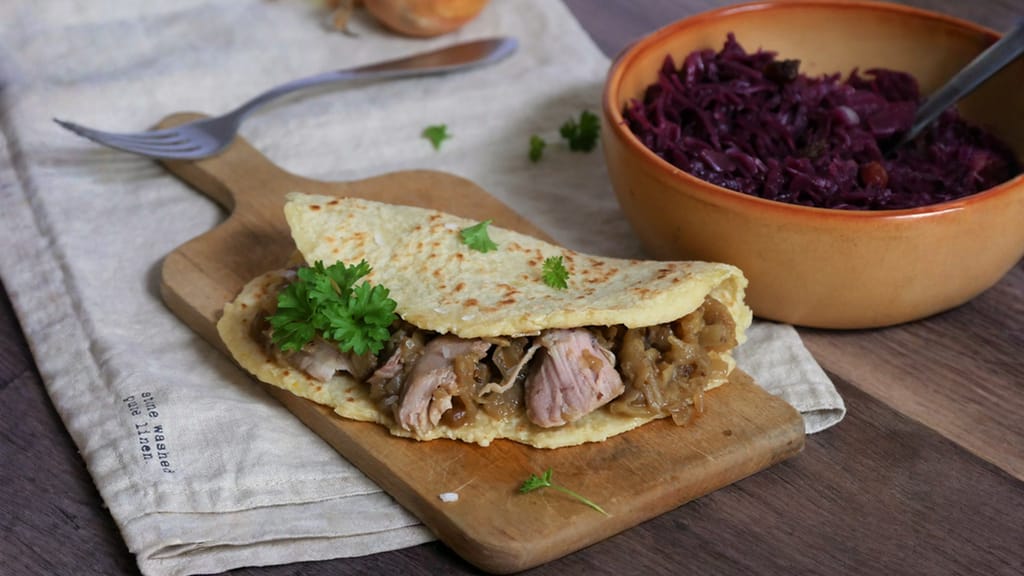
Goose breast on apples with potato lokše
Why Your Roast Goose Is Tough and the Skin Won't Crisp Up (And How to Fix It)
Updated Sep 25, 2026
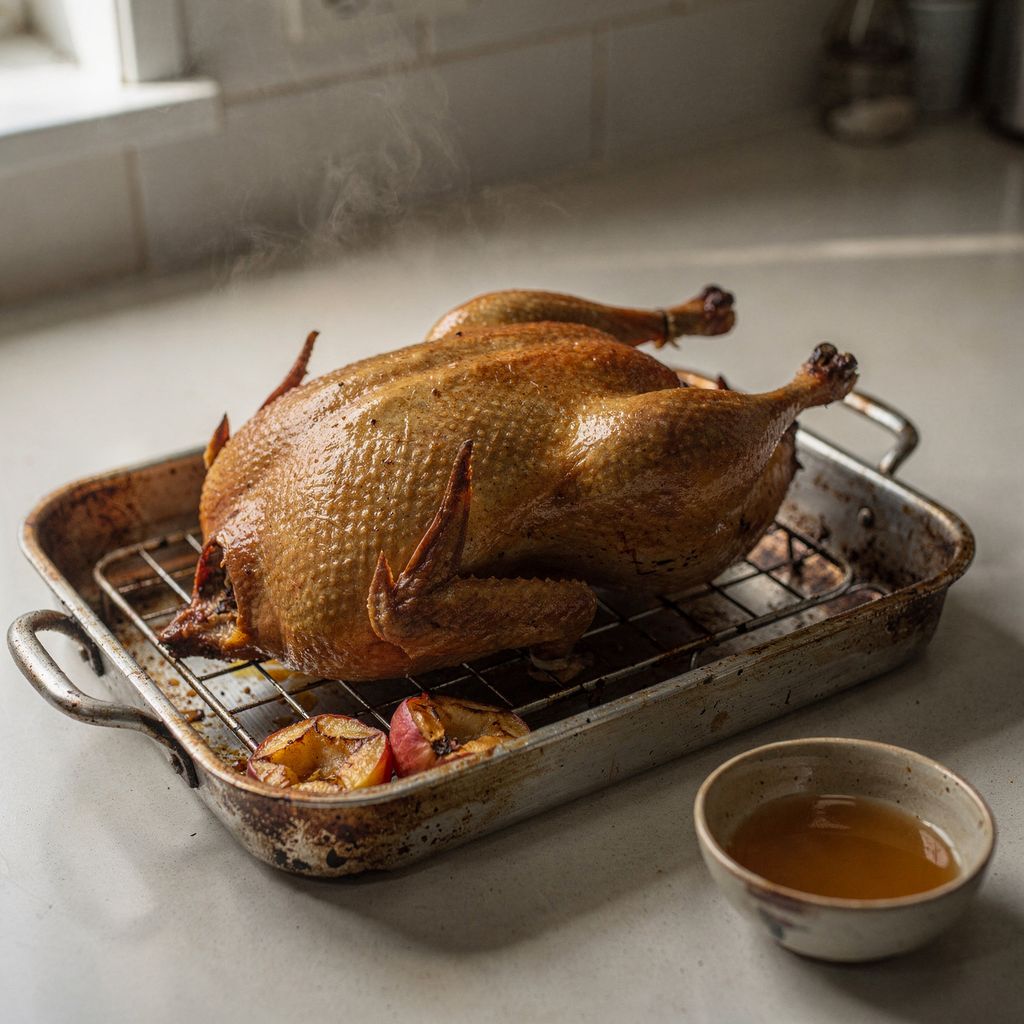
Roast goose turns out tough when it's cooked too quickly or for too short a time, and the skin stays soggy because it never dried out and the fat underneath never had the chance to render. Tender meat and crispy skin actually want two opposite things: the meat needs hours of gentle, moist heat, while the skin needs dry heat at the very end. Once you understand that, goose stops being intimidating — and even if it goes wrong, you can usually fix it that same day.
Goose turns out tough when the collagen inside it — the connective tissue holding the muscles together, and goose has far more of it than chicken, especially in the legs — doesn't get the chance to break down. Collagen starts converting into gelatine at around 60–70°C (140–160°F) inside the meat, but what it needs is time, not higher heat. An hour at 220°C (425°F) won't do it any favours; four hours at 150–160°C (300–320°F) will.
The most common causes:
Roasting for too short a time. A 4–5 kg (9–11 lb) goose needs roughly 1 hour per kilogram (about 30 minutes per pound), so 4–5 hours total. Anyone treating it like a chicken pulls it out half that time.
Too high a temperature the whole time. Muscle fibres tighten up under fierce heat and squeeze out their juices before the connective tissue has a chance to melt. The result is dry and tough at the same time.
An older bird. A free-range goose slaughtered at a year old or later has firmer meat than a young autumn goose (typically 4–7 months). An older bird needs an extra hour or more, plus more liquid in the roasting pan.
Carving it straight out of the oven. The meat needs 15–20 minutes to rest, or the juices will end up on the chopping board instead of in the meat.
The legs should be cooked through to 80–85°C (175–185°F) at their thickest point (probe near the bone, but not into it), and the breast to 70–75°C (160–165°F). The general safe minimum for poultry is 74°C (165°F), but for the legs it's about more than just safety: it's only around 80°C and above that the connective tissue properly breaks down and the meat pulls easily off the bone.
This is also the catch with a whole goose: the breast finishes cooking before the legs do. That's why goose is roasted gently and for a long time — it keeps the breast from drying out while the legs catch up. A probe thermometer takes the guesswork out of it; without one, try wiggling the leg — on a properly cooked goose it moves freely in the joint and the juices run clear.
Skin stays soft when it's either damp or still holding fat underneath. Crispness only happens once the water has evaporated from the skin and the fat has rendered out — as long as either one is still there, the skin stays rubbery and limp.
Where it usually goes wrong:
The goose wasn't dried properly. Skin that's still damp from packaging or from rinsing basically steams in the oven for the first hour before it even starts to brown.
It was roasted covered the whole time. A lid or foil traps steam — great for the meat, death for the skin. You have to uncover it towards the end.
The fat had nowhere to drain. Goose has a thick layer of fat under the skin. If you don't prick the skin, the fat stays trapped inside and the skin turns out thick and gummy.
The goose was sitting in its own drippings. The underside, soaking in juices and fat, will never crisp up. A rack in the roasting pan or regularly pouring off the fat helps.
No final blast of dry heat. The last 30–45 minutes need the oven at 200–220°C (400–425°F) with the pan uncovered.
Basting near the end. Every spoonful of pan juices poured over the skin in the final stretch just soaks it again.
Resting it under foil. A covered goose softens itself in its own steam. Let it rest uncovered.
The method has three phases: prep (dry it out and prick the skin), gentle roasting (long and covered, at 150–160°C/300–320°F) and dry heat (uncovered, finished at 200–220°C/400–425°F). Broken down into six steps:
Prep — salt and dry it a day ahead. Pat the goose dry with paper towels, salt it inside and out (about 1 teaspoon, or 5–6 g of salt per kilogram) and leave it uncovered in the fridge for 12–24 hours. This dries out the skin and the salt helps draw out a bit more moisture.
Prep — prick the skin. Using a thin needle or skewer, prick dozens of holes, focusing on the breast, thighs, and sides, where the fat is thickest. Angle the prick shallowly, going only through the skin and fat layer — not into the meat, or the juices will leak out.
Gentle roasting — on a rack, covered. Set a rack in the roasting pan, place the goose breast-side down on top, pour 1–2 cm of water underneath, and cover. This keeps the goose out of its own drippings and gives the skin underneath a chance to crisp. Roast at 150–160°C (300–320°F) for roughly 1 hour per kilogram. Flip it breast-side up halfway through.
Gentle roasting — pour off the fat. Pour off the excess fat every hour. A 4–5 kg (9–11 lb) goose can easily render 0.5–1 litre — save it, it's liquid gold.
Dry heat — uncover and turn up the heat. Leave the goose on the rack. Uncover it, raise the temperature to 200–220°C (400–425°F) and roast for 30–45 minutes, until the skin turns golden and starts to bubble. Don't baste it from this point on.
Rest it uncovered. 15–20 minutes loosely on the rack or a board, then carve.
Scalding a goose with boiling water isn't essential, but it helps if your skin keeps refusing to crisp up: it tightens and stretches the skin, which then dries out faster in the fridge. It's a trick borrowed from Peking duck. Just set the goose on a rack in the sink, pour over 1–2 litres of boiling water, pat it dry, then leave it uncovered in the fridge overnight. That said, thorough drying and pricking do most of the work already — scalding is an extra step, not the foundation.
Goose breast on its own goes tough from overcooking, not undercooking — it has very little connective tissue, so long roasting hurts it rather than helping. The method is therefore the opposite of a whole goose: score the skin in a crosshatch, sear the breast skin-side down in a dry pan over low heat for 8–10 minutes so the fat renders and the skin turns golden, then finish it in the oven just until it reaches 70–75°C (160–165°F) inside, and let it rest for 10 minutes. Try it with the recipe below.
Goose breast on apples with potato lokše
Goose Breast with Apples and Potato Pancakes — tender breast with crispy skin
You rescue a tough goose with more roasting time, not more heat; soft skin gets fixed with a short blast of high heat. Both work even once your guests are already at the table.
If the meat is tough: put the goose (or the carved pieces) back in the roasting pan, add 1–2 cm of water or stock, cover, and roast for another 45–60 minutes at 150°C (300°F). Then check the legs — they should move freely at the joint. It's best not to put carved breast meat back in the oven; just warm it briefly in the hot juices instead.
If the skin is soft: carve the goose, arrange the pieces skin-side up on a tray, and put them under the broiler or in the oven at 230–250°C (450–480°F) for 5–10 minutes. Watch closely — the skin goes from rubbery to burnt within a minute. Pat the skin dry first and don't add any liquid.
And if there are leftovers? Tough pieces make excellent pulled meat for filled dumplings, risotto, or pâté — find out more in the article Leftover Roast Goose and Duck: What to Do with the Meat, Carcass, Skin, and Fat.
Yes — roast the goose until tender the day before, then reheat it and crisp up the skin in the oven at 220°C (425°F) the next day. Skip the final blast of heat on day one, carve the cooled goose and store it in the fridge; the next day, reheat the pieces covered with the juices for about 30 minutes at 160°C (320°F), then uncovered for 10–15 minutes at 220°C (425°F). The meat often turns out even better this way.
Roast the goose breast-side down for the first half of cooking, then breast-side up for the second half. This shields the breast meat from drying out while the thighs, on top, catch up in cooking; flipping it then gives the breast skin — the part everyone sees — a chance to crisp up.
Thaw a frozen goose slowly in the fridge, allowing roughly 24 hours for every 2 kg (4.4 lb), so a 4–5 kg (9–11 lb) goose needs 2–3 days. Once thawed, pat it thoroughly dry before salting it and leaving it uncovered to air-dry.
A 4–5 kg (9–11 lb) goose typically renders about 0.5–1 litre (roughly 2–4 cups) of fat during roasting. Strain it through a sieve — kept in a sealed jar in the fridge it lasts for weeks and is fantastic for roast potatoes, cabbage, or spread on bread with a pinch of salt.
Roast goose turns out greasy when the fat under the skin hasn't rendered out — usually because the skin wasn't pricked, it was roasted too briefly, or it stayed covered the whole time. Prick the skin all over, pour off the fat every hour, and let it finish with at least 30 minutes of dry heat at 200–220°C (400–425°F).
One recipe worth heating the oven for, one tip, and one deal from the shop. Nothing else.