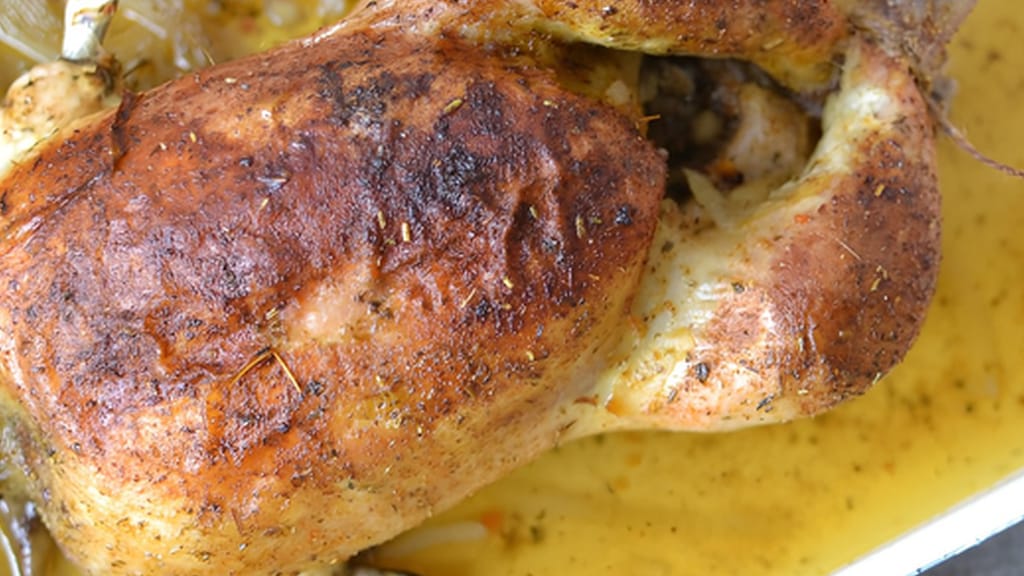
Roast chicken – impressive results, minimum effort
What Temperature to Roast a Chicken, and for How Long: Times by Weight and How to Tell It's Done
Updated Oct 17, 2026
What temperature should you roast a chicken at? Roast a whole chicken at 200 °C (fan 180 °C), allow roughly 45–50 minutes per kilogram, and it's done when the thickest part of the breast reaches at least 74 °C and the thigh joint moves freely. Below you'll find times by weight for a whole chicken as well as for thighs, breasts and wings, how to check doneness with and without a thermometer, and why a roast chicken needs to rest.
Chicken roasts best at 180–200 °C with conventional top and bottom heat, or 10–20 °C lower in a fan oven. Choose the temperature based on what you're after:
180 °C – gentle, even roasting. The meat stays juicy, but the skin turns golden more slowly. Good for larger chickens over 1.8 kg and for roasting on vegetables or in a roasting pan with liquid added.
200 °C – the best compromise for an average chicken of 1.2–1.8 kg. The skin roasts to a golden color and the breast doesn't have time to dry out.
220 °C – for pieces (thighs, wings) or for the last 10–15 minutes of a whole chicken when you want really crisp skin.
Why not higher? Above 220 °C, the skin and pan juices start to burn before the meat by the bone is cooked through. And why not lower? Below 160 °C the meat will be tender, but the skin stays rubbery and pale – that's more slow roasting than a classic roast chicken.
A whole chicken at 200 °C takes roughly 45–50 minutes per kilogram, and about a quarter longer at 180 °C. These times are for an unstuffed chicken taken out of the fridge about 30 minutes beforehand:
1.0–1.2 kg: 200 °C 50–60 min / 180 °C 60–75 min
1.3–1.5 kg: 200 °C 60–75 min / 180 °C 75–90 min
1.6–1.8 kg: 200 °C 75–90 min / 180 °C 90–105 min
2.0–2.5 kg: 200 °C 90–110 min / 180 °C 105–130 min
Half a chicken (about 0.7 kg): 200 °C 45–55 min
Spatchcocked chicken (backbone removed, flattened) 1.5 kg: 210 °C 45–55 min – it cooks faster and more evenly because the thighs and breasts sit at the same height.
This matches the US poultry safe-cooking chart (USDA), which says a 1.4–1.8 kg chicken needs roughly 75–90 minutes at 177 °C. Roast a stuffed chicken 15–30 minutes longer – the stuffing inside has to reach 74 °C too.
Treat the times as a map, not a stopwatch. Every oven heats differently, and if you're not sure yours really holds the temperature you set, an inexpensive oven thermometer will tell you. But whether the chicken is done is always decided by the meat, not the minutes.
Chicken pieces roast at 200–220 °C and take 20–45 minutes depending on size – bones and skin add time, while boneless meat shortens it:
Whole bone-in legs (250–350 g): 200 °C 40–50 min, skin side up
Bone-in thighs: 200 °C 35–45 min
Drumsticks (lower legs): 200 °C 35–40 min
Wings: 220 °C 35–45 min, turning halfway
Bone-in, skin-on breasts: 200 °C 35–45 min
Boneless breast fillet (180–220 g): 200 °C 20–25 min
Boneless, skinless thighs: 200 °C 25–30 min
If you're roasting thighs and breasts together, put the breasts in the oven 10–15 minutes later or take them out earlier. Thighs can handle more heat, and actually need it; breasts don't. For inspiration: chicken thighs roasted with wild mushrooms or chicken pieces roasted on a bed of carrot sticks, where the vegetables cook right under the meat and soak up the pan juices.
A chicken is cooked when the thickest part of the breast reaches at least 74 °C and the thigh reaches 80–85 °C. The temperature inside the meat is the only reliable indicator; time, skin color or the color of the juices alone aren't enough.
According to the US Department of Agriculture's Food Safety and Inspection Service (USDA FSIS), the safe minimum temperature for poultry is 74 °C – at that temperature bacteria such as salmonella and campylobacter are killed. Measure with an instant-read probe thermometer:
Breast: insert the tip into the thickest part from the side, horizontally, so the tip ends up in the middle of the meat.
Thigh: insert it into the thickest part between the thigh and the body.
Don't touch the bone – it conducts heat differently and will give a skewed reading.
Why aim for more than 74 °C in the thighs? Thigh meat has a lot of collagen (connective tissue). At 74 °C it's safe, but still rubbery; at around 80–85 °C the collagen melts and the meat starts to pull away from the bone. Breasts are the opposite – above 75 °C they dry out quickly. So you can take a whole chicken out of the oven when the breast is approaching 74 °C and let it finish cooking as it rests. After resting, though, always check that the breast is at least 74 °C – if it isn't, put the chicken back in the oven.
Without a thermometer, combine at least three signs at once – none of them is enough on its own:
The leg moves freely. When you pull on the drumstick, the joint gives and the leg wiggles loose easily.
The juices from the thigh run clear. Pierce the thickest part of the thigh with a knife or skewer; the juices should be transparent or slightly yellowish, not pink or bloody.
The meat by the bone isn't glassy. Cut into the thigh at the joint: the meat should be opaque and fibrous. Shiny, translucent, jelly-like meat needs more time.
The meat separates easily from the bone – especially easy to see on thighs and wings.
One trap to watch out for: slightly pink meat near the bone doesn't necessarily mean it's raw. In young chickens, the bone marrow and myoglobin in the meat turn pink during roasting even at a safe temperature – the USDA explicitly states that the color of the meat is not an indicator of doneness. And it works the other way too: meat can turn white before it reaches a safe temperature. That's why an inexpensive probe thermometer is the best insurance you can have in your kitchen.
Let a whole chicken rest for 10–15 minutes after taking it out of the oven, and pieces for 5 minutes. There are two reasons:
Carryover cooking. The internal temperature will still rise by roughly 2–5 °C – the bigger the piece, the more. That's why you can take the chicken out a touch early without drying out the breast. After resting, check that the breast is at least 74 °C.
The juices stay in the meat. If you cut the chicken right away, the hot juices run out onto the board. After resting, the meat firms up a little and holds on to its juices.
Let the chicken rest on a board or a rack, covered only loosely with foil. If you wrap it tightly, the skin steams and goes soft.
Three things ruin a chicken most often: wet skin, chicken straight from the fridge, and carving right after it comes out of the oven. Here's the full list:
Wet skin. Moisture has to evaporate before the skin can start to turn golden. Pat it dry with a towel, and if you have time, leave the chicken uncovered in the fridge overnight – the skin dries out and crisps up in the oven.
Chicken straight from the fridge. Ice-cold meat cooks unevenly: the skin is done while the bone is still cold. 30 minutes on the counter is enough, no longer.
A pan that's too small or overcrowded. The chicken and vegetables then stew in their own juices instead of roasting. Leave some space around the meat.
Opening the oven constantly. Each time you open it, the oven loses some heat and the roasting takes longer. Baste with the pan juices once or twice, not every ten minutes.
The breast dries out before the thighs. Roast the chicken breast side up, with the thighs toward the back wall of the oven (it's usually hotter), or spatchcock it.
Carving right after it comes out. See the resting section above – ten minutes of patience is the difference between juicy and dry meat.
Roasting other poultry too? Goose has a completely different balance of fat and cooking time – we have a separate guide for that: how long to roast a goose and how to tell when it's done.
The best way to put everything in this article to the test is with a whole chicken and a simple preparation – salt, butter, herbs and an oven at 200 °C. Once you've got the basics down, you'll find more ideas for thighs, breasts and whole chickens in chicken recipes on Yumsto.
Roast chicken – impressive results, minimum effort
Easy roast chicken – a whole chicken from the oven, step by step
In a fan oven, roast chicken at 170–180 °C, which is 10–20 °C lower than with conventional top and bottom heat. Circulating air transfers heat faster, so the time stays similar or gets shorter by 5–10 minutes. What counts is the temperature inside the meat: 74 °C in the breast.
Roast chicken uncovered for most of the cooking time, otherwise the skin will be soft and pale. You can cover it with foil only if the skin browns before the meat is done – typically with a large chicken over 2 kg. If you're using a roasting pan with a lid, take the lid off for at least the last 20–30 minutes.
Yes, you can roast a frozen chicken straight away, but it takes about half as long again and cooks less evenly. It's safer and tastier to thaw it in the fridge – allow about 24 hours for every 2 kg. Don't thaw chicken on the counter at room temperature; the surface warms into the danger zone while the inside is still frozen.
Roast chicken keeps in the fridge for 3–4 days in a sealed container. Put it in the fridge within 2 hours of roasting. Reheat it until it's piping hot all the way through – again to at least 74 °C.
Roast chicken is most often dry because the breast went past about 75 °C, or because it was carved without resting. If it does happen, slice the meat and pour warm pan juices or stock over it – it will soak them up. Next time, check the breast temperature with a thermometer, let the chicken rest for 10–15 minutes, and after resting make sure the breast is at least 74 °C."
One recipe worth heating the oven for, one tip, and one deal from the shop. Nothing else.