Why Is My Pavlova Chewy? Crisp Shell vs Marshmallow Center
Why Is My Pavlova Weeping? Syrup Beads, Leaks and How to Stop Them
Updated Nov 20, 2026
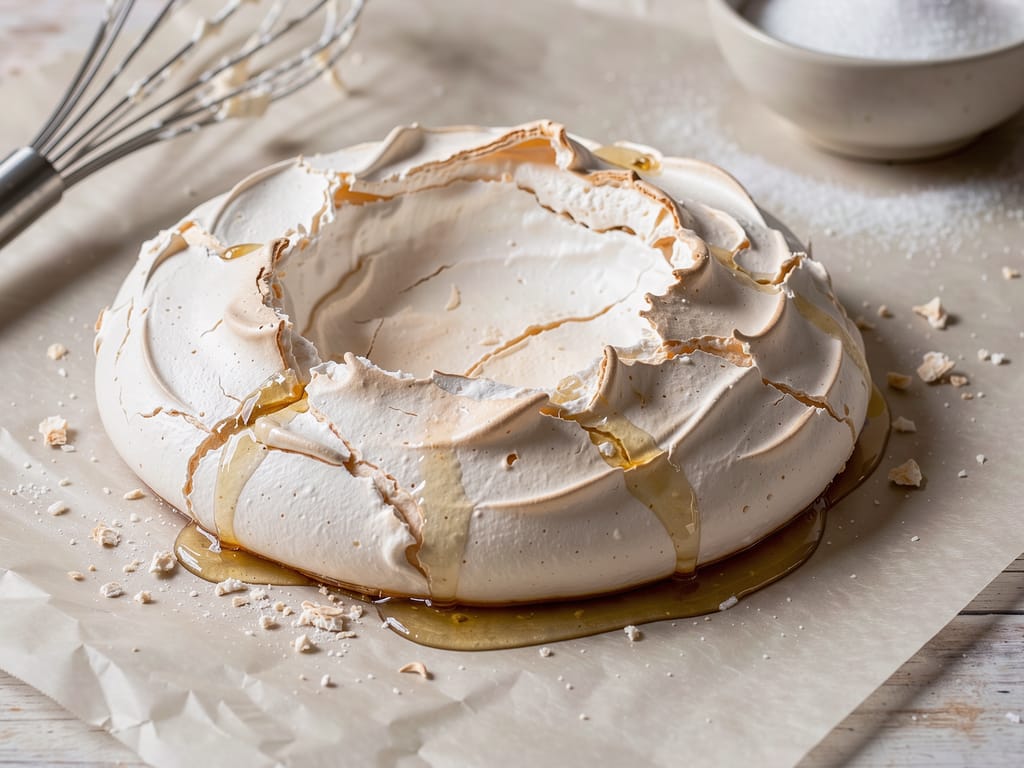
A pavlova weeps when sugar in the meringue turns to syrup and seeps out, most often because the sugar never fully dissolved, the air was humid, or the meringue was underbaked. Small amber beads on the surface and a puddle of syrup under the base look alike but point to different causes. Dissolve the sugar completely, bake long and low, and keep the shell dry until serving.
Meringue is a foam of egg white holding a lot of dissolved sugar. When that sugar comes out of the foam as syrup, the pavlova weeps. Four things cause it:
Undissolved sugar. Crystals left in the foam melt in the oven and leak out as syrup.
Humidity. Sugar is hygroscopic: it pulls water from the air. A crisp shell can soften and weep as it cools in a humid kitchen.
Underbaking. A wet center releases water into the shell, and the sugar dissolves into it.
Overbaking. Too much heat squeezes water out of the egg proteins and pushes amber beads of syrup to the surface.
This article is about weeping and beading. If your pavlova cracked, sank or turned sticky all over, our guide on why pavlova cracks and turns sticky covers those in detail.
Look at where the liquid is. It tells you which cause to fix.
Small golden or amber beads on the surface: the meringue was baked too hot or too long. The proteins tightened and squeezed out syrup, which then colored in the heat. Lower the temperature next time.
Clear droplets on the surface that appear hours after cooling: undissolved sugar is the most likely cause. The shell looked fine when it came out, then the hidden crystals drew in moisture and turned to syrup.
Syrup pooling at the base or leaking from the bottom: usually undissolved sugar or an underbaked center. The syrup sinks through the soft middle and runs out where the meringue meets the paper.
The whole shell goes dull, damp and sticky soon after cooling: humidity or underbaking.
The Australian Women's Weekly test kitchen points out that weeping affects how a pavlova looks, not how it tastes. It is worth fixing for next time, but it rarely ruins dessert.
Most weeping pavlovas start in the mixing bowl. To get all the sugar into the foam:
Use caster sugar (superfine sugar in the US). Its fine crystals dissolve much faster than granulated sugar. Our guide to types of sugar for baking explains the difference, and you can make your own by blitzing granulated sugar briefly in a blender.
Start adding sugar at soft peaks. Whites whipped stiff and dry before any sugar goes in struggle to dissolve it. Our article on how to tell whipped egg whites are ready shows each stage.
Add it a spoonful at a time, whisking between additions, rather than all at once.
Keep whisking after the last spoonful, until the meringue is thick and glossy.
Do the finger test. Rub a little meringue between your thumb and finger. If it feels gritty, keep whisking.
The sugar-to-egg-white balance matters too. The Australian Women's Weekly uses about 55 g of sugar per egg white as its classic ratio; more sugar gives a crisper, drier meringue, but only if all of it dissolves.
Once the sugar is dissolved, the oven and the weather decide the rest.
Bake low and long. Pavlova needs a long time in a gentle oven to dry the shell. Our pavlova cracking guide recommends about 100–120 °C (212–248 °F) in a conventional oven. Much above about 140 °C (285 °F) conventional, the meringue tends to puff, crack and color before the shell has dried. With a fan, set it a little lower.
Do not cut the time short. An underbaked center keeps leaking water into the shell. The outside should be dry and crisp to the touch and lift cleanly off the paper.
Cool it in the oven. Turn the oven off and leave the pavlova inside, door closed or just ajar, until it is completely cold. A sudden move into a warm, steamy kitchen is when beads appear.
Pick a dry day. On a rainy day or with pots boiling on the stove, the shell draws in moisture. Run the extractor fan and keep the kettle off.
Store the shell airtight at room temperature. The fridge is humid, and a bare meringue shell goes soft and sticky there.
They help a little, but they do not fix undissolved sugar.
Cornstarch (cornflour in the UK and Australia) binds some of the free water in the meringue. Recipes usually use ¼–½ teaspoon per egg white, and no more than about 1 teaspoon; more can taste chalky.
Vinegar, or another acid such as lemon juice, helps stabilize the egg white foam and is part of what gives the soft center.
Not everyone agrees on how much difference they make. The Australian Women's Weekly test kitchen, for one, says they don't make much difference. We use them, but if your pavlova weeps, look at the sugar and the oven first.
Recipe of the week, one tip that saves you time and one deal from the shop. Unsubscribe in one click.
The next issue goes out on Thursday, November 26.
Clean, fat-free whites make a stable foam that holds its sugar better. A trace of yolk or grease in the bowl weakens it.
If you want to avoid raw egg white altogether, for example because you like to taste the meringue from the bowl, use pasteurized whites, especially if you are serving anyone pregnant, very young, elderly or with a weakened immune system. The US FDA recommends pasteurized eggs or pasteurized egg products for recipes in which the eggs are eaten raw or undercooked. Check the carton says they whip: pasteurized liquid whites can whip to less volume, so whisk a little longer. Dried egg white, which is heat-treated, makes a very stable meringue and is our favorite fix for weeping.
A pavlova leaks syrup mostly because sugar did not fully dissolve in the egg whites, so the crystals melted in the oven and seeped out. Add the sugar slowly and whisk until a pinch of meringue feels smooth, not gritty, between your fingers.
Hardly: the beads are sugar syrup, and the Australian Women's Weekly test kitchen notes that weeping affects how a pavlova looks rather than how it tastes. The meringue may be stickier and softer, so serve it soon after topping.
Amber or golden beads on the surface are usually syrup pushed out by overbaking or too much heat, sometimes helped by undissolved sugar. Bake at a lower temperature and check that your oven does not run hot.
Yes, sugar pulls moisture from the air, so on humid days a pavlova can go sticky and weep as it cools. Bake on a dry day if you can, let it cool in the turned-off oven and store it airtight, not in the fridge.
You cannot undo the syrup, but you can hide it: blot the beads with paper towel, cover the top with cream and fruit just before serving, and turn a badly cracked or leaky shell into Eton mess.
One recipe worth heating the oven for, one tip, and one deal from the shop. Nothing else.