The perfect homemade pizza
Pizza Dough: How Much Water, Which Flour, and How Long to Proof for a Thin, Airy Crust
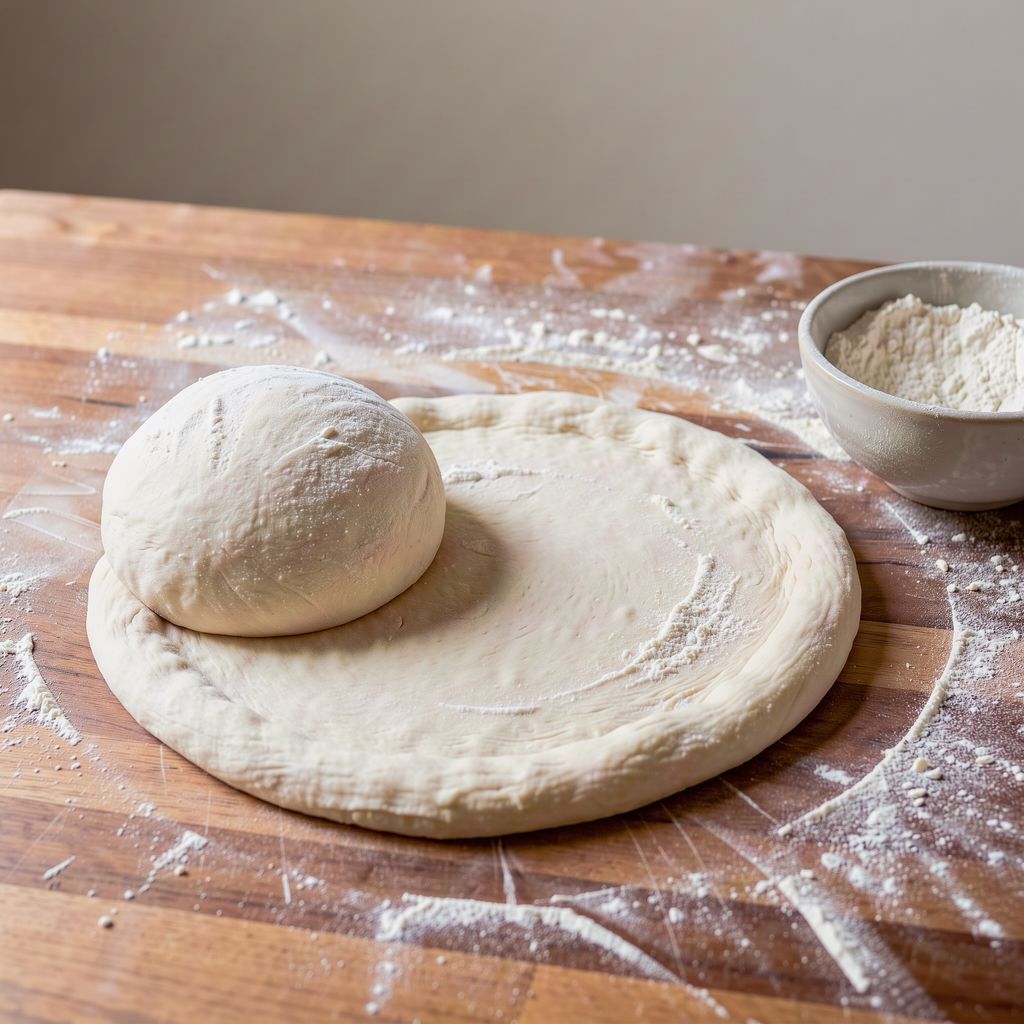
Updated Oct 17, 2026
Pizza dough that's thin in the middle and airy around the edge comes down to five numbers: **60–65% water** (by flour weight), **2.5–3% salt**, **0.1–0.5% fresh yeast for a long proof**, **00 or all-purpose flour**, and **24–72 hours of proofing in the fridge**. You don't need any secret ingredients, sugar or milk. What separates a rubbery flatbread from pizzeria-style pizza is mostly the water ratio and time. Below you'll find why that is, exactly how much of everything to use, and how to stretch the dough without tearing it.
Use 60–65% water by flour weight in pizza dough, which means 300–325 g of water for 500 g of flour. Bakers call this hydration, and it's always calculated against the flour, not the whole dough.
58–60% – a stiffer dough that's easy to handle. Good for your first attempts and for thin, crispier pizza.
62–65% – ideal for a home oven: the dough is supple, the edge puffs up and the base stays thin.
68–70% and up – sticky, and it takes practice and a strong flour. The reward is big bubbles in the crust.
Why so much water? In a hot oven the water turns to steam, which inflates the dough from the inside. The more water, the airier the edge – up to a point. Neapolitan pizza makers follow AVPN rules and work with 55–62% water, because their ovens reach 380–430 °C (715–805 °F) on the floor and around 485 °C (905 °F) under the dome, and a pizza bakes in 60–90 seconds. A home oven bakes more slowly (6–10 minutes), so the dough has more time to dry out, and a few extra percent of water does it good.
Weigh the water, don't measure it with a cup – a 30 ml difference between one "cup" and another is the difference between a stiff dough and a sticky one. And if the dough sticks to your hands right after mixing, that isn't a problem yet: after a 10–20 minute rest the flour absorbs the water and gluten begins to form on its own.
The best choice is Italian 00 flour made for pizza (look for "per pizza" on the bag or a strength of W 260–320), followed closely by Czech light plain flour T530. Wholemeal-leaning bread flour T1050 isn't suited to classic thin-crust dough.
00 doesn't mean "the best". It means the flour is the most finely milled and the lightest in color, an Italian grade based on ash content. Protein can be anywhere from 9% to 14%. For pizza, look for 00 with 11.5–13% protein; 00 meant for sponge cakes and biscuits is too weak, and the dough will tear.
Plain flour T530 has around 11–12% protein and is plenty for homemade pizza. The dough holds together well, though it handles 60–63% water better than 70%.
Czech bread flour T1050 is darker and contains more bran. The bran cuts through the gluten network, so the dough stretches less easily and the crust doesn't rise as much. Don't mix it up with English bread flour, which is a strong white flour and a different thing.
Semi-coarse and coarse flour – skip them. Coarser particles absorb water slowly and the dough turns out gritty.
Want the flavor of wholemeal flour? Replace no more than 10–20% of the plain flour with it and add 2–3% more water, because bran soaks up water.
Use 2.5–3% salt by flour weight (12–15 g per 500 g) and fresh yeast at 0.1–0.5% for a long proof, or 1.5–2% for quick pizza. Less yeast and more time is the rule that flavor is built on.
Salt does more than season: it strengthens the gluten, so the dough stretches better, and it slows the yeast, so the dough doesn't over-proof. Pizza without enough salt is bland and the dough tears. Dissolve the salt in the water and add the yeast with the flour, so the two don't come into direct contact.
Yeast by proofing time (per 500 g flour, fresh yeast):
2–3 hours at room temperature: 7–10 g (1.5–2%) – quick pizza, with a flat flavor.
8–12 hours at 20–22 °C (68–72 °F): 1–2 g (0.2–0.4%)
24–72 hours in the fridge: 0.5–1.5 g (0.1–0.3%) – a piece about the size of a pea.
Dried yeast goes in at one third of the amount of fresh (1 g fresh = about 0.35 g dried). Small amounts are easiest to weigh on a kitchen scale accurate to 0.1 g, or you can dissolve a whole block in water and take a proportional part.
Olive oil (0–3%) is optional: it softens the dough and helps keep the edge from turning hard in a home oven. Sugar isn't needed in Italian dough, but in an oven under 250 °C (480 °F) a pinch (1%) helps the crust brown.
The best pizza dough proofs for 24–72 hours in the fridge at 4–6 °C (39–43 °F), or for 8–12 hours at room temperature with a minimum of yeast. A quick 2–3 hours with 1.5–2% yeast (7–10 g per 500 g flour) gives you pizza, but not the airy, fragrant kind.
During a slow proof, the enzymes in the flour have time to break starches down into sugars and proteins into shorter chains. You'll notice the result in three ways:
flavor – lightly tangy and nutty, not "yeasty";
color – the free sugars caramelize in the oven, so the crust browns even at 250 °C (480 °F);
stretch – relaxed gluten stretches instead of snapping back.
A cold proof has three steps:
Mix the dough and leave it at room temperature for 1–2 hours so the yeast gets going.
Move it to the fridge in a covered bowl (24–72 hours).
4–6 hours before baking, divide it into balls, cover them with a lid or put them in a box, and let them finish proofing at room temperature. Cold dough won't stretch – this is the step people skip most often.
You'll know it's ready when the ball has grown about 1.5–2× in volume, feels soft, and when you gently press it with a finger the dent springs back slowly and only halfway. If it springs back right away, it needs more time. If it doesn't spring back at all and the ball spreads out, it's over-proofed – bake it anyway, the edge will just be flatter.
The general principles of proofing (temperature, environment, how to tell dough has risen) are covered in the article Yeast dough: basic ratios and how to handle it. Pizza differs from sweet yeast dough mainly in having more water, little or no fat and sugar, and a much longer proofing time.
For 4 pizzas 28–30 cm (11–12 in) across, you need 600 g flour, 380–390 g water, 16–18 g salt and 1 g fresh yeast (for 48 hours in the fridge). Divide the dough into 4 balls of 250 g each.
00 pizza flour or plain flour T530: 600 g (100%)
Cold water: 380–390 g (63–65%)
Salt: 16–18 g (2.7–3%)
Fresh yeast: 1 g (about 0.17%), or 0.35 g dried
Olive oil: 10 g (optional)
Use cold tap water (about 15–18 °C / 59–64 °F), and for a cold proof even ice-cold water – your hands, the mixer and the kneading all warm the dough, and warm dough proofs faster than you want. Knead for 8–10 minutes by hand or 5–7 minutes in a mixer, until the dough is smooth and doesn't tear right away when you stretch a thin film of it between your fingers.
You'll find the full recipe with toppings and baking, step by step, in the recipe for perfect homemade pizza. No time for proofing? Try yogurt dough pizza.
The perfect homemade pizza
Perfect homemade pizza – a recipe for pizza dough and toppings
Stretch pizza dough by hand, from the center out to the edges, never with a rolling pin, and only when it's rested and at room temperature. A rolling pin pushes the gas out of the edge, so you won't get an airy crust.
Dust the dough ball with flour or semolina (durum wheat semolina) on both sides. Semolina doesn't scorch and turn bitter the way plain flour does.
Press out a circle with your fingertips, working from the center outward, and stop 1.5–2 cm (about ¾ in) from the edge. This untouched ring will become the crust.
Turn and stretch: drape the dough over the backs of your hands (not your fingers, which would poke through) and turn it gently – gravity will stretch it on its own. Or place one palm on the center and pull the edge outward with the other, in quarter turns.
Goal: 28–30 cm (11–12 in) from 250 g, about 3 mm thick in the middle and a 1–1.5 cm edge.
If the dough keeps shrinking back, the gluten is tense – let it rest for 10 minutes under a dish towel and carry on. Forcing it will only tear it. If it tears, it's either cold from the fridge, the flour is too weak, there's too little salt, or it's over-proofed. Pinch a small hole shut, and patch a bigger one with a piece from the edge.
Bake homemade pizza for 6–9 minutes at the highest temperature your oven can reach (250–300 °C / 480–570 °F), on a baking sheet or stone preheated for at least 45–60 minutes. A hot surface matters more than the oven itself – the base has to set before the sauce soaks into it.
A pizza stone or baking steel transfers heat fastest. Without one, turn a baking sheet upside down and heat it along with the oven.
Lowest or highest rack? Put the stone in the upper third and switch on the broiler for the last 1–2 minutes – the edge will puff up and brown.
Less is more: 60–80 g tomato sauce and 100–125 g well-drained mozzarella per pizza. An overloaded pizza has a soggy center.
Work quickly: add the toppings only once the dough is stretched, let it sit for 1–2 minutes at most, then straight into the oven. The dough under the sauce goes soft.
For more Italian classics that go well with pizza, see our Italian cuisine section.
Pizza dough most often misbehaves in six ways: it's tough, rubbery, pale, tastes of yeast, tears, or shrinks back. Each problem has a clear cause, and you can fix it by adjusting the ratio or the time:
Tough and hard after baking – the dough has too little water for a home oven, or it baked too long in an oven that wasn't hot enough. Raise the hydration to 63–65% and heat the baking surface for longer.
Rubbery, chewy – the dough didn't proof long enough, or it was baked cold. Extend the proof and leave the balls for 4–6 hours in a warm place.
Pale, doesn't brown – the oven is under 250 °C (480 °F) and the proof was short. A cold proof, the broiler at the end, or 1% sugar will help.
Tastes of yeast – there was too much yeast. Cut it to 0.1–0.3% (0.5–1.5 g per 500 g flour) and extend the proof to 24–72 hours in the fridge.
Tears when stretched – cold dough, weak flour or too little salt.
Shrinks back – tense gluten. Rest it for 10–15 minutes.
Yes. Pizza dough freezes best after it's divided into balls, lightly brushed with oil and sealed in a bag, and it keeps for 1–3 months. Thaw it overnight in the fridge, then leave it at room temperature for 3–4 hours before stretching. Freezing weakens the yeast somewhat, so expect a slower final rise after thawing.
Pizza dough made with a small amount of yeast (0.1–0.3%) keeps in the fridge for 3 days, or 4 at most. After that the gluten starts to break down, the dough over-proofs and becomes harder to stretch. If you used more yeast, bake the dough within 24–48 hours.
Yes, you can proof pizza dough with sourdough starter. Use 10–20% active starter (by flour weight) instead of yeast and allow 12–24 hours of proofing. The flavor will be stronger and tangier, and the edge a little denser.
Pizza dough is sticky because it contains a lot of water and the gluten hasn't developed yet. After a 10–20 minute rest and a short knead, the stickiness drops noticeably. Don't add lots of extra flour, as that only makes the dough stiff. Instead, wet your hands or rub them lightly with oil, and fold the dough 2–3 times during the first hour. If it's still sticky after kneading, your flour is too weak for that hydration, so take out 2–3% of the water next time.
Either works for pizza dough: 8–10 minutes by hand, or 5–7 minutes with a dough hook on low speed. With a long proof the gluten develops on its own, so shorter kneading plus 2–3 folds during the first hour is enough. A mixer warms the dough more, so use the coldest water you can.
One recipe worth heating the oven for, one tip, and one deal from the shop. Nothing else.