Banana Bread Without Baking Soda: Baking Powder Ratios and What Changes
Self-Raising Flour in Europe: Where to Buy It and How to Make It
Updated Nov 20, 2026
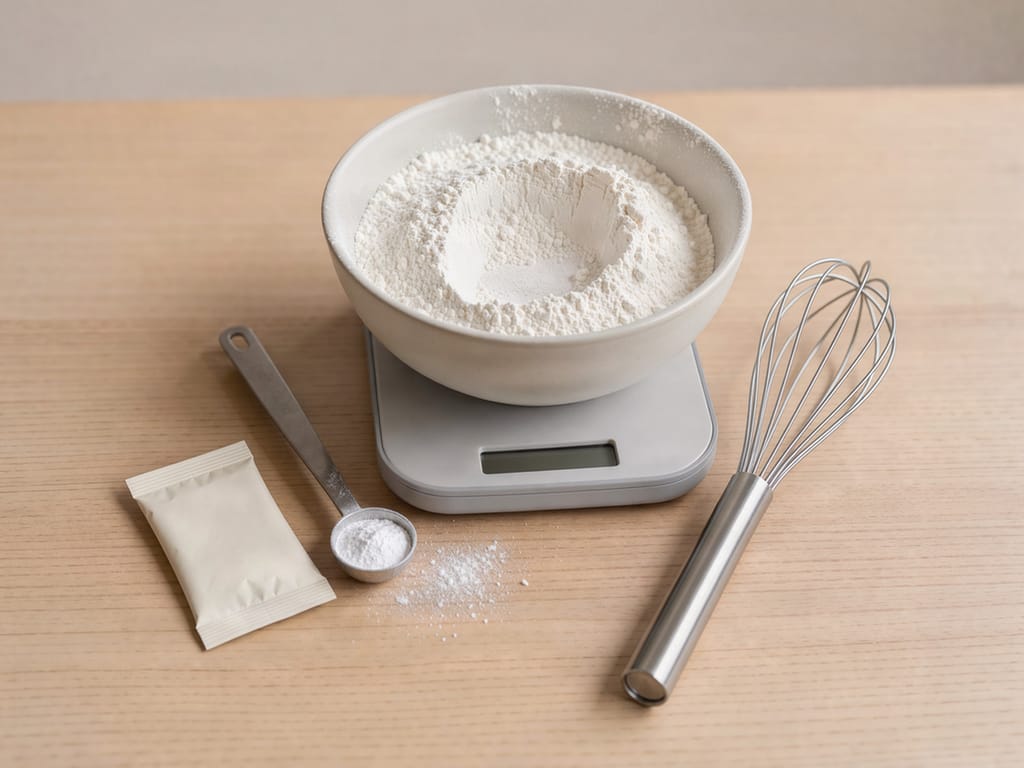
Self-raising flour is easy to buy in the UK and the Netherlands, sold in France as cake flour with baking powder added, and rare in Czech and German shops, where you make it yourself with about 1 level teaspoon of baking powder per 100 g of plain flour. In US cups, that is about 1½ teaspoons of baking powder per US cup of flour. Czech recipes skip self-raising flour altogether and use ordinary flour plus a sachet of baking powder.
It depends on the country.
UK: yes, everywhere. Self-raising flour sits next to plain flour in every supermarket, and many British cake recipes are written for it.
Netherlands: yes. Zelfrijzend bakmeel is a supermarket staple, both as a store brand and from Koopmans.
France: yes, under another name. Look for flour pour gâteaux with poudre à lever in the ingredients. Francine's T45 cake flour, for example, contains about 2% raising agent. Be careful with flour sold avec levure boulangère incorporée: that has dried baker's yeast in it and is for bread and brioche, not cakes.
Germany and Austria: rarely. Shops sell plain flour and separate baking powder (Backpulver) sachets. Imported British brands appear in some online grocers.
Czech Republic: rarely. There is a Czech word for it (samokypřicí mouka), but what you find is mostly imported, such as Marks & Spencer flour in online grocers. Czech baking simply does not use it.
If you are in Prague, Berlin or Vienna with a British recipe, mixing your own takes a minute.
Seasonal baking plans, tested recipes and kitchen tricks that save you time. Unsubscribe in one click.
The rule of thumb in UK baking guides is about 1 level teaspoon of baking powder per 100 g of plain flour. Guides vary a little, from 1 to 1¼ teaspoons. In weight, that is roughly 3–5 g per 100 g. Albert Heijn's own guide suggests 15 g of baking powder for 500 g of flour, which sits at the low end.
In US measures, King Arthur Baking whisks together:
1 US cup (236.6 ml) of all-purpose flour
1½ teaspoons of baking powder
¼ teaspoon of table salt
King Arthur weighs this cup at 120 g; our tool uses 125 g. Either way, it matches the 100 g rule closely. For a metric cup (250 ml, 132 g of flour), use a generous 1½ teaspoons. For other amounts, the cups and spoons to grams calculator does the conversion.
Whisk well or sift the mix twice. Baking powder that is not evenly spread leaves bitter spots and uneven holes in the cake.
If you live in Central Europe, your baking powder probably comes in sachets rather than a tub. The sizes, and our arithmetic for using them:
Czech sachet, 12 g: the packet says it is for 500 g of flour. To reach about 4 g per 100 g, the self-raising level, use one sachet for about 300 g of flour.
German sachet (Backpulver), about 16 g: also labeled for 500 g of flour. For self-raising strength, use one sachet for about 400 g of flour.
Use fine flour for this: hladká mouka in Czech shops, Type 405 in Germany and Austria. The coarser grinds are for other jobs, and our guide to flour numbers explained shows which bag matches UK plain flour.
Close, but not identical. Both are soft flour with a raising agent mixed in. The difference is salt.
US self-rising flour (for example White Lily) lists salt as an ingredient. It is made for Southern biscuits and quick breads.
UK self-raising flour (for example Homepride) lists wheat flour, raising agents and the usual UK fortificants, with no added salt in the ingredients.
So if an American recipe uses self-rising flour and you make your own, add about ¼ teaspoon of salt per US cup. If a British recipe uses self-raising flour, you can leave the salt out or follow the recipe.
Czech kitchens never adopted self-raising flour, and the reasons are practical:
The sachet is the measure. A Czech recipe says 1 prášek do pečiva (one baking powder) the way an American one says 2 teaspoons. Everyone has the same 12 g packets, so no one needs a pre-mixed flour.
The recipe sets the amount. A heavy fruit sheet cake, a light sponge and a quark bábovka (bundt cake) all want different amounts of raising agent, and with a separate sachet you choose per recipe. A ready-mixed flour fixes it for you.
Grind matters more than leavening. Czech recipes choose between fine, semi-coarse and coarse flour (hladká, polohrubá, hrubá). A self-raising version of each would triple the shelf.
Many Czech doughs use yeast. Buns, koláče (round filled yeast buns) and vánočka (the Christmas braid) rise with yeast, so they need plain flour anyway.
When you cook from a Czech recipe abroad, use plain flour (UK) or all-purpose flour (US) and buy baking powder separately. One 12 g Czech sachet is about 2½ level US teaspoons.
Sometimes. A few rules of thumb from our kitchen:
Czech cake recipe, only self-raising flour at hand: use it in place of the plain flour and leave out the baking powder sachet. Homemade self-raising flour (3–5 g of baking powder per 100 g) carries more raising agent than one Czech sachet per 500 g (2.4 g per 100 g), so the cake may rise a little higher. Shop-bought blends vary by brand.
Recipe with baking soda (bicarbonate) as well: keep the soda. It reacts with acidic ingredients such as yogurt, honey or cocoa and does a different job.
Yeast doughs, bread, pasta and shortcrust: do not use self-raising flour. Albert Heijn's guide makes the same point: it is for light, quick batters, not for doughs that need a firm, chewy structure.
If you have run out of baking powder altogether, our guide on what to substitute for baking powder has the ratios, and the baking powder page explains how it works.
Rarely: German supermarkets sell plain flour and separate baking powder sachets, so self-raising flour mostly turns up as imported British or Dutch brands in online shops. It is quicker to mix your own with about 1 level teaspoon of baking powder per 100 g of Type 405 flour.
Yes, French supermarkets sell cake flour with a raising agent already added, such as Francine's T45 flour for cakes, which contains about 2% baking powder. Do not confuse it with flour sold with baker's yeast mixed in, which is meant for bread and brioche.
Whisk about 1 level teaspoon of baking powder into every 100 g of plain flour, or 1½ teaspoons into one US cup (236.6 ml) of all-purpose flour, and sift it twice. US recipes also add about ¼ teaspoon of salt per cup.
Homemade versions use about 3–5 g of baking powder per 100 g of flour, roughly 1 level teaspoon. King Arthur's US recipe uses 1½ teaspoons per cup, and Albert Heijn in the Netherlands suggests 15 g per 500 g of flour.
Yes, use it in place of the flour and leave out the baking powder sachet. Homemade self-raising flour (3–5 g of baking powder per 100 g) carries more raising agent than one Czech sachet per 500 g, so the cake may rise a little higher; shop-bought blends vary by brand.
One recipe worth heating the oven for, one tip, and one deal from the shop. Nothing else.