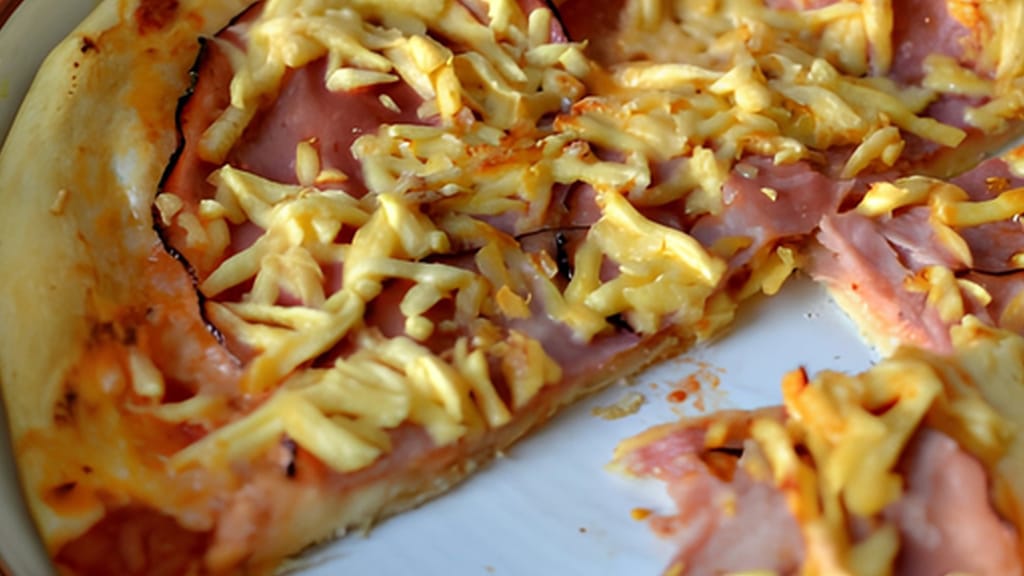
The perfect homemade pizza
Flour Numbers Explained: What 00, T650, 405 and 1050 Mean and How They Match Czech Flour Types
Updated Oct 17, 2026
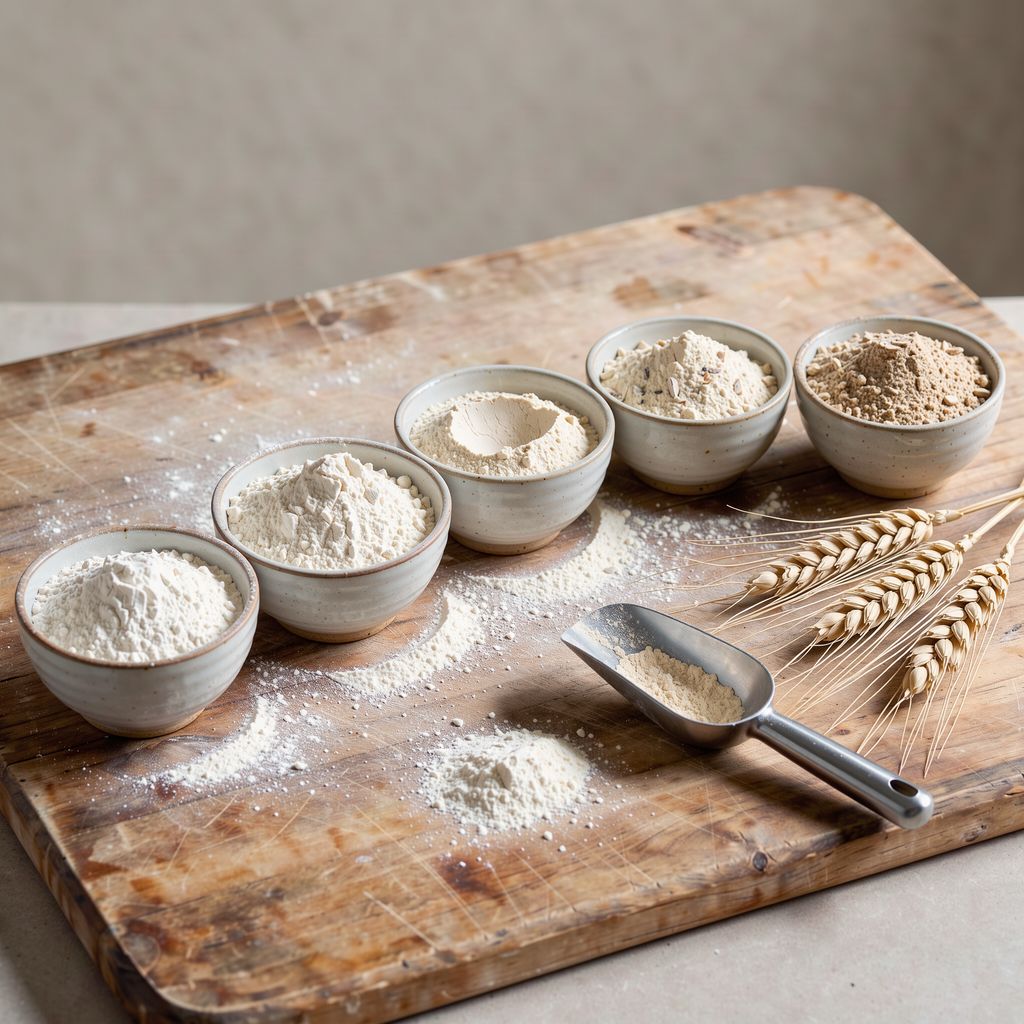
Flour labels like 00, T650, 405 or 1050 mostly tell you the ash content, meaning the minerals from the outer layers of the grain: the lower the number, the whiter and finer the flour. Roughly speaking, Italian 00 and German 405 match Czech fine light flour (T405–T530), T650 and Italian 0 match Czech semi-light flour, and German 1050 is our bread flour T1000. These foreign codes say nothing about how coarsely the flour is milled, which is why you won't find semi-coarse flour (polohrubá) as a "number" in Italy or Germany.
The number on a flour label tells you how much ash is left after the flour is burned, and therefore how many minerals and outer grain layers it contains. Czech, German and Polish numbers work in a similar way: roughly, the number is a thousand times the ash content in dry matter, and each number stands for a whole range, not an exact value.
T530 = 100 g of flour dry matter leaves roughly 0.5 g of ash.
405 (German type) = at most 0.50% ash.
1050 (German type) = 0.91–1.20% ash, so there's already a lot of husk in the flour.
Why ash? The white core of the grain (the endosperm) contains few minerals, while the bran and the layers beneath the husk contain a lot. So a mill's ash figure is essentially a measure of how "deep into the grain" it milled. That tells you what to expect from the flour:
Low number (up to ~550): white flour, neutral flavour, light and tender baked goods that lose moisture quickly.
Medium number (~650–850): creamy colour, fuller flavour, ideal for light bread and baguettes.
High number (1000+): darker and more robust, with more fibre; it absorbs more water, and the bran particles "cut" through the gluten, so the dough rises less.
Important: the number says nothing about the amount of gluten or the strength of the flour. A 00 flour can be weak enough for biscuits or strong enough for Neapolitan pizza. You can only tell that from the protein on the label.
The Czech terms "hladká / polohrubá / hrubá" (fine / semi-coarse / coarse) describe the grind size (granulation), not the ash content, and that's the main reason the codes are so hard to translate. In the Czech Republic we have two scales at once; in Italy and Germany there's only one.
Under Czech decree No. 18/2020, the types differ in how much flour passes through a sieve:
Fine (hladká): at least 96% passes through a 257 µm sieve and at least 75% through a 162 µm sieve, a fine powder.
Semi-coarse (polohrubá): at least 96% passes through a 366 µm sieve, while the fine fraction (under 162 µm) may be no more than 75%.
Coarse (hrubá): at least 96% passes through a 485 µm sieve, with a fine fraction of no more than 15%. It feels almost like semolina.
Semi-coarse and coarse flours are milled from the white core of the grain, so by ash content they're among the lightest flours (for light flour, the decree sets a ceiling of 0.60% ash in dry matter). That's why semi-coarse flour behaves differently from fine flour in yeasted dough and dumplings: the particles absorb water more slowly, so the dough is looser at first and then firms up.
Abroad, ordinary flours are almost always finely milled, the equivalent of our fine flour. The closest you'll get to semi-coarse is in Austria (griffig flour) or in Germany with Dunst (sold, for example, as "Spätzlemehl"). For more on Czech flour types and what each one is good for, see our article Flour types and what they're good for.
Italian flour grades run from the whitest 00 to whole grain integrale and are set by decree DPR 187/2001 according to maximum ash content and minimum protein content (all figures in dry matter):
Tipo 00: ash max. 0.55%, protein min. 9%
Tipo 0: ash max. 0.65%, protein min. 11%
Tipo 1: ash max. 0.80%, protein min. 12%
Tipo 2: ash max. 0.95%, protein min. 12%
Integrale: ash 1.30–1.70%, protein min. 12%
So when a recipe calls for "00 flour", it means the finest white wheat flour, which in Czech terms is fine light flour (hladká světlá). The myth that 00 is automatically "pizza flour" arose because pizzerias use 00 made from harder, stronger wheat. In Italy that strength is given as a W value: for Neapolitan pizza with a long rise, roughly W 250–320 is usually recommended, while for cakes and biscuits W around 150–180 is enough. Ordinary supermarket 00 tends to be weaker.
Watch out for a mix-up: semolina (Italian semola rimacinata) is not 00 flour but milled durum wheat. It's yellowish and more granular, and it belongs in pasta and southern Italian bread.
German flour labelling (Mehltyp, according to DIN 10355) is based on ash content in dry matter: 405 is the lightest and 1600 the darkest graded wheat flour. Each type covers a range, not an exact value.
Type 405 (up to 0.50% ash): white flour for Bundt cakes, cakes, cookies and thickening. In Czech terms, fine light flour.
Type 550 (0.51–0.63%): all-purpose baking flour for rolls, buns, pizza and light yeasted dough. In Czech terms, fine light T530–T550; at the upper end it's already close to semi-light T650.
Type 812 (0.64–0.90%): a flour between semi-light and bread flour, for lighter breads. It isn't normally sold as a separate type in the Czech Republic.
Type 1050 (0.91–1.20%): dark flour for caraway and mixed-grain bread. In Czech terms, bread flour T1000.
Type 1600 (1.21–1.80%): very dark flour, close to whole grain. The closest Czech match is whole grain.
Whole grain flour (Vollkornmehl) has no type number in Germany. It contains the whole grain, so ash isn't monitored.
With rye flour (Roggenmehl) you'll come across types 815, 997, 1150, 1370 and 1740. Czech rye bread flour (T960) corresponds roughly to type 997; rye flour around T1700 counts as whole grain in the Czech Republic, and the closest match is type 1740. Type 1800 already denotes rye meal (Roggenschrot), not flour.
T650 flour is a fine wheat flour with an ash content of around 0.65%, slightly darker and fuller in flavour than ordinary fine light T530. In the Czech Republic it's sold as fine semi-light flour (T650) and suits bread, baguettes, focaccia and pizza.
In other systems, it corresponds to:
Italy: tipo 0
Germany: between type 550 and 812
France: T65. The French number is the ash content in hundredths of a percent, so T65 means roughly 0.62–0.75% ash, not 6.5%.
If you don't have T650 at home, mix 3 parts fine light flour (T530) and 1 part bread flour (T1000). The result is very close in ash content. This is the flour that recipes like homemade focaccia or grissini, Italian breadsticks are built around.
Italian 00 and German 405/550 correspond to Czech fine light flour, tipo 0 and T65 to T650, tipo 2 and German 1050 to bread flour T1000, and integrale and type 1600 to whole grain. The values are approximate, as the systems measure slightly differently and mills vary within each range.
Fine light (T405–T530) = Italy 00 = Germany 405 / 550 = France T45 / T55
Fine semi-light (T650) = Italy 0 = Germany 550–812 = France T65
Between semi-light and bread flour (not normally sold in the Czech Republic) = Italy 1 = Germany 812 = France T80
Bread flour (T1000) = Italy 2 = Germany 1050 = France T110
Whole grain = Italy integrale = Germany 1600 / Vollkornmehl = France T150
And where do semi-coarse and coarse flours fit? In no row at all, because these systems don't have them. By ash content they're closest to the first row, and by grind to Austrian griffig or German Dunst.
The safest substitute is a Czech flour from the same "row" of the converter, and for yeasted doughs, a look at the protein on the label.
Recipe calls for 00 for pizza: use fine light flour with at least 11–13 g protein per 100 g. A weaker flour (around 10 g) gives a dough that tears and doesn't hold bubbles. Try it in our perfect homemade pizza.
Recipe calls for 00 for pasta or sponge cake: ordinary fine light flour is enough, and strength doesn't matter here.
Recipe calls for 405 (cakes, cookies): fine light T405–T530, with no adjustments.
Recipe calls for 550 (rolls, light baked goods): fine T530–T550; with T650, add about 2–3% extra water (10–15 ml per 500 g flour).
Recipe calls for 1050 (bread): bread flour T1000, for example in homemade bread.
Writing a Czech recipe with semi-coarse flour for someone abroad: tell them to use fine flour (00 / 405) and expect the dough to be thicker right away, so they should add the liquid gradually, not all at once. For dumplings and nočky, they should reach for griffig or Dunst.
For yeasted doughs, darker flour slows the dough down. Sweet yeasted doughs such as Mum's Christmas braided bread (vánočka) are therefore built on light flour, with the darker flour added only in small amounts. We cover how to choose the right Czech flour for a particular bake in our article flour types and what they're good for. You'll find flours and other baking basics in our baking and cooking ingredients section.
The perfect homemade pizza
Perfect homemade pizza – try a dough made with 00 or fine light flour
You can identify a flour without a type number from three details on the bag: the name (light / semi-light / bread / whole grain), the protein content and the fibre content. Czech regulations don't require the type number on the packaging, so on many bags you won't find it.
Name: "light" (světlá) = the lightest range, "semi-light" (polosvětlá) = around T650, "bread" (chlebová) = around T1000, "whole grain" (celozrnná) = the whole grain.
Protein in the nutrition facts: up to 10 g per 100 g is a weaker flour (cakes, biscuits), while 11–13 g is stronger (bread and rolls, pizza, yeasted doughs).
Fibre: light flour has around 2–3 g per 100 g, bread flour roughly double, and whole grain even more. Fibre is a good giveaway of how dark a flour is, even without a number.
Manitoba is a very strong wheat flour (protein around 13–15%, W above 350). In the Czech Republic, the closest match is fine light flour (hladká světlá) with 13 g or more protein per 100 g, often sold as pizza flour. It originally comes from Canadian hard wheat, and its ash content is usually around tipo 0. You can swap it for ordinary fine light flour only in doughs that don't need a long rise.
No. 00 flour is ordinary wheat flour and it contains gluten. The two zeros only indicate low ash content, in other words how white the flour is, not what it's made of. Gluten-free flours are labelled separately and have their own blends and ratios.
You can use T650 for cookies, but they will turn out slightly darker, less tender and with a more pronounced grainy flavour. For [tender Linzer cookies](/cs/recipes/klasicke-vanocni-cukrovi-krehke-linecke--46fd0408-fba6-407b-85c4-582976e057e9), [vanilla crescents](/cs/recipes/nejlepsi-vanocni-cukrovi-prece-vanilkove-rohlicky--e3b76f76-17f2-43e7-ac2f-8ac312f71a20) and similar delicate doughs, fine light flour (T405–T530, i.e. 00 or 405) is the better choice. T650 is better suited to rolls, bread and pizza.
One recipe worth heating the oven for, one tip, and one deal from the shop. Nothing else.