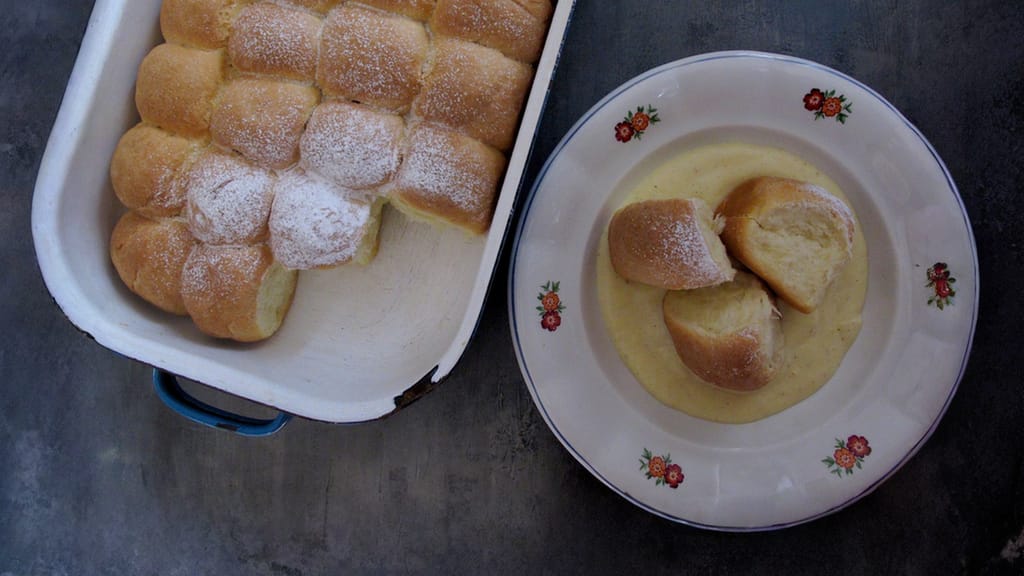
Sweet buns with silky vanilla custard
Mille-feuille: Flaky Puff Pastry and Cream, Step by Step

Updated Jul 19, 2026
Mille-feuille is a French dessert made of three layers of crisp puff pastry sandwiched with rich pastry cream (crème pâtissière) and finished with a dusting of sugar or a glossy icing. The name means "a thousand leaves" — and that's exactly the point: the contrast between shatteringly crisp pastry and silky-smooth cream. In this guide we'll walk through everything that determines the final result: real butter puff pastry, a cream that holds its shape, and assembly that won't collapse under the knife.
Mille-feuille is a classic French dessert made from three sheets of crisp puff pastry and two layers of pastry cream (crème pâtissière), topped with sugar, fondant icing, or fresh fruit. In French, the name means "a thousand leaves" — a nod to the dozens of paper-thin layers that puff up in the oven from a single block of dough.
The earliest description appears in the cookbook Le Cuisinier françois (1651) by François Pierre de La Varenne; culinary historians trace the name itself to print sources from around 1733. The dessert's modern form, with its cream filling, was codified in the 19th century by the legendary pastry chef Marie-Antoine Carême, and it was made famous in Paris by Adolphe Seugnot (1867).
The nickname "Napoleon" probably has nothing to do with the emperor — linguists believe it's a corruption of napolitain, meaning "Neapolitan." You'll find relatives of it around the world too: Italian millefoglie, the British vanilla slice, and the Australian custard slice.

The crispness of a mille-feuille all comes down to genuine butter puff pastry — thin sheets of dough separated by thin layers of butter that turn to steam in the oven and push the layers apart. The technique is called lamination: the butter between the layers heats up, the water in it and in the dough turns to steam, and that steam forces the individual sheets apart.
That's why the butter has to stay cold and firm throughout. As soon as it gets absorbed into the dough, the layers merge into one and the pastry just bakes solid instead of puffing up. The whole technique is really about temperature and patience, not muscle.
Flour: plain white wheat flour with a higher protein content. The gluten gives the dough the elasticity it needs to survive repeated rolling without tearing.
Butter: unsalted, at least 82% fat (so-called European-style, or better still, French "beurre de tourage"). It has less water than regular butter, so the layers hold together better. Use roughly equal weights of butter and flour.
Water: ice-cold. This keeps the butter firm while you roll; warm water would melt it and ruin the layers.
Salt: just a small pinch sharpens the flavour and slightly strengthens the gluten.
A splash of lemon juice or vinegar: the acid relaxes the gluten, so the dough rolls out more easily and shrinks back less. It replaces part of the water.
Swapping in spelt flour or a little coconut oil for some of the butter adds an interesting flavour twist, but expect more delicate, harder-to-shape layers — stick with the classic version for your first attempt.
Puff pastry comes together in five stages: (1) mix the base dough (détrempe), (2) prepare the butter block, (3) enclose the butter in the dough, (4) fold and roll five or six times, chilling between turns, (5) let it rest before baking. Each simple letter-fold triples the number of layers — six turns give you 3⁶ = 729 layers.
Base dough (détrempe): combine the flour, salt, a splash of lemon juice, and ice water into a smooth dough. Wrap in plastic and chill for 30 minutes — this lets the gluten relax so the dough rolls out more easily afterwards.
Butter block: roll cold butter between two sheets of baking paper into a rectangle about 1 cm thick. It needs to be just as firm as the dough; if it starts to soften, pop it straight back in the fridge.
Enclosing the butter: roll the dough into a rectangle, place the butter in the centre, and fold the edges over like an envelope so the butter is completely sealed inside.
Folding: roll into a long rectangle, fold into thirds like a letter, turn 90°, and roll out again. Repeat five or six times, chilling for 30 minutes after every second turn.
Resting: chill the finished dough for another 30 minutes before baking. Any pastry you don't use can be frozen.
Mille-feuille sheets are baked weighted down so they stay flat and thin — otherwise they'll puff up too much and you won't be able to stack them. First prick the rolled-out dough all over with a fork (this is called "docking"), lay it on a lined baking sheet, top with another sheet of paper, and weigh it down with a second baking sheet.
Bake at 200°C (400°F) until golden. In the last few minutes, you can dust the pastry with icing sugar and let it caramelise into a glossy crust — this adds extra crunch and a lightly bittersweet flavour. Let the baked sheets cool completely on a wire rack, so they don't turn soggy underneath.
The classic mille-feuille filling is crème pâtissière — a thick vanilla custard made from milk, egg yolks, sugar, and starch. For 500ml of milk, use roughly 4–6 egg yolks, 100g sugar, and 40–50g cornflour; always bring it to a full boil and let it simmer for at least a minute.
Why boil it at all? The starch only thickens properly right around boiling point, and boiling also destroys an enzyme in the egg yolks (amylase) that would otherwise thin the cream back out within a few hours. Strain the cooked cream, cover with plastic wrap pressed directly onto the surface (to stop a skin forming), and let it cool completely. The finished cream should be firm enough to hold its shape between the pastry layers — if it's runny, it either wasn't boiled long enough or needed more starch.
From here, you can experiment: stir chopped chocolate, pistachio paste, espresso, or matcha into the warm cream. Fold whipped cream into the cooled pastry cream and you get a light, airy crème diplomate, which makes for a lighter mille-feuille. Fruit fillings (raspberry, lemon) add a refreshing tartness — thicken them with pectin or a touch of gelatine.
Sweet buns with silky vanilla custard
Soft buns with vanilla pastry cream: another place where the same custard shines, no puff pastry required
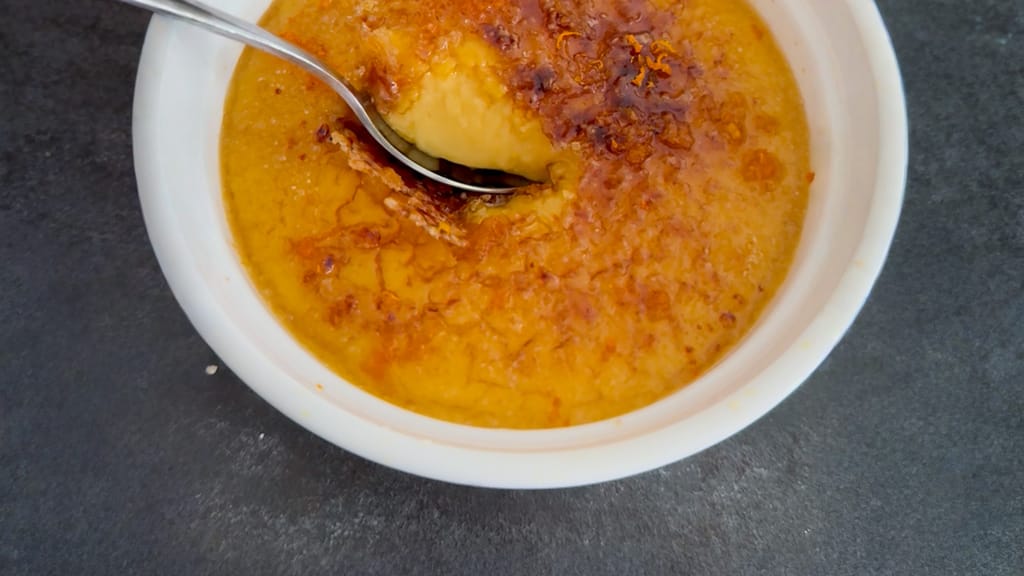
Crema catalana with orange zest and cinnamon
Crema Catalana with cinnamon and orange: a close cousin among southern European egg custards

Assemble your mille-feuille just a few hours before serving — the sooner the cream meets the pastry, the softer it will get. The cream needs to be completely cold, and it's best piped on using a piping bag (in rings or a tight spiral) so the layers come out even and level.
A solid base: only use pastry sheets that are well baked and golden all over. Damp or pale pastry will collapse under the cream almost immediately.
Cut it smart: the easiest approach is to portion each pastry sheet before assembling, or, once assembled, slice the finished mille-feuille with a serrated knife using one smooth, unhurried stroke without pressing down.
Portions: pieces around 4×4 cm hold their shape well and are easier to eat than large slices.
Garnish: icing sugar, fondant, or fresh raspberries and blueberries for colour and a tart contrast.
For more on plating and presentation in the style of a Parisian pâtisserie, see our article on serving desserts like a Parisian pastry shop.
Most failures boil down to four causes: warm butter, underbaked pastry, undercooked cream, and assembling too far ahead of time. Here's how to fix each one:
Tough, chewy pastry: this comes from overworked or overly warm dough and an oven that isn't hot enough. Roll as little as possible, keep everything well chilled, and bake at a full 200°C (400°F).
Damp, soft pastry sheets: let them cool completely on a wire rack after baking and store in an airtight container; assemble as late as possible before serving.
Runny cream: the starch wasn't cooked enough. Bring the cream back to a boil and simmer for a minute, or whisk in an extra teaspoon of cornflour.
Layers sliding apart when you cut: usually caused by a dull knife and too much pressure. Use a serrated knife, cut in one smooth motion, and wipe the blade clean between cuts.
Yes — good-quality butter puff pastry from the shop is a solid shortcut. Roll it out a bit thinner, prick it all over with a fork, and bake it weighted between two baking sheets so it stays flat. Choose pastry made with real butter rather than vegetable fat — you'll notice the difference in both flavour and crispness.
It's best eaten the day it's assembled; it'll keep in the fridge for about a day, but the pastry will gradually soften. So store the pastry layers and the cream separately — pastry airtight at room temperature, cream in the fridge — and only put them together right before serving.
Both are built on puff pastry and an egg-based cream, but mille-feuille has three thin layers, a dense crème pâtissière, and a sugar or fondant topping. Czech krémeš tends to be taller, with a fluffier whipped-cream-and-custard filling between two pastry layers. Mille-feuille is the more delicate, refined of the two.
Butter leaks when it gets too warm during rolling, or when the pastry parcel tears open. Chill thoroughly between folds, keep the butter as firm as the dough, and make sure it stays fully enclosed. A little leakage isn't a problem, but heavy leakage means you're losing your layers.
Yes. The same puff pastry works beautifully for a savoury mille-feuille — swap the cream for salmon with soft cheese, goat's cheese with roasted vegetables, or tomato with basil. The layering and baking method for the pastry stays the same; you simply leave out the sugar.
One recipe worth heating the oven for, one tip, and one deal from the shop. Nothing else.