Vacuum-Sealed Meat in the Fridge: How Long It Lasts and How to Store It Safely
Marinated Hermelín and Utopenci: How Long They Keep and How to Store Them
Updated Nov 17, 2026
Marinated hermelín (a Czech camembert-style cheese) in oil and utopenci (Czech pickled sausages in a vinegar brine) belong in the fridge from the very first hour, not in the cellar or pantry. Even there, they won't keep for months, whatever some recipes claim. For utopenci, go by the USDA (FSIS) charts for opened cooked sausages: roughly a week in the fridge. For hermelín in oil it's stricter still. There's no figure for cheese specifically, but the advice for homemade vegetables and herbs in oil, published in Czech by the portal bezpecnostpotravin.cz, is to refrigerate and use as soon as possible. Below you'll find why that is, where to put the jar, how to handle it once opened and when to throw it out.
Homemade marinated hermelín in oil has no officially recognized shelf life, and the authorities advise counting in days, not weeks. The guidance from Germany's BfR institute, published in Czech by the portal bezpecnostpotravin.cz, is clear for homemade vegetables and herbs in oil: store in the fridge and use no later than the day after making. BfR doesn't recommend making such products at home at all. There's no specific limit for cheese in oil, so this is the closest official equivalent.
Traditional recipes leave the hermelín to "mature" for several days. That's a habit for flavor, not a safety limit, and it exceeds the official guidance on its own. To be blunt: nobody can give you a safe time frame for homemade hermelín in oil. The claim that it "keeps up to two months", which circulates in recipes, isn't backed by any guidance.
What this means in practice:
the jar goes into the fridge right after pickling, not "first a day on the counter",
pickle small batches and eat them as soon as they've matured, not weeks later,
write the pickling date on the lid so you don't have to guess.
Marinated hermelín in oil is risky because the oil cuts off oxygen, and an airless environment suits the bacterium *Clostridium botulinum*. Neither hermelín nor garlic is acidic, and the oil doesn't preserve them. It only covers them up.
According to SZPI (the Czech Agriculture and Food Inspection Authority), C. botulinum produces toxin between 4 and 40°C (39–104°F), and both room temperature and a cellar fall squarely within that range.
The UK's FSA states that some strains (the so-called non-proteolytic ones) grow and produce toxin from as low as 3°C (37°F) in an oxygen-free environment. So the fridge slows the risk but doesn't stop it, which is why time matters too.
Garlic and herbs from the garden carry spores from the soil, so you add them to the jar along with the flavor.
Commercial products in oil are therefore acidified and technologically treated. A homemade jar has none of that.
Seasonal baking plans, tested recipes and kitchen tricks that save you time. Unsubscribe in one click.
Count on roughly a week in the fridge for homemade utopenci, which is how long USDA (FSIS) says opened cooked sausages keep. No authority issues a figure for homemade utopenci, so stick to the closest official equivalents:
opened package of cooked sausages (hot dogs, špekáčky): 1 week in the fridge (USDA/FSIS, fridge at 4°C/40°F),
unopened package: 2 weeks in the fridge (USDA/FSIS). That applies to store-bought špekáčky, not to a jar where you've cut and pickled them,
opened acidic foods in vinegar: 5–7 days in the fridge (USDA/FSIS).
A vinegar brine protects mainly the surface. Acid penetrates the inside of a thick špekáček slowly, so inside it's still a meat product. Špekáčky do contain curing salt (nitrite), which according to SZPI slows the growth of clostridia, but don't rely on that in a homemade jar of unknown acidity. The week is counted from pickling, not from the moment you first taste the utopenci.
Keep store-bought utopenci in the fridge once opened and eat them within 5–7 days, which is what USDA (FSIS) gives for opened acidic canned foods. Until opening, follow the date and storage conditions from the producer on the label: some are sterilized and keep outside the fridge, others are chilled and belong in the fridge from the moment you buy them.
Marinated hermelín and utopenci belong in the fridge, never in the cellar. Grandmothers did leave them in the pantry, but back then they were eaten quickly, and tradition doesn't mean safety.
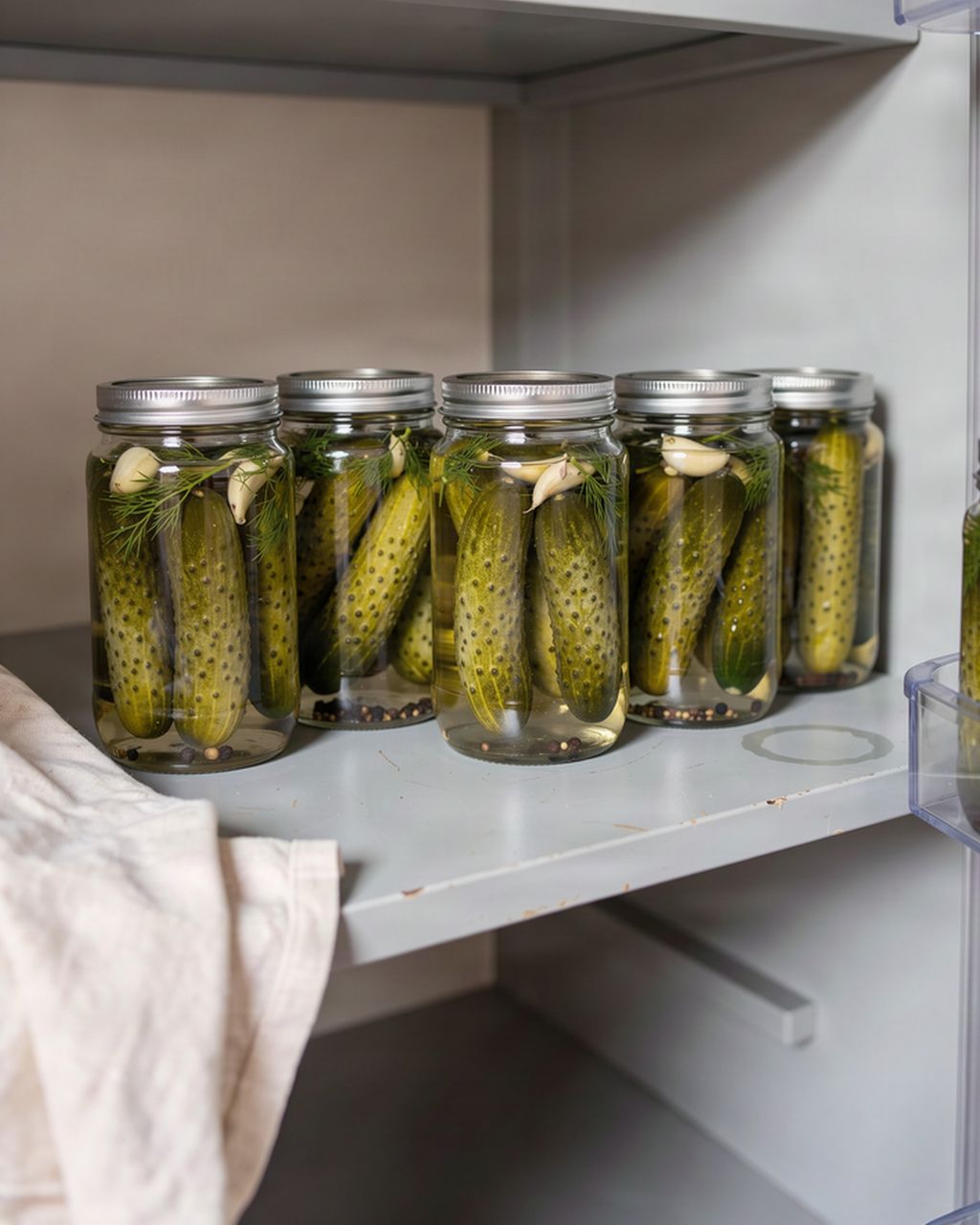
Fridge: USDA (FSIS) recommends keeping it at 4°C (40°F) or below. Check the temperature with a thermometer. The fridge door is usually the warmest spot, so put jars at the back on the middle shelf.
Cellar: even a cool cellar is usually warmer than a fridge, so above 4°C, in the range where, according to SZPI, C. botulinum produces toxin (4–40°C). It's no place for pickles in oil or meat in brine.
Room temperature: according to USDA (FSIS), perishable foods shouldn't sit outside the fridge for more than 2 hours. That includes the "leave it a day on the counter" step found in many recipes, so skip it.
If the power goes out and the fridge warms up, pickled foods are among the first things to deal with. There's more in our article on what to throw out of the fridge after a power outage.
After opening, keep everything under the surface, use only clean utensils and put the jar straight back in the fridge. Every opening lets in air and bacteria from the kitchen.
Use a clean fork or tongs, never fingers or cutlery you've already eaten with.
Submerge the rest under the oil or brine. Anything sticking out above the surface dries out and molds first.
Close the lid right away and return the jar to the fridge. It mustn't sit on the dinner table for more than 2 hours (USDA/FSIS).
Don't put back anything that has already been on a plate.
Don't add new pieces to the brine. Don't use the old oil or brine for another batch either, because new cheese would start with the old burden.
Olive oil thickens and turns cloudy white in the fridge. That's normal, not a sign of spoilage. Just take the jar out a little before eating so the oil liquefies again, then put it away right after.
The same rules suit other pickled foods too, such as sun-dried tomatoes in oil or canned and fermented pickles after opening.
You can often tell spoiled marinated hermelín or utopenci by their look, smell and a bulging lid, but you may not be able to detect botulinum toxin. According to BfR (in Czech on bezpecnostpotravin.cz), with some strains its formation shows in neither appearance, smell nor taste. A jar that looks fine isn't necessarily safe, which is why temperature and time matter most.
Throw the jar out if you see any of this:
a bulging lid, hissing or bubbles on opening,
cloudy, slimy or foamy brine on utopenci (clear brine with onion should be transparent),
a sticky, slimy surface on the špekáčky or grayish spots on the cut,
mold on the surface, the cheese or the spices, even a tiny spot,
a musty, fermented or "cheesy-rotten" smell that isn't the sharp scent of garlic and vinegar,
cheese that falls apart into mush and changes color from creamy to gray or pink,
a jar where you don't know how old it is or that has stood outside the fridge.
Never taste it to check whether it's still good. For general warning signs in preserves and what to do with a whole batch, see our article on when to throw out preserves.
You won't reduce the risk with longer marinating or more garlic, but with cold, cleanliness and small batches. A few rules worth following every time:
Clean, sterilized jars and lids and dry utensils.
Fridge from the first minute, not a day on the counter, not the cellar.
Everything under the surface of the oil or brine.
A small jar instead of a big one. Two smaller batches in a row are better than one giant one that waits for weeks.
The date on the lid and a clear plan for when you'll eat it.
As with pickled eggs, homemade pickling in the fridge is a matter of days, not a season. Shelf life in the pantry comes only from proper heat treatment, which doesn't suit cheese in oil.
Carry marinated hermelín in a cooler bag with ice or cooling packs, and take the jar out only right before eating. Keep the bag closed and in the shade, not in a hot car. Once the ice melts and the bag stops cooling, it no longer protects the hermelín, so don't put whatever is left back in the fridge.
We don't recommend freezing finished marinated hermelín or utopenci. The hermelín falls apart after thawing and the utopenci turn watery. The authorities give no freezer time for them. It makes more sense to freeze the špekáčky (Czech sausages) themselves before pickling: according to the USDA/FDA charts, cooked sausages keep 1–2 months in the freezer. Then thaw them in the fridge and pickle them.
More garlic won't extend the shelf life of marinated hermelín. Garlic isn't acidic and carries spores from the soil, so it tends to raise the risk in oil. Vinegar does acidify the environment, but at home you can't measure whether it's enough, whereas commercial products in oil have controlled, verified acidity. The only reliable brakes at home are the fridge and a short time.
Don't reuse the oil from marinated hermelín for pickling again, and don't keep it in the fridge for later. It contains garlic, spices and bits of cheese, which is exactly the oxygen-free environment that makes pickles in oil something to watch. If you want to use it, do so right away, for instance in a dressing or for frying bread, and then throw it out.
Yes, the onion from the brine is a full part of utopenci and you can eat it. But the same time limit applies as for the špekáčky in the same jar: roughly a week in the fridge from pickling. It sits in the same brine, so don't leave it for later once the utopenci are gone. When you throw the jar out, the onion goes with it.
One recipe worth heating the oven for, one tip, and one deal from the shop. Nothing else.