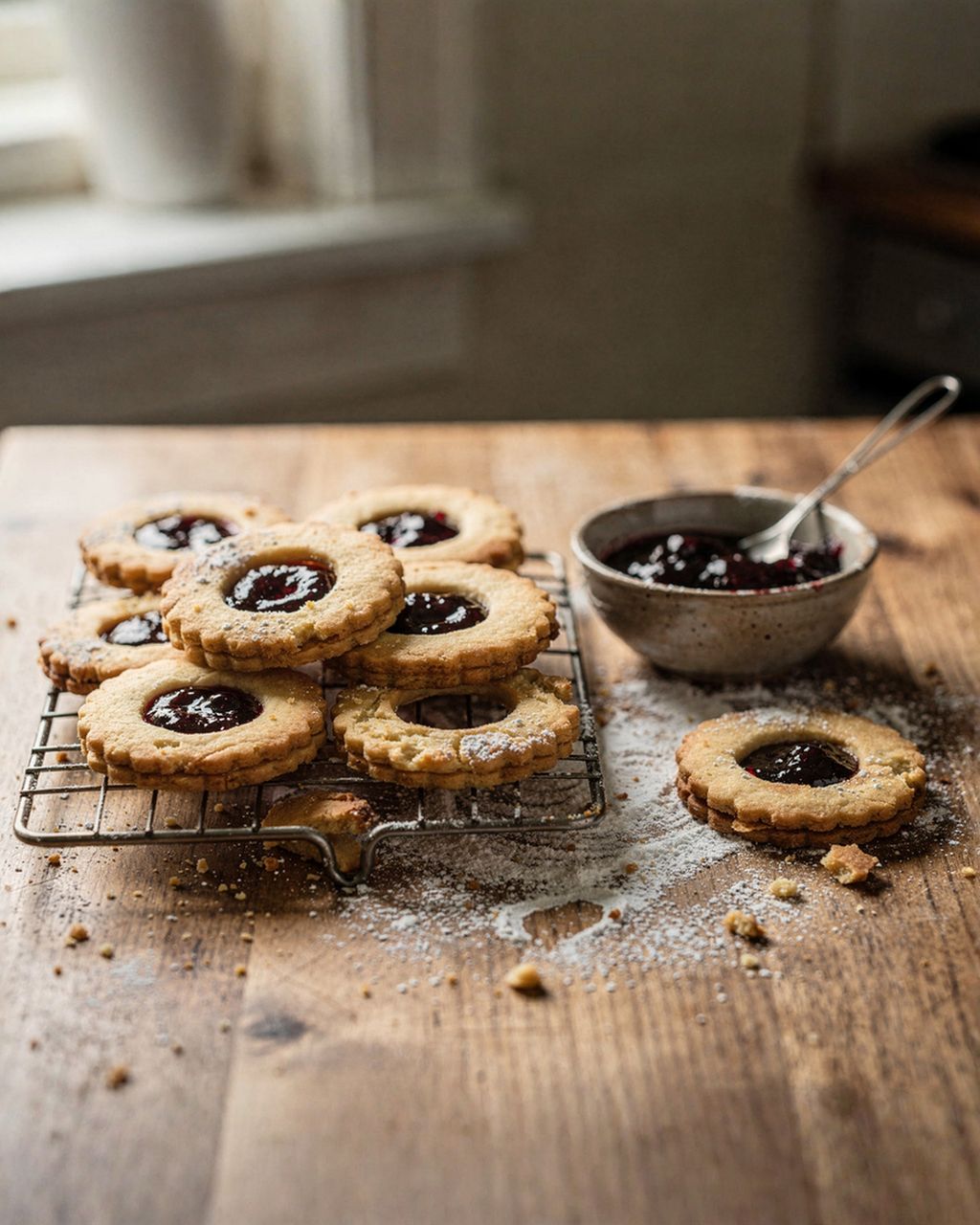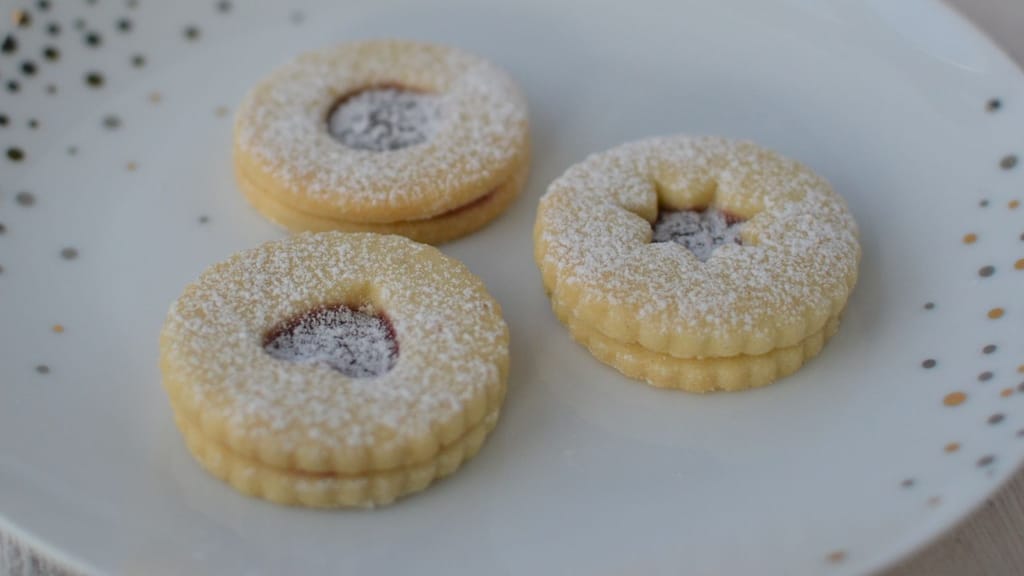
Classic christmas cookies: delicate linzer cookies
Updated Sep 18, 2026
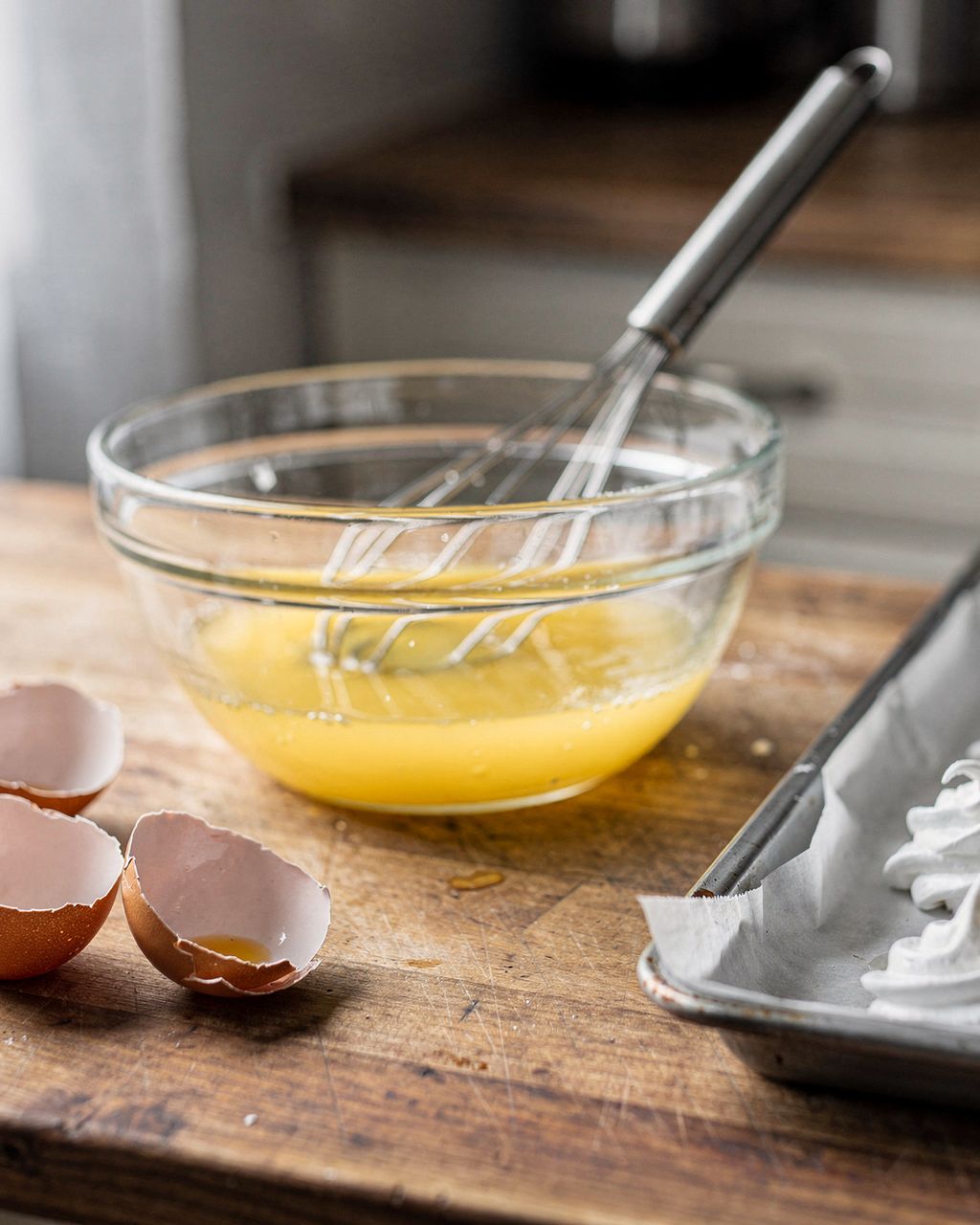
Linzer dough calls for just the yolk because egg white is about 88% water, and its proteins set into a firm, springy mesh in the oven — so instead of a crumbly cookie, you end up with something tough and brittle, like a cracker. The yolk does the exact opposite: it brings fat and lecithin that coat the flour, hold gluten formation in check, and keep the dough short and crumbly. Below you'll find exactly what happens in the dough, how many yolks per how much flour, when it actually pays to add a bit of egg white, and what to do with the leftover whites.
Egg white brings water and protein into the dough — and both make it tougher. This isn't about flavor, it's physics:
Water. Egg white is about 88% water. The white from a standard M-size egg weighs around 33 g, so you'd be adding roughly 29 g of extra water to the dough. Water plus flour equals gluten — and the more gluten, the tougher and chewier the baked cookie.
Protein. Egg white proteins start setting at around 62°C (144°F) — well before the cookies are even baked through. They form a firm, springy mesh that holds its shape. Perfect for meringues, disastrous for Linzer dough.
No fat. Egg white contains virtually no fat, so it has nothing to offset that with. All it adds are the two things you don't want.
That's why the traditional recipe says "2 egg yolks," not "1 egg." It's not old-fashioned frugality — it's technique.
Egg yolk brings fat, an emulsifier, half the water, and color — four things that make Linzer dough short and crumbly.
Fat (roughly a third of the yolk's weight). It coats the flour particles and physically stops the proteins gliadin and glutenin from linking up into gluten. Bakers call this shortening — which is exactly where the English term "shortcrust" comes from.
Lecithin. Phospholipids make up roughly a tenth of the yolk's weight. It's an emulsifier: it binds butter with water so the dough comes together on its own, without heavy kneading. Less kneading means less gluten.
Water — but only half as much. Egg yolk is roughly 50% water, compared to about 88% for egg white. For the same binding power, it brings half the moisture.
Color and flavor. Carotenoids in the yolk give raw dough a creamy golden tint, and fat carries flavor — butter, vanilla, and lemon zest all come through more in yolk-based dough.
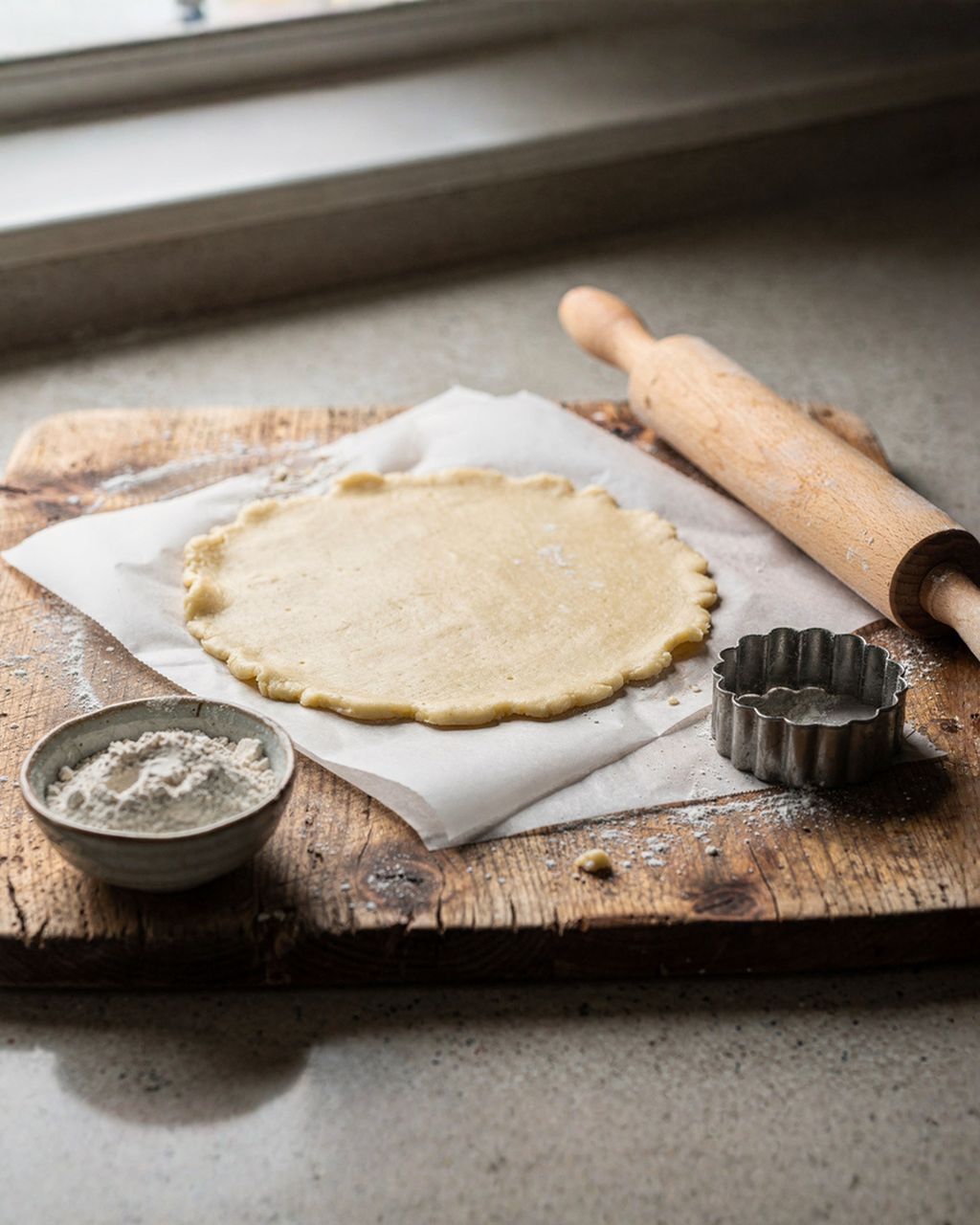
For 100 g of plain flour, use roughly 0.7 yolk — meaning 2 yolks for a standard batch made with 300 g of flour, which matches the classic ratio of 1 yolk per 150 g of flour. Basic Linzer dough follows a 3:2:1 ratio (flour : butter : sugar):
300 g plain flour
200 g cold butter, cubed
100 g powdered sugar
2 egg yolks (about 36 g)
a pinch of salt, zest of half a lemon
You can shift this ratio in either direction, but each direction has a trade-off:
More yolks (3 per 300 g flour) = richer, more crumbly, more golden cookies, but the dough is softer and harder to cut out. It needs a longer chill.
Fewer yolks (1 per 300 g flour) = crisper edges and a more reliable shape, but the dough crumbles easily even while rolling.
Handy numbers if you're doing the math: the yolk from an M-size egg weighs 18–20 g, the white about 33 g, and a whole egg without shell around 50–55 g.
Classic christmas cookies: delicate linzer cookies
Classic crumbly Linzer cookies — the 3:2:1 ratio and two yolks in practice
A little egg white makes sense in three situations: when the cookies need to be sturdier for travel, when you're making the lattice top for a Linzer Torte, and when the dough is heavy on nut flour. It's always a spoonful of white added to the two yolks — never a swap of yolks for whole eggs.
Cookies that need to travel. Crumbly Linzer cookies turn to rubble in a box on a long trip. One tablespoon of egg white (about 15 g) added to two yolks gives the dough enough structure to survive the journey while keeping most of its crumbliness.
Linzer Torte lattice. The strips of dough on a Linzer Torte need to hold their own weight over a layer of jam without sagging. Here, egg white actually works in your favor — it holds structure exactly where you need it.
Dough with nut flour. Ground almond or hazelnut flour has no gluten, so the dough has nothing to hold it together and falls apart while cutting out shapes. If nuts replace more than a quarter of the flour, add a bit of egg white as a binder.
The compromise that works best in all three cases: keep both yolks and add just one spoonful of white. You get extra binding without sacrificing crumbliness.
For one yolk (18 g) in Linzer dough, the best stand-ins are 20 g full-fat quark, 15 g sour cream, 15 g mascarpone, or 15 g heavy cream. They all work for the same reason as the yolk: they bring fat and emulsified moisture instead of plain water.
Full-fat quark, 20 g. The closest substitute. It provides both binding and fat, and the dough stays easy to cut out.
Sour cream, 15 g. Around 15% fat. Cookies turn out even more crumbly, but the dough is softer — chill for at least two hours.
Mascarpone, 15 g. At around 40% fat, it's the richest of the four, and gives the softest dough as a result. The crumbliest result, but expect a longer chill and rolling out on a well-floured surface.
Heavy cream (33%), 15 g. Works reliably, though you'll lose the golden color.
What doesn't work: water, milk, or plant milk on their own. They bring water without fat, which is exactly the egg white problem all over again.
One extra trick worth trying: mash the yolk of a hard-boiled egg into the dough. Its proteins are already set, so they can't reinforce the structure any further — all you're left with is the fat and lecithin. The result is an exceptionally short, almost sandy texture.
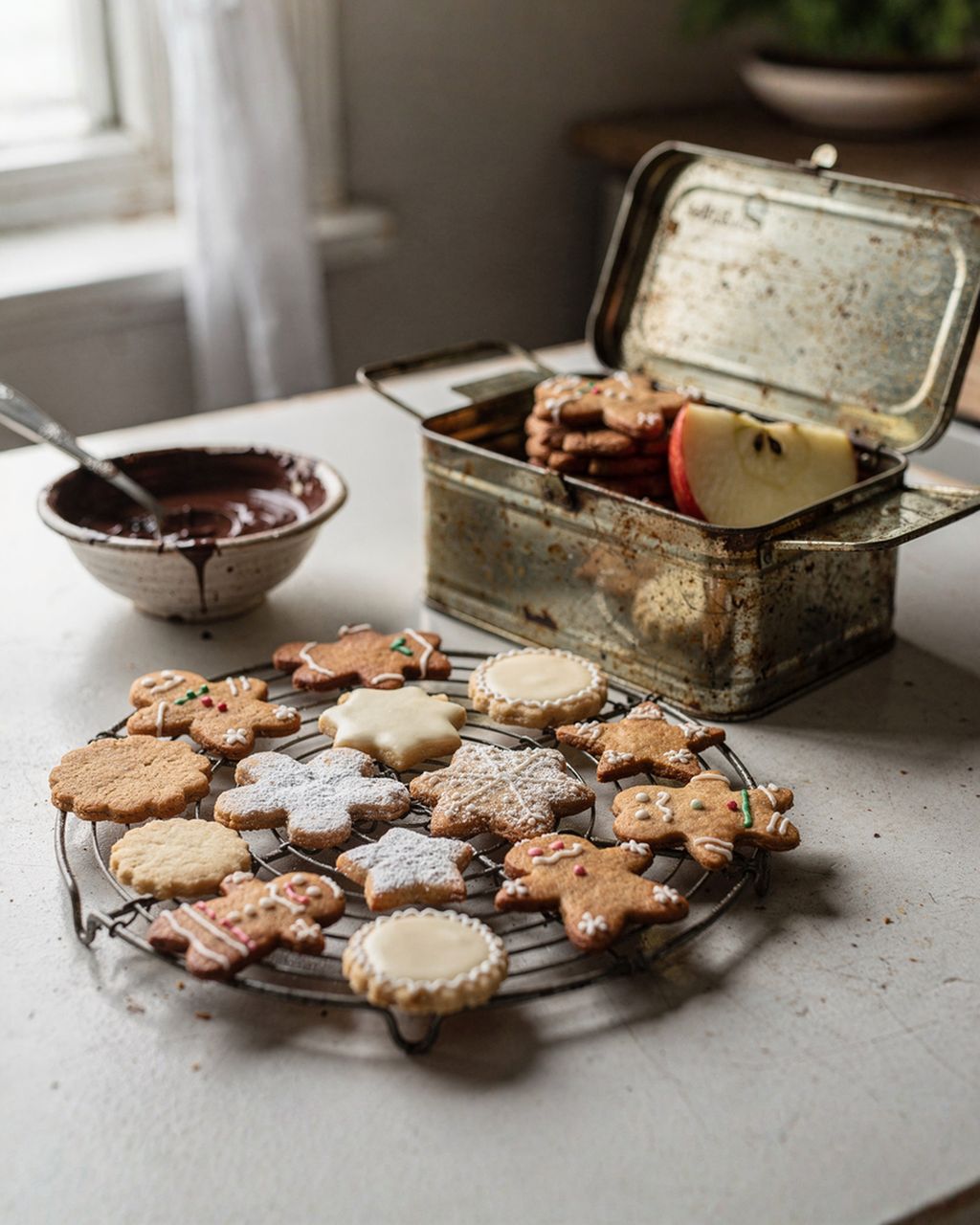
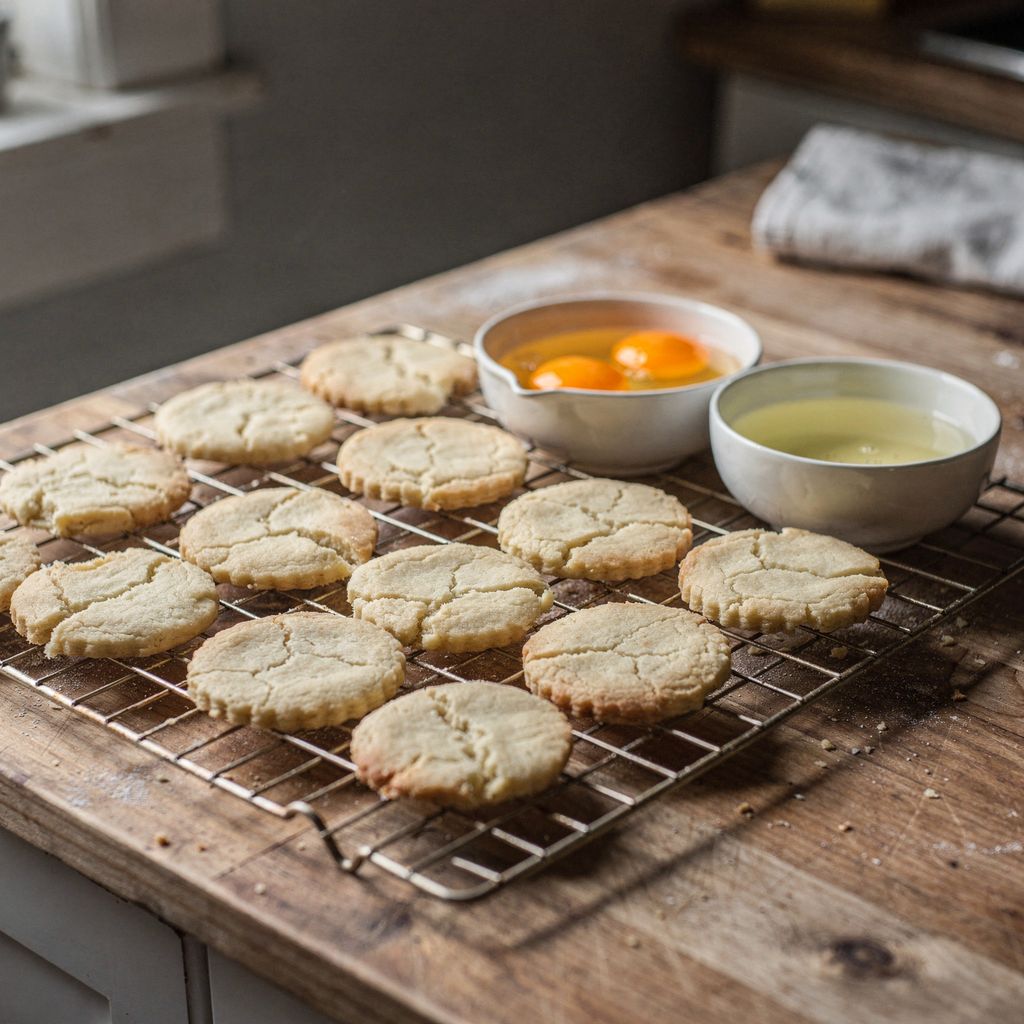
Freeze the leftover whites, or turn them straight into meringues, coconut macaroons, or royal icing for gingerbread. Storage is simple and precise:
In the fridge in a sealed container for 2–4 days.
In the freezer for up to 12 months (per USDA guidelines); for the best whipping performance, use within six months. Best frozen one at a time in a silicone ice cube tray, then transferred to a bag — note down the count, since you can't tell how many whites are in a frozen block just by looking.
Thaw in the fridge overnight. Cold egg white whips more slowly, so let it sit on the counter for half an hour before whipping.
One extra white also comes in handy for brushing: on its own it gives cookies shine without darkening them, while yolk would tint them. For a full rundown of uses, see our article Leftover Egg Whites: 12 Ways to Use Them Up.
The most common culprit is overworked dough, not the eggs. Gluten forms even without egg white if you knead the dough too long or keep re-gathering and re-rolling the scraps. Bring the flour together just until it comes into a dough, re-roll scraps no more than twice, and chill in between. The second most common issue is overbaking — Linzer cookies only need 8–10 minutes at 170°C (340°F) and should still look pale when you pull them from the oven.
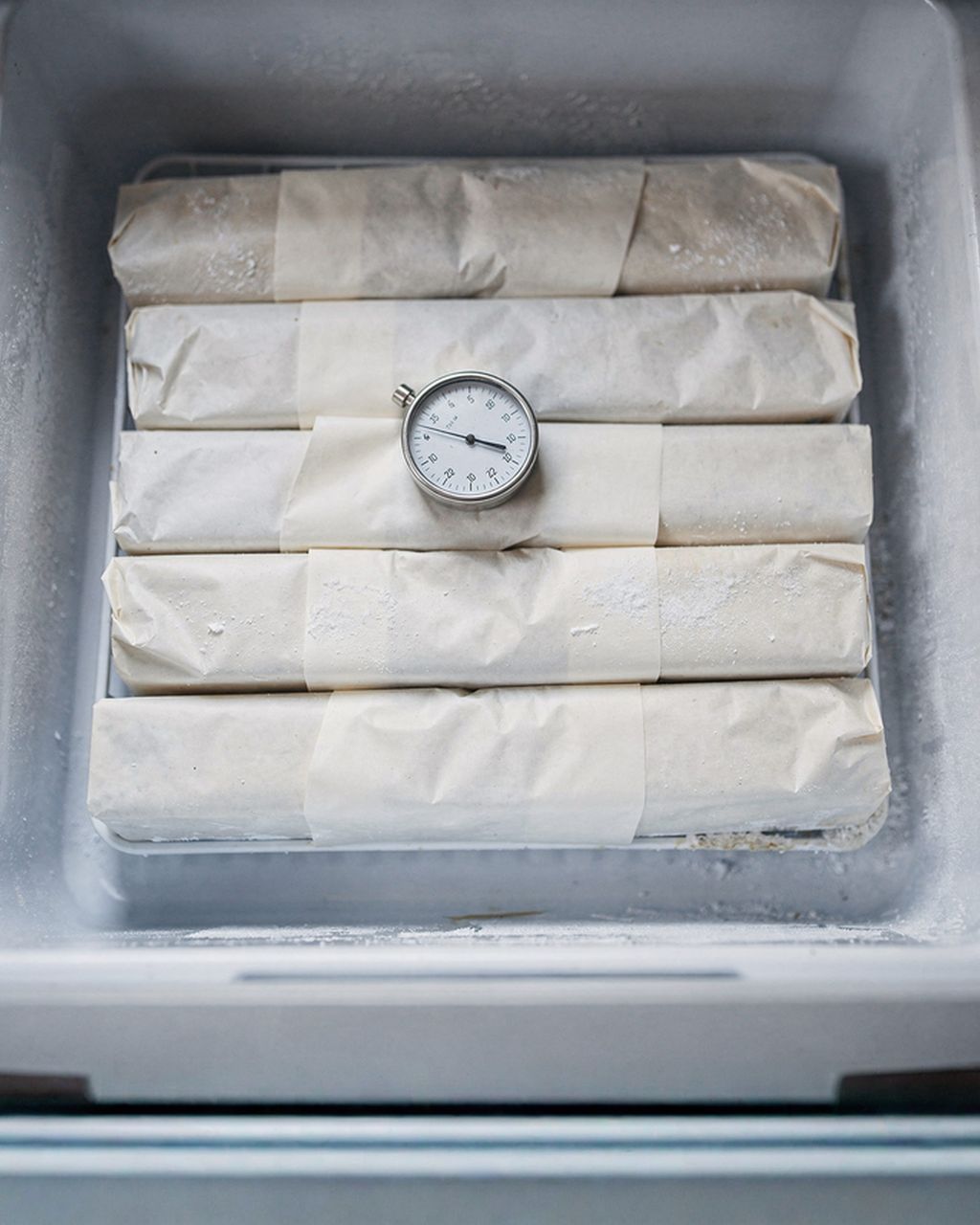
Yes, and it keeps in the freezer for 3 months. Wrap it in plastic as a flat disc about 2 cm (¾ inch) thick, not a ball — a disc freezes and thaws evenly. Thaw overnight in the fridge, then let it sit on the counter for 15 minutes; too cold and it'll crumble, too warm and it'll smear. You can also freeze cut-out shapes on a tray and bake them straight from frozen, just adding 1–2 extra minutes.
Cold, straight from the fridge. The whole dough depends on the butter staying firm and not melting into the flour before it hits the oven — a warm yolk starts softening it the moment you mix it in. This is what sets Linzer dough apart from sponge or creamed batters, where eggs are brought to room temperature on purpose, for volume.
Pale cookies usually come down to oven temperature, not the number of yolks. Yolks give raw dough a creamy tint, but that golden crust only forms once the Maillard reaction and sugar caramelization kick in properly — roughly from 150°C (300°F) up. Bake at 140–150°C and the cookies will stay pale no matter how many yolks you use. Bump the temperature up to 170°C (340°F) and shorten the baking time.
The base is the same, but Linzer Torte adds ground nuts and spices to the dough. A plain Linzer cookie is straightforward butter dough with jam, while Linzer Torte adds almonds or hazelnuts, cinnamon and cloves, and is traditionally filled with redcurrant jam. Culinary historians consider it the oldest named cake recipe on record — the earliest written version dates to 1653, from a cookbook by Countess Anna Margarita Sagramosa.
One recipe worth heating the oven for, one tip, and one deal from the shop. Nothing else.