Ice Chocolate: Why It Cools on the Tongue and How to Make Ice Cubes at Home
Ice Chocolate: Why It Cools on the Tongue and How to Make Ice Cubes at Home
Updated Oct 17, 2026
Ice chocolate is chocolate blended with coconut fat. Coconut fat melts at roughly 24 °C (75 °F), about 10 °C lower than cocoa butter, so it dissolves in your mouth right away and draws heat from your tongue as it melts. That's where the cooling comes from. At home you only need two ingredients in a 2:1 ratio, a cube mold and an hour in the fridge. Below you'll find why it works, which chocolate to pick, how to pour the cubes so they pop out of the mold, and how to store them.
Why does ice chocolate feel cold on the tongue?
Ice chocolate feels cold because coconut fat melts below the temperature of your tongue, and it uses up heat to melt, taking it from your mouth. Nothing in it is actually cold. It's the same effect as an ice cube: as long as it's melting, it draws energy from its surroundings (in physics, the latent heat of fusion).
What matters most is the melting point:
cocoa butter in ordinary chocolate melts at around 32–35 °C (90–95 °F), so it gives way almost only once it's in your mouth, and slowly,
coconut fat melts at roughly 23–26 °C (73–79 °F), depending on the type and how refined it is, so it flows away the moment it touches your tongue.
The more fat melts at once and the faster it happens, the stronger the cooling you feel. That's why ice chocolate feels colder when you eat it straight from the fridge: the cube is at 5–8 °C (41–46 °F), the coconut fat in it is still completely solid, and it all melts at once in your mouth.
It's nothing new. According to available sources, the confectioner Adam Eichelmann from Werneck invented Eiskonfekt, a sweet made from coconut fat and cocoa, in 1927. In Sweden, ice chocolate, known as ischoklad, is still a Christmas table classic. Commercial producers sometimes add menthol or glucose, which makes the cooling sensation even stronger.
Want a recipe that actually works, every Thursday?
Recipe of the week, one tip that saves you time and one deal from the shop. Unsubscribe in one click.
The next issue goes out on Thursday, November 26.
What ratio of chocolate to coconut fat for ice chocolate?
The basic ratio is 2 parts chocolate to 1 part coconut fat, for example 200 g chocolate and 100 g fat. This mixture holds its shape in the fridge, comes cleanly out of the mold and clearly cools on the tongue.
You can adjust the ratio depending on what you're after:
3:1 (225 g chocolate, 75 g fat): firmer cubes with a stronger chocolate flavor and weaker cooling. They hold up for a few minutes on the table.
2:1: the balanced classic, and the one to start with.
1:1 (150 g and 150 g): the strongest cooling and the softest cube, which almost melts in your fingers. It has to be eaten straight from the fridge.
Don't use more fat than chocolate. The mixture then tastes greasy and more of coconut than chocolate, and the cubes break when you take them out of the mold.
Which coconut fat: refined, meaning the solid white block you know from no-bake cookies. It has no taste or smell. Virgin coconut oil works the same way, but it brings a distinct coconut flavor to the cubes. Butter and vegetable baking fat are not substitutes: they melt at a different temperature and contain water, so the cubes won't cool and won't keep. For the opposite direction, what to replace coconut fat with where you don't need the cooling effect, see our article What to Replace Coconut Fat With in No-Bake Cookies.
Which chocolate should you choose for ice cubes?
For ice cubes, use real chocolate made with cocoa butter. Milk chocolate is the classic; dark chocolate is less sweet and lets the cooling effect come through more cleanly. Coconut fat dilutes the chocolate flavor by a third, so the better the chocolate, the better the cubes taste.
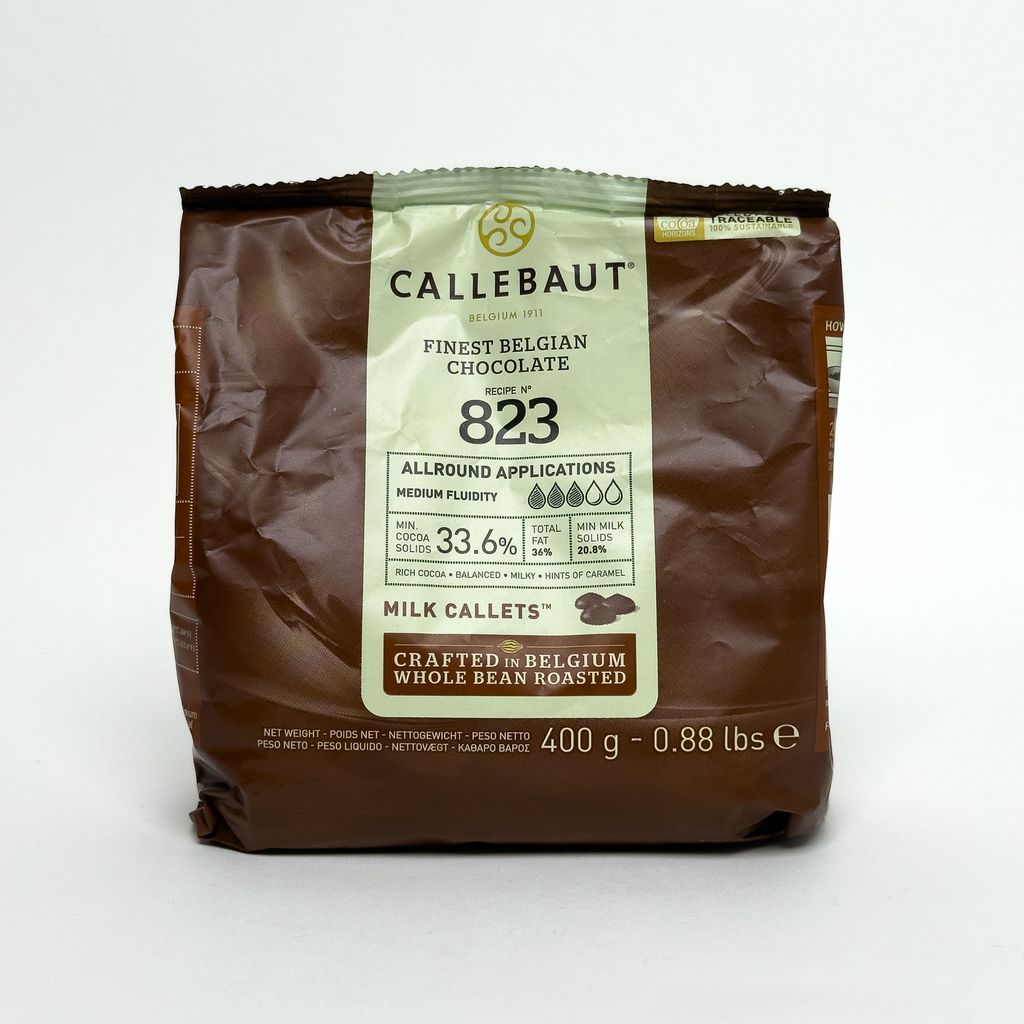
Milk chocolate gives you ice chocolate the way you remember it from childhood: sweet, creamy and mellow. Callebaut 823 milk chocolate callets (about 34% cocoa) work well. They have a full caramel flavor that doesn't get lost behind the coconut. You'll find more milk chocolates in our milk chocolate range.
Dark chocolate makes more grown-up, less sweet cubes. Callebaut 811 dark chocolate callets (about 54% cocoa) are bold enough that the coconut fat doesn't flatten them, yet not so bitter that the cooling gets lost. Chocolate above 70% cocoa can be used too, just expect a sharper taste.
A half-and-half mix, for example 100 g of 823 and 100 g of 811, is in our view the best compromise: sweet, but not too sweet.
White chocolate works as well, but it's very sweet on its own. Balance it with lemon zest or mint.
Callets (pistoles) have one practical advantage: they melt evenly and you can weigh them out without breaking anything up. Good bar chocolate broken into pieces works too.
What to avoid: cocoa and fat-based coatings (compound chocolate). Instead of cocoa butter they contain vegetable fats, so once you add more coconut fat you don't really know what ratio you're working with. The cubes then tend to be sticky and taste mostly of fat. Couverture, on the other hand, works very well: it's chocolate with a higher share of cocoa butter.
How to make ice cubes in a praline mold
You make ice cubes in six steps: melt the chocolate, stir in the coconut fat, let the mixture cool to 28–30 °C (82–86 °F), pour it into the mold, let it set in the fridge and turn the cubes out. A mold with 24 cubes of 25 mm takes roughly 350 g of mixture (about 375 ml in volume); for a different mold, measure the volume with water. Start with 200 g chocolate and 100 g fat, and if you run short, make a smaller extra batch.
Melt the chocolate in a water bath, or in the microwave in 20–30 second bursts, stirring each time. Don't overheat it: milk chocolate above about 45 °C (113 °F) and dark above 50 °C (122 °F) can scorch and turn grainy. Not a single drop of water can get into the chocolate.
Stir in the coconut fat, cut into pieces. It melts by itself in the warm chocolate, and the mixture will be thinner and glossier than the chocolate alone.
Let the mixture cool to 28–30 °C (82–86 °F). On your lip it should feel barely lukewarm. If you pour it hot, the fat separates as it sets, a gray, greasy film forms on top of the cubes and bubbles appear in the mold.
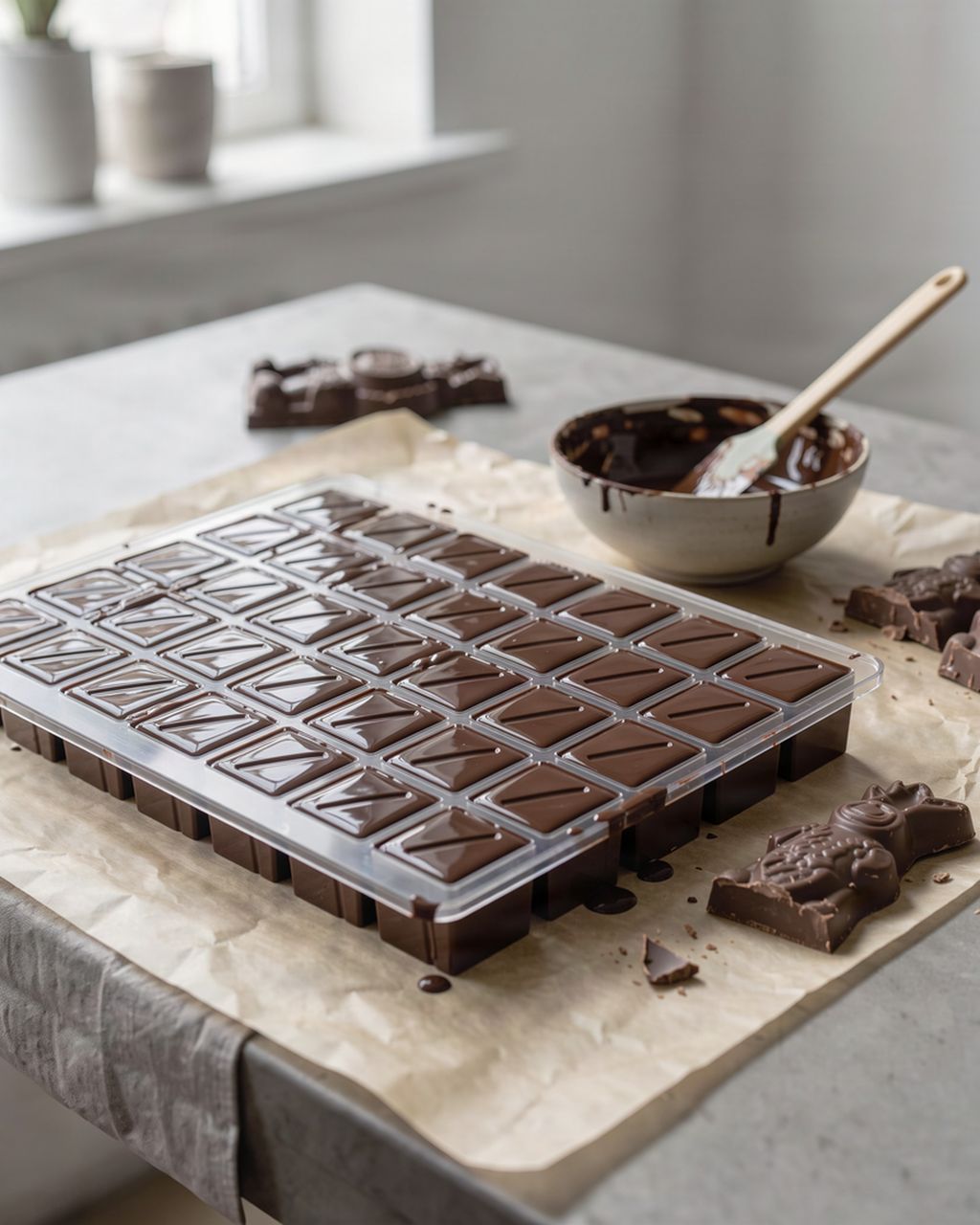
Pour into the mold right up to the rim and tap the mold lightly on the counter so the bubbles rise to the surface. The easiest way to fill it is from a small jug or from a piping bag with the tip snipped off.
Let it set in the fridge for about 1 hour, or 20–30 minutes in the freezer. The cubes are ready when you can see matte, released patches on the bottom of the mold.
Turn them out: flip the mold upside down over a cutting board and give it a short tap. The cubes should drop out on their own.
You don't need to temper the chocolate here. The coconut fat thins it so much that it sets mainly from the cold, not through cocoa butter crystallizing. A smooth mold and a cold fridge give you the shine and the clean release, not tempering.
Which mold should you choose for ice chocolate?
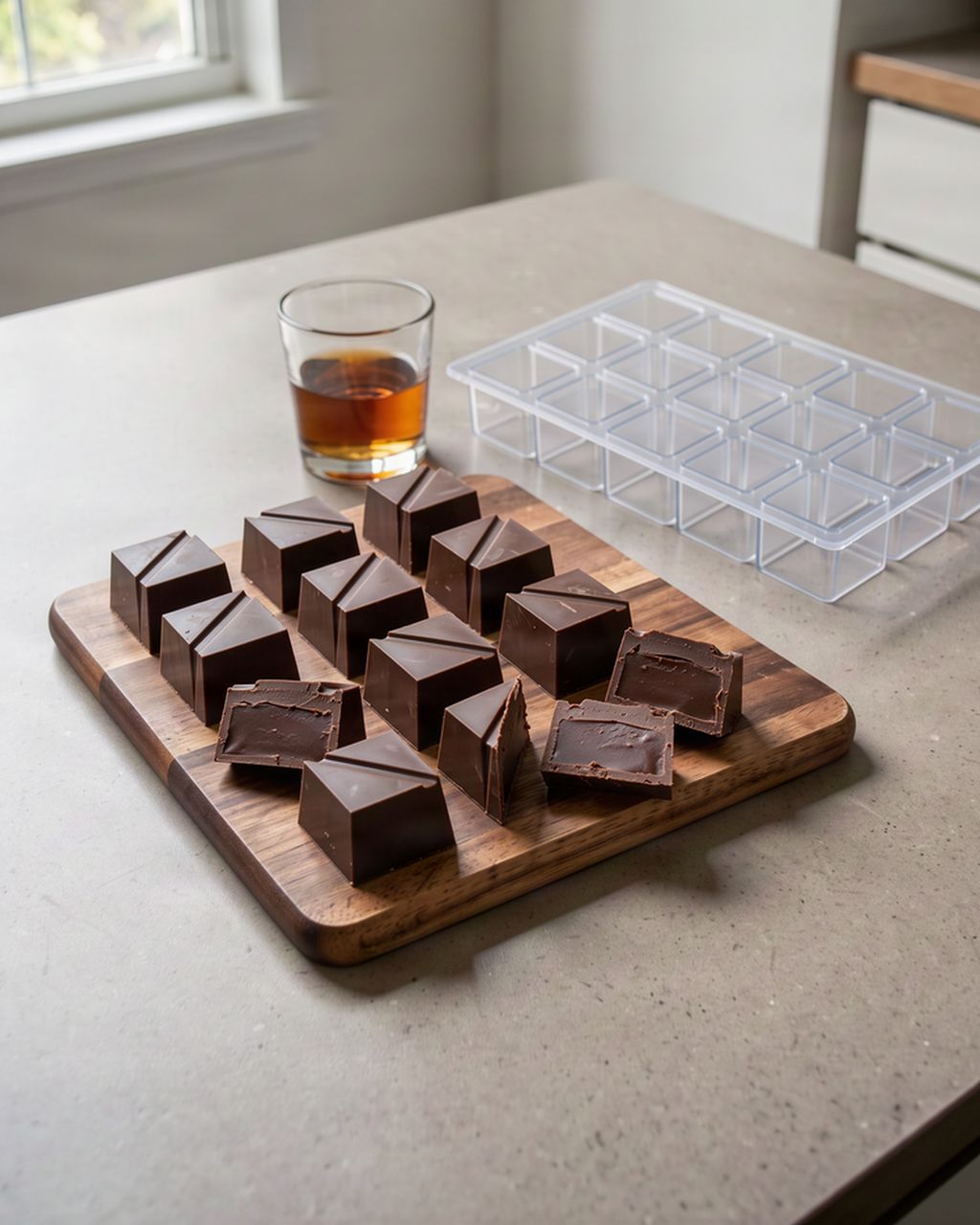
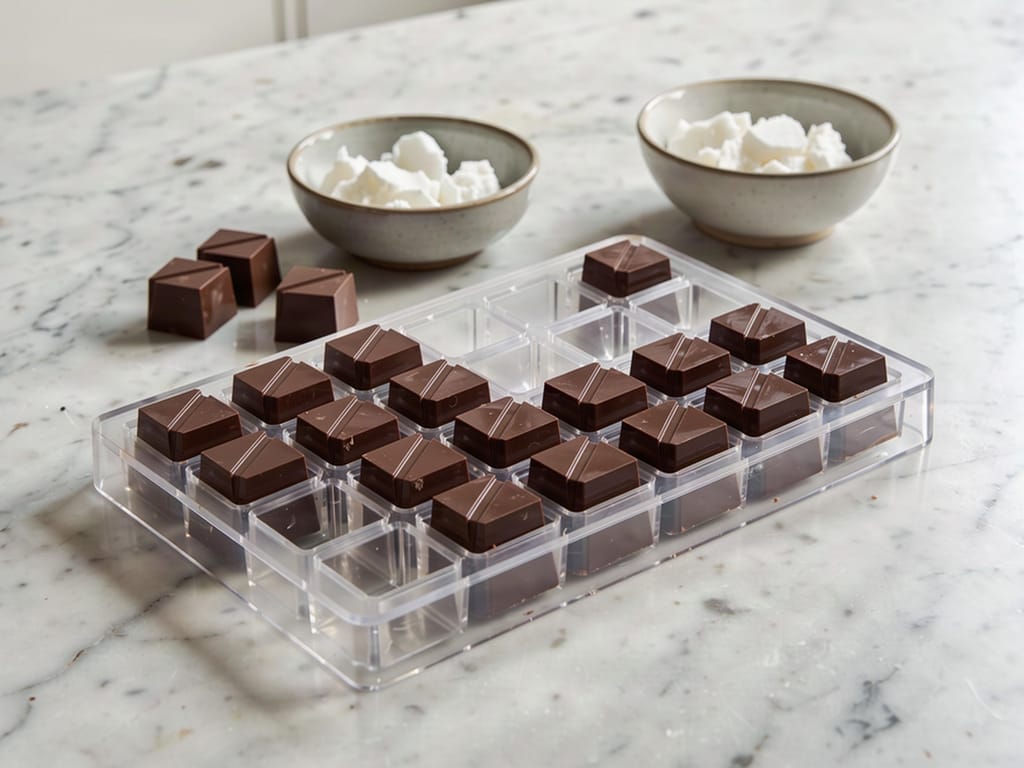
The best choice for ice chocolate is a hard polycarbonate praline mold with cubes about 25 mm on each side: it gives the cubes sharp edges and a mirror shine, because the mixture copies the perfectly smooth surface. The cube is the classic ice chocolate shape, and it makes sense: it's one bite that melts all at once in your mouth, so the cooling hits at full strength.
Here's an honest comparison of the options:
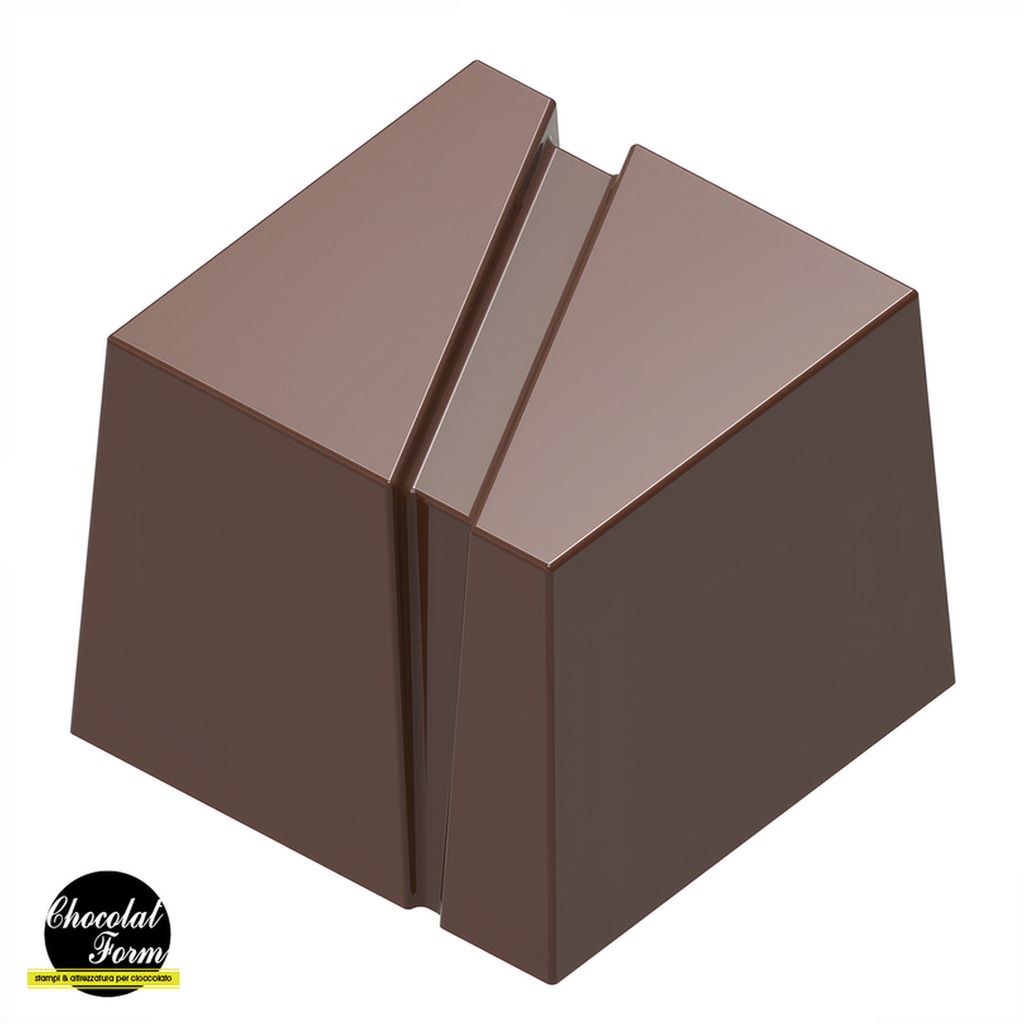
A polycarbonate mold is the best choice if you want cubes that look like they came from a confectioner's. We have the Chocolat Form praline mold – Cube with a stripe (24 cavities, 25 mm) with a fine stripe on top. The mixture shrinks slightly as it sets and drops out of the rigid mold by itself. Wash the mold only in lukewarm water, with no abrasive sponge, because scratches would be imprinted on every cube.
A silicone ice or praline mold is cheaper, and you can push the cubes out even if the mixture hasn't quite set. But the surface stays matte and the edges rounded.
Paper or foil praline cups are the traditional Swedish and German way. That's exactly how ice chocolate is sold there. There's nothing to turn out: you simply put the finished cup into a box of chocolates. The look is more homemade.
A baking sheet lined with parchment paper: pour the mixture in a layer 1–1.5 cm thick, let it set and cut it with a knife warmed in hot water. It's the fastest, but the least neat.
If you're packing the cubes as a gift, the article Homemade Box of Chocolates as a Gift will come in handy too.
Why won't the ice cubes come out of the mold, or why do they have a gray film?
Ice cubes most often stick in the mold or get a gray film because the mixture was too warm when poured or hasn't spent long enough in the cold.
The cubes won't come out of the mold: put them back in the freezer for another 15 minutes. The chilled fat contracts and the cubes let go. If they still hold on, the mold was greasy or scratched.
A gray or greasy film on the surface: the mixture went into the mold too hot and the fat separated. It doesn't affect the taste, only the look. Next time let it cool to 28–30 °C (82–86 °F).
The cubes crumble or break: there's too much fat in the mixture (more than 1:1), or something dry in it, such as cocoa, without enough fat.
The chocolate thickened and went grainy: it overheated or water got into it. You can't rescue chocolate like that, so use it for baking.
The cubes don't cool: the mixture contains a cocoa (fat-based) coating instead of chocolate, butter instead of coconut fat, or the cubes are too warm. Put them back in the fridge and eat them cold.
How long do ice cubes keep and how to store them
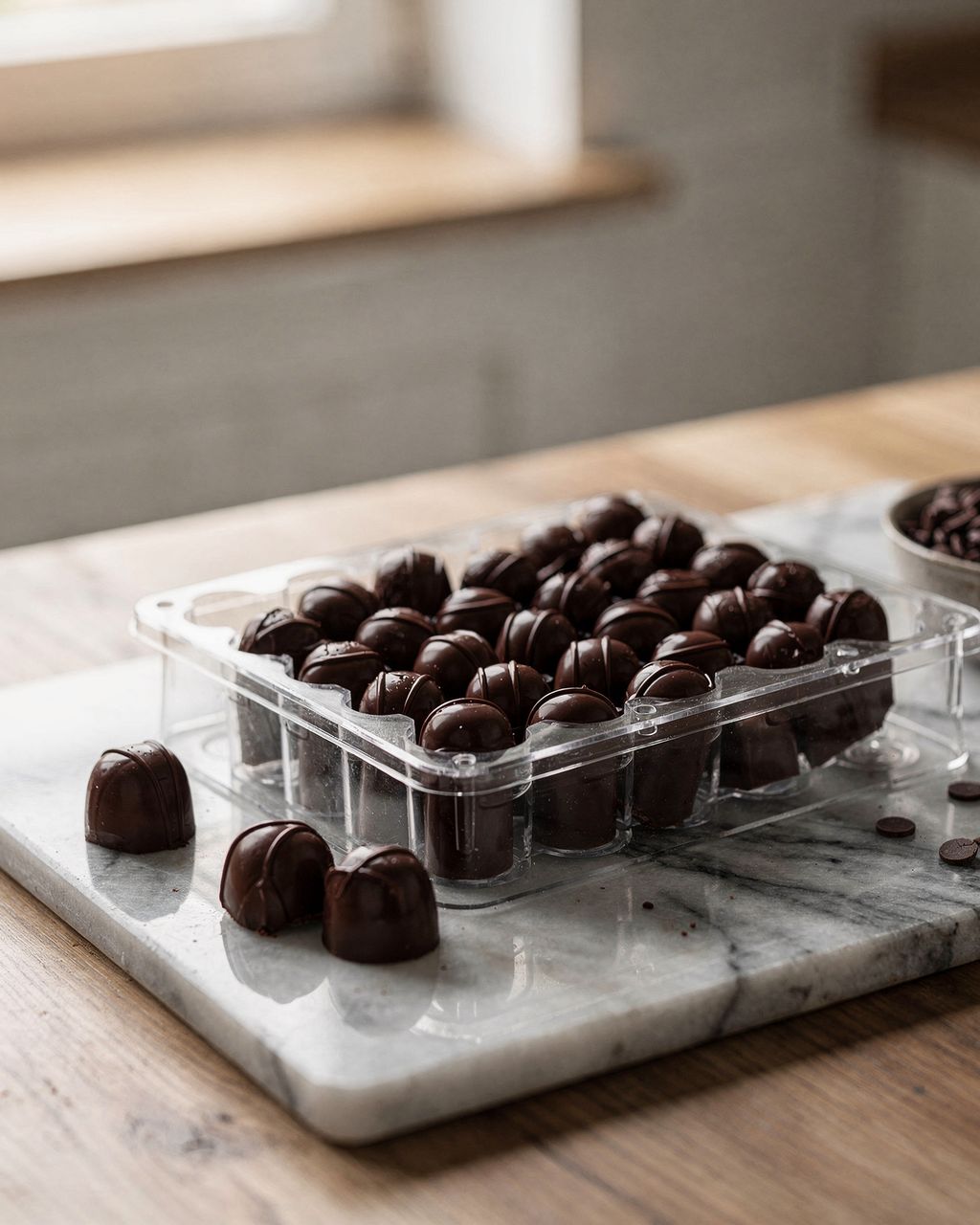
Store the ice cubes in a closed container in the fridge. They keep for 2–3 weeks that way, and up to 3 months in the freezer. At room temperature above roughly 22 °C (72 °F) they start to soften, so keep them out of the cold only as long as it takes to eat them.
A closed container is a must. Coconut fat readily absorbs smells from the fridge, such as cheese or onion.
Put parchment paper between the layers so the cubes don't stick together or scuff their shine.
Eat them straight from the freezer; they don't need to thaw. They cool the most that way. If you want to serve them, move them to the fridge about an hour ahead so they aren't rock hard.
On a Christmas platter, put them out at the last moment and not next to a warm oven or a candle.
Don't leave them to "sweat" on the table for long after taking them out of the fridge. Moisture from the air condenses on cold cubes and dissolves a little sugar on the surface, and once it dries a whitish sugar bloom is left. It doesn't affect the taste, but the cubes lose their shine. So open the container only when you're serving the cubes.
How to flavor ice chocolate: mint, nuts, zest
The best way to flavor ice chocolate is with fat-soluble flavorings, added to the lukewarm mixture just before pouring: mint oil, finely grated citrus zest, vanilla, a pinch of salt, or crushed nuts in the bottom of the mold.
Mint: 2–3 drops of food-grade mint oil per 300 g of mixture. Menthol strengthens the cooling effect even more, and it's the most classic combination. Make mint cubes for adults only, though.
Orange zest from half an orange, for the dark version.
Roasted hazelnuts or almonds, crushed finely and sprinkled into the bottom of the cavities before you pour in the mixture.
A flake of sea salt on top of cubes made with dark chocolate.
Don't add rum or liqueur. Water and alcohol don't combine with pure fat and will seize the chocolate. If you want pralines with alcohol, there's a different method, see Rum Pralines.
What to get for your ice cubes
Callebaut
Callebaut Milk Chocolate Callets (823) 400gKč 279.00Previous price Kč 325.00−14%

Frequently asked questions
Do I need to temper the chocolate for ice chocolate?
No, you don't need to temper the chocolate. A third of the mixture is coconut fat, which thins it so much that it sets mainly from the cold of the fridge, not through cocoa butter crystallizing. Just melt it gently (milk chocolate to no more than 45 °C / 113 °F) and let it cool to 28–30 °C (82–86 °F) before pouring.
Can I make ice chocolate with virgin coconut oil?
Yes. Virgin coconut oil cools just as well as refined coconut fat because it melts at a similar temperature. The difference is flavor: the cubes will smell strongly of coconut. If you want a pure chocolate taste, use refined coconut fat.
Is ice chocolate suitable for children?
Children usually like ice chocolate made with milk chocolate, but treat it as a sweet, not an everyday snack. Make the mint cubes for adults only: mint oil is generally not recommended for children, and if you're unsure, ask a pediatrician. This is general information, not medical advice.
Want tips like this every Thursday?
One recipe worth heating the oven for, one tip, and one deal from the shop. Nothing else.