How to Freeze Mushrooms: Blanching, Sautéing and How Long They Last
Updated Aug 28, 2026
You don't need fancy equipment to dry mushrooms at home: slice them 3–5 mm thick, dry at 40–50°C, and you're done the moment a slice snaps with a crack when bent instead of just bending. It all comes down to three things — picking the right species, keeping water away from them, and drying them properly all the way through. Skip any one of these steps and your jar will be mouldy within a month. Here's the full method, with temperatures, times and storage tips, so your mushrooms last through Christmas and beyond.
The best mushrooms for drying have firm flesh and low water content — porcini and other bolete-family mushrooms, birch boletes, leccinum species, parasol mushrooms, button mushrooms, oyster mushrooms and morels. Watery, brittle species turn to worthless flavourless paper once dried.
This holds true within species too: pick young, firm, dry specimens. A mushroom picked the day after heavy rain is waterlogged, takes twice as long to dry, and is much more prone to spoiling in the process.
Dry porcini and other boletes, leccinum species, parasol mushrooms, button mushrooms, oyster mushrooms and morels without hesitation — they have firm flesh and, if anything, gain aroma through drying.
porcini/boletes (pine, oak, dark, and yellow-cracked varieties) — the king of drying, their aroma only intensifies
leccinum species — they turn black once dried, but this doesn't spoil the flavour
brown birch bolete and other bolete relatives
parasol mushroom — dry only the caps, the stems are woody
button mushrooms and oyster mushrooms — from the shop or the garden, excellent for mushroom powder
morels — drying improves them, and this way a spring haul keeps for years
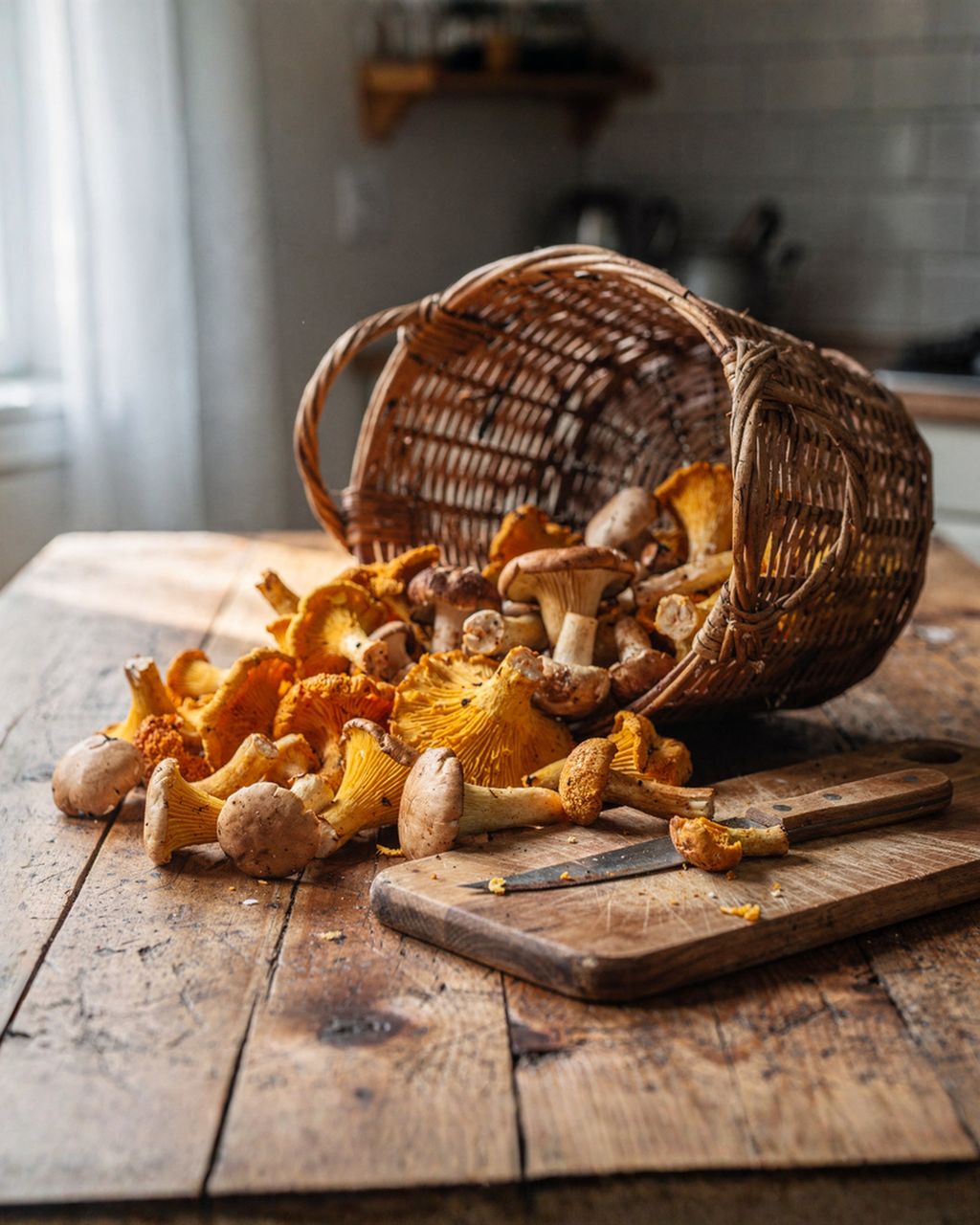
Dry chanterelles, milk-caps and russulas only with reservations — they can be dried, but once rehydrated they'll never be quite like fresh, so it's usually better to freeze or pickle them instead.
chanterelles — stay rubbery once dried and won't soften in a sauce; better to grind into powder or freeze
milk-caps and russulas — brittle and watery, better pickled or frozen
Never dry honey fungus, soft and watery species like puffballs, clouded funnel caps and pinwheel mushrooms, or any old, mushy or maggoty specimen.
honey fungus — needs a long boil with the water discarded, which neither drying nor soaking can replace (more on this in the box below)
puffballs, clouded funnel caps, pinwheel mushrooms and other soft species — full of water, and drying leaves neither flavour nor texture behind
old, mushy or maggoty specimens — drying won't turn a bad mushroom into a good one
Never wash mushrooms meant for drying under running water — a waterlogged mushroom takes hours longer to dry, loses aroma, and spoils far more easily. Clean them dry, ideally right in the woods or on the way home, while the dirt is still dry enough to brush off.
Cut off the base of the stem along with any soil. This saves you half the work.
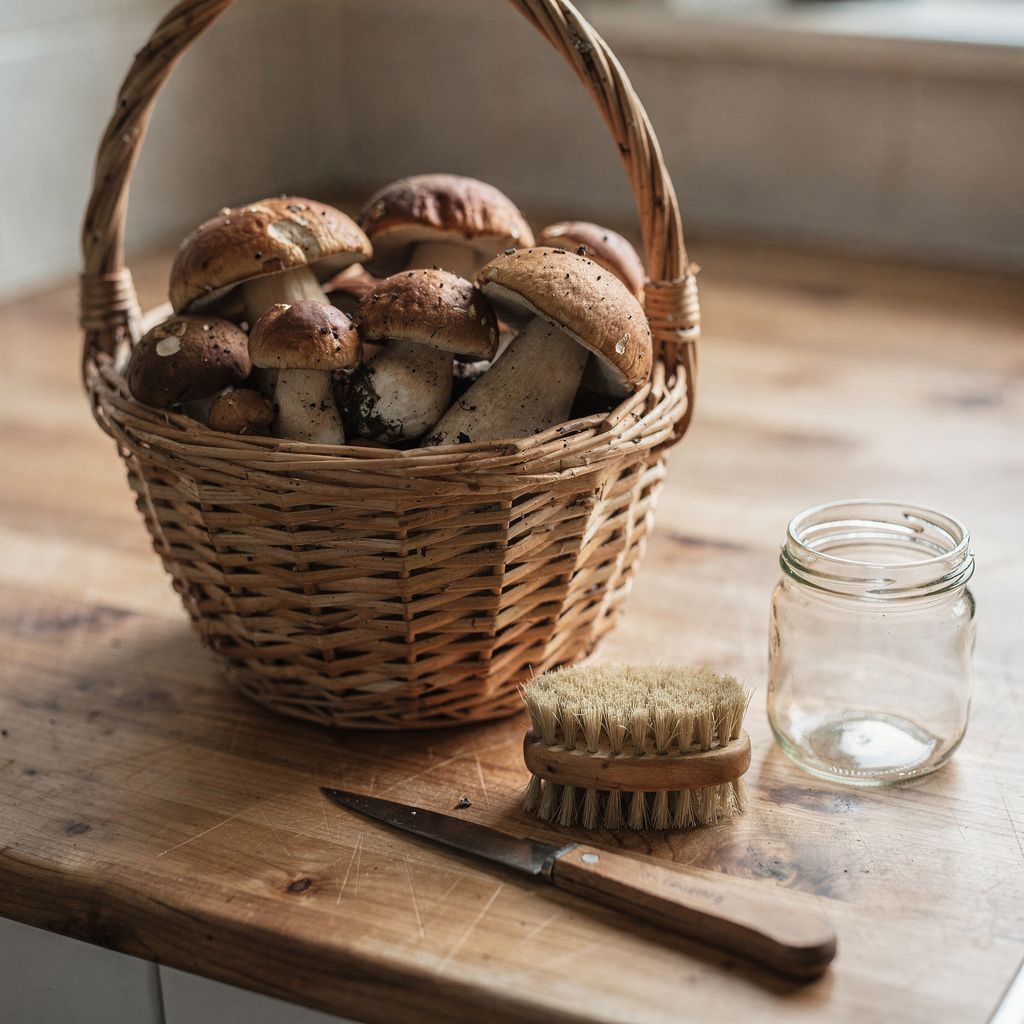
Brush off debris with a soft brush — that's enough for pine needles, leaves and sand.
Scrape the stem skin with a knife; on older boletes it's tough and won't soften in soup anyway.
Cut away any mushy tubes. Leave them on young boletes, but on older ones they make the whole slice damp and slow to dry.
Check for maggots. Cut the mushroom lengthwise; if the stem is riddled with holes, cut it off and keep just the cap.
If you do use a damp cloth, wring it out well — wipe the gills of button mushrooms with it, then dry them straightaway with a paper towel.
Clean and slice mushrooms as soon as possible after picking. Left overnight in a bag, they'll sweat and have nothing left to give by morning.
Slice mushrooms 3–5 mm thick, always lengthwise through both cap and stem, so every piece dries at the same rate. Uneven slices are the most common reason half a batch turns brittle while the other half stays limp.
Thinner than 2 mm and it'll crumble to dust before it even leaves the rack.
Thicker than 8 mm holds more aroma, but can easily add half again to the drying time, making it crucial to check for full dryness.
Small boletes can just be halved — they look nice in soup that way.
Tough stems should be sliced crosswise into rounds, or dried separately and ground into mushroom powder — it's the best seasoning for sauces and meat that you'll bring home from the woods.
Guide the knife smoothly and don't crush the flesh; crushed cells release water and the slice sticks to the rack.
Arrange the slices in a single layer with no overlap. Air needs to circulate around every piece — that's the whole secret of drying.
In a dehydrator, dry mushrooms at 40–50°C for roughly 5–8 hours. The safest approach is a two-stage method: the first 2 hours at 40°C to evaporate surface moisture, then finish at 50°C until done.
Don't exceed 55–60°C. Above this, the surface of the slice hardens before the moisture inside can escape (known as case hardening, or simply 'sweating' in plain terms). The mushroom then looks done but stays damp inside — and that's exactly the kind of jar that turns mouldy.
Single layer, no overlapping. It's better to dry in two batches than to overcrowd the trays.
Rotate the trays every 1–2 hours. The bottom layers tend to finish first.
Remove finished slices as you go. Thin edges turn brittle hours before the thicker centre.
Expect a ratio of roughly 10:1. 1 kg of fresh mushrooms yields about 80–120 g dried.
A dehydrator is the most reliable option because it holds a low temperature while also circulating air. If you dry mushrooms regularly, it pays for itself faster than you'd think.
In the oven, dry mushrooms at 50°C with the fan setting and the door slightly ajar, for 10–16 hours, depending on slice thickness and how well your oven holds a low temperature. The cracked-open door isn't optional — in a closed oven, moisture has nowhere to escape, and instead of drying, the mushrooms steam in their own vapour.
Wedge the door open with a wooden spoon or a rolled-up tea towel, leaving a 5–10 cm gap.
Dry on a wire rack, not a lined baking tray. Air needs to flow underneath the slices, or the bottom stays damp.
Set the lowest possible temperature with the fan on. If your oven's minimum is 70°C, open the door wider and check every half hour — above 70°C, mushrooms start to roast and brown instead of drying.
Turn the slices every hour and swap trays between shelves.
At the end, switch the oven off and let the mushrooms finish in the residual heat with the door still ajar.
An oven is noisier, pricier to run, and worse at holding a low temperature than a dehydrator. But for one batch a year, it does the job just fine.
To air-dry, thread mushrooms onto string or spread them on a rack in a dry, airy, warm spot — above 30°C and below 60% humidity, it takes 2–4 days. It's the cheapest and gentlest method, but the only one weather can ruin: the US National Center for Home Food Preservation doesn't recommend outdoor drying of vegetables or mushrooms at all, since in poor conditions mushrooms are more likely to mould than dry.
Thread slices onto plain string with gaps between them so they don't touch, and hang above a stove, in an attic, or on an airy balcony.
Cover them with muslin or mosquito netting. Flies lay eggs on mushrooms as they dry.
Bring mushrooms indoors at night. Outdoor humidity creeps back into them and undoes a whole day's work.
Don't start if it's raining or humid. In damp air, mushrooms will mould before they dry. Switch to a dehydrator or oven instead.
Always finish with heat. A final half hour at 50°C is a cheap safeguard against residual moisture you can't detect by feel.
Sunlight has one extra quirk: UV exposure converts some of the ergosterol in mushrooms into vitamin D2. How much forms depends on sun intensity and exposure time, but it has no effect on flavour or drying quality, so there's no need to insist on drying outdoors just for that.
A fully dried mushroom snaps with an audible crack when bent and rustles loudly in your hand. If a slice bends like leather or feels cool and damp to the touch, it isn't done yet.
Test it like this:
Let the mushrooms cool. Warm slices are always more flexible than they'll turn out to be. Testing them hot is a classic mistake.
Pick the thickest piece from the middle of the rack, not the edge, which dried first.
Snap it. It should crack, not bend. The broken surface should be just as dry and pale as the outside.
Do the jar test. Optional, but a cheap safeguard: put the cooled mushrooms into a sealed jar, close it and leave it on the counter for 7–10 days, shaking it daily and checking against the light. If the glass fogs up or the slices stick together, put them back in the dehydrator for a few more hours.
Weigh them. A finished batch weighs roughly a tenth of the original weight.
One thing can't be fixed after the fact: a sweated mushroom with a hardened surface and a damp inside. If you dried at too high a heat and a slice looks glassy on the outside but soft within, extra hours won't save it — sort those pieces out and use them straightaway.
Store dried mushrooms airtight, in glass or vacuum-sealed, somewhere dark, dry and below 20°C. They taste best in the first 6–12 months, after which the aroma noticeably fades — faster still if stored somewhere warm or bright. They're not spoiled, just less flavourful. Moisture creeping back in from the air is enemy number one, not time.
Seal jars only once fully cooled. Warm mushrooms release steam into the jar, which condenses on the glass and drips back down.
Use sealed glass jars, not cloth bags. Kitchens are humid, and a cloth bag lets moisture straight through.
Shake the jar daily for the first 7–10 days and check against the light — not essential, but a cheap safeguard. Fogged glass means back to the dehydrator.
Add a sachet of silica gel or a few grains of rice in a cloth pouch if you're storing in a damp flat.
3–4 days in the freezer at −18°C (a week to be safe) reliably kills off pantry moths at every life stage — the toughest survivors aren't the eggs but the larvae, and the longer time is mainly to let the centre of the jar reach −18°C too. Once out, leave the jar sealed until it reaches room temperature, so condensation doesn't form on the mushrooms.
Not above the stove, not by the window, not in the fridge. Heat and light strip the aroma, and the fridge is damp.
And one non-negotiable rule: if you spot mould in a jar, throw out the whole contents. Mould threads spread further through dry material than you can see, and picking out the 'good pieces' from a mouldy jar just isn't worth the risk.
The most common mistakes when drying mushrooms are washing them in water, drying above 60°C, a closed oven door, overlapping slices, testing for dryness while warm, and sealing mushrooms into a jar while still warm. Almost every mouldy jar can be traced back to one of these:
Washing mushrooms before drying. Water adds hours to drying time and raises the risk of spoilage.
Too high a temperature. Above 60°C, the surface hardens before moisture can escape from inside.
A closed oven. Without an escape route for steam, mushrooms stew instead of drying.
Overlapping slices. Wherever they touch, a damp patch stays behind.
Testing dryness while warm. A warm mushroom is always flexible — wait until it cools.
Sealing warm mushrooms into a jar. Condensed steam in the jar is the starting line for mould.
Drying isn't the only route — russulas, milk-caps, chanterelles and other watery species keep better frozen or pickled. Freezing comes with a rule that's often overlooked: mushrooms shouldn't be frozen raw, but parboiled or sautéed first. And if you come home from the woods with two full bags, it pays to sort your haul straight away — some for dinner, some for drying, some for the freezer, some for pickling.
Dried mushrooms really shine in mushroom soup, kulajda (a Czech sour cream and dill soup), mushroom sauce for dumplings, risotto and mushroom kuba (a Czech barley dish). In all of these, the dried mushroom has time to soak up the stock and give back its flavour in return.
A dried porcini is essentially concentrated umami — a handful soaked beforehand is enough for a whole pot of soup, and the soaking water should go straight into the pot too, since it holds most of the aroma. Just pour it off carefully and leave the grit behind. As for a quick fried mushroom dish? Reach for fresh mushrooms there — dried ones don't stand a chance of shining in it.
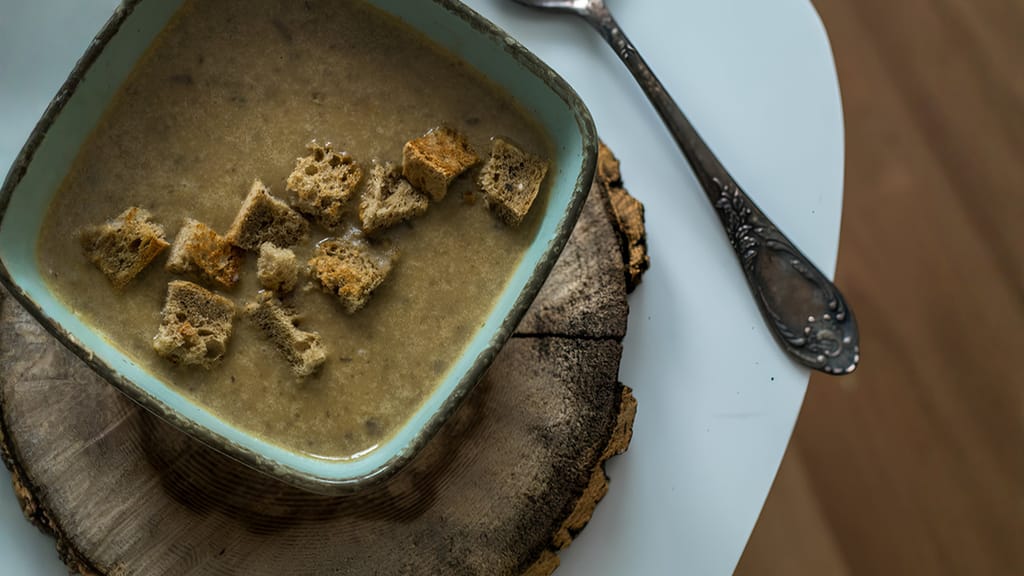
Mushroom soup
Mushroom soup from dried porcini — the fastest way to put this year's drying to good use

Kulajda – the best creamy mushroom soup
Kulajda with mushrooms: sour cream and dill, given depth by dried porcini
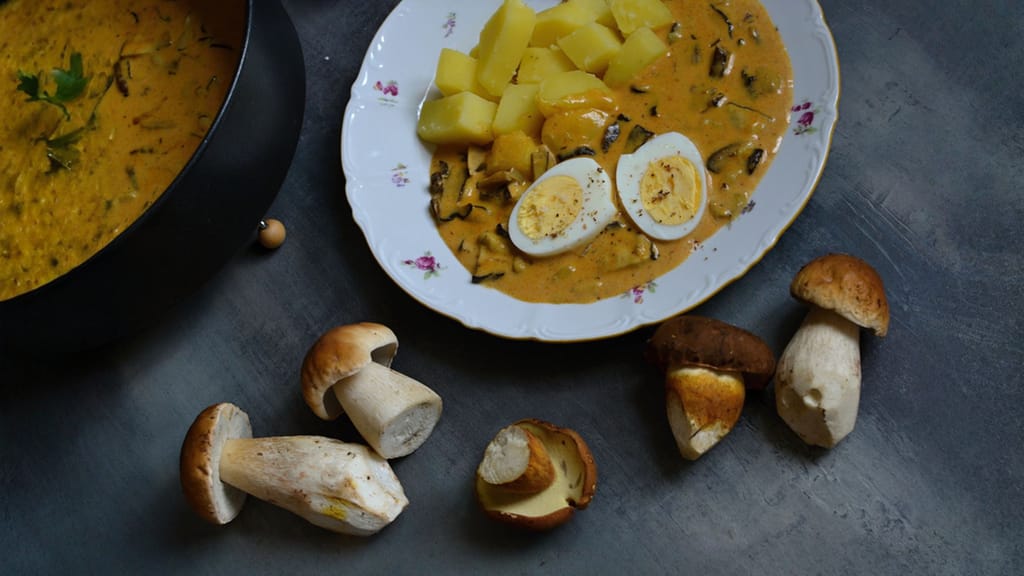
Mushroom sauce - an easy and wonderful autumn treat
Mushroom sauce for dumplings — an autumn classic made with dried or fresh mushrooms
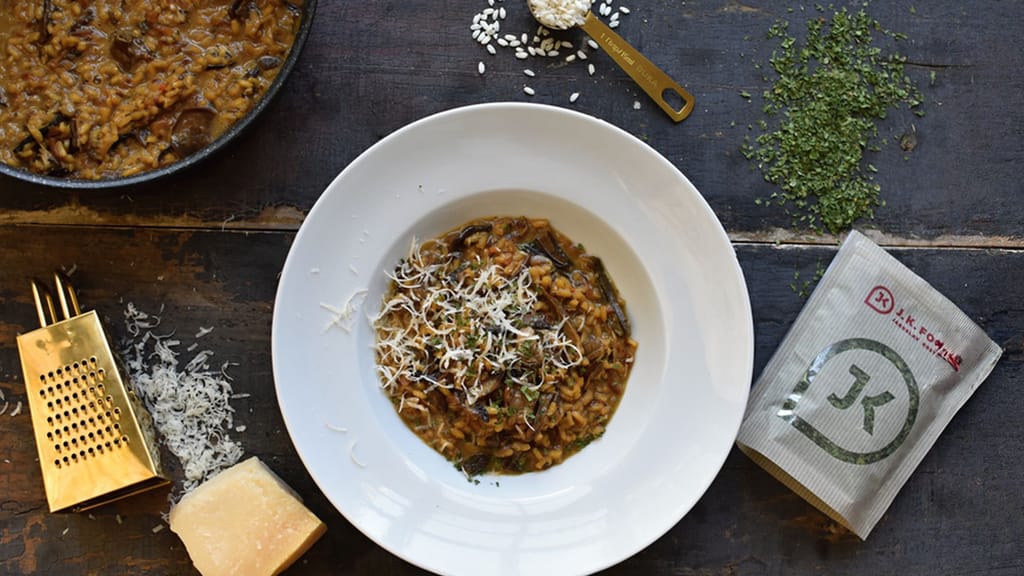
Italian mushroom risotto with kostera seasoning
Mushroom risotto, where stock from soaked dried mushrooms makes the whole dish
Roughly a tenth of the weight: 100 g of dried mushrooms is about the same as 1 kg fresh. Fresh mushrooms are mostly water, so they lose around 90% of their weight when dried. If a recipe calls for 500 g fresh mushrooms, 50 g dried plus the soaking water will do the job.
For soups and sauces, yes — soak them for 20–30 minutes in lukewarm water or milk; for risotto, just pour hot stock over them. Don't throw away the soaking liquid, as it holds most of the flavour; just pour it off carefully and leave any grit at the bottom. For stews with a long cooking time, you can add dried mushrooms straight in — they'll soak up the liquid themselves.
If they're just pliable with no mould or musty smell, spread them out on a rack again and dry for 2–3 hours at 50°C. Let them cool, then transfer to a clean, completely dry jar. But if you spot any mould or catch a musty whiff, throw out the whole jar — mould threads spread further than you can see.
Neither is really suited to drying mushrooms. A microwave heats mushrooms from the inside and effectively steams them in their own juice instead of drying them. An air fryer can work in a pinch for a small batch on the lowest setting, but the basket is small and airflow so strong that thin slices fly around and scorch — weigh them down with a rack and check every 10 minutes.
The surest way is to slice the mushrooms and sort out any wormy pieces — larvae are visible in the cut straightaway. Soaking in salted water does drive maggots out, but it also waterlogs the mushroom, so it's not suitable before drying. Leave lightly affected sliced pieces on a rack for half an hour and some larvae will crawl off on their own; badly riddled caps shouldn't be dried at all.
Yes, and it's the best use for stems and the crumbs left at the bottom of the rack. Grind thoroughly dried mushrooms in a coffee grinder or a powerful blender into a fine powder and store it in an airtight jar away from light. A teaspoonful adds umami to sauces, soups, mash and marinades — and since powder absorbs moisture from the air faster than slices, it's best made in small batches.
One recipe worth heating the oven for, one tip, and one deal from the shop. Nothing else.