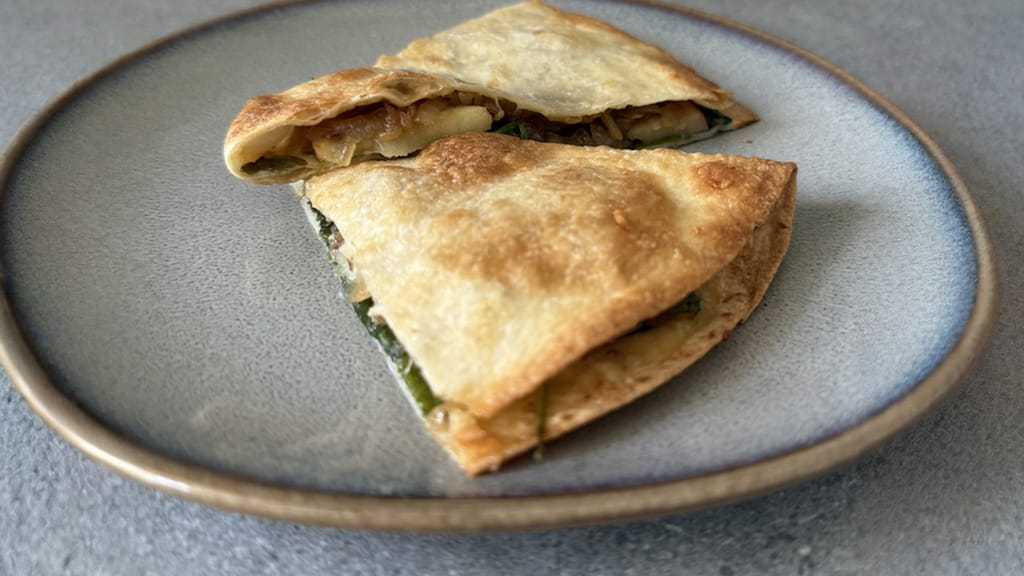
Apple, spinach and caramelized onion quesadilla

Updated Jul 19, 2026
You can cut an onion quickly and without tears if you combine three things: a sharp knife, the right cutting technique, and a trick for dealing with the irritating fumes. In this guide, we'll cover which knife to reach for when cutting onions, how to prep one, three basic techniques (slices, dice, and mince), and above all, how to cut an onion so it stops making your eyes sting. At the end, you'll also find tips on what to use your chopped onion for.
Reach for a sharp chef's knife with a blade around 20cm (8 inches) — it's the most versatile choice and works best on onions. The wide, slightly curved blade lets you use a rocking motion: the tip stays on the board while you rock the heel of the knife through the onion. Fast, smooth, precise.
An alternative is the Japanese santoku. It has a shorter, flatter blade, so it cuts more with a straight up-and-down chop rather than a rocking motion — some people find this easier to handle, especially for thin slices.
But what matters more than the type of knife is sharpness. A sharp blade slices cleanly through the onion's cells, needs less pressure, and won't slip on the smooth skin — making it safer, too. A dull knife tends to crush the onion instead, which means more mashed cells, more irritating fumes, and a higher risk of injury. Keep your knife in good shape by honing it regularly on a steel and having it professionally sharpened every so often.

Prepping an onion takes four steps: trim the top, cut it in half through the root, peel off the skin, and set the half cut-side down — but leave the root end intact for now. The root is what holds the layers together, so the onion won't fall apart as you cut, and you only trim it off at the very end.
Trim the stem end (about a centimetre) with a straight cut.
Cut the onion in half from top to root.
Peel off the skin — both halves now peel easily. Remove the first fleshy layer along with it if it's dried out or damaged.
Leave the root intact and set the half cut-side down on the board — now you have a stable base and can start cutting.
A small bonus: the root end holds the highest concentration of the sulfur compounds that make your eyes sting. The longer you keep the root intact, the fewer tears.
There are three basic ways to cut an onion — slices, dice, and mince — and each suits something different. The direction of the cut matters too: cutting with the grain (from root to stem) keeps the onion's shape better and gives a milder flavour, while cutting across the grain makes it fall apart more and taste sharper. Pick whichever suits what you're cooking.
For slices, cut the onion with the grain — the half-moons will hold their shape and won't fall apart. Set the onion half cut-side down, make your cuts from the stem end toward the root, and work evenly. Great for salads, stir-fries, pizza, or slow sautéing where you want the pieces to stay visible. Adjust the thickness to the use — thinner for raw, thicker for sautéing.
To dice an onion, cut it vertically and horizontally first, then across. Set the half cut-side down, root pointing away from you. Make several vertical cuts toward the root (leave the root uncut — it holds the onion together), then one or two horizontal cuts, and finally cut across — out come neat, even cubes. The closer together the cuts, the smaller the dice. Perfect for sauces, a base for meat dishes, or braises where the onion should cook down.
To mince an onion, first dice it finely, then run the tip of your knife over it in a rocking motion until it's almost mushy. Rest one hand flat on the spine of the blade, chop quickly, and occasionally scrape the pile back together. Onion this fine is great for dressings, marinades, salsa, or anywhere you want the onion flavour without anyone biting into a chunk.
You can avoid tears when cutting onion by combining a few tricks: a sharp knife, a chilled onion, an intact root, and venting the fumes away. None of these is a miracle cure on its own, but together they make a real difference.
Chill the onion for 15 minutes in the freezer or half an hour in the fridge — the cold slows the release of the irritating compounds.
Cut with a sharp knife, so you're slicing the cells, not crushing them.
Leave the root intact for as long as possible — it holds the highest concentration of sulfur compounds.
Vent the fumes away — set up a fan next to your cutting board, or cut with the extractor hood running.
It also helps to breathe through your mouth instead of your nose, and to avoid rubbing your eyes.
So why do we actually cry? When you damage an onion with a knife, it triggers an enzyme reaction (involving alliinase and so-called lachrymatory-factor synthase) that releases a volatile compound called syn-propanethial-S-oxide. This travels through the air to your eyes, where it reacts with moisture to form a mild acid, and your eye responds by tearing up to flush out the irritant. Cold temperatures and a clean cut from a sharp knife simply slow down and reduce this reaction.

Chopped onion is the base of countless dishes — from salads and sauces to curries, caramelised onion, and onion chutney. Depending on how you cut and cook it, you get a completely different flavour: raw onion is sharp and fresh, slow-cooked onion turns sweet and mellow.
Add thin slices of raw red onion to salads — they bring freshness and a pleasant bite. Tone down the sharpness by soaking the slices in cold water or a splash of vinegar for a few minutes.
Caramelised onion comes from slowly sautéing sliced onion in butter or oil until golden; sweet and soft, it's great with meat, in burgers, or in a quesadilla.
As a base for hot dishes, dice the onion and let it turn translucent — this is the foundation of most sauces, braises, and curries.
Here are a few recipes where chopped onion takes the lead role:
Apple, spinach and caramelized onion quesadilla
Apple, Spinach, and Caramelised Onion Quesadilla

Creamy polenta with roasted tomatoes and onion chutney
Polenta Porridge with Roasted Tomatoes and Onion Chutney

Sweet potato curry with red lentils
Sweet Potato and Red Lentil Curry — Onion as the Aromatic Base
Classic French onion soup lives or dies by slowly caramelised onion — you can coax a deep, sweet flavour out of it with a patient 40 minutes of gentle sautéing over low heat. Don't rush it or crank up the heat; burnt onion turns bitter. We're still working on our own French onion soup recipe for Yumsto.
Chopped raw onion keeps in the fridge for roughly 7 to 10 days if you store it in an airtight container or a well-sealed bag. Sealing it properly matters mainly so the onion doesn't perfume everything else in the fridge — its aroma easily transfers to butter, cheese, and milk.
Yes, you can freeze chopped onion, and it'll keep for about three months. Once thawed, it loses its crunch, so it's not great raw in salads, but it's ideal for sautéing, soups, sauces, and braises — and it saves you both the chopping and the tears next time. Spread the diced onion on a baking sheet, let it firm up, then transfer it to a bag so it doesn't clump together.
The best way to get onion smell off your hands is to rub them against stainless steel under cold running water — a sink, a spoon, or a stainless steel bar of soap will do. The sulfur compounds that cause the smell bind to the stainless steel, and the water rinses them away. Rubbing your hands with lemon or a bit of salt before washing also helps.
Cutting an onion under running water or in a bowl of water genuinely does cut down on tears, because the water catches the irritating fumes before they reach your eyes. It's not very practical, though — the knife and onion get slippery, and you risk cutting yourself. It's more reliable to chill the onion, cut it with a sharp knife, and vent the fumes away with a fan.
For fine, even dice, cutting by hand with a sharp knife is more precise, and the onion gets crushed less, so it's less bitter and makes you cry less. A food processor or chopper tends to mangle the onion into uneven pieces and releases a lot of juice — that's fine when you need to chop a large amount quickly for stock or a sauce where shape doesn't matter.
I send one like it every week. A recipe, a tip, one deal — nothing else.