Tuna steak with green asparagus and hollandaise sauce

Updated Jul 19, 2026
The right way to clean asparagus is simple: snap off the woody ends on green asparagus, and for white asparagus, also peel the skin from just below the tip down to the base. It's this small step — not the cooking — that decides whether you end up with a tender side dish or stringy fibers stuck between your teeth. In this guide we'll walk through cleaning both green and white asparagus step by step: how to tell where the woody part ends, when peeling actually matters, how to pick a fresh bunch, and how to store cleaned asparagus so it stays crisp.
Cleaning asparagus comes down to three steps: rinse it, remove the woody end, and — always for white asparagus, and depending on thickness for green — peel the lower part of the stalk. The whole thing takes just a few minutes, and it's the one thing standing between a tender side dish and fibers you can't chew through.
Start by rinsing the asparagus briefly under cold water and gently rubbing the tips with your fingers — sand loves to hide between the little scales. Then continue based on the type.
For most bunches, green asparagus just needs the woody end removed. Hold the stalk at both ends and bend it gently — it will snap naturally right where the tough part meets the tender part. For thicker stalks (over about 1 cm), peel the bottom third with a vegetable peeler too, since the skin can be fibrous even on green asparagus. Don't peel thin spring asparagus at all — you'd only lose the best part.
White asparagus should always be peeled, and more thoroughly than green — its skin is thick, bitter, and turns woody when cooked. Lay the stalk flat on a cutting board, hold it just below the tip, and use a peeler (ideally an asparagus peeler) to peel from just under the tip down to the end. Leave the tip itself untouched, as it's the most delicate part. Keep peeling until you reach the pale, moist flesh underneath. Finally, trim off 1–2 cm of the woody end.
The woody part ends exactly where the stalk snaps naturally when bent — usually in the bottom quarter to third. There's no need to measure: just hold the asparagus at both ends and bend it until it breaks. The fibers will snap right at the boundary between the tough and tender parts.
The bending method is the most reliable, but it'll trim a slightly different amount off each stalk. If you want the ends even (for grilling or plating), snap one stalk as a guide, line up the rest of the bunch against it, and cut them all at once with a knife.
White asparagus should always be peeled; green asparagus only sometimes, depending on thickness. The difference comes down to the skin: on white asparagus it's thick and bitter, while on thin green asparagus it's so delicate that peeling would only strip away good flesh.
White asparagus: peel the whole stalk from just below the tip down, otherwise the skin turns woody and bitter.
Thicker green (over ~1 cm): peel the bottom third.
Thin green: don't peel at all.
Improperly peeled white asparagus is the main reason cooked asparagus turns bitter.
Fresh asparagus has firm, straight stalks with rich color all the way to the tip, tightly closed tips, and a cut end that's moist rather than dried out. The shorter the journey from field to store, the better — peak season typically runs from April to June, traditionally wrapping up around late June.
Firmness: the stalk shouldn't bend like rubber — it should be stiff and crisp.
Squeak test: fresh stalks give a faint squeak when you press the bunch together.
Tips: tightly closed, not splayed open or wilted.
Color: green should be deep green all the way to the tip; white should be creamy with no pink or brown patches.
Cut end: moist and pale; a dry, brown, or hollow end means the bunch has been sitting for a few days.
There are three common mistakes: over-peeling, misjudging the woody end, and not rinsing the tips properly. All three are easy to avoid.
Over-peeling. For green asparagus, peel at most the bottom third — never the whole stalk — or you'll lose the tastiest flesh. Don't peel thin green asparagus at all.
Cutting the end in the wrong spot. If you just eyeball it and cut with a knife, you'll either leave woody fibers behind or trim off too much. Bending the stalk will show you the exact boundary.
Not rinsing the tips well enough. Sand collects between the little scales. Rinse briefly under running water while rubbing the tips gently with your fingers.
Cleaned asparagus stays fresh in the fridge for 3–4 days if you stand it upright in a glass with a little water, or wrap it in a damp kitchen towel; for longer storage, freeze it, but only after blanching. We've covered this in more detail in our guide to storing asparagus so it lasts as long as possible.
Stand the stalks upright in a glass with 2–3 cm of water, like a bunch of flowers, and loosely cover the top with a plastic bag. Change the water every day or two. This keeps the asparagus from wilting or drying out.
Wrap the asparagus in a lightly dampened (not soaking wet) kitchen towel or paper, and store it in the vegetable drawer of the fridge. A too-wet wrap will actually speed up spoilage.
Want asparagus flavor even out of season? Blanch it first — dunk it in boiling salted water for 2–3 minutes, then cool it immediately in ice water. This stops the enzymes that would otherwise ruin the color and flavor. Then pat it dry, portion it out, and freeze. Cook frozen asparagus straight from the freezer without thawing, or it'll turn mushy.
Asparagus is a low-calorie vegetable whose main strengths, according to nutritional data, are vitamin K and folate. 100g of raw asparagus provides roughly a third of the recommended daily vitamin K intake and around 10–13% of folate, plus potassium and fiber. Green asparagus has more vitamin C and carotenoids than white, though otherwise their nutritional profiles are nearly identical.
Cleaned asparagus is best kept simple — quickly sauté, grill, or blanch it in salted water until tender (3–5 minutes for green, 10–15 for white depending on thickness). All that's missing is a recipe. For more ideas on how to pair it, check out our article on asparagus taking center stage.
Tuna steak with green asparagus and hollandaise sauce
Green Asparagus with Hollandaise and a Tuna Steak
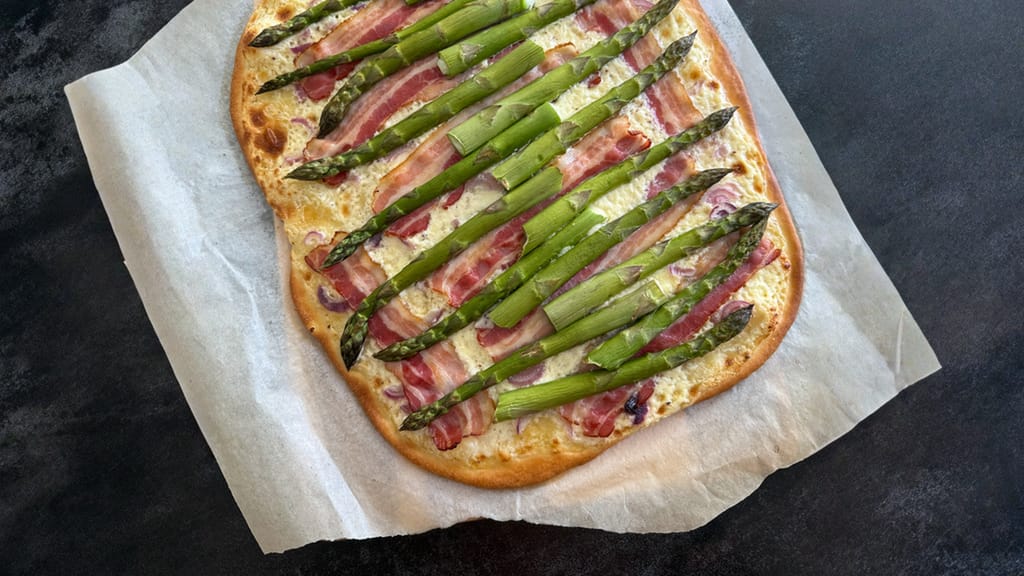
Savory asparagus tart with bacon and yogurt
Savory Asparagus Tart with Bacon and Yogurt
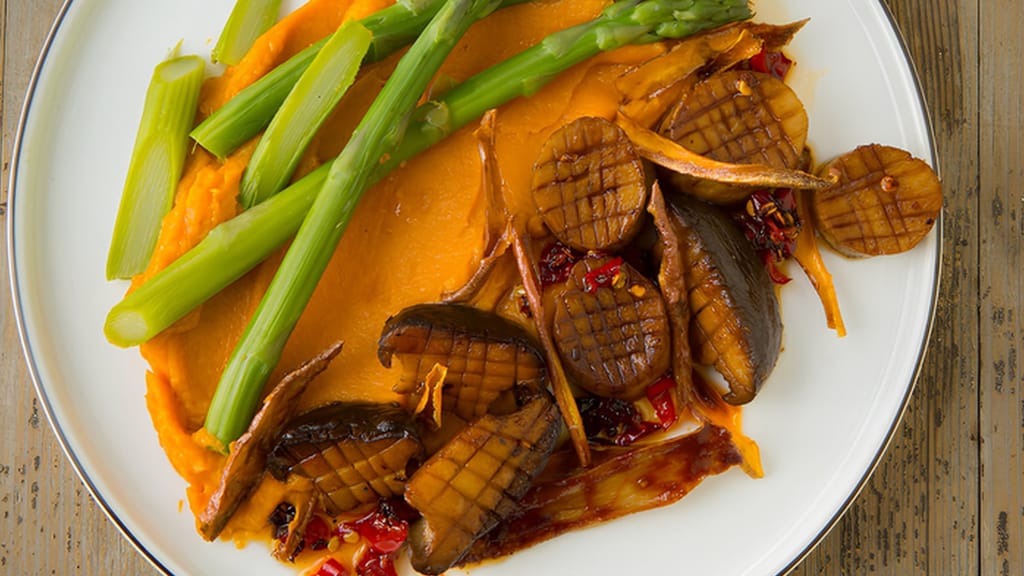
Sweet potato mash with asparagus and mushrooms
Sweet Potato Mash with Asparagus and Mushrooms
Yes, fresh green asparagus can be eaten raw — it's best thinly shaved into a salad with a little oil, lemon, and salt. White asparagus can technically be eaten raw too, but it tends to be bitter and tougher, so it's almost always cooked. Either way, rinse it well before serving.
The smell comes from asparagusic acid, which the body breaks down into sulfur compounds excreted in urine. Studies show it's completely harmless, and some people are genetically unable to smell it at all. It has nothing to do with the asparagus being unsafe or not fresh.
Spoiled asparagus feels slimy, the stalks turn limp or rubbery, the tips open up or darken, and there's a sour smell. A dry, hollow end on its own just means an older bunch — simply trim it back more. But if it's slimy or smells off, throw it out.
As a side dish, plan on roughly 200–250g of raw asparagus per person; as a main course, go up to 400g. Keep in mind that cleaning — especially peeling white asparagus — removes some weight. So a 500g bunch works out to about two servings.
You can freeze it raw, but the quality suffers — without blanching, it loses color, flavor, and firmness faster, and turns mushy once thawed. If you want to preserve the flavor, blanch it for 2–3 minutes and cool it in ice water. Frozen asparagus should then go straight into cooking without thawing first.
One recipe worth heating the oven for, one tip, and one deal from the shop. Nothing else.