Goose breast on apples with potato lokše
How to Bone a Goose and Prep the Breasts, Legs, Fat, and Stock
Updated Sep 25, 2026
Boning a goose into breasts and legs takes about 15–20 minutes; boning the whole bird for a roulade takes 40–60 minutes. All you need is a sharp knife and a bit of patience. It's worth the effort: breasts and legs need completely different cooking times, and once you separate them, you can cook each the way it deserves. The breasts stay juicy, the legs turn out tender, and you're left with a carcass for stock plus skin and fat to render into schmaltz and crispy bits. Here's the step-by-step method, along with what to do with each part afterward.
You break down a goose because the breasts are done far sooner than the legs. The breast muscle is lean and dries out during long roasting, while the legs are full of connective tissue that only softens after hours of gentle heat. When you roast the whole bird, one part always ends up compromising for the other.
Once broken down, one goose (usually 4–6 kg / 9–13 lb) gives you four things:
2 breast halves (breast fillets): quick to cook, seared in a pan and finished in the oven, about 20 minutes.
2 legs: slow-cooked, 2–4 hours roasting or confit in fat.
skin and fat: render into schmaltz and crispy bits.
carcass, neck, and wings: the base for a rich stock.
There are two ways to break down a goose. Either you cut it into pieces, which is quicker and easier for a first attempt, or you bone the whole bird so the skin stays in one piece. That's what you need for a stuffed roulade.
All you really need is a sharp, narrow-bladed knife, a large cutting board, and kitchen shears or poultry scissors.
A boning knife or small chef's knife with a 12–15 cm (5–6 in) blade. A narrow blade hugs the bone more precisely.
A large cutting board that won't slip. Set it on a damp kitchen towel to keep it steady.
Poultry shears for cutting through bones and separating the backbone.
Paper towels. Goose skin is slippery, so use paper to get a better grip while you work.
Bowls for the bones, for the fat and skin, and for the meat.
The goose should be fully thawed and well chilled. Cold meat and firm fat slice much more cleanly than when they're at room temperature.
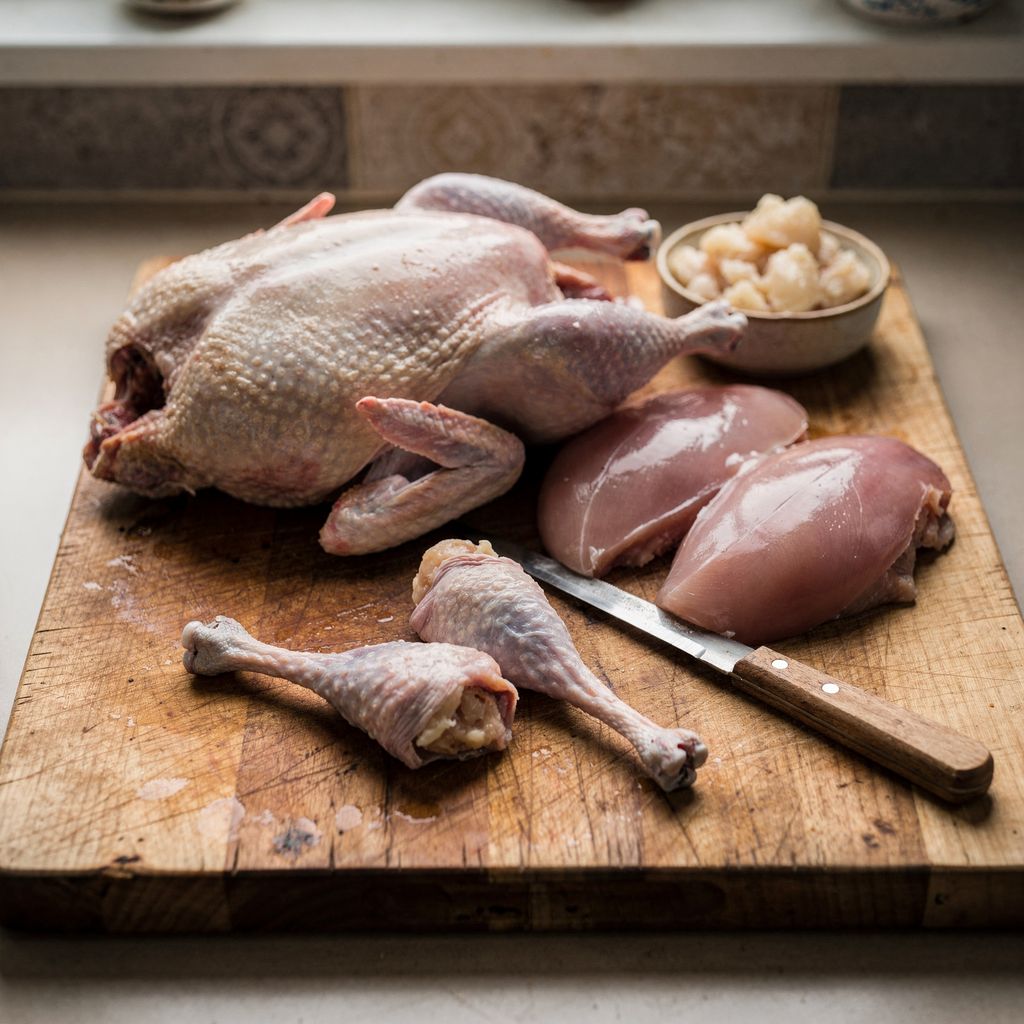
To break down a goose into breasts and legs, first cut off the wings, then pop out and cut off the legs, and finally slice the breasts away along the breastbone; it takes about 15–20 minutes.
Get the goose ready. Lay it on its back, pat it dry, and pull any loose chunks of fat out from the cavity. Set those aside for rendering.
Cut off the wings. Feel for the joint where the wing meets the body, score the skin around it, and cut straight through the joint with your knife. If you hit the joint right, you won't need to cut through bone.
Free up the leg. Slit the skin between the leg and the body. Then bend the leg firmly down and outward until the hip joint pops.
Cut off the leg. Run the knife along the backbone and through the joint. Don't forget the small round nugget of meat tucked in the hollow near the hip — leave it on the leg, it's the best bite on the whole bird.
Score the breast along the breastbone. Find the ridge running down the center of the breast and cut along its length, right down to the bone.
Cut away the breast muscle. Hold the blade flat, angled toward the carcass. Use short strokes to peel the meat off the ribs, letting it fall away toward you as you go. Leave the skin attached to the meat.
Trim the breast. Goose skin overhangs the meat, so trim it back to leave about a 1 cm (½ in) border around the meat. The trimmed skin and fat go into the bowl for rendering.
From a 5 kg (11 lb) goose you'll typically get two breast halves (breast fillets) weighing 400–600 g (14 oz–1.3 lb) each, and two legs weighing 500–700 g (1.1–1.5 lb) each. The rest is carcass, skin, and fat.
For a roulade, you bone the goose from the back, so the skin stays in one piece as a single sheet with the meat attached. It's slower — plan on 40–60 minutes — but the payoff is something you can stuff and roll.
The process in brief: cut along the backbone → cut the meat away from the carcass → pop the joints → free the breastbone → remove the carcass → bone the legs.
Lay the goose breast-side down and cut along the full length of the backbone with a knife or shears.
Peel the meat away from the carcass with short strokes. Keep the blade angled toward the bone and work down one side across the ribs.
Pop the hip and shoulder joints from the inside and cut through them, so the legs and wings stay attached to the skin.
Work most carefully around the breastbone. The skin sits right against the cartilage there and tears easily. This is a good spot to swap the knife for your fingers.
Bone the other side the same way and lift out the carcass in one piece.
Bone the legs. Cut along the bone, expose it, then cut it free at the joint. You can snip off the wings at the first joint and add them to the carcass.
Finally, lay the goose out skin-side down and score the thicker parts of the meat, opening them out like a book. This gives you an even sheet of meat that cooks evenly all through. A small tear in the skin isn't a problem — just stitch it up with kitchen string.
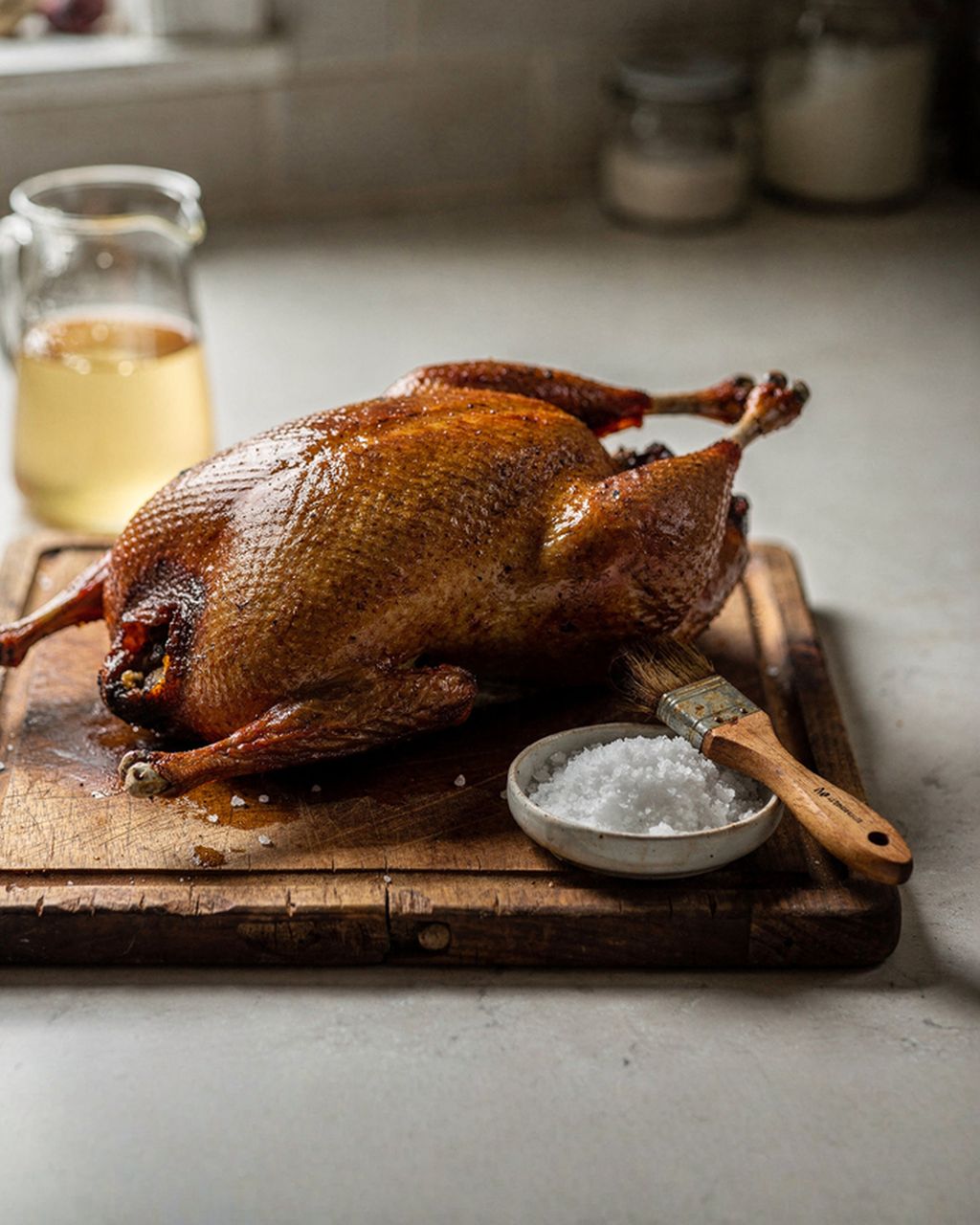
The best way to cook goose breast is to sear it skin-side down in a cold pan, then finish it briefly in the oven.
Score the skin in a crosshatch pattern at 1 cm (½ in) intervals. Cut only through the fat, not into the meat — this lets the fat render out more easily and stops the skin from curling.
Salt it, ideally the day before, and leave the breasts uncovered in the fridge. The skin will dry out and crisp up better.
Start in a cold pan, skin-side down, over medium heat. The fat will render slowly for 12–15 minutes, until the skin turns golden. Pour off the rendered fat into a bowl as it collects.
Flip the breasts and finish them in the oven at 180°C (350°F), for 6–10 minutes depending on thickness.
Let the meat rest for 8–10 minutes before slicing.
What temperature should it reach? According to the USDA, poultry is safe to eat at an internal temperature of 74°C (165°F). Chefs often serve goose breast pink, pulled around 57–60°C (135–140°F), much like duck. It's a matter of taste, and the call is yours. If you want certainty, cook to 74°C (165°F) and check with an instant-read thermometer at the thickest point. Serve breast well-done at 74°C (165°F) for pregnant women, young children, older adults, and anyone with a weakened immune system.
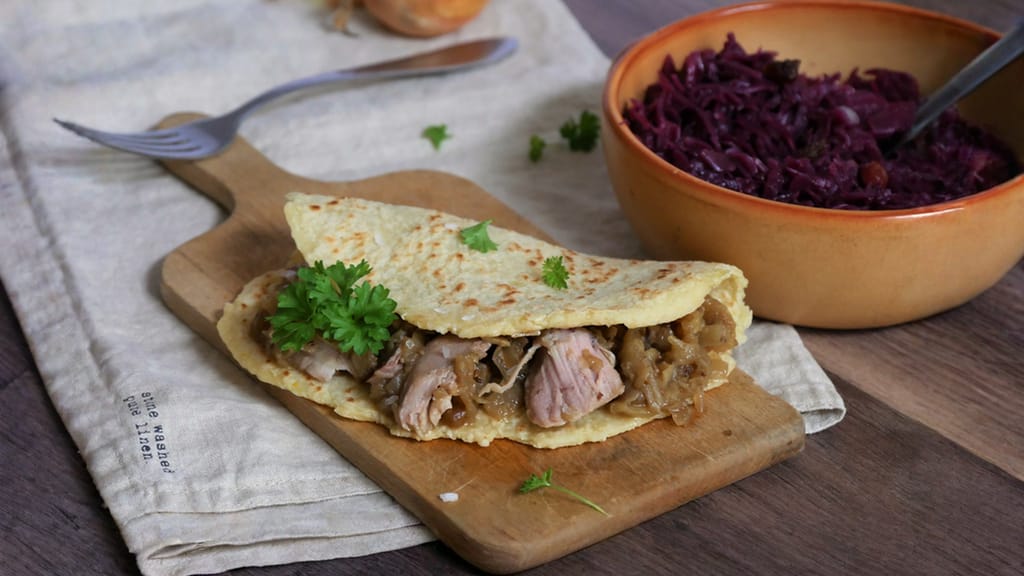
Goose breast on apples with potato lokše
Goose Breast with Apples and Potato Pancakes
Goose legs need low heat and time. The classic approach is either slow-roasting or confit in fat. Both methods take 2–4 hours.
Roasted legs: salt them, lay them skin-side up on a bed of onion and apple, add a splash of water (about 100–200 ml / ½–¾ cup), and roast covered at 150–160°C (300–325°F) for about 2–2.5 hours. Then uncover, raise the heat to 200–220°C (400–425°F), and let the skin brown for 15–20 minutes.
Confit: salt the legs (about 15 g / 1 tbsp salt per kilo of meat), add thyme and garlic, and let them sit in the fridge for 12–24 hours. Pat them dry, submerge them in melted goose fat, and cook in the oven at 90–100°C (195–212°F) for 3–4 hours, until the meat pulls easily from the bone. Finish by browning skin-side down in a pan.
The legs are done when the bone at the joint moves freely and the meat comes apart with a fork. By that point, the internal temperature has long passed the safe minimum. Getting the legs truly tender takes more heat and time than food safety alone requires.
If the skin on your legs comes out rubbery instead of crisp, check out our article on what to rub on goose for crispy skin.
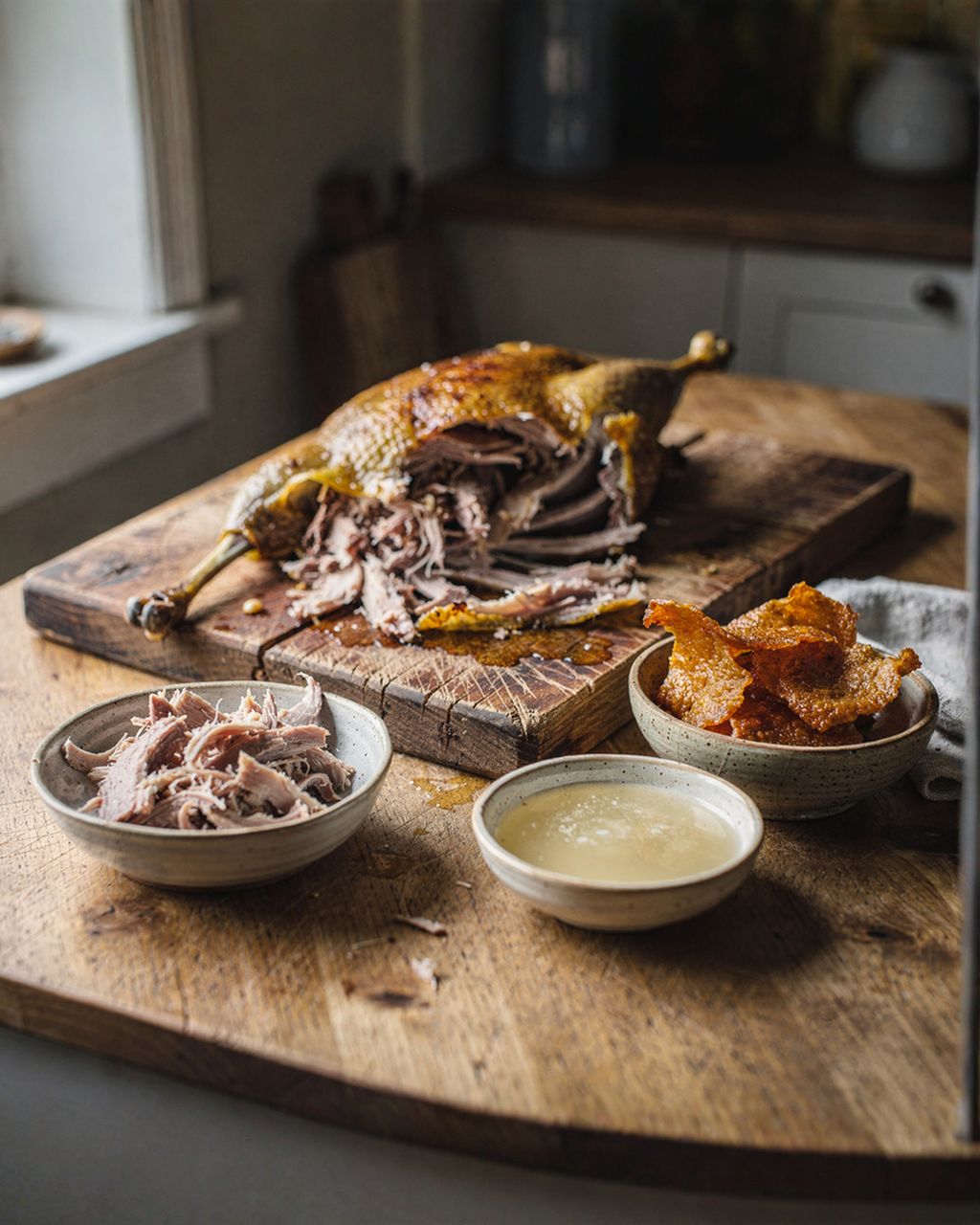
To render goose fat, cut the skin and fat into cubes, add a splash of water, and let them simmer gently until the fat has rendered out and the crispy bits turn golden.
Cut the skin and fat into roughly 1–2 cm (½–¾ in) cubes. Smaller pieces render faster and more evenly.
Put them in a heavy-bottomed pot with about 100 ml (⅓ cup) of water. The water keeps the fat from scorching at the start, and it evaporates off as things go.
Render over low heat for 1–2 hours, stirring occasionally. The fat should just barely bubble, not sizzle.
Once the crispy bits are golden and the fat runs clear, strain it through a fine sieve or cheesecloth into clean jars.
Depending on how well-fed the goose was, one bird usually yields about 0.5–1 liter (2–4 cups) of fat, more from a fattier bird. Add in any fat rendered while searing the breasts and roasting the legs — just strain it separately first.
The tastiest stock from a goose carcass comes from roasting the bones in the oven first, then simmering slowly for 3–4 hours.
Chop or cut the carcass, neck, and wing tips into smaller pieces and roast on a baking sheet at 200°C (400°F) for 30–40 minutes, until deep golden brown.
Transfer to a pot, add carrot, celery, onion, a bay leaf, and a few peppercorns, and cover with about 3 liters (12 cups) of cold water.
Simmer very gently, partially covered, for 3–4 hours, skimming off the foam. If the stock boils hard, it will turn cloudy.
Strain it and let it cool. The fat on top will solidify and you can lift it right off — add it to the rest of your rendered fat.
This stock is the base for a sauce to go with the legs, or for a winter soup. You can use a carcass that's already been roasted with the meat on in much the same way. Find more in our article on what to do with leftover roast goose and duck.
Rich, fatty goose meat needs something sharp or sweet-and-sour alongside it. That's why red or white cabbage, paired with dumplings or potato pancakes, is the classic Czech match. Roasted apples, cranberries, or pears work well too.
You can cook the red cabbage a day ahead — it sits well and actually tastes even better.
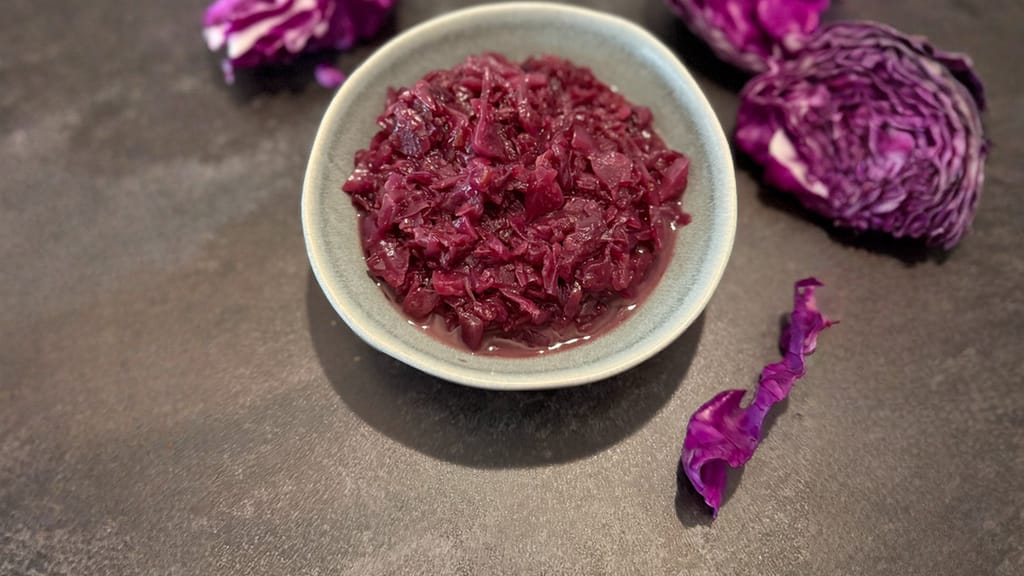
Sweet and sour braised red cabbage
Sweet-and-Sour Braised Red Cabbage with Goose
From a 5 kg (11 lb) goose you'll get roughly 2–2.5 kg (4.5–5.5 lb) of meat with skin on — two breast halves and two legs. The rest is carcass, fat, and skin, which you turn into stock, rendered fat, and crispy bits. Plan on about one leg or half a breast per person.
Well-strained rendered goose fat keeps in a sealed jar in the fridge for about 2–3 months, and up to a year in the freezer. The more thoroughly you strain it, the longer it lasts, since bits of meat and water left behind speed up rancidity. If it smells rancid or sour, toss it.
Thaw a frozen goose in the fridge — for a 4–6 kg (9–13 lb) bird, that takes about 2–3 days. Set it in a bowl so the juices don't drip onto other food. Don't thaw it on the counter at room temperature, since the surface will warm up long before the inside thaws.
Yes, you bone a duck using the same method as a goose, just faster since it's smaller. Duck breasts are thinner, so they'll cook through faster in the pan, and the legs only need about 2–3 hours to confit.
Yes, you can bone the goose a day ahead. Leave the portions salted and uncovered in the fridge overnight — they'll dry out a bit and the skin will crisp up better. Cook raw goose meat within 1–2 days, and either simmer the carcass for stock right away or freeze it.
One recipe worth heating the oven for, one tip, and one deal from the shop. Nothing else.