Canned Pickles and Fermented Pickles: How Long They Last and How to Store Them Once Opened
Homemade Sauerkraut: Why You Pound It, How Long It Ferments and How Long It Keeps
Updated Nov 17, 2026
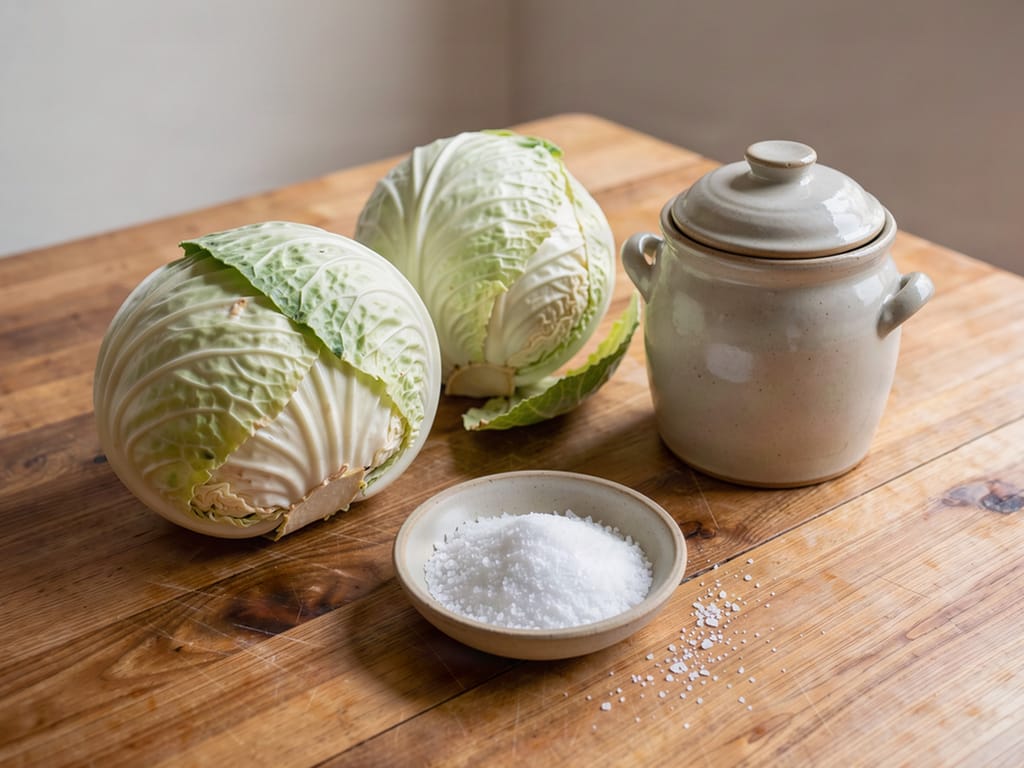
Homemade sauerkraut needs just cabbage, salt, time and one rule: the cabbage must stay under its own brine the whole time. You pound it to release that liquid quickly and to leave no air pockets. With about 2% salt, it ferments for three to four weeks at a room temperature of 21–24°C (70–75°F), and the finished sauerkraut keeps for several months in the fridge and 8–12 months in the freezer.
You pound cabbage so it quickly releases its juice, which then covers it completely and leaves no air in the crock. Sauerkraut fermentation is anaerobic: lactic acid bacteria work without oxygen, whereas molds need oxygen. According to food scientists at the University of California, Davis (UC Davis), mold grows only where the ferment touches air.
Here's what pounding (or tamping with a pestle, or squeezing by hand) does:
It breaks down the cells. Salt draws water out of shredded cabbage by osmosis. If you also damage the cells, you get more juice, and faster.
It pushes out air. Tightly packed cabbage has no pockets where anything other than brine could settle.
It sinks the cabbage below the surface. Ohio State University recommends keeping 2.5–5 cm (1–2 in) of brine above the cabbage and weighting it so it doesn't float up.
Pounding it with bare feet in a big barrel is a tradition. At home, in a crock or a jar, clean hands or a wooden pestle are enough. The US National Center for Home Food Preservation (NCHFP) advises packing it down until the salt draws out the juice.
Seasonal baking plans, tested recipes and kitchen tricks that save you time. Unsubscribe in one click.
Use 2–2.5% salt by weight of the trimmed cabbage, most often 20 g per 1 kg. The NCHFP gives 3 tablespoons of salt per 5 pounds (2.27 kg) of cabbage, which works out to roughly 2–2.5%.
Weigh the salt; don't measure it by the spoonful. Coarse and fine salt weigh different amounts per tablespoon.
Don't use less salt. Ohio State University explicitly says not to reduce the amount of salt or use salt substitutes. Salt holds back unwanted microbes until the lactic acid bacteria have soured the cabbage.
Use salt with no iodine and no anti-caking agents (such as pickling salt). According to US university extension services, iodine and anti-caking agents can cloud the brine.
Distribute the salt evenly. Spots with too little salt ferment differently from the rest of the batch. That's why cabbage is salted in layers or mixed through before packing.
Add spices such as caraway, whole peppercorns, bay leaf or grated apple right in. They make no difference to the amount of salt.
At room temperature of 21–24°C (70–75°F), sauerkraut is ready in 3–4 weeks; at 15–18°C (59–64°F), in 5–6 weeks (NCHFP figures).
Below 15°C (59°F) (cellar, cool pantry), the NCHFP says the cabbage may not start fermenting at all.
Above 24°C (75°F), the NCHFP says it turns soft. Penn State Extension sets the limit slightly higher, at 27°C (80°F), above which the cabbage softens and may spoil.
During fermentation, Penn State Extension says to check the cabbage two to three times a week and skim off any film that forms on the surface.
In the first days it bubbles and releases gas, so don't fill a crock with a water-seal channel, or a jar with a lid that lets gas escape, right to the brim. You tell it's done by taste: sour, pleasantly sharp and no longer raw and "cabbagey". When the bubbling stops and the flavor doesn't change over a few days, it's fully fermented.
A flat white to grayish film on the surface is usually yeast (known as kahm yeast) and you can simply skim it off. Fuzzy or colored mold, whether green, blue, brown or black, means the fermentation has failed and the whole batch goes in the trash. That's how the UC Davis leaflet on problems with fermented vegetables tells them apart.
Harmless film (kahm yeast): thin, flat, smooth or slightly wrinkled, white or gray, spreading flat across the surface. Skim it off regularly. If left to grow, it spoils the flavor and texture and lowers the acidity.
Mold: raised, fuzzy tufts or colored spots. According to UC Davis, it grows wherever the ferment touches air, and a batch with confirmed mold must be thrown out right away.
Rot: sauerkraut should smell pleasantly sour. A rotten, musty smell means the fermentation has failed, even if you can't see anything.
Texture: soft cabbage is often a sign of a room that's too warm. Don't taste slimy, sticky cabbage (Penn State Extension).
The best protection is always the same: cabbage under the brine, weighted down, a well-fitted lid and clean equipment.
A crock is for fermenting, not for long-term storage: once the cabbage has finished fermenting, move it to the fridge, freeze it or can it. That's how both the NCHFP and Ohio State University handle finished sauerkraut. None of the verified sources gives a safe length of time that finished sauerkraut can stay in the crock at room temperature, so we won't guess at one here.
Why not leave it in the crock to "see in spring":
At room temperature the cabbage keeps souring and softening, and the surface attracts more yeast and mold.
Every time you open it, air gets in around the edge of the cabbage. If you keep taking it straight from the crock, always push it back under the brine and weight it down again.
Fully fermented sauerkraut keeps for several months in the fridge when well sealed (NCHFP). The cold nearly stops fermentation, so the cabbage holds its flavor and crunch.
Transfer it with its brine into clean jars and pack it down so the cabbage is under the liquid.
Take it out with a clean fork, not your fingers, and push it back under the surface each time.
Check it before each use: smell, color, texture. Fuzzy or colored mold, a rotten smell or slimy cabbage = throw out the whole jar.
If you want jars stored in the pantry rather than the fridge, the cabbage has to be heat-processed (canned). That's a different technique from fermenting. The article canning for beginners explains the method, sterilizing and lid seals. Canned sauerkraut softens with the heat, though, so it's mainly a long-keeping ingredient for cooking.
Yes, you can freeze sauerkraut, and it keeps 8–12 months in the freezer (Ohio State University).
Portion it into freezer bags or containers, with a little brine. You thaw only as much as you'll cook.
Leave room to expand. Penn State Extension advises leaving about 1.3 cm (½ in) of free space in freezer containers and jars, because the brine expands when frozen.
Label and date each portion.
Thaw it in the fridge. The texture softens a little after thawing. For cabbage soup, roast pork or Szeged goulash (segedín) it doesn't matter, but for a raw salad, fresh from the fridge is better.
So use frozen sauerkraut mainly for cooking. You'll find fermenting and freezing fruit in the article how to preserve summer fruit with no added sugar.
For sauerkraut, choose firm, heavy heads of fresh white cabbage, ideally late-autumn varieties. The NCHFP recommends starting to ferment within 24–48 hours of harvest, while the cabbage is still juicy. Remove the outer and damaged leaves, quarter the head, cut out the core and shred it into thin strips about 1–2 mm thick (about the thickness of a coin). A wilted head releases less juice and is harder to cover with brine.
If the cabbage doesn't release enough liquid, leave it under a weight for a few more hours, and only then top it up with boiled, cooled brine, about 28 g of salt per 1 l of water. The juice often comes out gradually, so keep pressing the cabbage in the meantime. Add brine only if the cabbage still isn't under the surface after that. The NCHFP gives 1.5 tablespoons of salt per quart of water (roughly 28 g per liter).
Most often sauerkraut in a crock isn't bubbling because it's too cold: below 15°C (59°F), the NCHFP says fermentation may not start at all, so move the crock to a room at 18–24°C (64–75°F). Bubbling is also strongest in the first few days and then fades on its own, even though the cabbage keeps fermenting. A crock with a water-seal channel therefore bubbles only now and then, so don't go by the bubbles. Taste is what counts. If the cabbage doesn't smell at least a little sour after a week in a warm spot, check that you added enough salt and that all the cabbage is under the brine.
One recipe worth heating the oven for, one tip, and one deal from the shop. Nothing else.