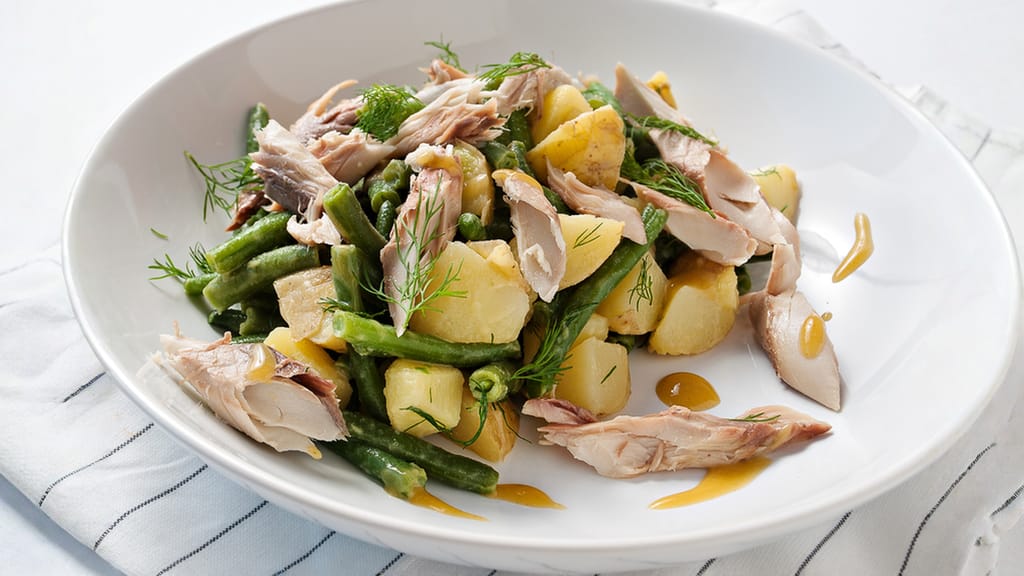
Potato salad with green beans and smoked mackerel
Green Beans: How Long to Cook Them, How to Store Them and How to Freeze Them
Updated Nov 17, 2026
Boil green beans in a rolling boil for at least 30 minutes, as Germany's Federal Institute for Risk Assessment (BfR) recommends. Raw green beans keep 3–5 days in the fridge and blanched ones 8 months in the freezer (both per USDA FoodKeeper). Below you'll find how to keep as much green color as possible through a long boil, how to store the beans so they don't go limp, and how to blanch and freeze them properly.
Yes, raw and undercooked green beans are poisonous because they contain the lectin phasin, which causes nausea, vomiting and diarrhea. The body can't digest it, according to a BfR statement from January 2024. In Czechia this isn't just theory: BfR cites a Czech study (Víchová and Jahodář, 2003) in which the common bean and the scarlet runner bean were among the plants that most often put children in the hospital in Czechia between 1996 and 2001. There were 13 cases.
The good news is that phasin can't withstand high heat. Boil the beans thoroughly and the pods are safe. The exceptions are sugar snap peas and garden peas, which contain few lectins and, according to BfR, can be eaten raw in small amounts. That doesn't apply to green beans.
Seasonal baking plans, tested recipes and kitchen tricks that save you time. Unsubscribe in one click.
Cook green beans for at least 30 minutes in a rolling boil, as BfR recommends for fresh beans.
BfR recommendation: at least 30 minutes from the moment the water returns to a boil
Why: in the lab, lectins break down at 100°C (212°F) in roughly 10–15 minutes, and 30 minutes ensures the whole pod heats through.
Temperature: a true boil, 100°C (212°F). A mere simmer isn't enough: in an experiment with red kidney beans cited by BfR, lectin activity at 80°C (176°F) after 15 minutes was actually higher than in raw beans.
In practice, it goes like this:
Wash the pods, snap or cut off the ends and cut them into 3–4 cm (about 1–1½ in) pieces. Shorter pieces heat through faster and more evenly.
Add them to salted, rapidly boiling water. The more water, the faster it returns to a boil after the cold beans go in.
Time it from when the water returns to a boil, not from when you dropped the beans in.
Done beans are soft all the way through, don't squeak when you bite them and don't taste grassy.
Recipes that promise crisp beans after 4–5 minutes of boiling don't take this recommendation into account. After 30 minutes the beans will be soft and darker, so deal with crispness afterward, by briefly browning the cooked beans in a skillet (see below).
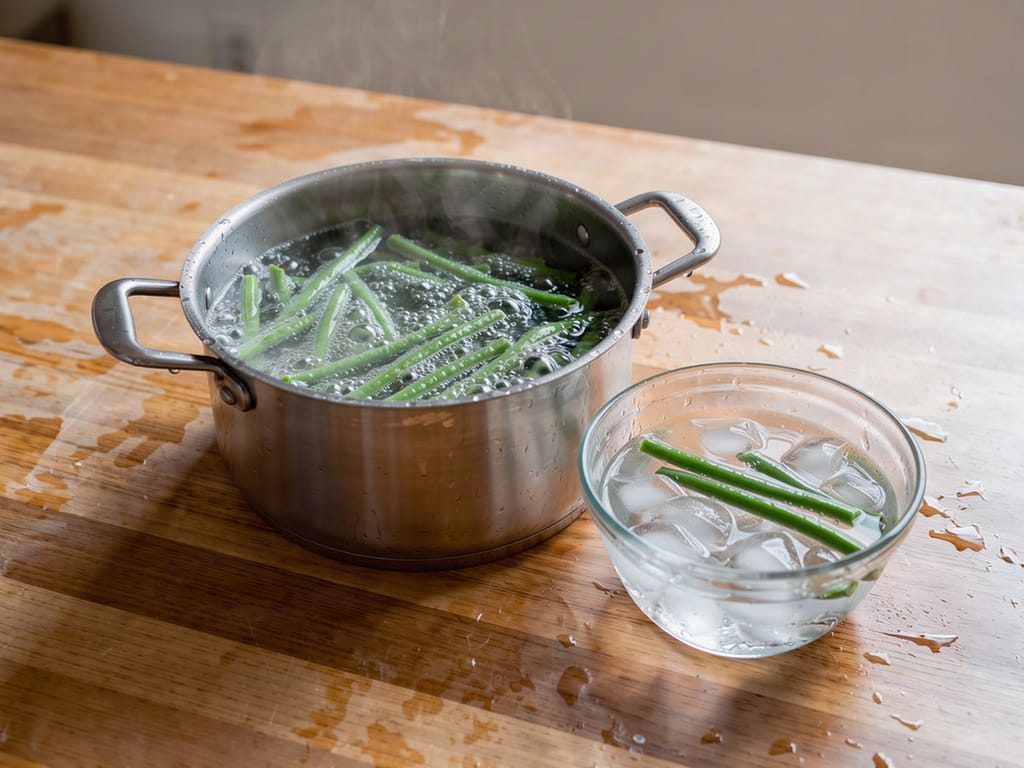
Four tricks save the most green color during a long boil: a big pot with plenty of water, no lid for the first few minutes, acid added only at the end, and an ice bath right after cooking. A long boil darkens the beans, and they won't stay bright green after 30 minutes, but these steps decide whether they end up dark green or olive brown.
A big pot and plenty of water. The boil returns quickly and the beans don't sit in lukewarm water.
No lid for the first few minutes. Vegetables release volatile acids as they cook, and according to food chemistry these turn green chlorophyll olive brown. Without a lid, they evaporate.
Add acid only at the end. Add lemon juice, vinegar or dressing just before serving, not to the water and not to beans that will sit.
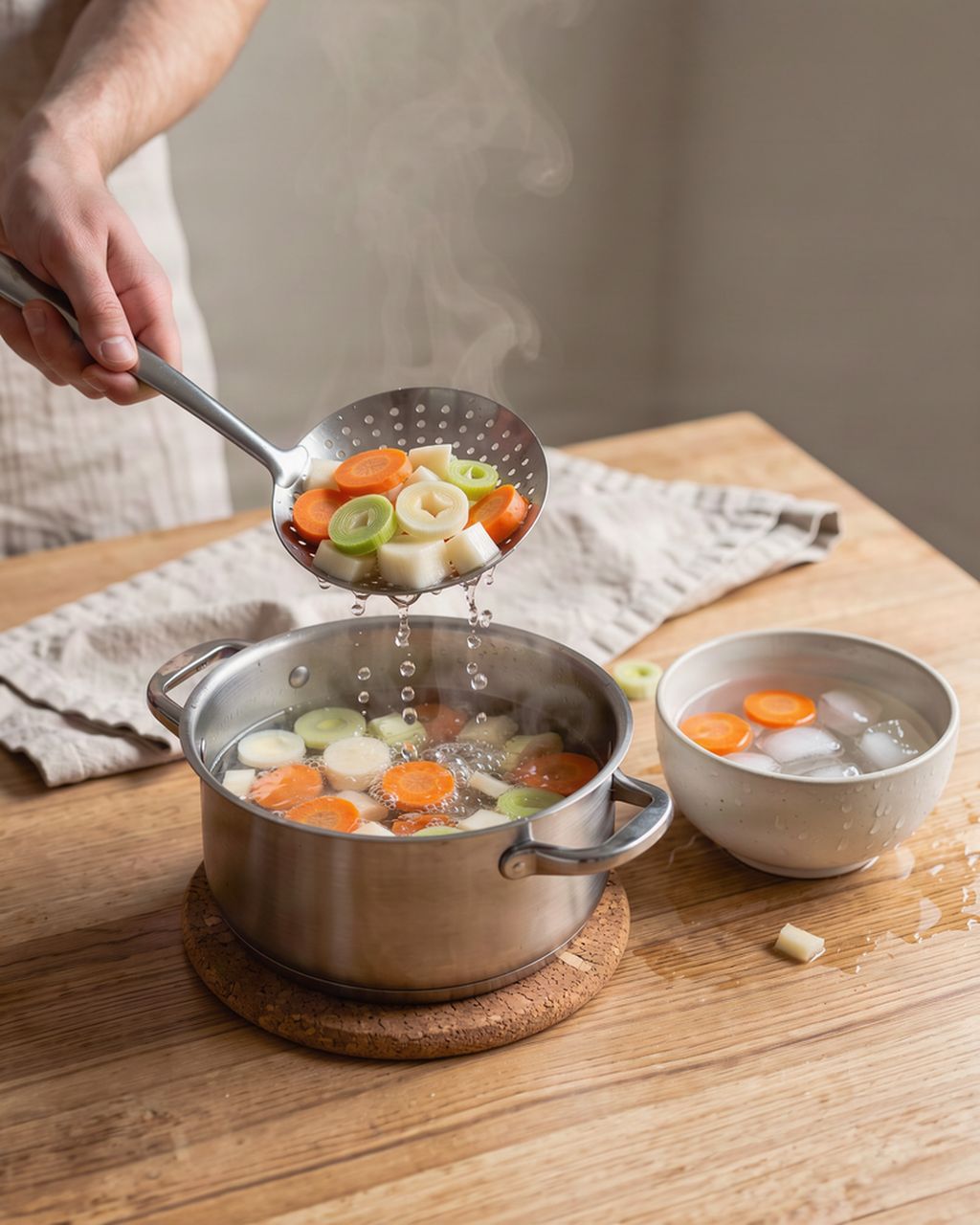
An ice-water shock. If you're not serving right away, drain the beans and plunge them into a bowl of ice water. This stops the cooking and the color stops darkening. Once they're cold, drain and dry them.
Don't steam raw beans or cook them in a skillet. Always boil them in water first. BfR explicitly states that gentle methods such as light braising or steaming aren't suitable for most legumes, because they don't reach a high enough temperature throughout the pod.
For flavor and texture, though, both the skillet and the oven work great as a second step. Boil the beans, shock them in ice water, dry them thoroughly, then briefly sauté them in butter with garlic or in oil with bacon, or finish them in the oven. The surface firms up slightly, they get back a bit of crispness, and dressing and seasoning cling better.
Raw green beans keep 3–5 days in the fridge (USDA FoodKeeper). Cooked ones keep 3–4 days in the fridge (USDA FSIS). According to USDA FSIS, the fridge should be at 4°C (40°F) or below.
To keep fresh pods from going limp:
Don't wash them ahead of time. Moisture on the surface speeds up spoilage. Wash them just before cooking.
Store them dry in a bag or container lined with a paper towel to absorb excess moisture, and put them in the crisper drawer.
Trim them just before cooking. Snapped-off ends dry out and darken.
A fresh pod snaps cleanly with a pop when bent. If it just bends, it's losing water: you can still cook it, but it won't be as juicy. Throw out any pod that's slippery, slimy or smells off.
Don't leave cooked beans at room temperature for more than 2 hours (USDA FSIS). Let them cool in a shallow dish, then put them in the fridge.
Before freezing, blanch green beans in boiling water for 3 minutes, cool them, dry them and freeze them. They'll then keep their quality in the freezer for 8 months (USDA FoodKeeper). The method, per the US National Center for Home Food Preservation (USDA NCHFP):
Choose young, firm pods, wash them in cold water, trim the ends and cut them into pieces roughly 5–10 cm (2–4 in) long.
Blanch them for 3 minutes in boiling water (NCHFP).
Cool them immediately in ice water and let them drain well.
Dry them with a kitchen towel. The less water left on them, the fewer ice crystals.
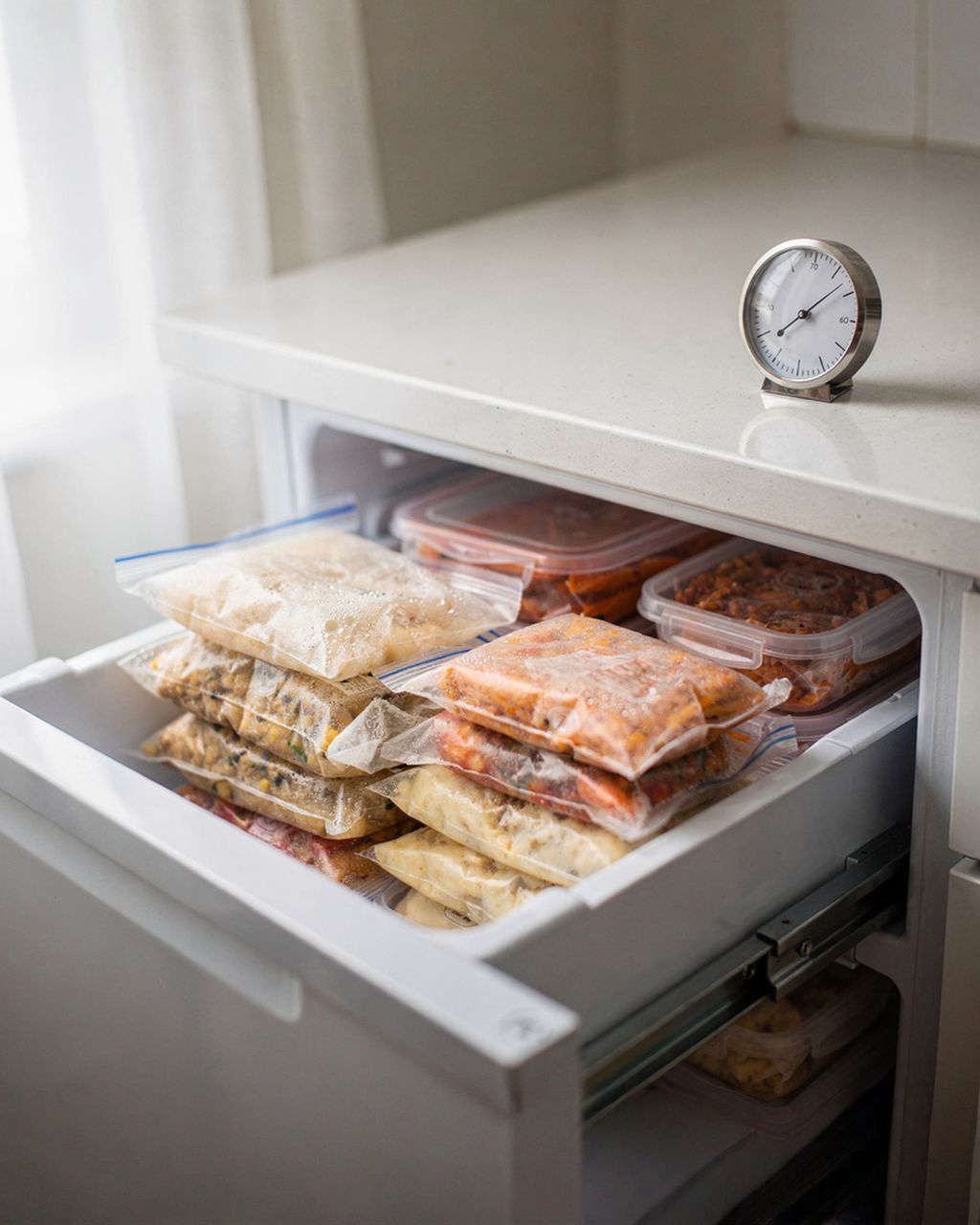
Spread them on a baking sheet or tray and freeze them so they don't stick together in one block. Then transfer them to a bag or container, leaving about 1–1.5 cm (½ in) of headspace (NCHFP).
Write the date on the package.
Why blanch: according to NCHFP, blanching slows or stops the enzymes that make vegetables lose flavor, color and texture in the freezer. Unblanched beans turn gray faster in the freezer and go rubbery.
Keep your freezer at −18°C (0°F). At that temperature, food is safe indefinitely according to USDA FSIS, so 8 months is a quality limit, not a safety limit. For how long other foods keep and how to package them, see the article storing food in the freezer and how long things keep.
Important: three minutes of blanching is for quality, not safety. It isn't enough to destroy lectins. So don't thaw frozen beans: put them straight into boiling water and cook them as long as fresh ones, that is, at least 30 minutes from when the water returns to a boil.
Cooked and cooled beans work well in salads, where they pair nicely with potatoes and smoked fish. Try potato salad with green beans and smoked mackerel.
From Czech classics, there are green beans in cream sauce served with dumplings or boiled potatoes, and green beans sautéed in butter with garlic as a side for meat. The same rule applies to them: the pods are first boiled thoroughly in water and only then go into the sauce or the skillet.
Potato salad with green beans and smoked mackerel
Potato salad with green beans and smoked mackerel
No, fresh green beans aren't soaked. Just rinse and trim them. Soaking (at least 5 hours according to BfR) applies to dried legumes. With fresh pods, what matters is the boiling, not soaking.
Usually not. Today's green bean varieties generally don't have a tough string along the seam. With older, wide or flat pods, snap off the end and pull it down along the seam: if a thin string comes away with it, pull it off. Once cooked, it would be tough and unpleasant.
Cook store-bought frozen green beans straight from frozen, without thawing. They're only briefly blanched before freezing, so the same rule applies as for fresh ones: at least 30 minutes in a rolling boil. Don't eat them just thawed, for example in a salad.
Green beans are a low-acid vegetable, and the US National Center for Home Food Preservation (USDA NCHFP) recommends canning them only in a pressure canner, not in a water bath. Ordinary sterilizing in a pot doesn't reach a temperature that reliably destroys the spores of Clostridium botulinum. For longer storage at home, the freezer is therefore the safer choice.
Reheat cooked green beans from the fridge until they're hot all the way through. According to USDA FSIS, leftovers should be reheated to 74°C (165°F). The quickest way is briefly in a skillet with a bit of butter, and the browning adds flavor too. Eat cooked beans from the fridge within 3–4 days (USDA FSIS).
One recipe worth heating the oven for, one tip, and one deal from the shop. Nothing else.