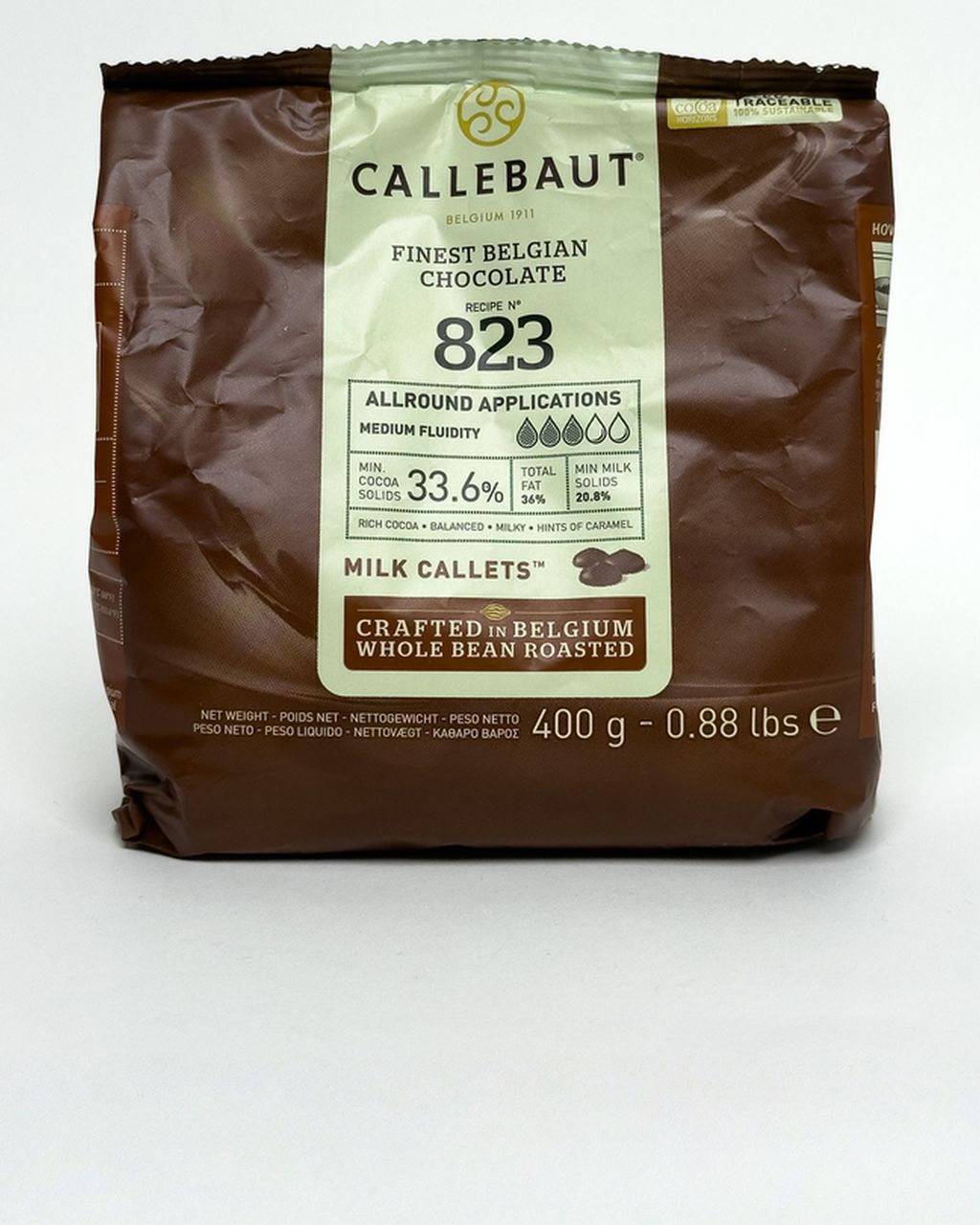
Callebaut Dark Chocolate Callets (811) 400g
Firm Whipped Ganache Cake Filling: Chocolate-to-Cream Ratios That Hold
Updated Oct 15, 2026
You get a firm whipped ganache for cakes from the right ratio of chocolate to cream, a night in the fridge and a short whip. Use 1:1 for dark chocolate, 1.5:1 for milk and roughly 1.75:1 for white (chocolate to 33% cream). When the ganache slumps, it's usually because there wasn't enough chocolate in it, it didn't chill long enough or it was overwhipped. Below you'll find the ratios, the method with temperatures and timings, and what to do if something goes wrong.
For a firm whipped ganache, use dark chocolate with 33–35% cream at 1:1, milk chocolate at 1.5:1 and white chocolate at 1.5–2:1.
Dark chocolate (50–60% cocoa): 1:1, for example 300 g chocolate to 300 g cream. A cake made with it holds up and slices cleanly. If you want an even firmer ganache for covering a taller cake, go with 1.2:1.
Milk chocolate: 1.5:1, for example 300 g chocolate to 200 g cream.
White chocolate: 1.5–2:1, 350 g chocolate to 200 g cream works well.
Always weigh both the chocolate and the cream in grams; measuring by volume isn't accurate enough here. The less cocoa solids a chocolate has, the more of it you need. The backbone of the ganache is cocoa butter, which crystallizes in the cold, and cocoa solids help it firm up too. Dark chocolate has the most of both. Milk and white chocolate contain sugar and milk in place of cocoa solids, and those don't firm up the ganache.
If the ratio drops below 0.8:1, you're left with more of a chocolate whipped cream. It's light and good for serving in cups, but in a two-tier cake it will squeeze out to the sides under the weight of the cake layers.
For a cake 20 cm (8 in) across, with two layers of filling and a thin coating on the sides, you need whipped ganache made from 300 g dark chocolate and 300 g of 33% cream. For other sizes, count on roughly the following (dark chocolate 1:1):
Cake 18–20 cm (7–8 in) across: 300 g chocolate + 300 g cream
Cake 22–24 cm (9–9.5 in) across: 400 g + 400 g
Cake 26 cm (10 in) across: 500 g + 500 g, and up to 750 g + 750 g if you want thick layers
With milk and white chocolate, keep the amount of cream the same and increase the chocolate according to the ratio.
Use real chocolate. On the packaging, look for "chocolate" or "couverture", not "cocoa-flavored" or "compound coating". Pair it with whipping cream containing 33–35% fat. The firmness of the ganache depends on these two things more than anything else.
Dark: Callebaut 811 with 54.5% cocoa has proven very reliable. It's bitter enough that the ganache isn't sweet, and it melts well. Any other good couverture or dark baking bar with 50–60% cocoa will also do the job. Above 70%, the ganache is firmer and slightly dry, so add about 10% more cream.
Milk: Callebaut 823 (33.6% cocoa) gives a smooth, caramel-leaning ganache that kids like better than a dark one. Besides cocoa butter, it also contains milk fat, which is why it needs a higher ratio.
White: Callebaut W2 (28% cocoa) tastes of vanilla and isn't overly sweet. White ganache can be colored, but it's the softest of all, so don't reduce the ratio.
What to watch out for: Be careful with "cocoa" or "compound" coatings. They aren't chocolate, and instead of cocoa butter they're mostly made of other vegetable fats, which crystallize differently, so a ganache made from them turns out greasy and waxy. A "couverture coating", on the other hand, is couverture, meaning real chocolate with a higher share of cocoa butter, and it suits whipped ganache well. Cream under 30% fat, meanwhile, won't whip to a firm peak.
You'll find the full selection of couvertures among our baking chocolate and fillings.
To make whipped ganache, pour cream heated to 80–90 °C (175–195 °F) over chopped chocolate, blend it into a smooth ganache, chill it in the fridge for at least 8 hours, and give it a short whip the next day.
Chop the chocolate into pieces smaller than 1 cm (½ in). Chocolate buttons (callets) don't need chopping.
Heat the cream to 80–90 °C (175–195 °F), just short of boiling, until small bubbles start to form around the edge. Don't let it boil for long, because water would evaporate from it and shift the ratio.
Pour the hot cream over the chocolate and leave it alone for 1–2 minutes so the chocolate softens from the inside.
Stir from the center with a spatula in small circles until the ganache is glossy and smooth. Even better is to sink an immersion blender to the bottom and blend without letting it suck in air. This gives you a fine emulsion that whips better later.
Cover the ganache with cling film pressed directly onto the surface and let it cool to room temperature.
Refrigerate for at least 8 hours, ideally overnight.
Chill the ganache for at least 8 hours before whipping, ideally 12, at 4–6 °C (39–43 °F). A shorter chill is the most common reason a ganache doesn't firm up.
Cocoa butter needs time to form a crystal network in the ganache. If temperature were all that mattered, an hour in the freezer would do, but the network wouldn't have time to form and the ganache would loosen after whipping. By the end, the ganache in the fridge should be as firm as softened butter, so a spoon stuck into it stays upright.
Whip the ganache straight from the fridge at medium speed and stop as soon as it holds a soft to firm peak. That usually takes 1–3 minutes, not ten.
The color tells you when to stop. As you whip, the ganache gets lighter and turns matte. When it forms a firm peak and has changed color by a shade or two, it's done.
Whip the last half minute by hand. A mixer goes from peak to split ganache in a few seconds. With a hand whisk you can keep control.
The moment it looks grainy, stop. Overwhipped ganache is lumpy like cottage cheese and releases fat, much like cream turning into butter.
In a warm kitchen (above 24 °C / 75 °F), put the bowl and whisks in the fridge for 10 minutes beforehand.
Almost always it comes down to one of four things: too little chocolate, too short a chill, overwhipping, or the wrong chocolate or cream.
The ganache is runny even after whipping: There was too little chocolate in it, or too little fat in the cream, or it didn't chill long enough. Put it back in the fridge for 2–3 hours and try again. If it still won't catch, warm it up, stir in melted chocolate (about 50 g per 300 g of ganache) and let it set overnight again.
The ganache is grainy and split: It was overwhipped. Gently melt about a fifth of it over a water bath or in the microwave and fold it back into the rest with a spatula. The ganache will come back together and smooth out. Don't whip it any more.
There's a greasy layer on the surface even before whipping: The cream was too hot or the ganache didn't come together. A few seconds with an immersion blender while the ganache is still lukewarm will help. For more on why emulsions break, see the article Why ganache splits and how to rescue it.
The ganache is waxy and greasy: It was made with a cocoa or compound coating containing vegetable fat, not with chocolate. That can't be rescued.
For a smoother ganache that stays pliable longer, you can add glucose syrup to the hot cream, about 5–10% of the cream's weight. The article Glucose in ganache explains why this works.
Spread whipped ganache in layers 0.8–1.5 cm (⅓–⅝ in) thick. Level each layer, then let the whole cake set in the fridge for 2–4 hours before you cover the sides.
The cake layers must be cool. On a warm sponge, the ganache melts and runs. A simple chocolate cake as the base or a fluffy génoise sponge works well here.
If you brush the layers with syrup, go easy. More than 3–4 tablespoons of syrup per layer will soak the ganache from below.
A cake with fruit needs a dam. Pipe a ring of ganache around the edge and put the fruit inside it. Without a dam, the fruit pushes the ganache out to the sides.
First spread a thin layer to trap the crumbs, and put the cake in the fridge for 30 minutes. Then spread the final layer. For straight sides and sharp edges, see the article How to cover a cake with frosting or ganache.
Whipped ganache can also support fondant, as long as it's made from dark chocolate at a ratio of at least 1:1 and the cake is thoroughly chilled before covering.
Whipped ganache and pouring ganache are the same mixture of chocolate and cream, with dark chocolate even at 1:1. But whipped ganache is chilled overnight and whipped, while pouring ganache is poured lukewarm and isn't whipped.
Whipped ganache: with dark chocolate 1:1 to 1.2:1, chilled overnight and whipped. For fillings and covering cakes.
Pouring ganache: with dark chocolate 1:1, or with more cream for a runnier drip glaze, up to 1:1.5. It's poured at 30–35 °C (86–95 °F) and isn't whipped. For dripping edges and a smooth top. You'll find ratios for different uses in the article Chocolate ganache: ratios, preparation and uses.
Sliceable glaze: a firm layer that doesn't crumble or crack when you cut it. You'll find the method in the article Sliceable chocolate glaze.
If you're torn between whipped ganache, buttercream and mascarpone cream, the article Chocolate cake frosting: whipped ganache, buttercream or mascarpone compares them. For an overview of all the basic fillings, see How to make cake frosting and Types of cake frosting and where each one works best.
Whipped ganache keeps for 3 days in the fridge, just like the cream it's made from. Store unwhipped ganache with cling film pressed directly onto the surface and whip it only on the day you fill the cake. Eat a finished cake with whipped ganache within 2–3 days.
Yes, you can freeze whipped ganache for up to 2 months, ideally as ganache that hasn't been whipped yet. Thaw it slowly overnight in the fridge, then whip it as usual. A cake that's already filled and covered with whipped ganache can be frozen too. Thaw it in the fridge so condensation doesn't form on the surface.
You can't make a classic firm whipped ganache with plant-based whipping cream, because it emulsifies and sets differently. The result tends to be thinner and can have an artificial aftertaste. If you need a dairy-free version, use full-fat coconut milk and dairy-free dark chocolate in a ratio of roughly 1.5:1, and expect a softer set.
At a room temperature of around 22 °C (72 °F), a cake with whipped ganache holds its shape for about 2 hours. Above 25 °C (77 °F), the ganache starts to soften sooner. For a party, take the cake out of the fridge 20–30 minutes before slicing and put the rest back in the cold.
The best way to flavor whipped ganache is with ingredients that don't add water: instant coffee dissolved in the cream, orange zest, flavoring paste or vanilla. If you add a liquid, such as alcohol or espresso, take away the same amount of cream, otherwise the ganache will turn soft. For 300 g of ganache, 1–2 tablespoons of liqueur is enough.
One recipe worth heating the oven for, one tip, and one deal from the shop. Nothing else.