Harvest your plums, skip the slivovitz, and make chutney instead
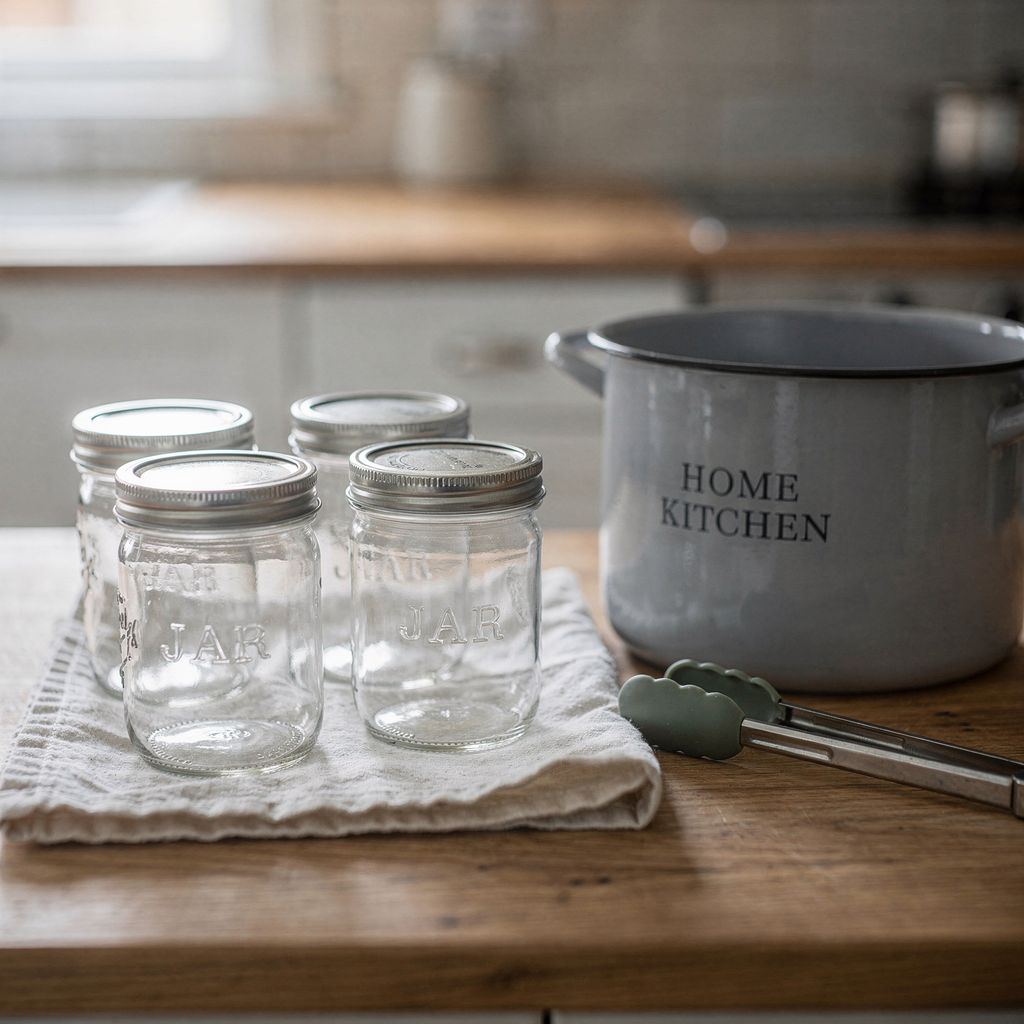
Updated Aug 24, 2026
If your canning lids didn't seal, it means one thing: no vacuum formed inside the jar. The contents got hot enough, but the air under the lid either never escaped or found its way back in as things cooled — and without a vacuum, a jar just won't hold. It's not a disaster, and it usually has nothing to do with how well you cooked. It's a mechanical hiccup, and you can pin down exactly what went wrong. Below you'll find how to spot an unsealed jar even after it's cooled, the five most common reasons the vacuum didn't form, what can be saved by reprocessing, and how long you have to deal with the rest.
A concave lid has sealed; a flat or bulging one hasn't. That's the whole test — but it only applies once the jar has fully cooled, which takes 12 to 24 hours after coming out of the pot. Until then, just set the jar on a dry towel, let it sit, and don't touch it.
Two things you really shouldn't do at this stage:
Don't retighten the lid while the jar is still hot. The sealing compound is soft, and tightening it further will cut into it — turning a lid that would have sealed into one that leaks.
Don't carry jars by the lid. The vacuum is still forming, and any strain on it will undo it.
Not necessarily — a pop is a good sign, but silence doesn't automatically mean the lid failed. As the contents cool, steam inside condenses, pressure drops, and the lid gets pulled inward; with metal lids you'll usually hear a sharp click, often soon after coming out of the pot, though sometimes it takes a few hours.
Don't write off silent jars, though. Smaller jars and thick contents (jams, fruit butters) get pulled down slowly and quietly. Wait for the jars to cool fully and judge by the tests below, not by sound.
You can confirm a sealed jar with four tests: looking at it from the side, pressing with a finger, tapping with a spoon, and lifting by the lid. The jar needs to pass all four. Do these after 12 to 24 hours, and first remove any retaining ring from the lid.
Look from the side. Hold the jar at eye level and look across the lid. The center should be visibly concave, curving downward. A flat lid is suspicious; a bulging one is clearly unsealed.
Press with a finger. Push your thumb into the center of the lid. It shouldn't move or click. If it pops down under your finger and springs back up when released, there's no vacuum.
Tap with a spoon. Tap the center of the lid with the bottom of a teaspoon. A sealed jar rings high and clear; an unsealed one sounds dull and flat.
Lift by the lid. Carefully grip the jar by the lid only and lift it a couple of inches off the counter. If the lid holds the full weight, the vacuum is good. Do this over a table, not over tile.
An unsealed jar almost always comes down to one of five things: insufficient temperature or too short a processing time, a worn or wrong lid, a dirty jar rim, an overfilled jar, or rapid cooling. Work through them in this order — the first two account for most cases.
One piece of good news up front: if just one jar out of a batch fails to seal, the problem is with that jar specifically — the rim, the lid, or the fill level. If most of the batch fails, the problem is in your process, and you'll find it below.
A vacuum only forms when the contents of the jar actually reach the target temperature — not just the water around it. Hot contents push air out; as they cool, the volume shrinks and the lid gets pulled down. If the core of the jar stays lukewarm, there's nothing to push out, and the lid stays flat.
These reference figures apply only to acidic and sweet preserves processed in a boiling water bath:
Fruit and compotes: 80°C (176°F), 30 minutes for soft berries; 90°C (194°F), 30 minutes for stone fruit and pome fruit
Pickles and vegetables in vinegar brine (pH below 4.6): 82–85°C (180–185°F) for the full 30 minutes — neither a shorter time nor a higher temperature makes up for the other.
Meat, ready meals, and low-acid vegetables can't be safely canned in a pot or oven — you need a pressure canner and a tested recipe. Without one, freeze it or keep it in the fridge. Pressure canning runs at 116–121°C (240–250°F, 10–15 psi), and both time and pressure depend on the specific tested recipe; US extension services, for example, recommend 75 minutes for pint jars and 90 minutes for quart jars of cubed meat at 11 psi.
A word of caution on vegetable stews like ratatouille: without added vinegar or lemon juice, it's a low-acid food and falls under the same rule as meat — 85–90°C (185–194°F) won't make it safe, even if the lid seals perfectly.
Processing time is counted from when the contents reach the target temperature, not from when you turn on the stove. The most common mistake is measuring the water temperature in the pot and trusting that — the water near the top is always hotter than the center of the jar. Put a thermometer in one test jar and go by that. Jars also shouldn't sit directly on the bottom of the pot; line it with a towel or rack so water can circulate around them.
A lid seals via a thin layer of sealing compound on its inner rim, and that compound can only handle a limited number of compressions. After the first use, the imprint of the jar rim is permanently pressed into it, and it may not seat in exactly the same spot a second time.
Discard a lid if you spot any of the following:
A dented or broken ring of sealing compound on the inside
Rust, scratches, or chipped lacquer where the seal sits
A bent or wavy rim — a lid set on the table shouldn't wobble
A center that's already bulging before you've even canned anything
Watch the diameter too. Twist-off lids come in standard sizes (TO 66, TO 82, and so on), and a lid one size too big will screw on but won't seat properly. Lids from store-bought pickles or compote jars are fine for fridge storage, not for canning — they've already done their one industrial vacuum seal and are single-use.
And tightening: firm by hand, but don't force it. An over-tightened lid won't let air escape during processing, and ironically, the vacuum fails precisely because you tried too hard.
A single drop of jam on the rim is enough to stop a lid from sealing. The seal sits on a strip of glass just a few millimeters wide, and any residue — sugar, fat, bits of herbs, a drip of syrup — creates a tiny channel that lets air back in.
After filling, wipe every jar with a clean cloth dampened with hot water; for fatty or sugary contents, add a drop of vinegar. While you're at it, run a finger around the entire rim: a chip or hairline crack in the glass means that jar shouldn't be used for canning at all. Discard it rather than wash it — no lid, however new, will seal over that flaw.
Leave headspace under the lid: 0.5 cm (¼ inch) for jams and preserves, 1 to 1.5 cm (½ inch) for fruit and compotes — that's the space the vacuum forms in. For bubbling fruit and compotes, aim for the higher end of that range.
Both extremes cause trouble, just in different ways:
Too little headspace: the contents expand during processing, overflow the rim, and contaminate the sealing surface from inside. This is the most common reason jams fail to seal.
Too much headspace: too much air is left in the jar to be fully pushed out, so the vacuum ends up weak. The jar might still seal, but it holds less well and fails sooner.
Rapid cooling causes damage in two ways. First, the glass: a temperature swing of more than about 40°C (72°F) can crack it, since the surface contracts faster than the core of the wall. Second, the vacuum: if the pressure inside drops too quickly, it can pull liquid up past the seal and out, contaminating the rim on the way — and then the lid won't seat properly.
That's why jars shouldn't be cooled with cold water, set on a stone or metal surface, or placed in a draft or out on the balcony after canning.
The right approach is boring, but it works: turn off the heat, let the jars sit in the turned-off pot for another five minutes, then lift them out onto a folded towel, leave finger-width gaps between them, and let them cool undisturbed at room temperature for 12 to 24 hours. Don't cover them with a blanket — slow cooling is fine, but a wrapped jar stays hot for a long time, and that mismatch catches up with it later.
This also covers liquid leaking out during cooling. You'll spot it as a trail down the side of the jar — a jar like that almost never seals.
You can reprocess within 24 hours of the original canning, always with a new lid and for the full original processing time — cutting the time short won't fix anything. US extension services that have tested this method add one condition: it only applies if you followed a tested recipe the first time around. If you were estimating times and temperatures, treat the window as more like two hours, and after that, it's fridge only.
Reprocessing isn't free of cost to quality. Fruit softens further, compote turns mushy, colors darken. With jams and chutneys you'll barely notice; with, say, apricot halves you will — and in that case it's often better to just eat the jar sooner rather than reprocess it.
Reprocessing comes down to seven steps: a new lid, reheated contents, a clean rim, and the full original processing time. Here's the whole process.
Remove the lid and run a finger around the jar rim to check it. A chip in the glass means you need a new jar, not just a new lid.
Transfer the contents to a pot and reheat — bring thinner preserves back to a boil; for thicker ones, at least back to the original temperature, stirring as you go.
Fill a clean, preheated jar, leave 1 to 1.5 cm (½ inch) of headspace, and run a spatula or skewer along the inside to release air bubbles.
Wipe the rim with a clean cloth and hot water, adding a drop of vinegar for sweet or fatty contents.
Put on a new lid and tighten firmly by hand — no extra force or leverage.
Process for the full original time at the same temperature as before.
Let it cool for 12 to 24 hours and test again. If it still doesn't seal, don't reprocess a third time — move it straight to the fridge.
Reprocessing is a rescue, not a disinfectant — it won't fix contents that have already gone off. Leave it alone and either use it another way or throw it out if any of the following apply:
More than 24 hours have passed since the original canning. Not even a new lid will help at this point.
The contents are low-acid — meat, mushrooms, legumes, vegetables without vinegar or lemon juice.
The jar sat out overnight at room temperature and you're not sure exactly how long.
You see bubbles rising, cloudy liquid, or anything that smells like fermentation. At that point it's no longer about the lid.
The jar rim is chipped and you don't have a replacement jar.
One rule worth sticking to: never reprocess a jar that's already been reprocessed once. A second heat treatment is the line past which both quality and safety drop off fast.
Decide within 24 hours of canning — after that, you're down to two options instead of three. An unsealed jar isn't a preserve anymore; it's cooked food sitting in an open container, so treat it that way.
Your three options, ranked by how long the contents will keep:
Reprocess — within 24 hours of the original canning, with a new lid, for the full processing time. After that, it keeps like a normal preserve.
Freeze it — leave 3 to 4 cm (about 1½ inches) of headspace in the jar, since the contents will expand and otherwise crack the glass. Even better, transfer it to a plastic container or bag. It'll keep for 6 to 12 months.
Refrigerate it — right away, with the lid just set on top or loosely screwed on.
In the fridge, rough guidelines are:
Compotes and canned fruit: 3 to 5 days
Vegetables and pickles: 3 to 4 days
Meat and ready meals: 2 to 3 days, no exceptions
Jams, preserves, fruit butters, chutneys: 3 to 4 weeks — the high sugar and acid content buys you time
Syrups: 2 to 4 weeks, less for low-sugar versions
Label the jar with the date once it's in the fridge. A week from now, you won't remember which of five identical-looking jars was the one that didn't seal.
Six habits will save most failed batches: new lids, hot jars, proper headspace, a wiped rim, hand-tight lids only, and checking the temperature right in the contents. None of them cost you extra time.
New lids for every batch, the right diameter, no rust or dents in the sealing compound.
Fill jars hot, with hot contents — a cold jar and hot jam is an unnecessary crack risk.
Headspace of 1 to 1.5 cm (½ inch) and air bubbles cleared from the sides with a skewer.
Wipe the rim with a hot, damp cloth on every jar, even ones that look clean.
Tighten by hand, not with force — air needs a way to escape during processing.
Measure the temperature of the contents, not the water, and start counting processing time only once that temperature is reached.
One small habit that saves the most hassle: can in smaller batches than you're tempted to. Six jars in one pot heat evenly; twelve jars crammed in on top of each other don't — and it's that top layer that ends up not sealing.
The least can go wrong with acidic and sweet preserves — high sugar or vinegar content forgives small mistakes, and they can be reprocessed without losing flavor. Practice your technique on these before moving on to compotes.
Harvest your plums, skip the slivovitz, and make chutney instead
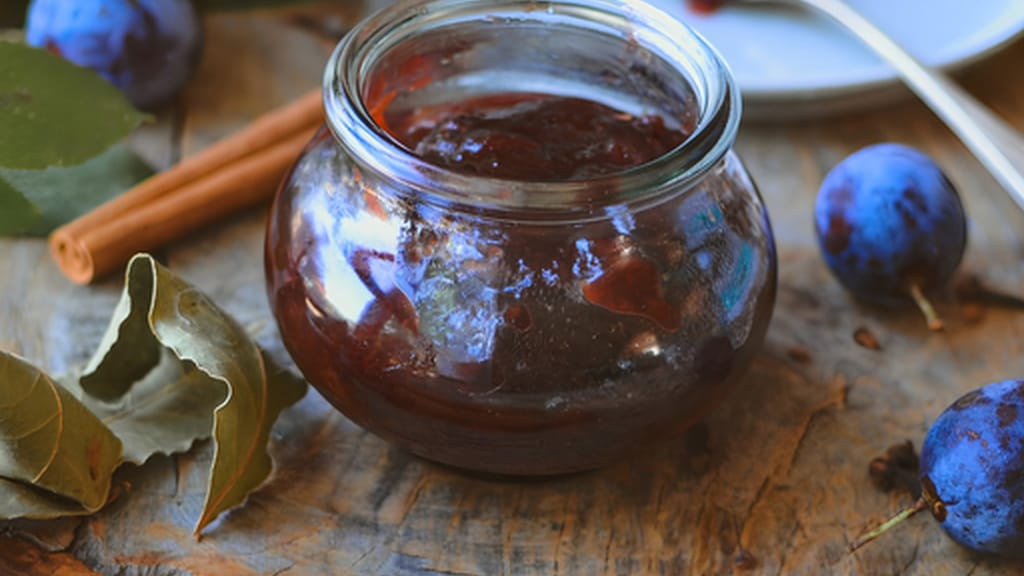
Jarred plum chutney — both acidic and sweet, ideal for practicing your canning technique

Chilli marmalade
Chili jam: a thick preserve where a clean jar rim matters most
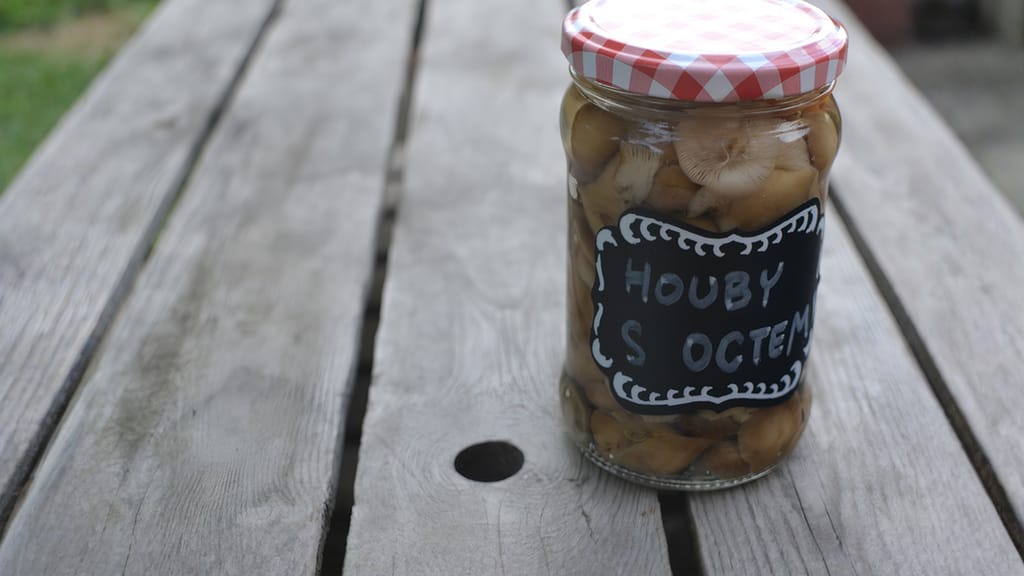
Pickled mushrooms in vinegar
Pickled mushrooms in vinegar — safe only when made from a tested recipe where the brine reliably acidifies the contents.
No — flipping doesn't create a vacuum, and it's more likely to cause problems. The vacuum forms as the contents cool, not from the jar's position. Worse, when flipped, hot food sits directly on the sealing compound, softening and potentially damaging it — and if the lid isn't sealing perfectly, the liquid will leak out and contaminate the rim. Let jars stand upright on a folded towel and leave them alone.
Not for long-term storage. A commercial lid's sealing compound has already been compressed by one powerful vacuum seal, and it permanently retains the imprint of that jar's rim — so it may not seat properly a second time. It's fine for fridge storage or dry goods, but not for preserves meant to sit in the pantry for a year.
A lid that bulges after some time means gas is building up inside — in other words, the contents are spoiling. Yeast or bacteria produce carbon dioxide, which overpowers the vacuum and pushes the lid outward. Unlike a lid that never sealed in the first place, this isn't a mechanical fault and can't be fixed by reprocessing. Don't open that jar to taste it — throw it out, contents and all.
This means a vacuum did form but then disappeared — air slowly leaked back in through some gap. The pop only confirms the moment the lid got pulled down; whether it actually holds only becomes clear once the jar has fully cooled. The leak is usually a microscopic channel left by a bit of food on the rim, a hairline crack in the glass, or a sealing compound that had already been used once before. Treat the jar as unsealed: reprocess it with a new lid within 24 hours, or otherwise move it straight to the fridge.
Sterilizing has no bearing on whether the lid seals — the vacuum comes from the temperature of the contents and the seal itself, not microbial cleanliness. The jar does need to be clean, free of residue, and importantly hot, so it doesn't crack when filled with hot contents; warm it in hot water (right in the canning pot works fine) or in the dishwasher — don't heat jars in the oven, as dry heat warms them unevenly and they can crack. Sterilizing an empty jar on its own only matters for preserves with a short processing time under ten minutes; for longer processing times, the canning process itself takes care of it. Never put hot contents into a cold jar, or vice versa.
One recipe worth heating the oven for, one tip, and one deal from the shop. Nothing else.