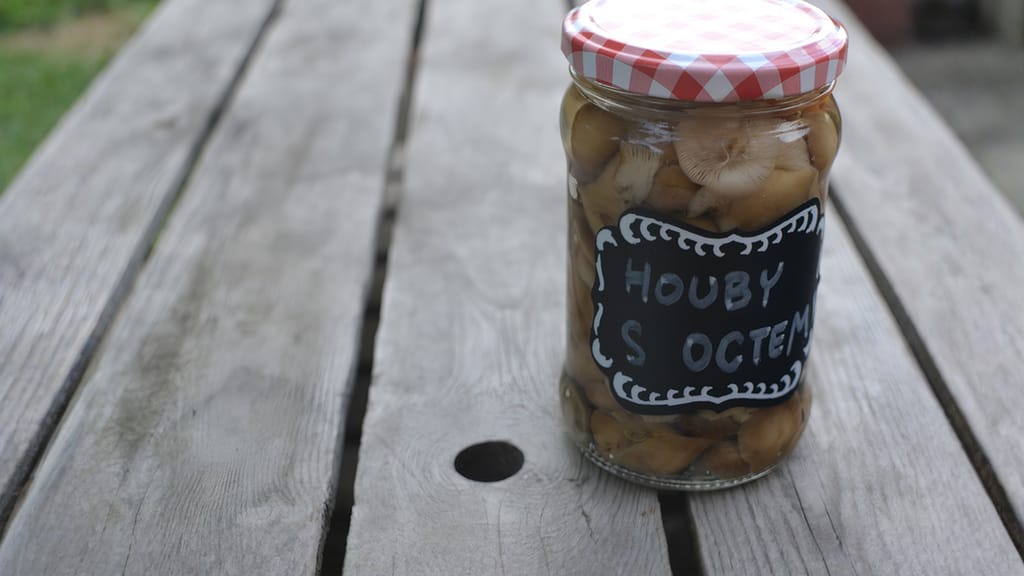
Pickled mushrooms in vinegar
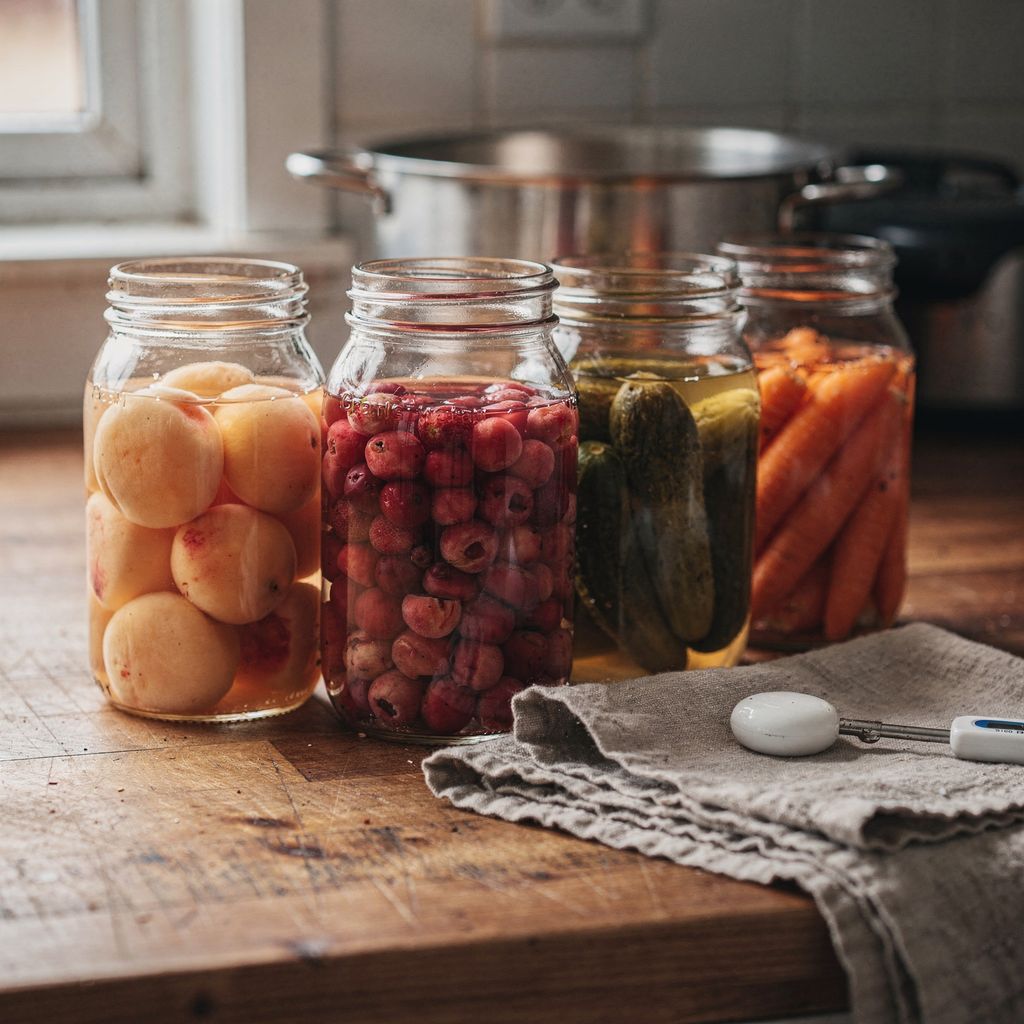
Updated Aug 24, 2026
There are three ways to can at home, and each one has its own ceiling: a pot holds a precise temperature up to 100°C (212°F) and is the most reliable, an oven fits the most jars in a single batch, and a dishwasher is the cheapest and most hands-off option — but it only reaches 70–75°C (158–167°F), so it only works for sweet and acidic foods. One thing holds true for all three: none of them is safe for meat, mushrooms in brine, or low-acid vegetables. Below you'll find the exact temperatures, times, capacities, and energy use for each.
In short: the pot for precision, the oven for volume, the dishwasher for convenience with sweet and acidic foods.
Pot (water bath) — 80–100°C (176–212°F), 10–40 minutes, 3–14 jars of 0.7 litres depending on pot size. The only method where you know exactly what temperature the jar contents actually reach. The best choice for pickles, fruit preserves, and anything that turns to mush easily.
Oven — 150–180°C (300–350°F) set on the oven, 40–90 minutes, 8–12 jars at once. But the number on the dial isn't the temperature inside the jar; that still tops out around 100°C (212°F). Good for fruit and acidic vegetables in large batches.
Dishwasher — hottest cycle, 70–75°C (158–167°F), 1.5–3 hours, 12–20 jars. Lowest energy use per jar and zero hands-on effort. Only works for jams, marmalades, syrups, and fruit butters filled hot.
None of these three methods ever exceeds 100°C (212°F). That's the ceiling the rest of this article hinges on.
What makes home-canned food safe is the acidity of the food, not what you heat it in. The cutoff is pH 4.6: below that, Clostridium botulinum bacteria can't multiply or produce botulinum toxin; above it, they can.
Acidic foods (pH below 4.6) — fruit, fruit preserves, jams, anything in a vinegar brine, tomatoes with added lemon juice. Here it's enough to heat the contents to 80–100°C (176–212°F) to kill live microbes and mold, while the acidity handles the rest. A pot or oven can manage this just fine.
Low-acid foods (pH above 4.6) — meat, poultry, fish, mushrooms in brine, green beans, peas, corn, carrots, soups, ready-made meals. These need the spores destroyed too, and spores survive plain boiling. According to the USDA and Czech food-safety sources alike, that takes 116–121°C (240–250°F), which you simply can't reach in water at normal pressure — water tops out at 100°C (212°F) no matter whether you boil it for twenty minutes or six hours.
You can actually fine-tune acidity yourself:
Vinegar in the brine — with 8% vinegar, Czech recipes typically use a ratio of 1:3 to 1:2 (vinegar:water), giving a brine of roughly 2–2.7% acetic acid. Treat this as a flavor guideline, not a safety threshold: what matters is that the finished brine has a pH below 4.6 — for homemade recipes, check this with pH test strips.
Lemon juice in tomatoes — the pH of tomatoes, old and new varieties alike, sits right around the 4.6 cutoff, which is why they always need acidifying. The USDA recommends one tablespoon of bottled (standardized) lemon juice per pint jar and two tablespoons per quart jar. Don't use freshly squeezed juice — its acidity varies too much.
Sugar in jam — doesn't lower pH, but above roughly 60% concentration it reduces available water enough that microbes can't survive on it.
This is exactly why you can safely can pickles and tomatoes at home, but not green beans.
The pot is the only one of the three methods where you have real control over the temperature of the contents — the water around the jars is at essentially the same temperature as the liquid inside them, so what the thermometer reads is what you actually get.
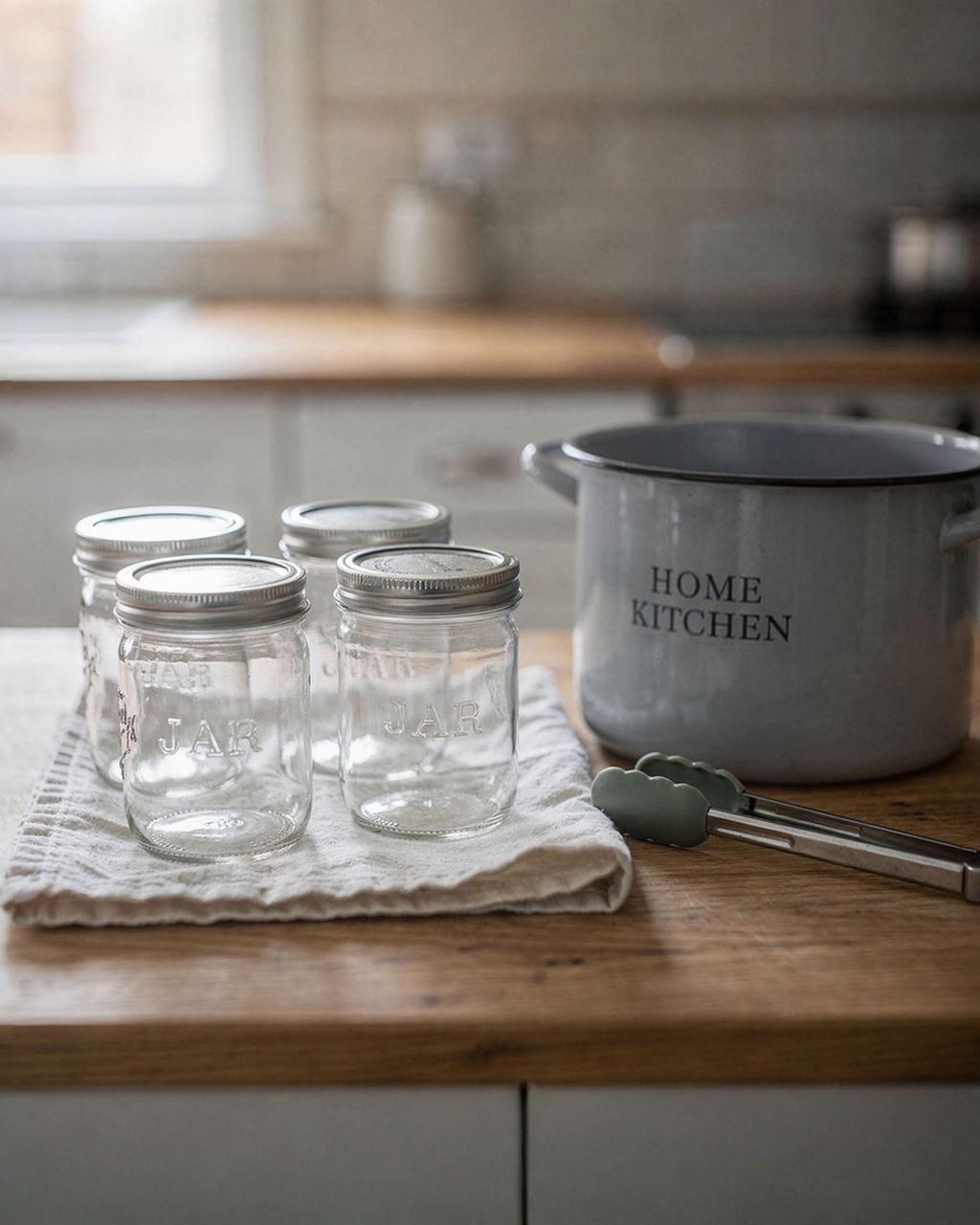
The process stays the same every time. Line the bottom of the pot with a folded tea towel or a rack so the glass doesn't touch the hot bottom directly. Jars shouldn't touch each other. For fruit preserves, European canning charts say water up to three-quarters of the jar height is enough. For pickles, following the NCHFP method (82–85°C/180–185°F for 30 minutes), the jars need to be fully submerged, with about 2.5 cm (1 inch) of water above the lids — otherwise the process doesn't apply. And measure temperature with a thermometer clipped over the edge of the pot, not by guesswork: "a gentle simmer" is 95–100°C (203–212°F), not 85°C (185°F).
Start counting your processing time from the moment the water reaches the target temperature, not from when you turned on the stove. This is the single most common reason home-canned food doesn't keep.
In a pot, canning happens at 80–100°C (176–212°F) for 10–40 minutes, depending on what's in the jar. Specifically:
Pickles and crunchy pickled vegetables — hold at 82–85°C (180–185°F) for the full 30 minutes, regardless of jar size. Below 82°C (180°F), the brine won't be adequately processed; above 85°C (185°F), the pickles go soft and lose their crunch. (This is the only research-verified low-temperature pasteurization method for pickled vegetables, per the American NCHFP, and the time doesn't shorten with smaller jars.)
Preserves from soft fruit (strawberries, raspberries, redcurrants) — 80°C (176°F), 25–30 minutes. European canning charts list berries — strawberries, raspberries, redcurrants, and gooseberries — at 80°C (176°F) for 25–30 minutes; stone fruit and pome fruit go at 90°C (194°F) for 30 minutes.
Preserves from firm fruit (pears, apples, plums) — 90°C (194°F), 30 minutes.
Jams and marmalades filled hot — 85°C (185°F), 10–15 minutes as a safeguard.
Tomato purée and passata, acidified with lemon juice — 100°C (212°F), 35–40 minutes.
Syrups — 85°C (185°F), 15 minutes.
Once the time is up, let the jars sit in the pot for another 5–10 minutes, then lift them out onto a towel and let them cool slowly. Not onto a cold countertop — the temperature shock can crack the glass.
The oven is the method for large batches: a single deep baking tray fits 8–12 jars of 0.7 litres, roughly double what a standard pot can hold. The trade-off is that you can't see what's happening inside the jars.
The key thing most guides never mention: setting the oven to 160°C (320°F) does not mean the contents of the jar reach 160°C. The water inside the jar still tops out around 100°C (212°F), exactly like in a pot. The oven's dial just determines how fast the contents get there. So the oven doesn't can "better" or "more thoroughly" — it just lets you heat more jars at once.
Always with water. Fill the deep tray with 2–3 cm (about an inch) of water and stand the jars in it. The American NCHFP doesn't recommend oven canning at all — not even with a water bath — because there are no scientifically validated processing times for it; for dry oven canning, where jars sit directly on the rack, glass manufacturers themselves warn against it. In Europe, oven canning with a water bath is common practice for acidic foods; treat it as a volume method, not a scientifically verified safety method.
Place the jars in a cold oven, on the lowest rack, without letting them touch each other. Heat up and cool down slowly.
In the oven, go by what you see, not the clock — start timing only once bubbles begin rising in the nearest jar.
Fruit and preserves — 150–160°C (300–320°F) fan (or 160–180°C/320–350°F conventional top-and-bottom heat). Bubbles appear after 40–70 minutes depending on jar size. Then turn off the oven and leave the jars inside, door closed, for another 30 minutes.
Acidic vegetables in brine — preheat to 170–180°C (340–350°F) fan, and once the contents start bubbling, lower to 130–140°C (265–285°F) and hold for another 30–60 minutes depending on jar size. Don't use the oven for crunchy pickles — the only verified method for those is 82–85°C (180–185°F) in a pot. Only make acidic vegetables in the oven when texture doesn't matter to you.
Jams and fruit butters — 150°C (300°F), 25–30 minutes from when bubbling starts. Going longer serves no purpose — it just darkens the color.
Keep the oven door closed the entire time it's cooling. Opening the oven with hot jars inside is the surest way to crack one.
The dishwasher is the most convenient and cheapest of the three methods, but it has a ceiling you simply can't get around: the hottest cycle on a typical dishwasher heats water to 70–75°C (158–167°F), and the contents of the jar end up a few degrees lower still. That's 25–30°C (45–55°F) less than a pot delivers.
So let's be honest about what's actually happening in a dishwasher. The dishwasher doesn't can anything. You fill the jars with hot contents, seal the lids, and the dishwasher keeps them warm for two to three hours while they slowly cool and pull a vacuum. What actually preserves the food is what's inside it — the sugar in the jam, the vinegar in the brine, the acidity of the fruit — not the temperature in the dishwasher.
To be clear: the American NCHFP explicitly lists the dishwasher among methods it doesn't recommend, alongside the oven, microwave, and hot-fill-with-no-heat-processing. What actually works in there relies on sugar and acidity, not temperature — hence the narrow list below.
That's not a reason to write off the dishwasher entirely. Within that narrow scenario, it works reliably and needs zero supervision. You just need to know exactly where that scenario ends.
The dishwasher reliably handles only jams, marmalades, fruit butters, and syrups filled hot; it never works for meat, mushrooms in brine, or low-acid vegetables.
Works: jams, marmalades, fruit butters, fruit spreads, syrups, and jellies — anything filled hot, with a high sugar content or strong acidity.
Borderline: preserves made from acidic fruit. They'll keep, but noticeably less long than pot-canned ones, and they want a cool, dark pantry. Pickles and acidic vegetables in brine come out softer and less stable than you'd expect.
Never do this in the dishwasher: meat and meat preserves, pâtés, mushrooms in brine, green beans, peas, corn, carrots, soups, and ready-made meals. Low-acid foods need 116–121°C (240–250°F), not 70°C (158°F) — and you can't tell the difference between "looks fine" and botulinum toxin by sight or smell.
Practical rules if you're going the dishwasher route:
Run the hottest cycle (intensive, 70–75°C/158–167°F), not eco. Eco runs around 50°C (122°F) and is useless for this.
Never run it with dishes. Jars go in on their own.
No detergent tablet, no salt, no rinse aid. There's nothing to wash, and rinse aid residue will end up on your lids.
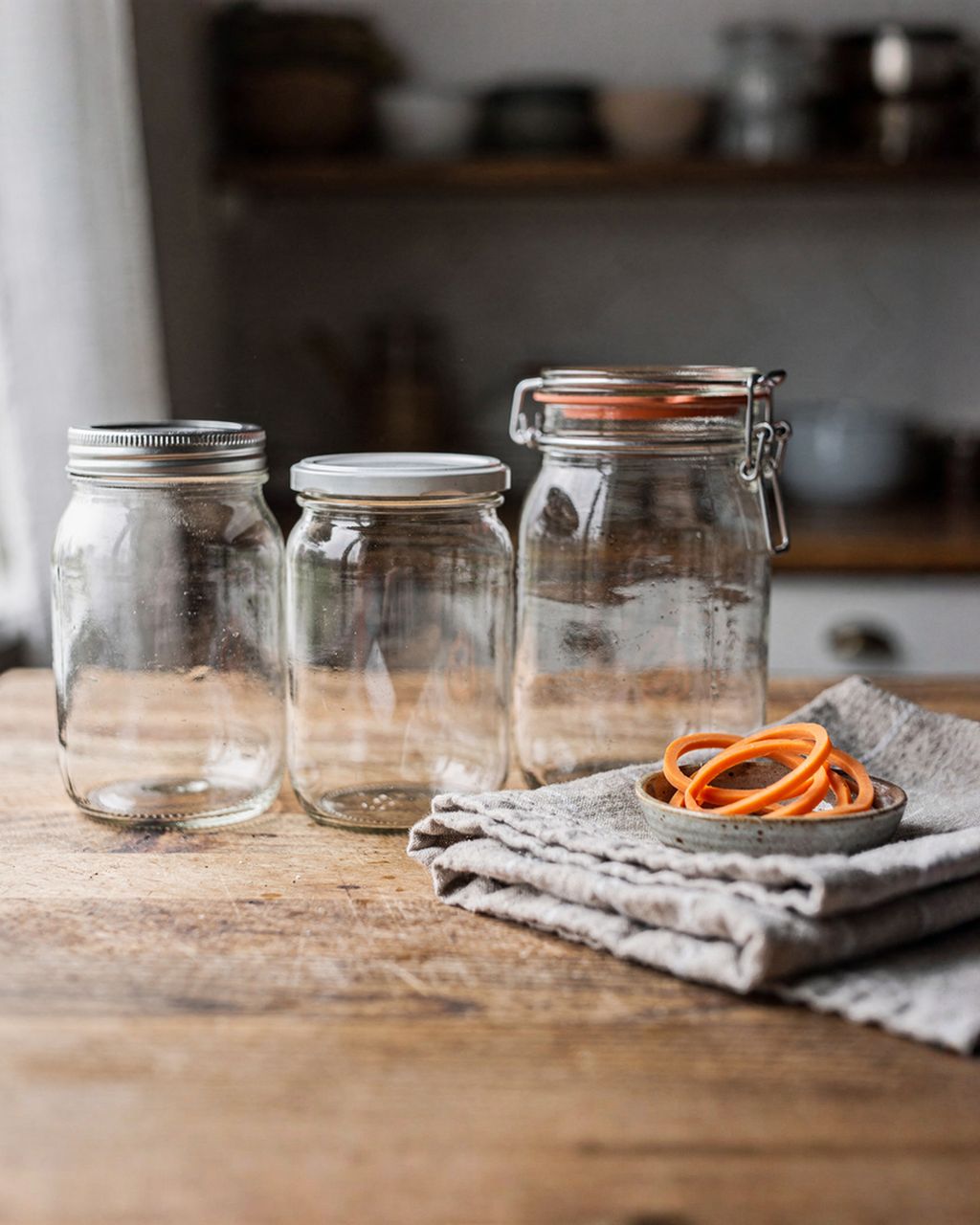
Tighten twist-off lids properly. Don't put clip-top jars with rubber seals in the dishwasher — the clamp holds a weaker vacuum, and water can seep in.
Stand the jars in the bottom rack, making sure they don't touch or tip over.
Only take them out once the cycle has fully finished and they've cooled.
In one batch you can fit 3–14 jars of 0.7 litres in a pot, 8–12 in an oven, and 12–20 in a dishwasher. In detail:
Standard 5-litre pot — 3–4 jars of 0.7 litres in a single layer.
27-litre canning pot — 7–14 jars of 0.7 litres; more if you use shorter jars stacked in two layers.
Oven, one deep tray — 8–12 jars of 0.7 litres.
Dishwasher, both racks — 12–20 jars of 0.7 litres, depending on their shape.
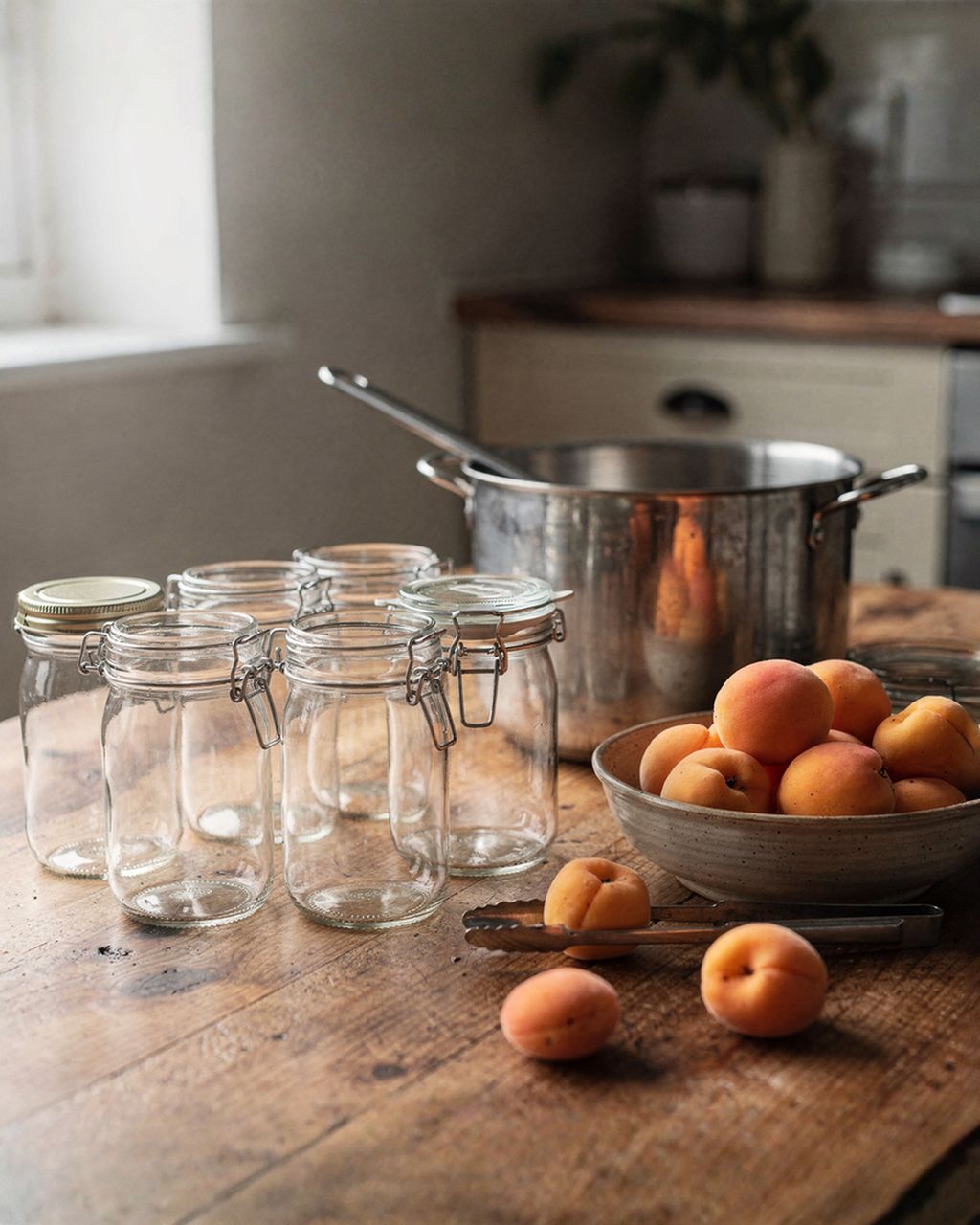
Capacity is the main reason people abandon the pot. If you're processing 15 kg (33 lb) of apricots in one afternoon, the difference between four jars and sixteen jars per batch is the difference between one run and five.
The dishwasher is the cheapest per jar, and a standard pot the most expensive — but capacity matters far more than wattage.
Rough energy use per batch (the exact figure depends on your appliance):
Pot — heating 10 litres of water to 85°C (185°F) and holding it there for 30 minutes costs roughly 1–1.5 kWh. Lower end on induction, higher on a classic cast-iron hob.
Oven — 160°C (320°F) for 60–90 minutes runs roughly 1.5–2.5 kWh. Fan mode is a bit more efficient than conventional top-and-bottom heat.
Dishwasher — the intensive 70°C (158°F) cycle uses roughly 1–2.5 kWh per cycle, depending on the model and load. Eco (around 50°C/122°F) is more efficient at 0.6–0.9 kWh, but it's useless for canning.
Per jar, that works out to roughly 0.2 kWh for the pot, roughly 0.2 kWh for the oven, and roughly 0.05–0.2 kWh for the dishwasher. So the dishwasher is generally the cheapest per jar — but only for the narrow slice of foods you're actually allowed to use it for, which is a fraction of what you'll can over a season.
Bottom line: don't let energy cost drive your decision. The difference between methods amounts to a few dollars over an entire season. Choose based on what you're canning and how much of it you need to get through.
Make acidic vegetables and tomatoes in a pot, large batches of fruit in the oven, jams and syrups in the dishwasher, and meat and legumes only in a pressure canner. Item by item:
Pickles, peppers, acidic vegetables in brine → pot. You need 82–85°C (180–185°F) for 30 minutes, or you'll lose either the crunch or the safety margin.
Preserves from soft fruit → pot; oven for large batches.
A big batch of fruit at once, 10 kg (22 lb) or more → oven. One tray, one watch.
Jams, marmalades, fruit butters, syrups → dishwasher, as long as you're filling them hot.
Tomatoes, passata, purée → pot, 100°C (212°F), with lemon juice added for safety.
Mushrooms in vinegar → pot.
Mushrooms in brine, meat, legumes, ready meals → pressure canner, or the freezer. None of the three methods in this article can handle these safely.
Seven mistakes ruin home-canned food regardless of method: mistimed processing, guessed temperature, overfilled jars, dirty jar rims, fast cooling, reused lids, and overtightened clamps. One by one:
You start timing from when you turn on the heat, not from when it reaches temperature. The most common mistake with both pots and ovens. The jar then gets only half the heat it actually needs.
You guess the temperature from the bubbles. Between 80°C and 95°C (176–203°F), the visual difference is tiny, but the effect on the result is enormous. A thermometer settles this once and for all.
You fill jars right to the brim. Leave 1–2 cm (about half an inch) of headspace, or the contents will push the lid up during heating and no vacuum will form.
You skip checking the jar rim. A drop of jam on the rim means a lid that won't seal. Wipe it with a damp cloth before sealing, every single time.
You cool the jars too fast. A jar straight from 100°C (212°F) set on a cold countertop will crack. Let it cool slowly, on a towel, away from drafts.
You reuse lids. A twist-off lid with a dented or scratched seal won't grip properly. New lids are the cheapest insurance in the whole process.
You crank clip-top clamps to the max. Air needs somewhere to escape during heating, or the jar will crack.
Pick based on which method you want to try. Pickled mushrooms in vinegar are a textbook pot job — an acidic brine and precisely held temperature. Chilli jam is a classic dishwasher candidate: lots of sugar, plenty of acidity, filled hot. And summer fruit in a jar is the easiest entry point into fruit preserves, whether you go with the pot or the oven.
Pickled mushrooms in vinegar
Pickled mushrooms in vinegar: an acidic brine, canned in a pot

Chilli marmalade
Chilli jam: a sweet-and-sour preserve perfect for dishwasher canning
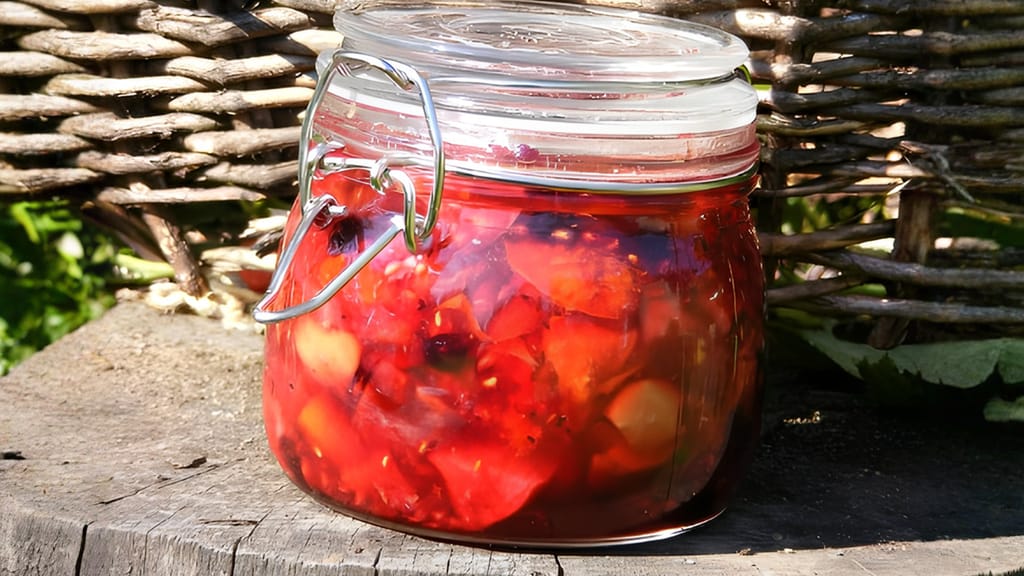
Summer fruit in a jar
Summer fruit in a jar: a fruit preserve for the pot or the oven
For acidic foods that will be processed for at least 10 minutes at 100°C (212°F), it's enough to wash the jars thoroughly in hot water with dish soap and let them drain — the canning process itself sterilizes them. For anything processed at a lower temperature or for a shorter time, sterilize the jars beforehand (10 minutes in boiling water — don't use dry-heat sterilization in the oven, as canning jars aren't built for it). This also applies to things filled hot and never given a heat bath at all, like jams and syrups that are simply jarred and flipped upside down. Never boil the lids for long, or you'll damage the sealing compound.
A properly sealed lid is slightly concave in the middle, doesn't flex when you press it, and makes a high, clear ping when you tap it with a spoon. Check only after the jar has fully cooled — roughly 12–24 hours later — since the vacuum hasn't fully set before that. For jars with clip lids, remove the clamp and carefully lift the jar by the lid: if it holds, you're good. If a jar didn't seal, refrigerate it and use it within a few days, or reprocess it with a new lid.
No, neither one works for canning. An air fryer uses dry heat with no water bath, so the glass heats unevenly and can easily crack, and the contents still never get above 100°C (212°F) anyway. A microwave heats even more unpredictably, and metal lids have no business going in one at all. For small batches, just use a pot — two jars in a small saucepan take about as much time as canning in the dishwasher.
Food canned in a dishwasher keeps for a shorter time than food canned in a pot. The contents of a jar in a dishwasher never exceed about 70°C (158°F), so heat-resistant molds and yeasts can survive — store it in a cool, dark pantry and eat it sooner than pot-canned goods. Check the lid and surface more often, and if you spot any mold or bubbling, throw the whole jar out.
You can, but set your time based on the largest jar — smaller jars won't suffer, whereas a larger one would end up under-processed otherwise. In a pot, also make sure the water level reaches three-quarters of the way up the tallest jar. This works less well in the oven: small jars start bubbling much sooner than 1-litre ones, so you'll easily overheat some jars before the others are properly heated through — it's best not to mix sizes there.
One recipe worth heating the oven for, one tip, and one deal from the shop. Nothing else.