- Season
- Year-round
- Price
- Low
Calories and nutrition
per 100 g
381 kcal
Calories
0.3 g
Protein
91.3 g
Carbs
0.1 g
Fat
Wheat Starch
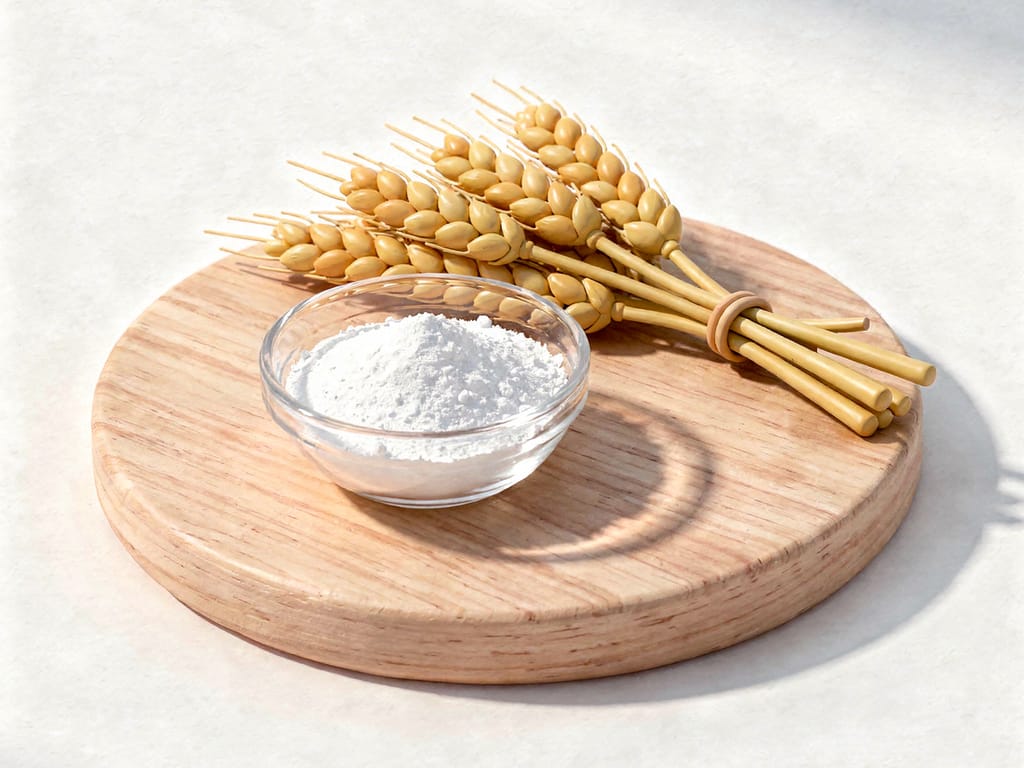
Wheat starch is a fine white powder, pure starch washed out of wheat, used to thicken sauces, creams and puddings. It comes from wheat, so it must be labelled as an allergen, and it is gluten-free only when explicitly labelled so.
per 100 g
381 kcal
Calories
0.3 g
Protein
91.3 g
Carbs
0.1 g
Fat
Keep it dry and dark in a well-sealed bag or tub, away from strong-smelling foods. Starches keep a good year dry in a closed tub, but go by the best-before date; throw out starch that is damp, musty or lumpy.
Do not refrigerate it. It does not need it, and in a container that is not perfectly sealed it could take up moisture.
There is no point freezing it. Temperature changes can cause moisture to condense.
Look for wheat starch in the ingredient list; cornstarch (such as Gustin) and potato starch (Solamyl) are different products. Wheat must be emphasised as an allergen in the ingredients. If you cook for someone with coeliac disease, buy only starch or blends labelled "gluten-free" or carrying the crossed-grain symbol. The starch should be free-flowing; lumps give away moisture.
Cornstarch: in sauces and puddings, dose it as in cornstarch recipes, 15–20 g per 500 ml of sauce. Corn contains no gluten; for coeliac disease, buy packs labelled "gluten-free".
Potato starch (Solamyl): it thickens more strongly, 10–15 g per 500 ml of sauce is enough, and it does not stand up to long boiling, so add it at the end.
To thicken, always slake it in cold liquid first, then pour it into the hot sauce or milk while stirring and simmer briefly. Do not tip dry starch into hot liquid; it will go lumpy.
Use up an opened pack to thicken a sauce or pudding or to coat meat before frying.
Roughly what a spoon or cup weighs, filled the way you usually would.
4 g
1 teaspoon
11 g
1 tablespoon
Wheat starch thickens sauces, custards and puddings. Industrially made gluten-free flour blends and bread use deproteinised wheat starch, and in baking powder and raising agents wheat starch serves as a carrier. In Cantonese cooking, wheat and tapioca starch make the translucent dough for har gow dumplings.
It is extracted from wheat mechanically: the raw material is crushed and the starch washed out of it. Under Czech Decree No. 18/2020, starch is not a milled cereal product, so it is not flour. Gluten-free products use deproteinised wheat starch, with the gluten removed; ingredient lists usually call it "wheat starch", in full "wheat starch specially processed to reduce its gluten content".
It has almost no taste. In a sauce or custard it gives a smooth body without masking the other ingredients.
2 min read
Ordinary wheat starch is made from wheat, so EU Regulation No. 1169/2011 classes it among products of cereals containing gluten: wheat must be emphasised as an allergen in the ingredient list. The only exemptions are wheat-based glucose syrups including dextrose and wheat-based maltodextrins; starch is not among them.
Gluten-free products use deproteinised wheat starch, with the gluten removed. Under EU Regulation No. 828/2014, a product may be labelled "gluten-free" only if it contains at most 20 mg of gluten per kilogram, even when it contains wheat ingredients specially processed to reduce their gluten. How to spot such starch in an ingredient list is explained in our article what to use instead of flour in gluten-free Christmas cookies.
Gluten-free does not mean wheat-free. Deproteinised wheat starch has had its gluten removed but still comes from wheat, and wheat allergy is triggered by wheat protein, not gluten. With a wheat allergy, always read the ingredients; wheat must be named and emphasised there. Wheat starch hides, for example, in baking powder and raising agents, where it serves as a carrier. More in our article wheat allergy: symptoms, diagnosis and living wheat-free.
In the kitchen, wheat starch is used like other starches: slaked in cold liquid, poured into the hot sauce or milk and simmered briefly. Doses and a comparison with cornstarch and potato starch are in our article how to thicken sauce without flour and on the cornstarch page.
In Cantonese cooking, wheat starch together with tapioca starch is the base of the dough for har gow, shrimp dumplings served as dim sum. The dumplings are steamed and the wrapper turns translucent, which is why they are also called crystal shrimp dumplings.