- Season
- Winter into early spring: from Italy and Spain December to April (Moro first, Sanguinello last); imports from the southern hemisphere in summer.
- Price
- Medium
Calories and nutrition per 100 g
- 47 kcal
- 0.9 g protein
- 0.1 g fat
- 11.8 g carbs
Blood Orange
A blood orange is a sweet orange with red-streaked to deep ruby flesh. Its colour comes from anthocyanins, which form in the fruit during cold nights; the best-known varieties are Moro, Tarocco and Sanguinello, and the main season runs from December to April.
About a week at room temperature, a little longer in a cool room or pantry. Do not leave cut fruit out of the fridge for more than 2 hours.
Whole fruit keeps 2–3 weeks in the crisper drawer. Eat peeled segments or supremes in a closed container within 3–4 days, and fresh juice within 2–3 days.
Juice in ice-cube trays or supremes in a closed container freeze for about 3 months. Thawed supremes are soft, so use them in smoothies, sorbet or sauces. You can grate the zest and freeze it separately.
Choose fruit that feels heavy for its size, with taut, glossy, firm skin; these have the most juice. A red blush on the skin is a hint but no guarantee of deep red flesh: Tarocco often has an almost orange skin and only streaked flesh. Soft fruit, wrinkled or mouldy patches and a sour smell mean old fruit. For zest in baking, buy fruit labelled untreated (unwaxed) or organic.
An ordinary orange or Cara Cara orange, which lack the red colour; a little pomegranate juice adds both colour and fruity acidity.
Mandarins or grapefruit combined with a few spoonfuls of pomegranate or redcurrant juice.
If you are using the zest, wash the fruit in warm water and dry it first. For salads, cut supremes: slice off the top and bottom, cut away the peel with the white pith, then cut the segments out from between the membranes. Juice by hand or with a juicer; Moro gives the darkest juice. Blood oranges stain boards and hands, but the colour washes off.
Grate the zest before peeling and freeze it for baking. Dry leftover peel from untreated fruit and grind it into spice blends or sugar, or add it to mulled wine. Squeeze the membranes and trimmings from supreming into a dressing.
Roughly what one measure weighs, scooped the way you normally would in the kitchen.
It shines raw: as supremes in salads with fennel, beetroot, goat cheese or olives, as fresh juice, or in desserts with chocolate and pistachios. The juice suits dressings, cocktails, granitas and sorbets. It tolerates brief cooking in a sauce for roast duck or a syrup for a cake; long cooking turns the juice brown and flat. Blood oranges also make marmalade, which tends to come out deep orange rather than red.
A blood orange is a sweet orange with red-streaked to deep ruby flesh. Its colour comes from anthocyanins, which form in the fruit during cold nights; the best-known varieties are Moro, Tarocco and Sanguinello, and the main season runs from December to April. Botanically it is the same species as the ordinary orange, Citrus × sinensis; the red flesh is a natural trait of the variety, not a cross or a dye. The best known are Sicilian blood oranges from around Mount Etna, which carry the EU protected geographical indication Arancia Rossa di Sicilia. In Czech shops they are sold as červené or krvavé pomeranče (red or blood oranges), often with the variety on the label. How red the flesh is varies from fruit to fruit and with the weather in a given season.
It tastes like a sweet orange with a note of raspberry, cherry or pomegranate, fresh and slightly winey. Moro is the darkest and boldest, with a light bitterness; Tarocco the sweetest and gentlest; Sanguinello juicy and balanced. The zest smells like ordinary orange zest, and the skin often has a red blush.
Seasonal baking plans, tested recipes and kitchen tricks that save you time. Unsubscribe in one click.
3 min read
A blood orange is a sweet orange that produces anthocyanins, the same group of pigments that colours cherries, blackberries and red cabbage. In ordinary oranges the gene for making them in the flesh is switched off; in blood orange varieties cold switches it on. That is why the colour develops mainly where cold winter nights alternate with warm, sunny days, as on the slopes of Mount Etna in Sicily.
For the same reason the intensity varies from season to season and fruit to fruit. Fruit from warm regions or a mild winter is often only lightly streaked. Blood oranges are not dyed and are not crossed with grapefruit or any other fruit; the Sicilian rules for Arancia Rossa di Sicilia even ban artificial degreening of the skin.
In shops you will mostly meet three varieties. They differ in colour, flavour and when they reach the market.
The darkest variety, with flesh from deep red to almost purple. It has the boldest flavour, of dark berries, with a slightly bitter finish. It opens the season, arriving in shops from December to February or March. Best for juice and desserts where the colour should show.
The most widely grown Sicilian variety and, for many, the best tasting: sweet, low in acid, nearly seedless and easy to peel. The flesh is mostly orange with red streaks. It is harvested from January to April and is best eaten raw.
A late variety grown in Sicily and in Spain. The flesh is medium red, the flavour juicy and balanced, the season February to April. It stretches the blood orange season into spring.
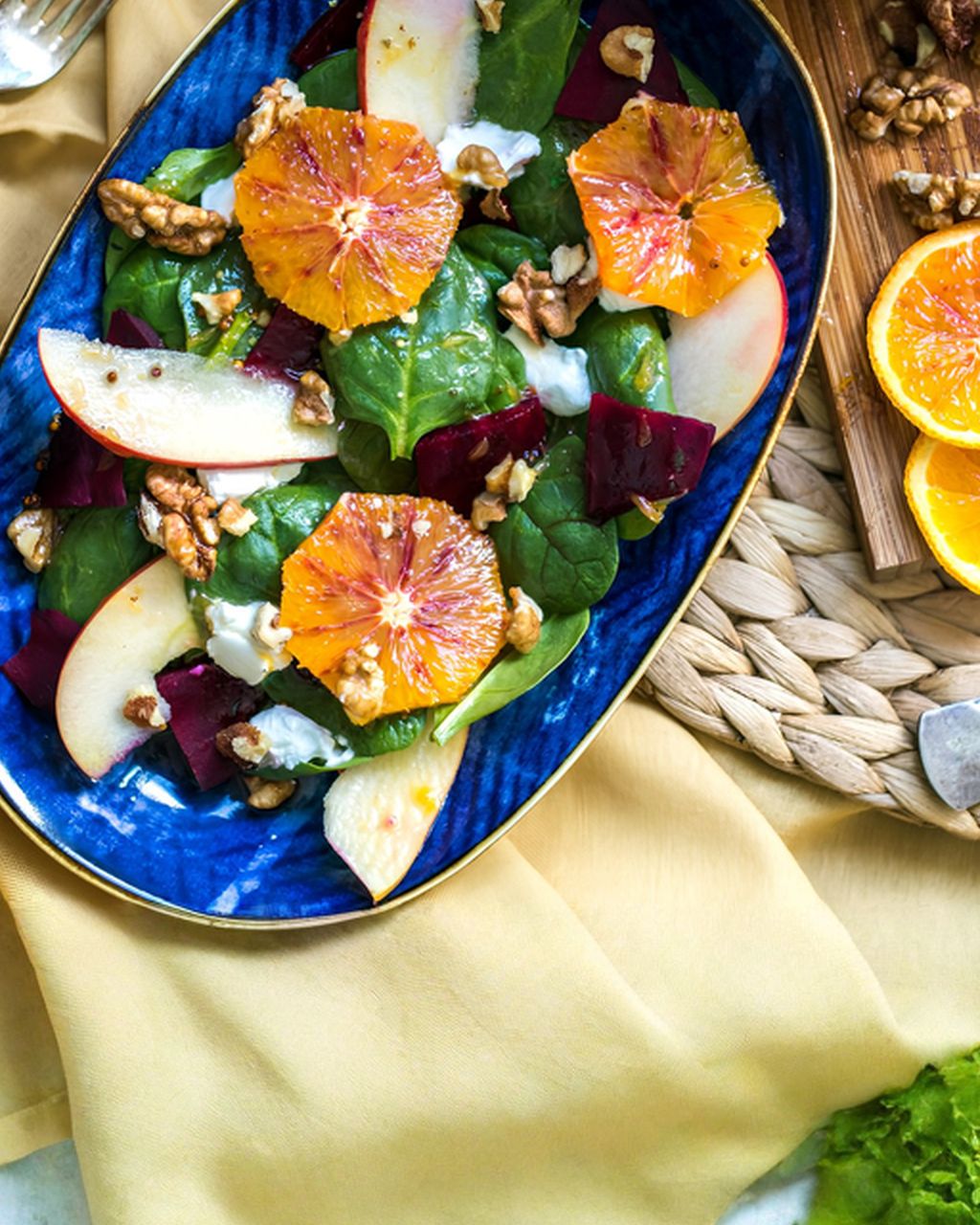
Supremes suit winter salads where the colour stands out: with beetroot, spinach and goat cheese, as in this light salad with blood oranges, or Sicilian-style with fennel, red onion and olives.
Simmer the juice briefly with stock and a little honey for a sauce for roast duck; for roasting the duck itself, see how long to roast a duck. In desserts, add supremes to chocolate mousse, panna cotta or yogurt, and the juice to granita, sorbet and cocktails.
A blood orange is nutritionally similar to an ordinary orange: roughly 45–50 kcal per 100 g of flesh, about 12 g of carbohydrate, mostly sugars, around 2 g of fibre and under 1 g of protein. It contains vitamin C, about 70 mg in a medium fruit (around 130 g). Its flesh also contains anthocyanins, which ordinary oranges lack. It has almost no fat.
Portuguese and Genoese traders brought the sweet orange to Europe in the 15th and 16th centuries, and red-fleshed fruit appeared as a natural mutation in Sicily or elsewhere in the Mediterranean. The Jesuit botanist Giovanni Battista Ferrari described an orange with red-flecked flesh as early as 1646 in his treatise Hesperides. Today, besides Sicily, they are grown mainly in Spain, the USA, South Africa and Australia; Sicilian fruit from the provinces of Catania, Siracusa and Enna carries protected geographical status.