- Season
- Year-round in chilled fish counters. Mackerel is fattiest when caught from late summer into winter.
- Price
- Medium
Calories and nutrition
per 100 g
263 kcal
Calories
22.8 g
Protein
0 g
Carbs
17.5 g
Fat
Smoked Mackerel
Smoked mackerel is Atlantic mackerel that has been salted and smoked, in Central Europe almost always hot-smoked, so it is fully cooked and eaten cold straight from the pack. It is sold whole or as fillets, chilled and often vacuum-packed, and is most often eaten with bread, in a spread or in potato salad.
per 100 g
263 kcal
Calories
22.8 g
Protein
0 g
Carbs
17.5 g
Fat
Do not leave it at room temperature. It is a chilled ready-to-eat fish. Take it out of the fridge shortly before serving and put leftovers back within two hours.
Keep it in the fridge at the temperature on the pack, usually 0–5 °C or at most 8 °C, in the coldest part. Eat it unopened by the use-by date, not a day later. Eat an opened pack or fish bought loose within 1–2 days, and never after the date on the pack. Wrap it well or keep it in a closed container so the smell doesn't spread.
It freezes well. Freeze it soon after buying, well before the use-by date, tightly wrapped or vacuum-packed, and use it within about two months. Thaw it in the fridge, not on the counter, and eat it within a day of thawing. Do not refreeze thawed mackerel. The flesh softens slightly, so it is then best in a spread or salad.
Choose whole fish or fillets with glossy, golden to bronze skin and firm, juicy flesh. It should smell cleanly of smoke, with no ammonia, sour or rancid notes. A sticky surface or slimy liquid in the pack means it is past its best. Buy only mackerel kept chilled. On the label check the use-by date, storage temperature, species and catch area, usually the Northeast Atlantic (FAO area 27), and whether it is hot- or cold-smoked.
The closest substitute is smoked trout. It is also hot-smoked and flakes the same way, just leaner and with milder smoke. Buckling (hot-smoked herring) also works in a spread.
For spreads and salads, use canned mackerel in oil, sardines in oil or smoked sprats. The flavor differs, but the richness is similar.
Hot-smoked mackerel needs no cooking. Peel off the skin, run a knife or your fingers along the spine and lift off both fillets. Flake the flesh and feel through it with your fingers, as thin pin bones remain. The dark strip of flesh along the spine is edible; scrape it off if you don't like it. To serve it warm, heat it briefly in the oven at 150 °C for about 5–8 minutes, or stir it into a finished hot dish. Longer baking dries it out. Slice cold-smoked mackerel thinly and follow the label on whether it is ready to eat.
Crisp the skin in a dry pan and crumble it over a salad. Put scraps from the frame and trimmings into a spread, fish cakes or potato salad. Simmer the cleaned head and bones into a smoky stock for potato or fish soup. Use it sparingly; it is salty.
Roughly what one piece weighs.
250 g
1 piece
Smoked mackerel is already cooked, so it belongs mainly in cold dishes. Flake it into potato salad, a beetroot and horseradish salad or a leafy salad. Mash or blend it with quark or cream cheese, lemon and horseradish into a spread. Lay it on rye bread with pickles and onion. Add it to pasta with crème fraîche, risotto or British kedgeree (rice with fish and eggs) only at the end, just to warm through. Its strong flavor pairs best with sharp, acidic partners: lemon, horseradish, mustard and pickles.
Smoked mackerel is Atlantic mackerel (Scomber scombrus) that has been salted and smoked, in Central Europe almost always hot-smoked, so it is fully cooked and eaten cold straight from the pack. Hot-smoking cooks the flesh, which turns pale and flakes easily. Shops sell it chilled, whole with or without the head, as skin-on fillets and often vacuum-packed. Fillets coated in cracked pepper are common too. Cold-smoked mackerel is rare in Czech shops: the flesh stays raw and dense, and depending on the label it is either ready to eat or must be cooked. Smoked mackerel is also different from canned mackerel in oil or brine, which is sterilized and stored differently.
The flavor is full, rich and salty, with a gentle sweetness and a strong smoky aroma. The high fat content keeps the flesh juicy and silky. Depending on the wood and smoking time, the smoke is mild or bold like a campfire. Peppered mackerel adds heat. The darker flesh along the spine tastes more strongly of fish than the pale flesh on the sides.
Seasonal baking plans, tested recipes and kitchen tricks that save you time. Unsubscribe in one click.
4 min read
Most smoked mackerel in Czech shops is hot-smoked. The fish is brined and then smoked at a gradually rising temperature until the flesh is cooked through. The result is ready to eat and flakes easily. Cold-smoked mackerel is smoked at a low temperature, so the flesh stays raw and dense; depending on the producer it is either ready to eat or must be cooked. The label tells you which.
Canned mackerel in oil or brine is a different product: it is sterilized in the can, keeps at room temperature until opened, and once opened should go into a closed container in the fridge.
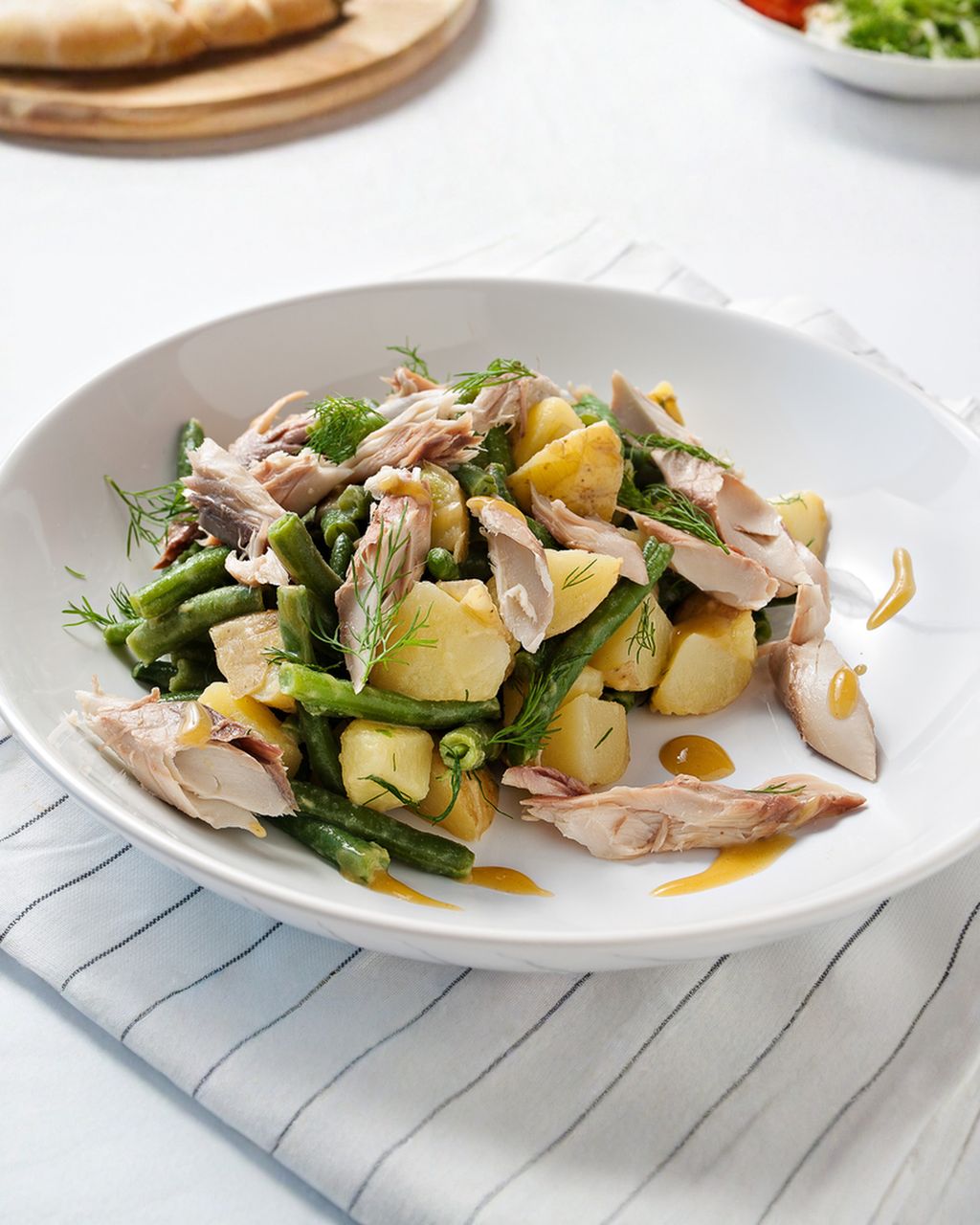
The simplest way is cold with bread, onion and lemon. It is one of the fattiest common fish, so it makes a thick spread with only a little quark or cream cheese. Ratios and method are in Fish and tuna spread: which fish to use. It also works well in potato salad, for example in Potato Salad with Green Beans and Smoked Mackerel.
Hot-smoking cooks the fish, but Listeria monocytogenes can get onto it during later handling and packing. Unlike most bacteria, listeria grows at fridge temperature. For healthy adults the risk is low, but listeriosis can be serious for pregnant women, older people and anyone with weakened immunity. These groups are generally advised to eat chilled smoked fish only when heated until steaming hot, at least 70 °C in the center. Just warming it through in a dish is not enough. This applies all the more to cold-smoked mackerel.
For everyone: keep smoked mackerel in the fridge, eat it by the use-by date and within 1–2 days of opening. How long smoked fish keeps and how to freeze it is covered in Salmon and sushi in the fridge. Mackerel is one of the fish in which histamine forms when it is not kept cold enough. Histamine is not destroyed by cooking or smoking and causes poisoning with flushing, rash and headache. Fish is one of the 14 major allergens that must be declared on EU labels.
In Europe, smoked mackerel is mostly Atlantic mackerel (Scomber scombrus) from the Northeast Atlantic and North Sea. Chub mackerel (Scomber japonicus) is slightly smaller and leaner. King mackerel from the western Atlantic is a different, much larger species that is high in mercury, and the US FDA lists it among fish pregnant women and children should avoid. Atlantic mackerel, by contrast, is a low-mercury fish. Products include whole fish, skin-on fillets, peppered or herbed fillets and smoked mackerel spreads.
Smoking is one of the oldest ways to preserve fish. Mackerel is caught in large numbers in northern Europe and spoils quickly, so salting and smoking helped keep it and carry it inland. Smoked mackerel has a strong tradition in the British Isles, Germany, Poland and the Baltic states. Czech shops get it from processors who smoke frozen or chilled North Atlantic mackerel, often from Norwegian and Scottish catches.
Brining drives salt into the flesh, draws out some water and leaves a thin tacky layer on the surface that holds the smoke. Smoke adds phenolic compounds, which give aroma and slow rancidity, and carbonyl compounds, which react with surface proteins to turn the skin golden. Hot-smoking sets the proteins and cooks the flesh. Mackerel fat is high in polyunsaturated fatty acids: raw Atlantic mackerel has about 2.3 g EPA and DHA per 100 g according to USDA. These fats oxidize easily, which is why mackerel kept too long or too warm tastes rancid.
Northeast Atlantic mackerel is caught mainly with pelagic trawls and purse seines. The fishing nations have for years failed to agree how to share the quota, so total catches have repeatedly exceeded ICES scientific advice. MSC sustainability certification for this fishery was suspended in 2019. EU rules require the label to state the species, catch area and fishing gear category. If it matters to you, choose by those details, or sometimes pick fish from better-rated stocks.