- Season
- Year-round. Fresh Czech cauliflower is in season mainly from June to October.
- Price
- Low
Calories and nutrition per 100 g
- 24 kcal
- 2 g protein
- 0.3 g fat
- 4.7 g carbs
Frozen Cauliflower
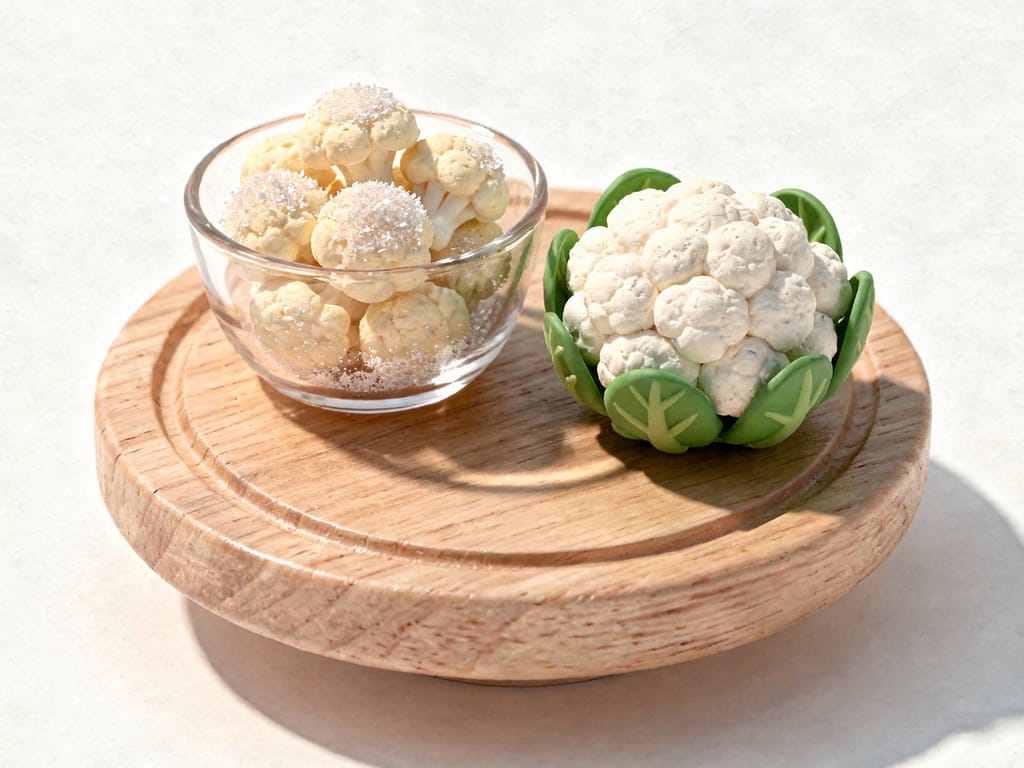
Frozen cauliflower is cauliflower florets that are briefly blanched after harvest and quickly frozen. It is cooked straight from frozen, without thawing, and because it is already part-cooked it needs less time than fresh cauliflower.
Do not leave it on the counter. It thaws, releases water and goes soggy. If thawed cauliflower has been out of the fridge for more than 2 hours, do not refreeze it.
Cook thawed cauliflower within 24 hours. Cooked, it keeps 3–4 days in a closed container in the fridge.
At −18 °C it keeps its best quality for 10–12 months. It stays safe for longer but loses flavour and vitamin C. Seal an opened bag tightly so the cauliflower does not dry out or get freezer burn.
Choose bags in which the florets move freely. A solid lump and a lot of ice in the bag mean it has thawed and refrozen. The florets should be white to cream, with no brown spots. Large florets suit roasting; small ones and riced cauliflower suit soups and mash. Get it into your freezer as soon as possible, ideally in a cool bag.
Frozen broccoli. It has a similar texture and cooks in the same time, just with a stronger flavour.
Fresh cauliflower: allow time for cleaning and cutting and a few extra minutes of cooking. For mash, potatoes or parsley root also work.
Cook it straight from frozen. Boil it in salted water for 3–5 minutes from when the water returns to the boil, or steam it for 5–7 minutes. For roasting, spread it on a tray preheated to 220 °C. For mash and soup, cook it until soft. Frozen cauliflower is not meant to be eaten raw, so always cook it as the pack directs.
Use the cooking water as a base for soup or for cooking rice. Blend cooked leftovers into soup or turn them into fritters.
Roughly what one measure weighs, scooped the way you normally would in the kitchen.
Boiling for 3–5 minutes or steaming for 5–7 minutes, always straight from frozen. Roasting at 220 °C for 20–30 minutes on a preheated tray, in a single layer and uncovered, turning halfway. Air frying at 200 °C for 12–15 minutes. In soup, simmer it in stock until soft, about 10 minutes, then blend.
Frozen cauliflower is cauliflower florets that are briefly blanched after harvest and quickly frozen. It is cooked straight from frozen, without thawing, and because it is already part-cooked it needs less time than fresh cauliflower. It is sold in bags as florets, as riced cauliflower (cauliflower chopped into small grains) or in mixes with broccoli and carrots. It saves cleaning and cutting and keeps cauliflower on hand all year. Blanching stops the enzymes that would spoil its colour and flavour in the freezer.
Frozen cauliflower tastes mild, slightly sweet and nutty, much like fresh. Blanching softens its sulphurous smell a little. It is softer than fresh, so it suits soups, mash, bakes and roasting best.
Seasonal baking plans, tested recipes and kitchen tricks that save you time. Unsubscribe in one click.
3 min read
Frozen cauliflower is blanched at the factory, so it needs less time than fresh. Put it straight from frozen into boiling salted water and cook for 3–5 minutes from when the water returns to the boil. Steamed, it needs 5–7 minutes. For mash or soup, cook it longer, until completely soft.
Fresh florets take 3–6 minutes and a whole head 10–15 minutes. All the times for broccoli and cauliflower are in Broccoli and Cauliflower: How Long to Cook, Store and Freeze Them.
As it thaws, cauliflower releases water and softens, so in a pan or oven it steams rather than browns. Take it straight from the freezer. For roasting, preheat both the oven and the tray to 220 °C, toss the florets in oil and spread them in a single layer with gaps. Do not cover them, and turn them halfway. In 20–30 minutes the edges are browned.
For bakes and fritters, drain the cooked cauliflower well and pat it dry with a towel, or it will make the batter soggy. Try cauliflower fritters just like my mom makes them or creamy cauliflower and cheese soup.
Frozen vegetables are only briefly blanched during production, not cooked. Unless the pack states that they are ready to eat, they should be boiled or roasted before eating, even if you want them in a salad. The European Food Safety Authority (EFSA) advises this after a listeriosis outbreak linked to frozen vegetables in 2015–2018.
So do not put frozen cauliflower raw into salads or smoothies. For a cold salad, cook it, cool it and only then use it.
You can freeze cauliflower, but blanch it first. Cut it into florets of about 2.5 cm, boil them for 3 minutes (about 1 teaspoon of salt per litre), cool them at once in ice water, drain and pat dry. Spread them on a tray, freeze, then tip them into a bag and press out the air. This is the method given by the US National Center for Home Food Preservation (NCHFP).
At −18 °C it keeps its best quality for 10–12 months. Unblanched cauliflower turns grey and bitter in the freezer. More on blanching and packing is in How to Freeze Vegetables.
Blanching stops the enzymes that would spoil colour, flavour and texture in the freezer. Quick freezing forms small ice crystals that damage the cells less than slow freezing at home. Some vitamin C leaches into the water during blanching, though, and more is lost over long storage.
Cauliflower is about 92% water. That is why it softens so easily when cooked, and why high heat and plenty of room on the tray are the key to browned florets: the water has to evaporate quickly.
Cauliflower descends from wild cabbage of the Mediterranean. Arab botanists described it in the 12th and 13th centuries, it reached Italy at the end of the 15th century and became a favourite vegetable in France under Louis XIV. Today China and India are the largest growers. Frozen vegetables for European shops are processed mainly in Belgium and Poland.