Decorating Tip JEM – Petal / Ruffle #104
Ruffle Cake: How to Pipe Buttercream Ruffles with Tip 104 or 123
Updated Oct 8, 2026
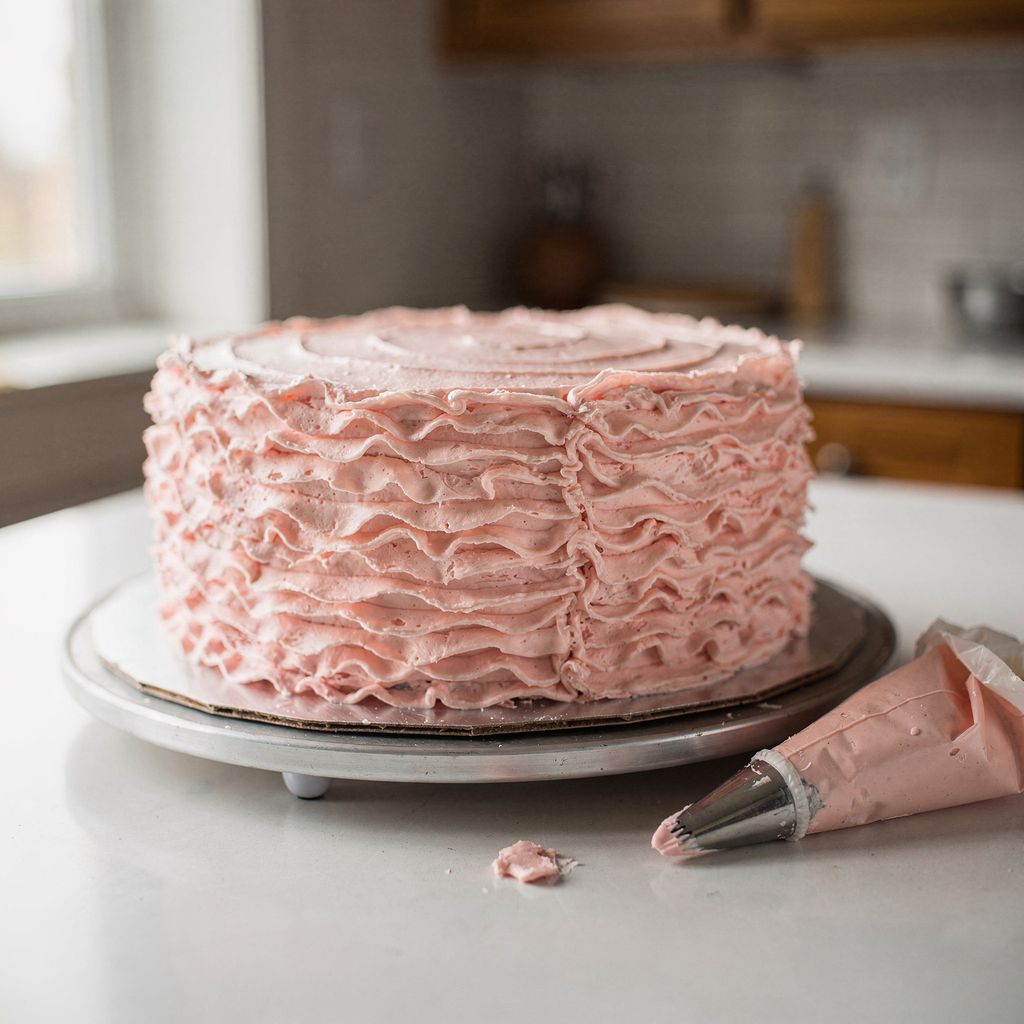
A ruffle cake is piped with a single flat petal tip (most often No. 104 or 123), a firm buttercream, and a chilled, evenly crumb-coated cake. Hold the tip with its wider end against the cake and the narrower end facing away, then drag a strip of buttercream while gently wiggling your wrist — it ruffles up on its own. The whole trick comes down to three things: the right angle, the right buttercream consistency, and the right temperature. Below you'll find how to dial all three in, which tip to pick, and what to do when the ruffles collapse or tear.
A ruffle cake comes together in five steps: crumb-coat and chill the cake, whip a firm, smooth buttercream, fill a piping bag fitted with a petal tip, pipe ruffles from the bottom up, and chill the cake again.
Crumb-coated, chilled cake – straight sides, a thin layer of buttercream, 30–60 minutes in the fridge.
Buttercream – firm, smooth, no air bubbles, ideally around 18–20°C (64–68°F).
Bag and tip – tip 104 or 123, bag filled no more than halfway.
Piping – wider end of the tip against the cake, narrower end facing out, with a gentle wrist wiggle.
Chilling – at least 30 minutes before you move or slice the cake.
The base is just a regular layer cake, so pick whichever sponge you like — the main thing is that the layers are flat and firm once chilled. Both a light Génoise sponge and a simple chocolate cake work well.
For buttercream ruffles you need a flat petal (ruffle) tip — a narrow slit that's wider at one end and tapers to a thin edge at the other. The thin side creates the delicate wavy edge of the ruffle, while the thick side anchors it to the cake.
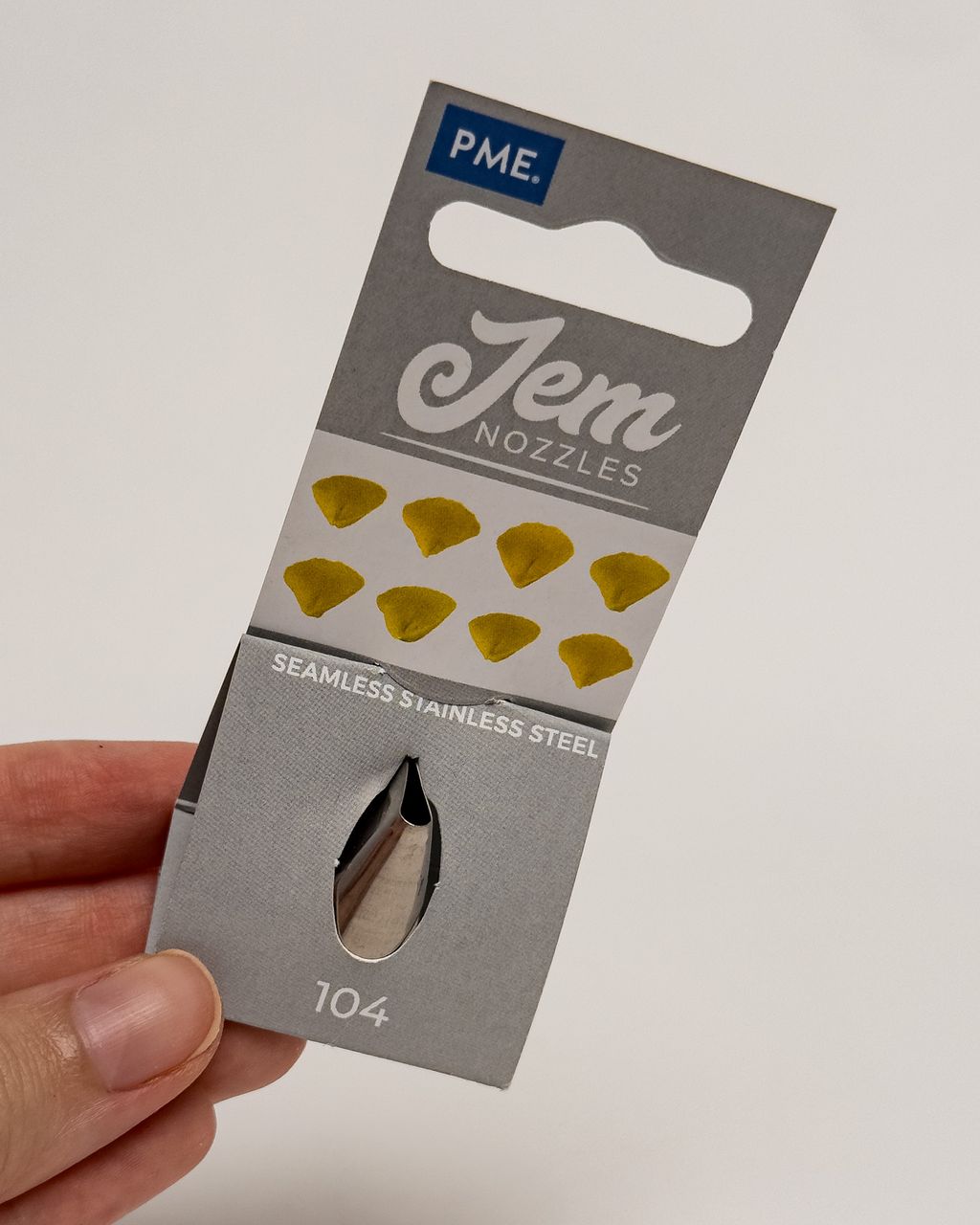
Tip 104 – medium-sized, with a slit measuring about 14.5 × 3 mm according to JEM. It makes fine, denser ruffles and works well on smaller cakes (15–18 cm / 6–7 in), cupcakes, and classic buttercream roses. If you're only buying one tip, make it this one.
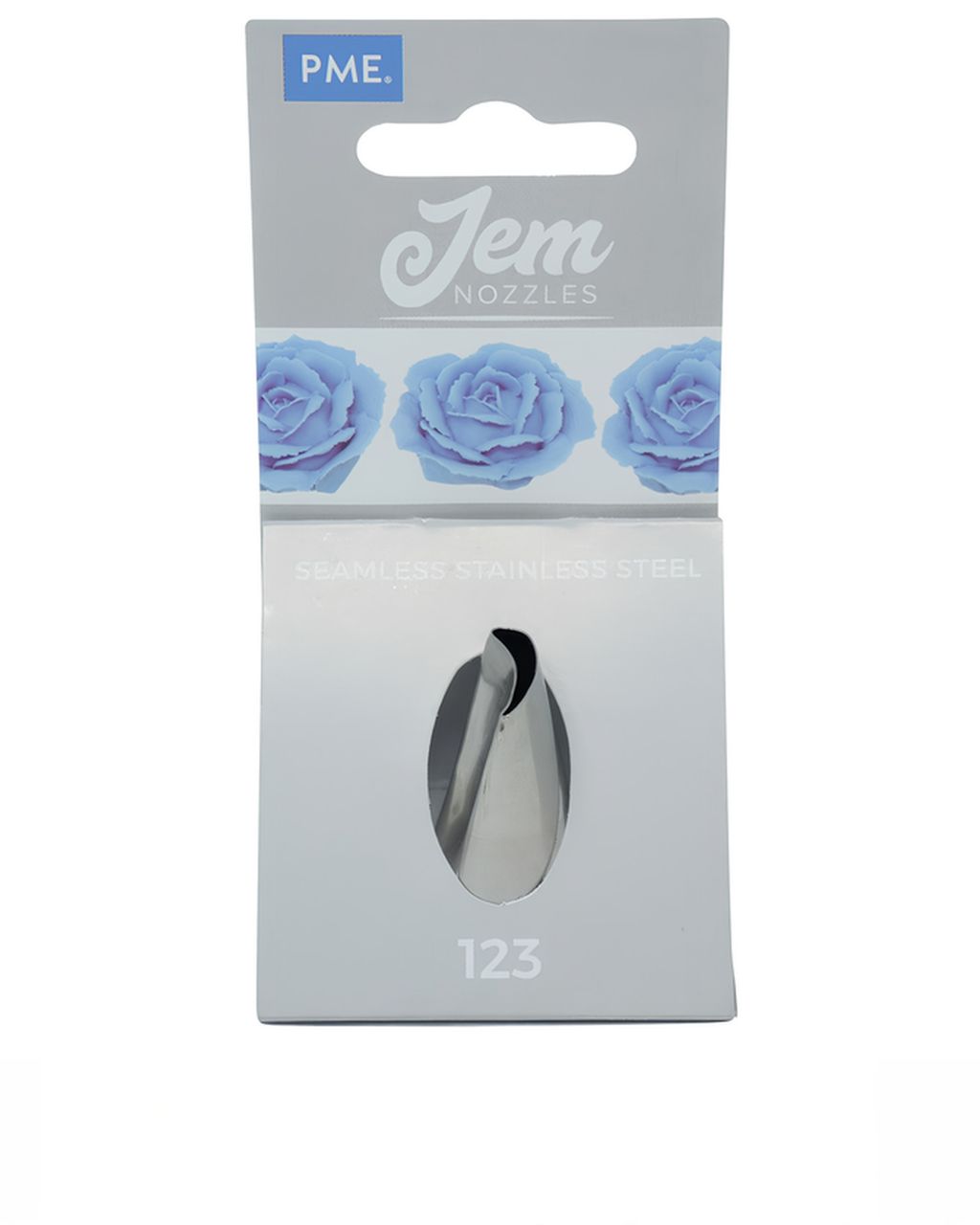
Tip 123 – large, with a 17 × 4 mm slit and a more pronounced curve. The size difference is only a few millimetres, but the thicker, curved slit releases more buttercream, so the ruffles come out fuller and bolder — meaning you'll cover a 20 cm (8 in) cake a row or two faster.
Both JEM tips share the same base (25 mm diameter), so you can swap between them on the same bag just as easily. We stock both: the Petal/Ruffle Tip 104 and the large Petal/Ruffle Tip 123. Tie off the bag securely and go for a larger size — browse our piping bags and tips.
What else works (and what we don't carry): even larger flat petal tips (No. 125–127) for ruffles spanning the full height of the cake side, curved tips (No. 97, 116) for softer, "fabric-like" ruffles, and Russian tulip tips — though those don't make ruffles, they pipe whole flowers instead. You can also fake rustic ruffles without any tip at all: snip a bag into a V-shape, or use an offset spatula to sweep little arcs of buttercream up the side of the cake. The result is rougher around the edges, but good enough for a first attempt.
Ruffles need a firm, smooth, butter-based frosting — ideally Swiss or Italian meringue buttercream, American buttercream made with butter and icing sugar, or a cooked flour-paste buttercream. The frosting has to hold a crisp edge while still flowing smoothly through the slit without tearing.
Swiss / Italian meringue buttercream – the smoothest edges, less sweet, and ideally pipeable at 18–20°C (64–68°F). The best choice.
American buttercream – the firmest and most heat-resistant, but sweeter, and its sugar content makes it tear more easily along the ruffle's edge. An extra 1–2 tablespoons of cream helps.
Cooked flour-paste buttercream (ermine) – milk and flour cooked into a thick paste, cooled, then whipped with soft butter. It's essentially the old-fashioned "pudding buttercream," and with enough butter it holds ruffles nicely.
Won't work: whipped cream, pure mascarpone frosting, or plain pudding/pastry cream without butter. A ruffle made from these will sag and collapse within an hour — it's the chilled butter that gives it structure.
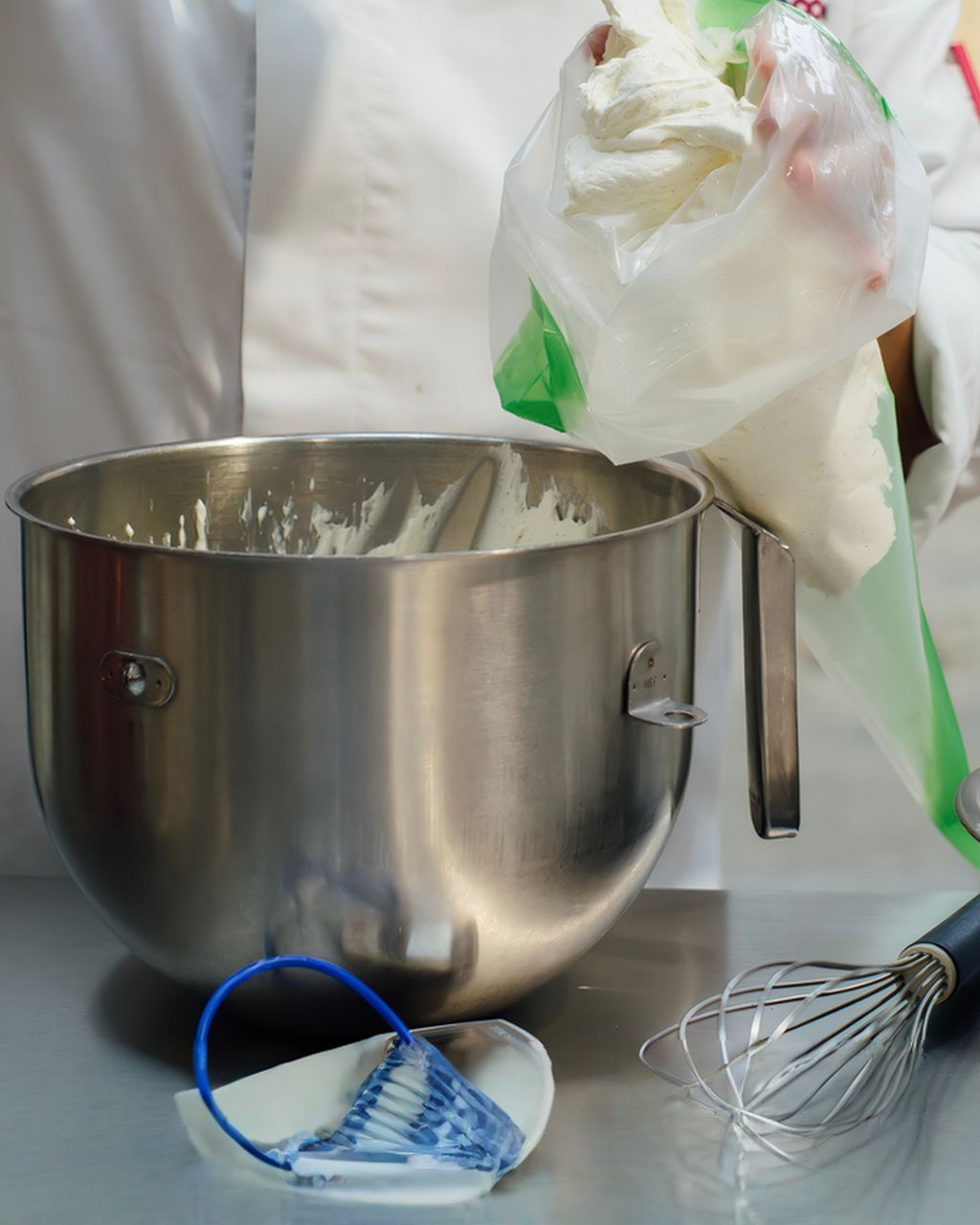
Consistency: the buttercream should have the texture of toothpaste. If a ragged edge comes out of the tip, it's too stiff or cold — warm it briefly in your hands or give it a short re-whip. If the ruffle bends and droops, it's too warm — pop the bag in the fridge for 10 minutes. Before filling the bag, stir the buttercream with a spatula to push out air bubbles; a bubble in the bag means a hole in the ruffle's edge.
For an overview of all buttercream types and when to use each, see our article on Types of cake frosting.
Ruffles need a flat, chilled cake with a thin crumb coat — every bump on the side will show through. Stack and fill the cake, apply a thin crumb coat, then chill for 30–60 minutes until the buttercream is firm to the touch.
Pipe a dam of firm buttercream between the layers so a softer filling doesn't push the sides out.
Colour the crumb coat the same shade as the ruffles. There are always small gaps between ruffles, and white peeking through under pink will show.
Set the cake on a turntable. Ruffles are piped in one continuous motion all the way around, and it's hard to do well without turning the cake.
Before you start, pipe a few test ruffles onto parchment paper or a plate. Within a minute you'll know if the buttercream's consistency and your angle are right.
Horizontal ruffles are piped from the bottom up, in rows around the cake: the wider end of the slit touches the cake, the narrower end points outward and slightly downward. Each new row overlaps the top edge of the one before it.
Fit the tip so the wider (thicker) end of the slit faces the cake and the thin edge faces away. Looking into the slit, it should look like an elongated teardrop — the thick part belongs against the cake.
Set the angle. Hold the bag at roughly 45° to the side of the cake (not to the work surface), tip pointing slightly down. The wider end of the slit lightly touches the buttercream on the cake, while the narrower end sticks out about 5 mm away from it.
Start at the bottom edge, slowly rotating the turntable toward you while applying even pressure.
Wiggle your wrist up and down in small movements (about 5–8 mm). This is what creates the waviness. Move from the wrist, not the whole arm, and keep the pressure consistent.
Each new row goes 1–1.5 cm above the previous one, overlapping its bottom edge. For a 10 cm tall cake, pipe 7–9 rows with tip 104, or about 6–8 rows with tip 123.
Hide the end of each row: stop pressure and pull the tip down and away. Place the seam at the back of the cake.
Finish the top edge with one final ruffle around the top rim of the cake, or smooth it with an offset spatula and decorate.
Left-handers mirror the process: turn the turntable the opposite way and start on the other side of the cake.
You can pipe five different designs with the same tip: horizontal rows around the cake, vertical ruffles from top to bottom, a diagonal cascade, an ombré colour fade, and ruffles with a two-tone edge. Only the direction of piping and how you fill the bag change.
Horizontal rows – as described above. The simplest option, and it looks like a skirt.
Vertical ruffles – hold the tip with the thin end facing out and pipe from top to bottom down the side of the cake, column by column, each one slightly overlapping the last. It's faster, but needs perfectly straight sides.
Diagonal / cascading – ruffles arcing across one side of the cake, leaving the rest smooth. Elegant for weddings, and uses roughly half the buttercream.
Ombré – split the buttercream into 3–4 bowls and colour them from most intense to white. Pipe the darkest shade at the bottom, fading to the lightest at the top. Gel colours won't thin the buttercream, so the consistency stays the same.
Two-tone edge – brush a stripe of deeper colour along the thin end of the tip inside the bag. The ruffles will come out with a darker edge.
Besides ruffles, tip 104 also pipes buttercream roses on a flower nail. A few such roses on top of a ruffle cake look great, and you won't need another tip.
Most ruffle fails come down to buttercream temperature, the wrong tip angle, or uneven pressure — rarely hand technique.
Ragged, torn edges – the buttercream is too cold or stiff, or contains undissolved sugar. Warm it up, add a spoonful of cream, and mix.
Ruffles bend and droop – the buttercream is too warm (above 22°C/72°F) or your hand is heating it up. Chill the bag and cake for 10 minutes, and hold the bag by the top rather than in your palm.
Ruffles lie flat like a ribbon – the tip is pressed too close to the cake. The narrow end should stick out away from the cake.
Ruffles stick out and fall off – the wider end isn't touching the cake, or the crumb coat is frozen solid and the buttercream won't stick to it. 30–60 minutes in the fridge is plenty — skip the freezer.
Uneven rows – you're turning the turntable unevenly. Try marking light guide lines with a toothpick first.
Holes in the edge – air bubbles in the buttercream. Stir it with a spatula before filling the bag.
For a ruffle cake measuring 20 cm (8 in) across and 10–12 cm (4–5 in) tall, plan on 1–1.2 kg (about 2.2–2.6 lb) of buttercream in total. Roughly a third goes into the filling and crumb coat, with the rest for the ruffles. A 15 cm (6 in) cake needs about 700 g (1.5 lb), while a 25 cm (10 in) cake needs 1.6–1.8 kg (3.5–4 lb).
Yes, a buttercream ruffle cake can easily be decorated a day in advance and stored in the fridge. The cold firms up the ruffles and helps them survive transport better. Take it out an hour or two before serving so the buttercream softens and its flavour comes through. Box it up only once it's fully chilled, so the ruffles don't get flattened.
A buttercream ruffle cake holds its shape at 20–22°C (68–72°F) for about 2–3 hours before the ruffles start to soften and droop. Above 24°C (75°F) or in direct sun, it will give way much sooner, so for an outdoor party, only take it out of the fridge right before cutting. If the cake has a cream, cheesecake-style, or fruit filling, get it back in the fridge within 2 hours.
Transport a ruffle cake chilled for at least 2 hours, in a box that's 2–3 cm wider and taller than the cake. Place the box on the flat floor of the car rather than on a seat, and run the air conditioning in summer. Chilled buttercream can handle light contact, but warm buttercream dents instantly.
Yes, tip 104 lets you pipe ruffles on cupcakes in a spiral from the edge to the centre, or a small petal rose. Tip 123 is usually too large for a standard 5 cm (2 in) cupcake.
One recipe worth heating the oven for, one tip, and one deal from the shop. Nothing else.