Dried Soup Vegetables: How to Dry Them in the Oven or a Dehydrator
Rose Hips: When to Pick Them, How to Dry Them and What to Make
Updated Nov 17, 2026
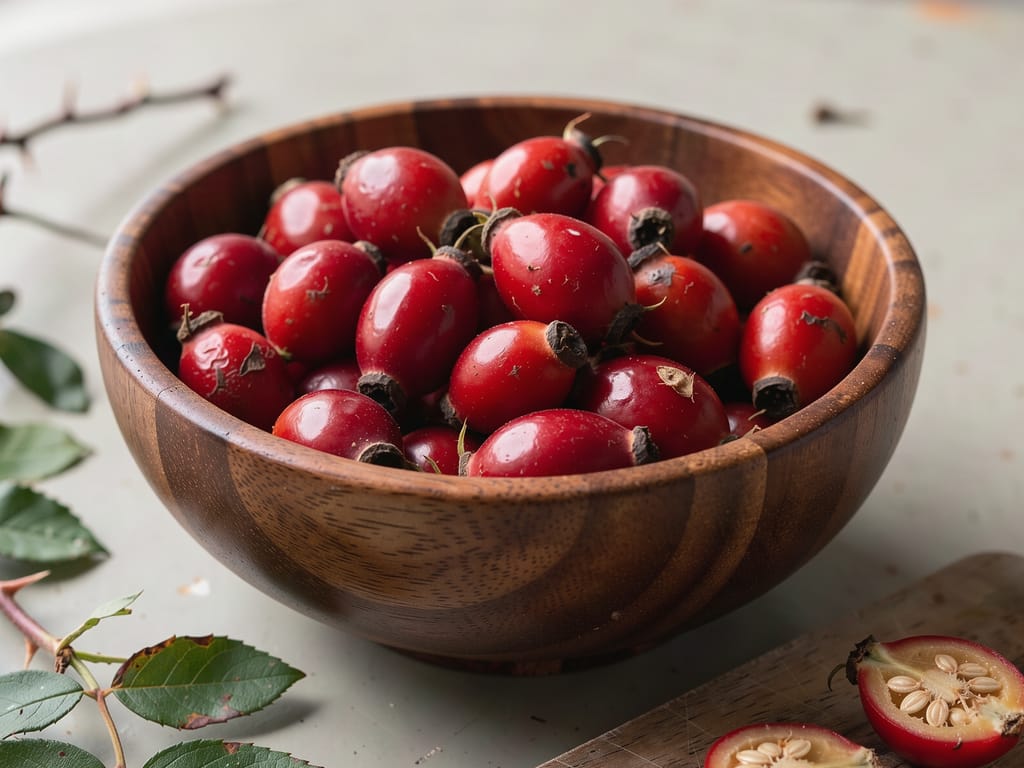
Pick rose hips in autumn, once they are deep red, glossy and firm. For drying and tea, pick them before the first frost, while they still hold their shape. For puree, syrup or sauce, feel free to wait for the first light frost, which softens them and makes them sweeter. Rose hips are the fruit of wild roses, most commonly the dog rose in Czechia. Before drying, halve them and scrape out the seeds along with the fine hairs, which irritate the skin, mouth and digestion. Then dry the halves at 140°F (60°C) in a dehydrator or in an oven with the door slightly ajar, until they are rock hard.
Pick rose hips for drying and tea before frost, and for puree, syrup and sauce after the first light frost. Choose your timing based on what you plan to make:
For drying and tea: firm, fully colored rose hips that haven't been frozen yet. They halve easily, don't fall apart when cleaned and won't mold during drying.
For puree, syrup and sauce: rose hips after the first light frost. The flesh softens and sweetens, so it's easy to press through a sieve.
After hard, repeated frosts the rose hips on the bush turn mushy, begin to ferment and go moldy. Leave those for the birds.
You can tell a ripe rose hip by its deep red to orange-red color, its glossy skin and the slight give under your finger. Greenish or orange ones are unripe and won't ripen once picked. The season starts around the end of September and, depending on location and weather, runs into November.
You can make your own frost. Spread rose hips picked before frost on a baking sheet, freeze them in the freezer, then thaw them. They soften just as if they had frozen on the bush, and they're good for puree. This also lets you hold them over on days when you can't get to them. For drying, though, use them fresh, because thawed ones can't be halved.
Seasonal baking plans, tested recipes and kitchen tricks that save you time. Unsubscribe in one click.
Pick rose hips far from roads, parking lots and sprayed fields. The fruit catches dust and traffic fumes, and washing doesn't remove them completely. Also avoid bushes along dog-walking routes and in roadside ditches. The same rules apply as for foraging spring herbs: pick only what you can identify with certainty, and in places where you'd happily eat it.
Take gloves, since the dog rose has sharp thorns. Pick the rose hips with the stem and sepals attached. Snip those off at home, so the fruit doesn't burst in the basket.
The most reliable way is to halve the rose hips and scrape out the seeds and hairs with a teaspoon. Then rinse them.
Rinse the rose hips and snip off the stems and dry sepals.
Cut each rose hip lengthwise in half with a sharp knife.
Use the tip of a teaspoon or knife to scrape out the seeds along with the hairs.
Rinse the halves in a colander under cold water to wash away any remaining hairs, then leave them to drain on a kitchen towel.
Only firm rose hips picked before frost can be cleaned this way. Soft, frozen fruit mashes under the spoon, so it is processed whole and the hairs are removed afterward by straining. If you don't feel like halving them, you can dry the rose hips whole. They take much longer to dry, though, and you'll have to strain the tea through cloth.
Dry halved, cleaned rose hips for tea at 140°F (60°C) until they are hard and rattle. In a dehydrator this takes roughly 6–10 hours, in an oven up to about twice as long, and whole rose hips take a day or more. According to Montana State University Extension, which follows USDA recommendations, 140°F (60°C) is the ideal temperature for drying fruit. At a higher temperature, a crust hardens on the surface, moisture stays trapped inside and the rose hips can spoil in storage.
Treat the times as a guide, since a lot depends on the size of the rose hips, their moisture and the power of your appliance. What matters is whether they rattle, not the clock. The same principles apply to anything you dry at home. We cover the difference between an oven and a dehydrator in detail in dried vegetables for soup.
In a dehydrator, dry halved rose hips in a single layer at 140°F (60°C). The halves are done in roughly 6–10 hours. Whole rose hips need much longer, often more than a day. A dehydrator is the easiest route, because it has a fan and holds the temperature.
Spread the halves on the trays in a single layer, cut side up, so they don't touch.
Set it to 140°F (60°C). If your dehydrator's manufacturer gives a different temperature for fruit, follow their instructions.
Swap the trays around now and then, since the top and bottom trays dry at different speeds.
Do the first check after 5 hours, then every hour.
In the oven, dry halved rose hips at 140°F (60°C) with the door slightly ajar, which can take up to about twice as long as in a dehydrator. If your oven won't go down to 140°F (60°C), don't dry rose hips in it. They are more likely to bake than dry. Use a dehydrator instead. Whole rose hips dry unevenly in the oven, so put in only halves.
Spread the halves on a baking sheet lined with parchment paper in a single layer.
Leave the door ajar by 2–6 inches (5–15 cm) so moisture can escape. Montana State University Extension advises stirring up the air further with a fan set in front of the oven. You can also switch on the convection setting.
Shake the baking sheet now and then so the halves don't dry on just one side.
Dried rose hips are hard, brittle and rattle in your hand. When you squeeze a half, it must not give or stick. Let them cool completely before storing, because warm ones would sweat in the container.
Conditioning: Montana State University Extension recommends loosely filling a glass jar with the dried fruit, closing it and leaving it for 7–10 days at room temperature. Shake the jar every day. If droplets appear on the glass, put the rose hips back in the dehydrator. This evens out the moisture among the pieces and lowers the risk of mold.
Storage: in a closed jar in a dark, dry, cool place. According to the same source, dried fruit keeps for roughly 1 year at 59°F (15°C) and about 6 months at 80°F (27°C). The warmer it is, the faster it loses quality, so a cool pantry is better than a shelf above the stove.
If dried rose hips start to smell musty or a coating appears on them, throw out the whole jar.
For rose hip tea, pour 250 ml (about 1 cup) of boiling water over 1 teaspoon of dried rose hips, cover and steep for 10–15 minutes. Then strain. This is how Leros, a maker of loose rose hip tea, describes the preparation. Always make the tea fresh.
With cleaned halves, it's enough to strain the tea through an ordinary sieve.
With whole or crushed rose hips, strain it through tightly woven cloth or a coffee filter, otherwise the hairs will stay in it.
Before pouring on the water, you can break the halves up or crush them roughly in a mortar. The tea will then be stronger and redder.
The flavor is fruity and tart, a little like dried apples. You can sweeten it with honey, and it goes well with an orange slice or a piece of cinnamon. In summer, you can also dry the blossoms of the dog rose on their own.
Besides tea, you can make puree, syrup or the traditional rose hip sauce from rose hips. Soft rose hips after frost suit all three, and all three are strained or pressed through a sieve, so you don't need to halve them.
Rose hip puree (rose hip jam): simmer soft rose hips with a little water until they break down, then press them through a fine sieve. The sieve catches the seeds and hairs. The result is thick, deep orange and tart. It's good for sandwiching cookies, for instance instead of red currant jam in classic Linzer cookies with jam.
Rose hip syrup: simmer the rose hips in water, strain the juice twice, the second time through tightly woven cloth, and only then boil it with sugar. The second straining is what removes the hairs.
Rose hip sauce: a sweet-and-sour Czech classic served with beef or game and dumplings. Rose hip puree is the base.
We don't yet have rose hip puree, syrup or sauce as separate recipes on Yumsto. They're coming soon.
Good dried rose hips are hard, dry pieces in a red to orange-red color, with a fruity, tart smell. On the package, look for labels such as „šípky loupané“ (peeled rose hips), „bez semínek“ (seedless) or „šípková slupka“ (rose hip shell), which mean cleaned halves without the hairs. If the label just says „šípek“ (rose hip) or „drcený šípek“ (crushed rose hip), expect seeds and hairs, and strain the tea through cloth or a filter. Brown to black pieces, a musty smell, stickiness or a white coating mean the rose hips are old or were stored badly.
You can eat rose hips raw, but only the flesh, not the seeds with their hairs. A soft rose hip after frost can be squeezed open, and you can suck or squeeze out the sweet-tart flesh. Spit out the seeds and hairs, as they irritate the mouth, throat and digestion.
You can use rose hips from ornamental roses as long as the bush hasn't been sprayed. The hips of all roses are edible, but garden roses are often treated against black spot and aphids with products that aren't meant for food. Don't use rose hips from sprayed bushes or from store-bought cut roses.
Yes, you can make rose hip tea from fresh rose hips. Just halve them first and clean out the seeds and hairs. Pour boiling water over the fresh halves as you would with dried ones. The tea comes out lighter and milder, with a fruitier flavor. If you don't clean the fresh rose hips, strain the tea through tightly woven cloth or a coffee filter.
One recipe worth heating the oven for, one tip, and one deal from the shop. Nothing else.